

By Kai Curry
NORTHWEST ASIAN WEEKLY
When Scott Oki wants to get something done, there is very little that stands in his way. His latest mission? Nothing less than to reform the Washington state K-12 education system. To this end, Oki recently earned his Ph.D. We spoke to him about what drives him to pay it forward.
At 78 years old, Oki’s accomplishments would be considered by many more than enough to justify sitting on his laurels. But Oki will never do such a thing. A former Microsoft senior vice president of sales and marketing, Oki is credited for building out Microsoft’s international operations. Part of the founding group for Densho, Oki has helped preserve and share the history of Japanese Americans in the United States—particularly their incarceration during WWII. With the Oki Foundation, which he manages closely with his wife and children, Oki has prioritized three philanthropic areas: homelessness, children’s health and welfare, and K-12 education.
Oki retired from Microsoft at 43, yet he has never slowed down, and he doesn’t intend to. After a diagnosis of dementia, Oki is, if anything, more cognizant of the urgency of getting things done. He believes that he has “failed at making a dent” in one of the systems most important to him—the education system in our state. Some 20 years ago, Oki became active on issues impacting education when he joined the Education Committee at the Washington Policy Center. His eyes were opened then, he said. This led to Oki publishing his first-ever book in 2009: Outrageous Learning: An Education Manifesto: Foundational Thoughts on Reforming Our Public Schools. At the end of this book, Oki told us, there are several pages of questions about K-12 education, which he says are yet to be resolved. Questions he was asking himself, still asks himself, and has been unable to come up with any “common sense” answers.
“The outcomes for the investment are not very good,” Oki commented about Washington state’s education funding dollars. “As a business executive, I would expect more. You’re funding this [education system] and the results that are coming out are absolutely awful.” Now, with what he openly predicts are maybe 10 more good years for himself to stay active, Oki is set to tackle state K-12 public education himself—with help from as many qualified and interested parties as he can gather. “What I will try to do is I will try to assemble a village, with all the voices that matter,” Oki told the Northwest Asian Weekly. Teachers, administrators, foundations, corporate America, everyone involved and who has a stake in our K-12 education outcomes.
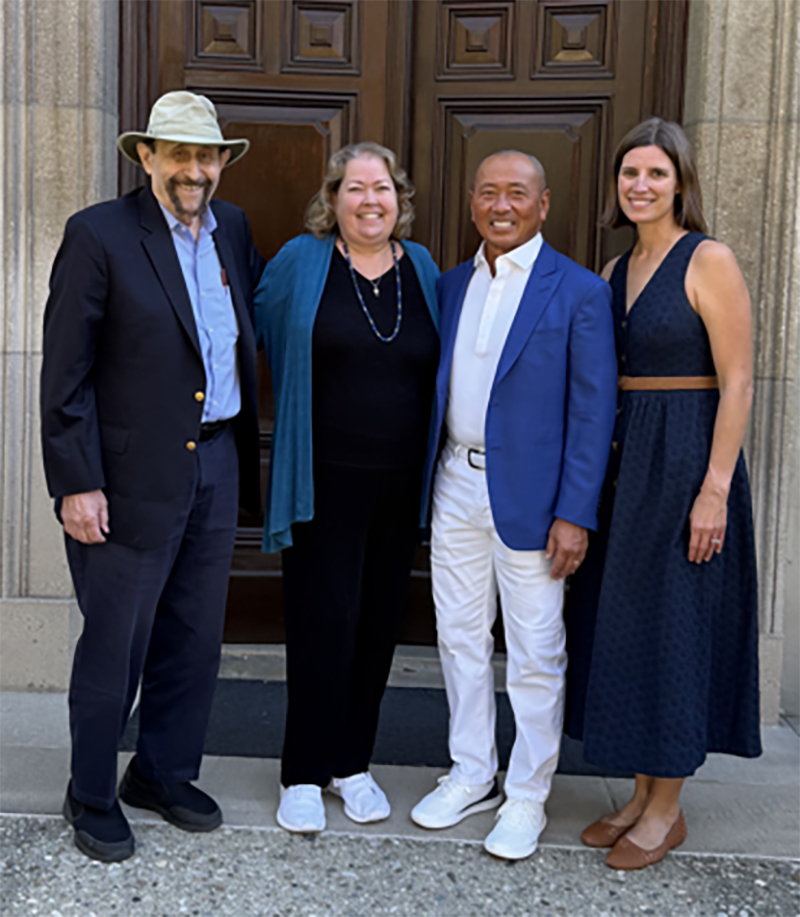
From left: Dr. Drew, Emeritus Professor; Dr. DeLacey Ganley, Dissertation Committee Chair and Dean of CGU’s SES; Scott Oki, PhD; and Dr. Emilie Reagan, Professor. (Photo provided by Scott Oki)
As a next step in this process, Oki decided to get his doctorate. Why? He felt that he was not yet fully qualified to be considered an authority on education. “The reason why I did the Ph.D. in the first place was to catalyze education reform,” he said. If he could have those three letters after his name, then he, like other education professionals, could advocate better for “our littles and not-so-littles.” Because he was in a bit of a hurry, Oki was unable to attend graduate school at his first choice, the University of Washington. Serendipitously, he happened to run into a friend and colleague from Claremont Graduate University, who told him that they could probably help him out. It wouldn’t be easy, it would be rigorous, but he could finish in two years versus the usual five. “A big part of that has to do with picking the right dissertation topic,” Oki told us.
Originally, Oki hoped for a broad topic. “I wanted to do a compare and contrast dissertation, which studied the top five countries in the world and what it is they do that the U.S. obviously is not doing,” he said. Wise advice from the Dean of the School of Education, DeLacy Ganley, convinced Oki to select a narrower topic that would better suit his timeline. “That’s how the game is played,” Oki observed. He felt somewhat disappointed, as he believes such narrow dissertation topics typically do not lend themselves to wide application in the real world. Nevertheless, he did what had to be done. His topic: “What either encourages or discourages secondary math teachers from adopting artificial intelligence?” “It got my attention,” he said.
Before you start asking Oki what he thinks about AI, keep in mind, again, that the topic was very narrow. It wasn’t so much about the tools a teacher would use, but why they would use those tools in the first place. To complete his research, Oki adopted the Everett Rogers diffusion of innovations theory, which was originally used to determine why a farmer would or wouldn’t plant a certain variety of corn, yet can be applied to any product. Oki sent out a survey to about 200 teachers and received back more than enough to satisfy statistical requirements. After interpreting the data and writing his dissertation, it was time to go before the dissertation committee for his oral defense. This proceeding is open to the public, so several people were in attendance, including Oki’s family, who, he joked, maybe wanted to watch him make a fool of himself. He did not, of course. He succeeded, although it was one of the hardest things he’s ever done. “After two of the most intellectually demanding, challenging, and rewarding years of my life, I can now proudly add three letters to my name: 𝗣𝗵.𝗗.!”
Oki has never done things in half measures. Even his hobbies he digs in, as he describes it. He strongly believes that by staying active, he will lead a healthier, longer life. Once, the Washington Policy Center challenged him to tackle the issues of Washington state’s K-12 public education, and he never took that lightly. “When someone challenges me, I accept the challenge. I’m going to do whatever it takes to make a difference.” Throughout all of his accomplishments, this recent recipient of Japan’s Order of the Rising Sun [our article] stays humble. “It was a surprise and an honor,” he said of the award.
When asked what drives him to achieve great things, Oki said it was his sense of obligation. During WWII, Oki’s family was released from an incarceration camp, with nothing to their name. “They started life all over again,” he said. Oki’s dad worked for the post office and his mom was a secretary for the Federal Housing Administration. They weren’t home much, so Oki was raised mainly by his paternal grandmother. They lived in what he terms “tenements” on the corner of 14th and Yesler until his parents had saved enough to move them to Rainier Valley. A stint in the U.S. Air Force forced Oki to grow up, he said. At that time, he just happened to be in Colorado, where tech was blowing up, so he used the GI Bill to get a degree in computer science, “the wave of the future.” He was in Silicon Valley, California, when, as his story goes, he “ran into some guys in a bar who wanted to start a software company.” That was Microsoft. The rest is not just history. It’s history that is still being made.
“I consider myself extremely fortunate to be in the place that I am in,” Oki said.
Kai can be reached at newstips@nwasianweekly.com.
Leave a Reply