



By James Tabafunda
NORTHWEST ASIAN WEEKLY
Five years after President Joe Biden signed the COVID-19 Hate Crimes Act into law, anti-Asian hate crimes remain at nearly three times their pre-pandemic rate, and advocacy leaders warned that federal rollbacks under the Trump administration are making the crisis worse.
Civil rights advocates, data researchers, and community organizers gathered virtually on May 1 for a national media briefing organized by American Community Media in partnership with Asian Americans Advancing Justice – AAJC. The briefing, titled “Hate Crimes Continue to Rise, Despite Federal Legislation,” was held as the nation enters Asian American, Native Hawaiian, and Pacific Islander (AANHPI) Heritage Month.
“We are in a crisis moment in many, many ways,” said John C. Yang, president and executive director of AAJC. “When we have a federal government that is not only failing to prevent hate incidents but actively engaging in conduct and speech that incentivizes it, all of us—all Americans—suffer.”
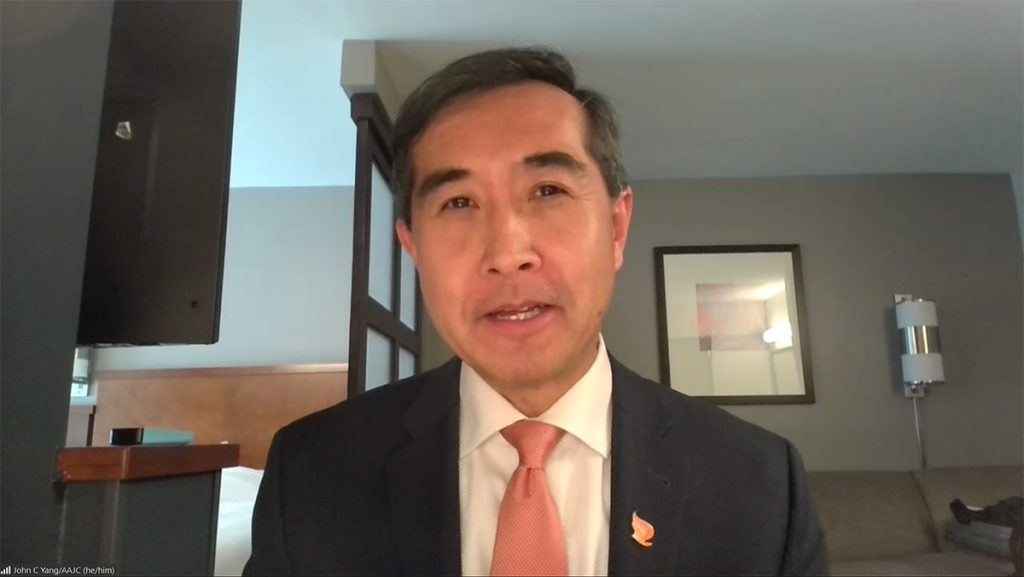
John C. Yang, president and executive director of Asian Americans Advancing Justice | AAJC
FBI data shows increased numbers, but experts say figures are undercounted
According to FBI Uniform Crime Reports data cited during the briefing, 291 hate crimes targeted Asian Americans last year out of 5,810 total race- and ethnicity-based hate crimes reported nationally. Added to hate crimes against Sikhs (243), Muslims (214), Buddhists (34), Hindus (31), and Native Hawaiian and Pacific Islanders (20), the total reaches 833 hate crimes targeting the broader AANHPI community.
AAJC’s analysis of preliminary 2025 FBI data found 318 anti-Asian hate crimes recorded—approximately 2.4 times the pre-pandemic annual average of 133 incidents per year, from 2013 to 2018. Anti-Sikh, anti-Hindu, and anti-Buddhist hate crimes all reached their highest levels ever recorded by the FBI in 2025.
All four speakers agreed that official figures represent a dramatic undercount. Stephanie Chan, director of data and research at Stop AAPI Hate, said her organization tracks a larger universe of harm.

Stephanie Chan, director of data and research at Stop AAPI Hate
“FBI data is incomplete because not all law enforcement agencies submit data,” she said. “In our survey, we found that only 22% of those who experienced a hate act reported it to a formal authority. Oftentimes it is because they have little confidence that anything will be done.”
New Stop AAPI Hate report: Half of AAPI adults experienced hate in 2025
Stop AAPI Hate released its third annual State of Anti-AA/PI Hate report also on May 1, titled “Closing Doors, Widening Harm: Persistent Hate Against Asian Americans and Pacific Islanders in an Anti-Immigrant Climate.” Based on a nationally representative survey of roughly 1,400 AAPI adults who experienced hate reported feeling stressed, compared with 54% who had not. The share of AAPI adults participating in acts of resistance dropped from 74% in 2023 to 56% in 2025.
Chan noted an alarming change in attacker rhetoric.
“From the stories submitted to our online reporting center from 2020 to 2025, we have seen a shift from hearing attackers blaming Asian people for COVID to now saying things like, ‘Trump should deport you,’” Chan said. “We know they are being emboldened by the anti-immigrant rhetoric and policies of this administration.”
Trump’s repost of ‘hellhole’ rant draws criticism
The briefing opened with an examination of a Truth Social post President Trump shared on April 23, amplifying a transcript and video from the “Savage Nation” podcast hosted by conservative commentator Michael Savage. In the segment, Savage argued against birthright citizenship and described China and India as “hellholes,” calling Chinese and Indian immigrants “gangsters with laptops.”
Trump reposted the text without additional comment.
Yang called the post part of “a broader context that we need to remember.”
“The clear reality is that anti-immigrant rhetoric is at an all-time high,” he said. “We currently have a president who is adding fuel to that fire. The rant included how Asian Americans are disloyal to this country and that we somehow fail to integrate as ‘Europeans have in the past.’”
Yang drew historical parallels to the Chinese Exclusion Act, the incarceration of Japanese Americans during World War II, and the targeting of Arab, Muslim, Middle Eastern, and South Asian Americans after Sept. 11, 2001.
“This is the context in which Trump’s posts and his language matters—in making sure that we do not go back to a space where we see murders like we did in 2021,” he said.
“So what we need is state and local governments to stand up, help fill that void that is being presented by the federal government.”
That year, six Asian American women were killed in the Atlanta spa and massage shootings, and four Sikh Americans were killed in the FedEx mass shooting in Indianapolis. A Fulton County trial for shooter Robert Aaron Long—who is serving multiple life sentences in Cherokee County—is working through pretrial motions with no confirmed trial date set.
Federal grant cuts weaken hate crime infrastructure
All four speakers raised concerns about the Trump administration’s April 2025 cancellation of more than 365 Department of Justice grants, including approximately $35 million directed for hate crime prevention and response. Those cuts eliminated programs in 18 states working to increase reporting, conduct public outreach, and expand victim services.
Yang said the damage compounds an already underreported problem.
“We also have a federal government that has canceled hate-crime grants that actively are trying to prevent hate crimes and hate incidents, and they are pressuring social media companies to reduce efforts to moderate hate content,” he said. “We have a patchwork infrastructure where government agencies are not incentivized to report hate crimes and hate incidents.”
Mannirmal Kaur, senior federal policy manager at the Sikh Coalition, said there are many factors that go into whether or not someone reports a hate crime to the Sikh Coalition, “including whether they know about the Sikh Coalition and know what kind of services we provide.”

Mannirmal Kaur, senior federal policy manager at the Sikh Coalition
“When you look at everything that this administration is doing to box certain communities out of public life and limit their access to essential services, I think it is hard to imagine that those efforts wouldn’t inevitably have an impact on communities like ours,” she said.
Kaur recalled that the Sikh Coalition was founded nearly 25 years ago after more than 300 cases of violence and discrimination against Sikhs were documented in the first month following the Sept. 11 attacks. She said that in 1907, violent mobs attacked the Sikh immigrant mill workers in Bellingham, Wash., driving the entire community from the area.
South Asian and Muslim communities report surges
Sameer Hossain, managing director of the Muslim Public Affairs Council (MPAC), said his organization’s Center for Security, Technology, and Policy documented in the past month “an 11-fold increase in the number of attacks against American Muslims and mosques in comparison to all previous months that we’ve been tracking.”

Sameer Hossain, managing director of the Muslim Public Affairs Council
“For many years, we’ve consistently seen a year-to-year rise in hate-fueled bias, harassment, discrimination, and violence across the United States, especially against Asian American, Native Hawaiian, and Pacific Islander communities,” he said. “Even the best data is a gross undercount and gives us insufficient insight into the daily indignities faced by many underrepresented and underserved communities.”
Hossain identified three reasons hate crimes go unreported: communities are unaware of how and where to report; many who do report say they never hear back, making them less likely to try again; and trust deficits between communities and law enforcement remain deep.
Chan said immigration enforcement fears are directly suppressing reporting.
“About half of AAPI adults said they or an AAPI person they know personally have been impacted by anti-immigrant rhetoric and policies, and this includes being fearful of deportation, arrest, and detention,” she said. “I definitely think part of the reason why is this fear of surveillance.”
Advocates call for community reporting, state action
With federal protections reversed or stalled, the speakers urged state and local governments to fill existing gaps. Yang called for passage of the Improving Reporting to Prevent Hate Act and distribution of congressionally appropriated community grants and funding for state-run, non-law enforcement hate crime hotlines.
All four speakers urged community members to report every incident through organizational channels—including Stop AAPI Hate’s online portal, the Sikh Coalition’s confidential intake line, and MPAC’s community security resources—even if they are hesitant to contact local law enforcement officers.
“Please report every single incident,” Hossain said. “If you’re in immediate danger, always dial 9-1-1. Otherwise, please find ways to report every single incident, whether you reach out to law enforcement directly or work through community advocates.”
Despite the unsafe environment, Yang closed the national media briefing with hope.
“We are in a crisis moment in many, many ways,” he said. “At the same time, I am positive and optimistic that we can overcome this. We have seen these playbooks before. Our communities have responded to these playbooks before, and we just need to rise up and do that again.”