


By Nina Huang
NORTHWEST ASIAN WEEKLY
In a light-filled studio tucked into Seattle’s Queen Anne neighborhood, a centuries-old garment is being transformed—quite literally—into something new.
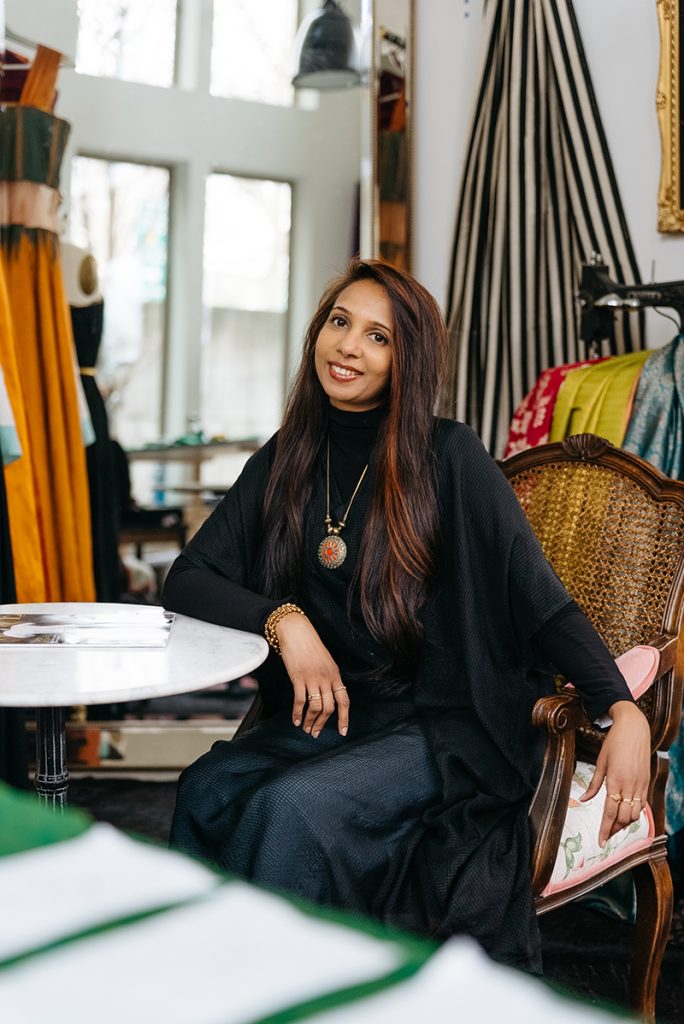
Dhivya Balasubramanian (Credit: Hannah Hix)
For South Indian designer Dhivya Balasubramanian, who grew up in Kerala, fashion has never been just about clothing. It’s about memory, migration, and making space for identity in a place far from home.
“Fashion was one of my initial interests,” she said. She applied to fashion school in India in the 1990s and came very close to making it, but didn’t make it past the final round.
Her path to design was anything but linear. After completing her undergraduate studies in India, she moved to the United States in 2002 to pursue a master’s degree in hospitality and tourism management. Like many immigrants navigating visa constraints, she found that passion and practicality didn’t always align. Despite internships and hotel work, the industry proved difficult to sustain long-term.
So she paused—and recalibrated.
In 2012, she reflected on what she really wanted to do in her career. She remembered how much she loved fashion.
She enrolled in a technical fashion program in San Francisco, learning French-style pattern-making, draping, and garment construction from the ground up—despite never having used a sewing machine before. The experience was transformative.
“I loved the creative space and making things with my hands,” Balasubramanian said.
An intensive internship in New York followed, where she worked long hours in a high-end fashion house, Marchesa, dressing celebrities and absorbing the fast-paced rhythm of the industry. But soon after, life shifted again. She started a family, stepped back from full-time fashion, and spent several years balancing motherhood with freelance creative work.
In 2019, after relocating to Seattle—a move prompted by her husband’s role at Amazon and a change of scenery for their growing family—she set up her studio in Queen Anne. It was there that her business truly began to take shape.
Balasubramanian’s design philosophy is rooted in something deeply personal and cultural: the sari.
Growing up in India in the 1990s, her everyday style reflected a blend of cultures—tunics paired with jeans, traditional textiles worn in modern ways. That “East meets West” sensibility continues to define her work today.
“My aesthetic is very much still that—using textiles like saris,” she said.
One couture class during fashion school sparked the idea that would eventually become her signature: transforming her old sari into a gown.
“That’s one of my unique offerings with a sustainability focus—creating custom garments not only from saris, but pretty much everything,” Balasubramanian added.
Now, clients bring her heirloom or preloved saris—sometimes damaged or no longer wearable in their original form—and she reimagines them into custom garments: cocktail dresses, skirts, bridal pieces, and more.
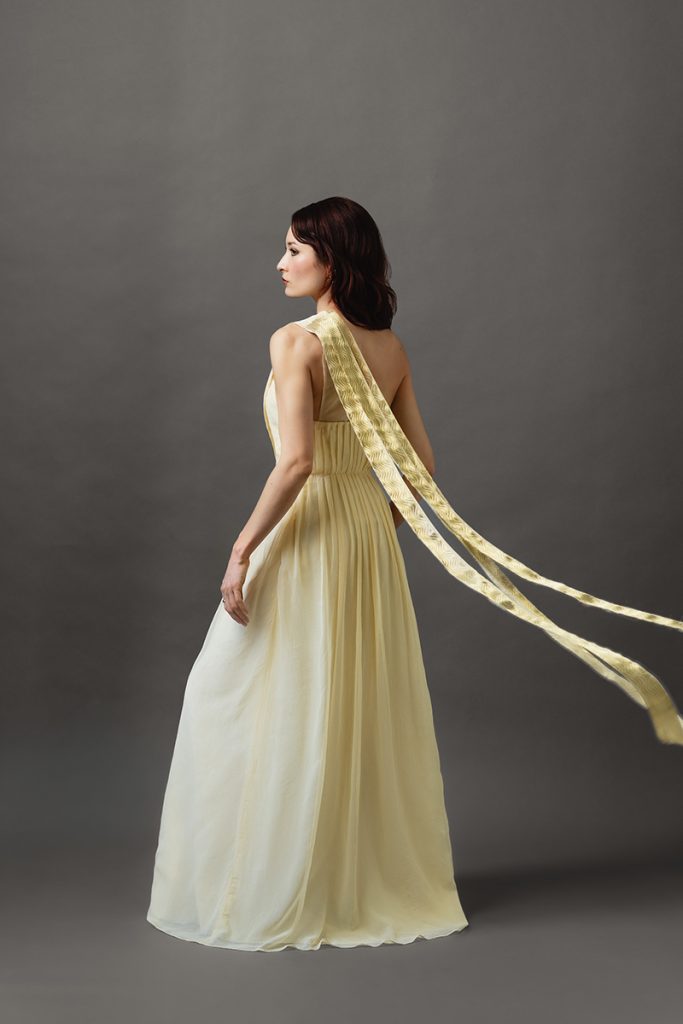
The Grecian Gown. Photo provided by Dhivya Balasubramanian (Credit: Hannah Hix)
Each sari, typically about five yards of fabric, carries history. Weddings, celebrations, family stories, and more. Rather than letting those textiles fade into storage, she gives them a second life.
Her studio experience is intentionally collaborative, inspired by the tailoring culture she grew up with in India. As a child, she would accompany her mother to local tailor shops, flipping through pattern books and selecting designs—sometimes with unpredictable results.
“I wanted to recreate that experience here, but better,” she said. “More thoughtful, more precise, and centered on the client.”
Balasubramanian’s process typically spans four to six weeks, with multiple fittings that allow clients to see their garments evolve in real time. The result is not just a custom piece, but a relationship.
“I design for women who care about the way they dress, but also have a hard time finding the right pieces,” she noted.
Her clientele often includes brides—particularly those seeking something unconventional—as well as women in their 30s to 60s looking for meaningful, well-fitted pieces for milestone events.
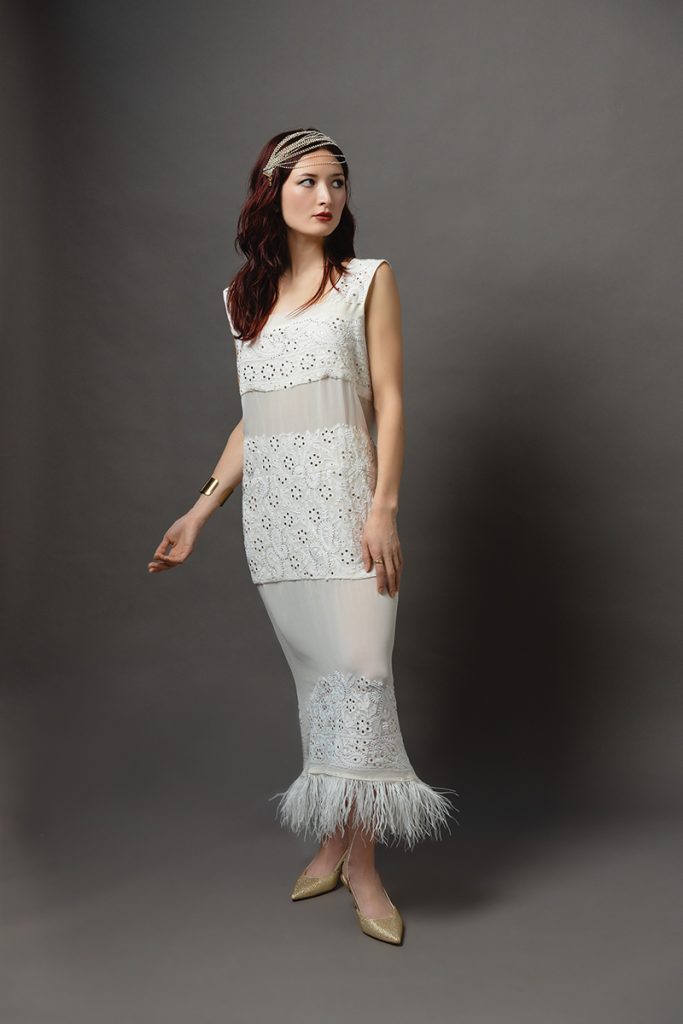
The Flapper Dress. Photo provided by Dhivya Balasubramanian (Credit: Hannah Hix)
Recently, she has begun working on a conceptual collection that reinterprets iconic fashion silhouettes through the lens of sari textiles. Inspired by historic designs—from flapper-era dresses to structured suits—she asks a simple question: What would these look like if they were made from a sari?
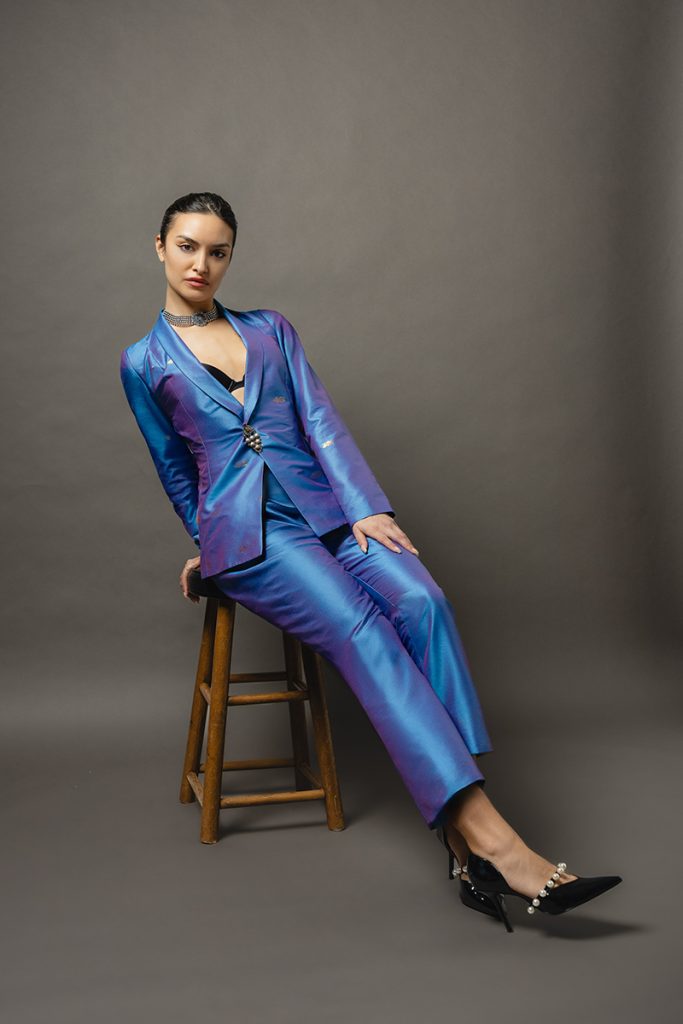
Le Smoking Suit. Photo provided by Dhivya Balasubramanian (Credit: Hannah Hix)
“What can’t I recreate some of the things that were iconic in the past? Like how painters reinterpret the masters,” Balasubramanian said.
Outside of her studio, her commitment to sustainability continues. She frequents vintage and consignment shops, often choosing secondhand over new. She is also experimenting with ways to repurpose fabric scraps into smaller goods, such as drawstring bags and home items.
Her long-term vision is to expand her studio into a lifestyle space—one that offers custom fashion, textiles, and thoughtfully made goods rooted in reuse.
At home, her work has already inspired the next generation. Her daughter, now learning to sew, spends time in the studio creating doll clothes and experimenting with design.
“She’s my most difficult client and I’m scared of making clothes for her. She’s very particular,” she joked.
It’s a full-circle moment—one that reflects not only a personal journey, but a broader story shared by many in the Asian diaspora: the courage to returyn to a dream, the blending of cultures, and the creation of something entirely new.
Balasubramanian is launching her DHIVYA BALA collection, “Draped in History,” at an upcoming event on Monday, April 21. DM @dhivyabala.designstudio for more information.
Leave a Reply