

By Carolyn Bick
NORTHWEST ASIAN WEEKLY
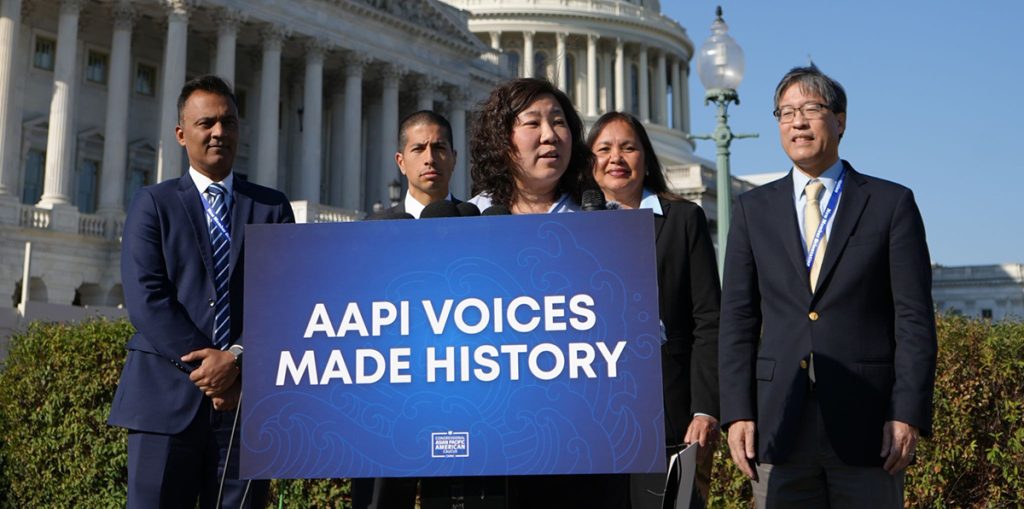
In addition to a blue wave sweeping the House and Senate, the November midterms also ushered in a historic first for Asian American and Pacific Islander (AAPI) representation. With the addition of four newly elected representatives from the AAPI community in January 2027, the Congressional Asian Pacific American Caucus will stand at 23 members, the largest in U.S. history.
While the caucus describes itself as nonpartisan, all of its current members are Democrats. The newly elected representatives who joined the caucus are also all Democrats.
Alicia Garrido Limtiaco, the delegate who represents Guam, is the first Chamorro woman to represent the island. Dan Koh, who is mixed-race Korean-Lebanese, is the first Arab and Asian American elected to Congress from Massachusetts, and worked in the White House under President Joe Biden. Dr. Amish Shah is the first South Asian American to represent Arizona, Dr. Richard Pan is the first Chinese American to represent Northern California, and Pia Dandia is the first South Asian woman to represent Florida.
But this milestone, as Democratic New York Rep. Grace Meng reminded listeners during a news conference on Nov. 11, is one of many important highlights from the recent election.
Not only did AAPI voters swing nine points in favor of Democrats since the 2024 election—the second-largest shift of any group after Latino voters—but AAPI communities were also responsible for the Democratic margins of victory in historically red states, including Texas, Georgia, North Carolina, and Nevada.
“These victories were the result of historic investments made to reach our AAPI voters.
This includes multilingual, culturally competent outreach, and a message of affordability and accountability that resonated with our community,” Meng said. “For the first time in history, AAPIs were more likely than white voters to be contacted about registering and turning out to vote. In fact, one in eight AAPI voters had voted for the very first time this election.”
Resonant messaging
Limtiaco, Koh, Shah, and Pan joined Meng to speak at the conference. Each gave a little insight into their backgrounds and the messages they believed resonated, especially with AAPI voters.
Limtiaco noted that Guam faces “a significant gap” when it comes to assistance programs. For instance, unlike state residents, residents of Guam do not receive supplemental security income, a needs-based welfare program that can be a boon for elders or those on limited incomes. She also touched on expanding access to healthcare, and said that she would work to include Guam in the Radiation Exposure Compensation Act (RECA), which allows survivors of fallout from Pacific nuclear testing and their families to seek compensation.
“This is not unique to Guam,” she said. “We have had radiation survivors all over the country. Some states and jurisdictions have very fortunately received the compensation under RECA, and so the community members in Guam are also deserving and entitled to this compensation.”
Koh leaned into mixed-race, immigrant heritage.
“Over 80 years ago, my grandfather sat in a little fishing village in Jeju-do, dreaming of a better life. Halfway around the world, my great-grandparents in Lebanon were thinking about the same thing,” Koh said. “They couldn’t have looked more different. They couldn’t have spoken a more different language. … They made that risk of their lives and came to the United States. … That’s a story unique to me, but not unique to so many people who are here fighting for the American Dream, and whose stories they could tell of a good, welcoming America, welcoming their families, overcoming all odds to be here today.”
He also openly criticized President Donald Trump’s actions and messaging, noting that the president “just recently tweeted a graphic celebrating the decline of all immigration from all countries, including Asia,” and had enriched himself in office.
“We have a president who is worth three times what he was when he began this second time as president, who is making life more expensive for everyone, who is enriching his family and allies, while people all across this country, especially people of color, are finding it harder and harder to live,” Koh said.
Both Shah and Pan also touched on their heritage, and highlighted the need they saw as physicians for affordable healthcare, among other cost-of-living challenges.
“Access to healthcare, while it does include things like how much things cost … we also need to have interpreter services,” Pan said. “How are you going to get mental health from someone who doesn’t speak your own language? We need to be sure that happens, particularly for our community.”
New legislation, relational priorities
In addition to new faces, CAPAC plans to introduce new legislation. Though this includes legislation that would make both Diwali and Eid official federal holidays, Pan said that the legislature first needs to “stop the bleeding—the attacks on immigrants, the cuts to healthcare, the war against Iran, the things that are driving up prices for everyone.”
“We’re going to be sure we try to land things in the Senate and on his desk … but then we need to move forward and work on many of the other things we talked about here today,” he said.
When asked about the tense relationship between the U.S. and South Korea and Trump’s upcoming visit with North Korean leader Kim Jong-Un, Koh said that the relationship between the U.S. and South Korea should be “ironclad, like it has been under [previous] Republican and Democratic presidents.”
“To see the way this president has vilified not only immigrants, but specifically targeted Koreans, not just Korean Americans … is dangerous to our standing as a global leader, is dangerous to the economic relationship we have. The tariffs that we’ve out of nowhere put on our allies, I think is an absolute disgrace,” Koh said. He said that he would do everything he could to restore the alliance he personally had been “thriving” under Biden.
“I am somebody who believes in diplomacy. And my grandfather dreamed of a unified peninsula one day,” Koh said. “I do not believe this president’s intentions are ones that would have a productive outcome for South Korea or the United States, and is in genuine good faith. This is a president who has praised Kim Jong-un as being a dictator that people bow to. And he envies him because of that. I do not think that this is a president who’s going to look for a productive, peaceful progress forward between South and North Korea. I think he’s looking for notes on how to be a dictator. And I don’t think that we should be playing that game.”
Leave a Reply