

Asian communities are more likely than any other racial group to live in neighborhoods hosting data centers, according to a new study examining the relationship between race and the rapid expansion of artificial intelligence infrastructure in the United States.
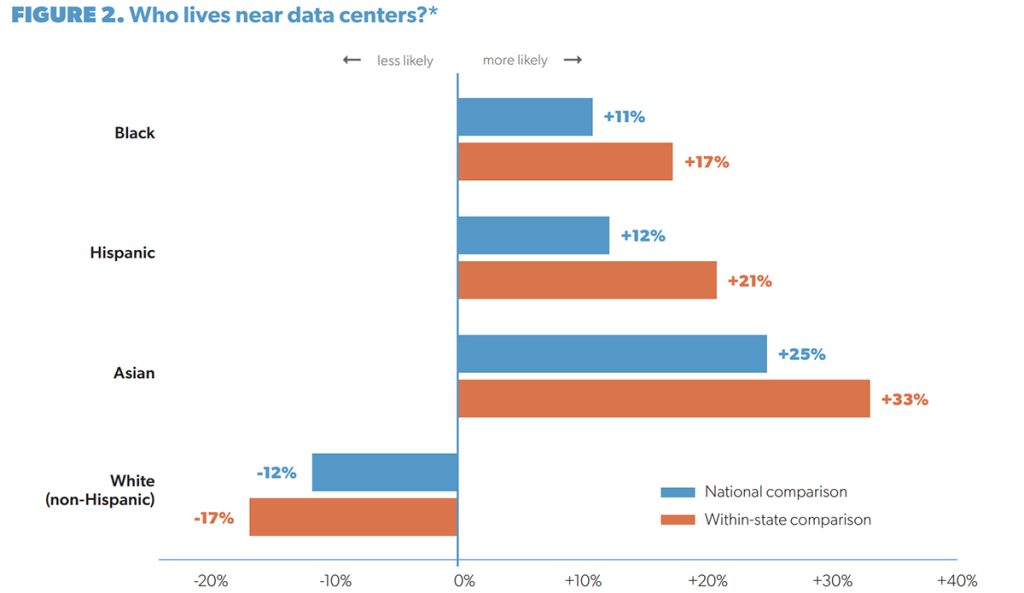
The report, Redlining in the Age of AI: The Relationship Between Data Center Locations and Race in the U.S., found that majority-Asian neighborhoods have 4.2 times the odds of hosting a data center compared with majority-white neighborhoods in the same state. That figure is higher than the odds for majority-Hispanic neighborhoods, at 2.6 times, and majority-Black neighborhoods, at 2.2 times.
Researchers analyzed more than 5,200 data centers that are operating, planned or under construction across more than 81,000 U.S. census tracts.
The study, conducted by researchers affiliated with George Washington University Law School and American University, found that the racial disparities persisted even after accounting for population, household income, education, land costs and proximity to major power lines.
The findings raise questions about who bears the burden of the country’s growing digital infrastructure as technology companies pour billions of dollars into facilities supporting artificial intelligence.
Data centers require enormous amounts of electricity and water to operate, raising concerns about the strain they can place on local resources. For nearby residents, one particular concern is whether increased demand for electricity and water could contribute to higher household utility bills.
The study also found that the communities most likely to host data centers do not necessarily receive the greatest economic benefits.
Large hyperscale data centers, typically operated by major technology companies such as Amazon, Google and Meta, are more commonly located in predominantly white neighborhoods. These facilities are associated with greater tax revenue and other economic benefits.
By contrast, smaller co-location facilities are more commonly found in densely populated, racially diverse urban communities. These facilities generally provide fewer economic benefits to their surrounding neighborhoods.
The study also examined community opposition to data center development. Opposition was more frequently documented in predominantly white neighborhoods, where residents were, on average, 79% white. In communities without documented opposition, residents were approximately 53% white.
Researchers cautioned that this does not necessarily mean communities of color are more supportive of data centers. Differences in media coverage, political influence and community resources may help explain why opposition is more visible in predominantly white communities.
The study authors recommend that local and state governments require racial impact assessments before approving data center projects, strengthen zoning protections and provide residents with meaningful opportunities to participate in development decisions.
Leave a Reply