

By James Tabafunda
NORTHWEST ASIAN WEEKLY
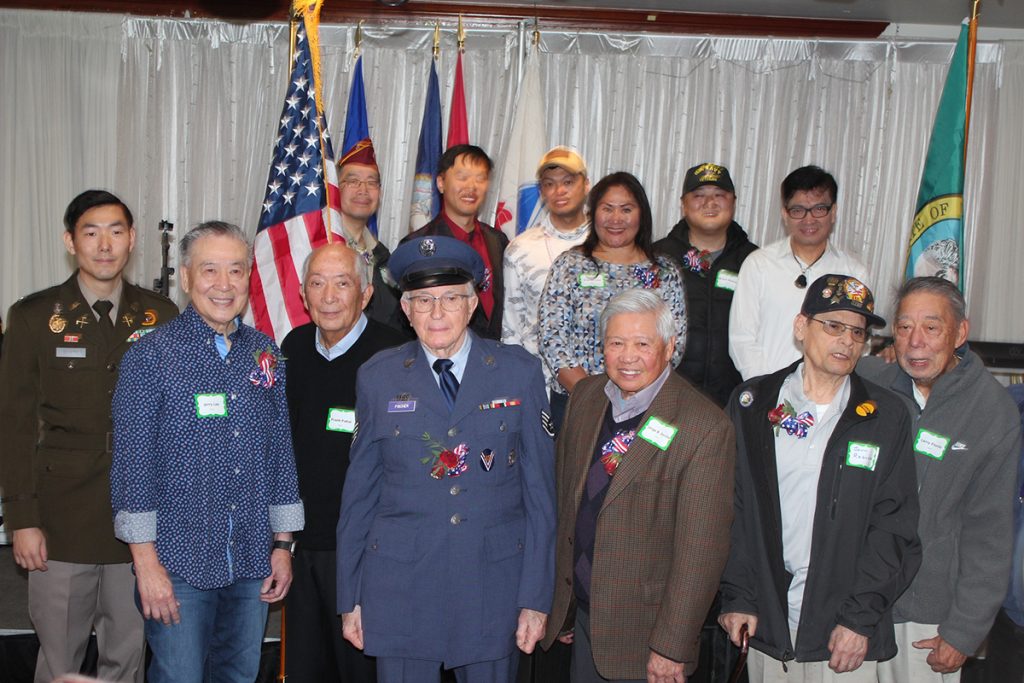
Thirteen AAPI veterans on stage (Photo by James Tabafunda)
Thirteen Asian American and Pacific Islander (AAPI) veterans spoke at United Hub’s annual gathering, sharing stories of their military service. They took the stage on Nov. 22 at Joyale Seafood Restaurant in the Chinatown-International District (CID).
Emcee and Northwest Asian Weekly Founder and Publisher Emeritus Assunta Ng asked them about some of their hardest and proudest moments while serving their country at a program, titled “Asian American Veterans Appreciation Day: Honoring Service, Embracing Heritage.”
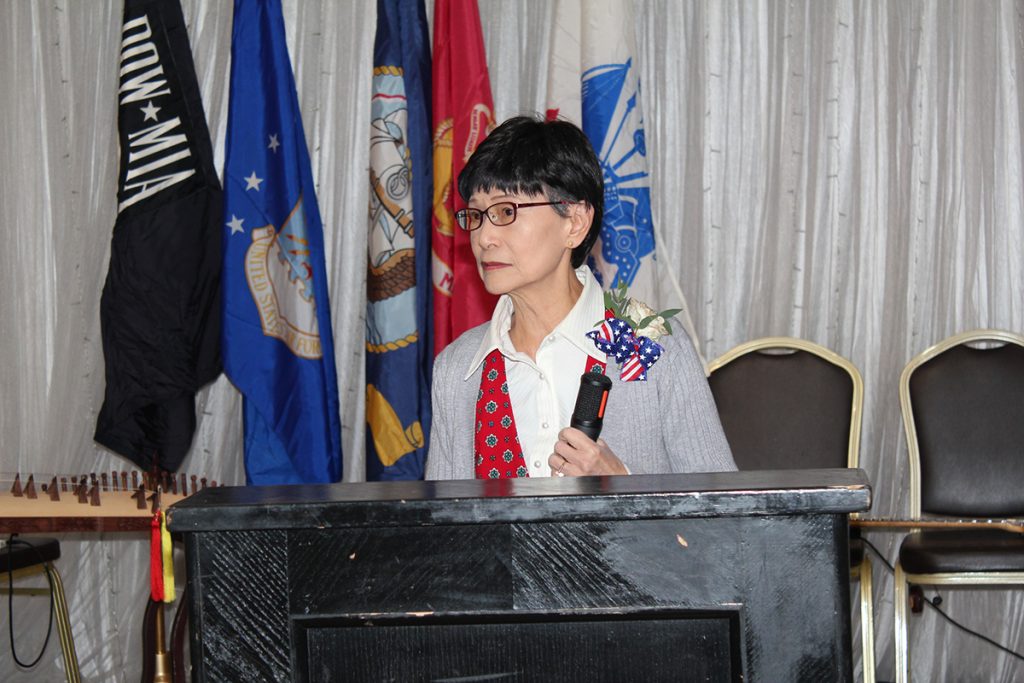
Assunta Ng, United Hub luncheon co-emcee and Northwest Asian Weekly founder and publisher emeritus (Photo by James Tabafunda)
The second annual United Hub luncheon brought veterans together with family members and community supporters—over 110 in total. The nonprofit said it received $20,000 from King County’s Veterans, Seniors, and Human Services Levy through the Vets Engaged program for this year’s luncheon. The county describes the program as a way to help veterans, service members, and their families build social connections through community events and networks.
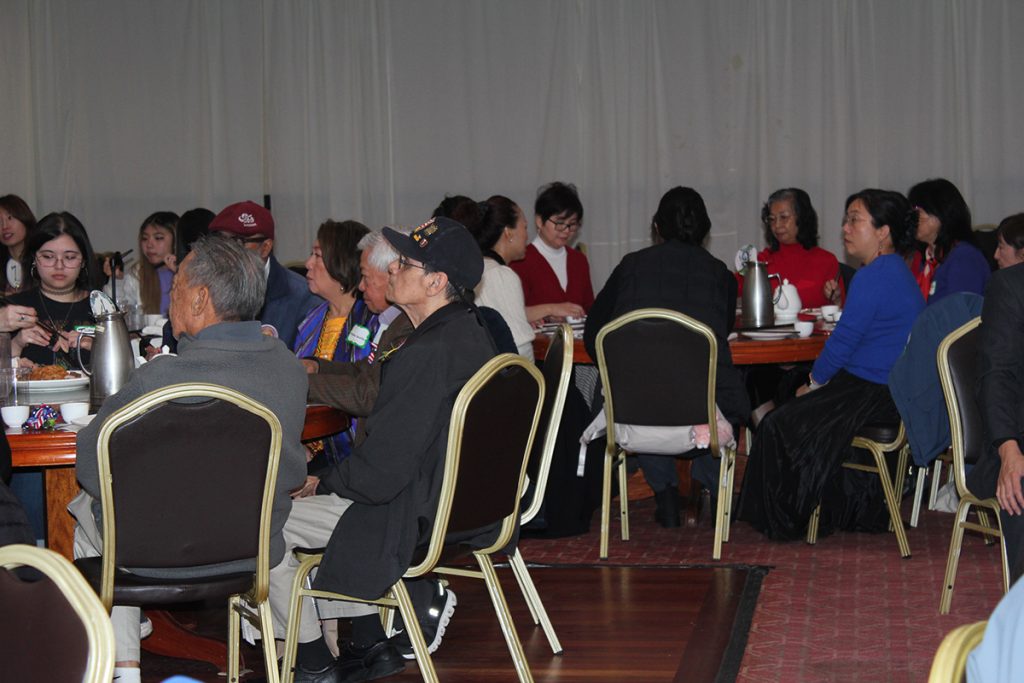
AAPI veterans, family, and friends attending Asian American Veterans Appreciation Day (Photo by James Tabafunda)
Ng began the event with a story about a Japanese American soldier fighting in France during World War II while his parents were held behind barbed wire in the United States. “Many AAPI veterans fought two wars, one overseas and another one right here in this country against suspicion, discrimination, and broken promises,” she said.
After the presentation of colors and the national anthem, Ng introduced Winston Lee, senior director of United Hub.
He recognized several elected officials at the start of the program, including state Sen. Javier Valdez and state Rep. Janice Zahn, both Democrats. He also welcomed Edmonds City Councilmember Will Chen, Mercer Island City Councilmember Julie Hsieh, and Newcastle City Councilmember Sun Burford.
Origin of United Hub’s annual gathering
Lee said he and United Hub Executive Director Qiong Chen got the idea for the luncheon after meeting veterans individually and hearing how often their experiences went unrecognized. “How can we put all the individual veterans together and make one AAPI veteran group?” Lee asked. He said he wanted the event to reach more AAPI veterans in future years.
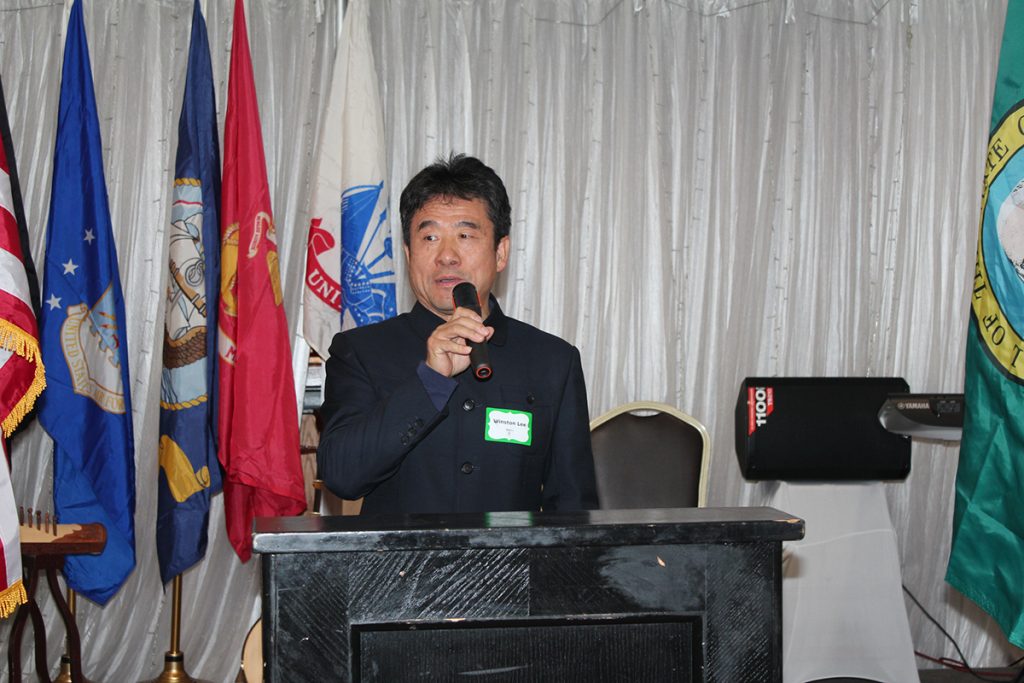
Winston Lee, United Hub senior director (Photo by James Tabafunda)
A Navy veteran remembers a day at sea
Ng invited veterans in their 80s to come on stage first. Among them was Jorge Sevilla, who spent two years on active duty in the Navy in the early 1960s. When Ng asked about his most memorable experience, Sevilla recalled riding out a storm in the Pacific Ocean when President John F. Kennedy was killed. He said the crew held a memorial aboard the ship as it rocked in the water. Kennedy was assassinated in Dallas on Nov. 22, 1963, 63 years before the second annual United Hub luncheon.
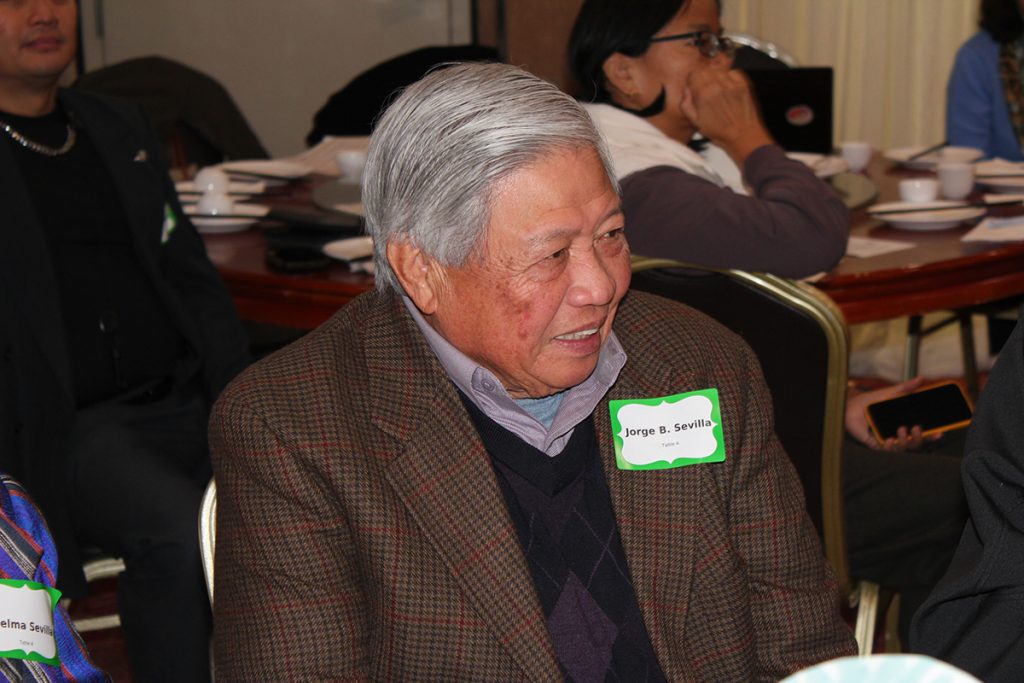
Jorge Sevilla, U.S. Navy veteran (Photo by James Tabafunda)
Sevilla grew up in Manila and moved with his family to Hawaii in 1956 to join his father, who was serving in the Army. Two years later, his father was assigned to Fort Lewis, and the family settled in Tacoma. Sevilla joined the Naval Reserve in 1961 while attending Stadium High School and went on active duty after graduating in 1962.
He served as a medical corpsman and dental assistant aboard the USS Maury and stayed in the reserve until 1967 after leaving active duty in 1964. The Navy’s history of the USS Maury identifies it as a survey ship and says it helped chart waters in the Gulf of Siam—now called the Gulf of Thailand—the Straits of Malacca, the Andaman Sea, and surveyed areas of the Philippines from 1961 to 1963.
After active duty, Sevilla used the GI Bill to enroll at Pacific Lutheran University, worked at Boeing in Renton while attending community college, and earned a mathematics degree from the University of Washington in 1975. He began working for the Defense Department in Bremerton in 1978 and spent 35 years as a civilian employee doing radiological work on Navy ships, including submarines and aircraft carriers, before retiring in 2013.
His story is part of “Filipinos and Washington’s Waterfront,” a traveling and online exhibit developed by the Filipino American National Historical Society and the Maritime Washington National Heritage Area. The project records the experiences of Navy sailors, cannery workers, longshoremen, and other Filipinos whose work and family lives brought them to Washington’s waterfronts.
Cooking for soldiers and serving Seattle
Jerry Lee, an Army veteran who served as a staff sergeant in the Army National Guard, told Ng he cooked for a lot of people.
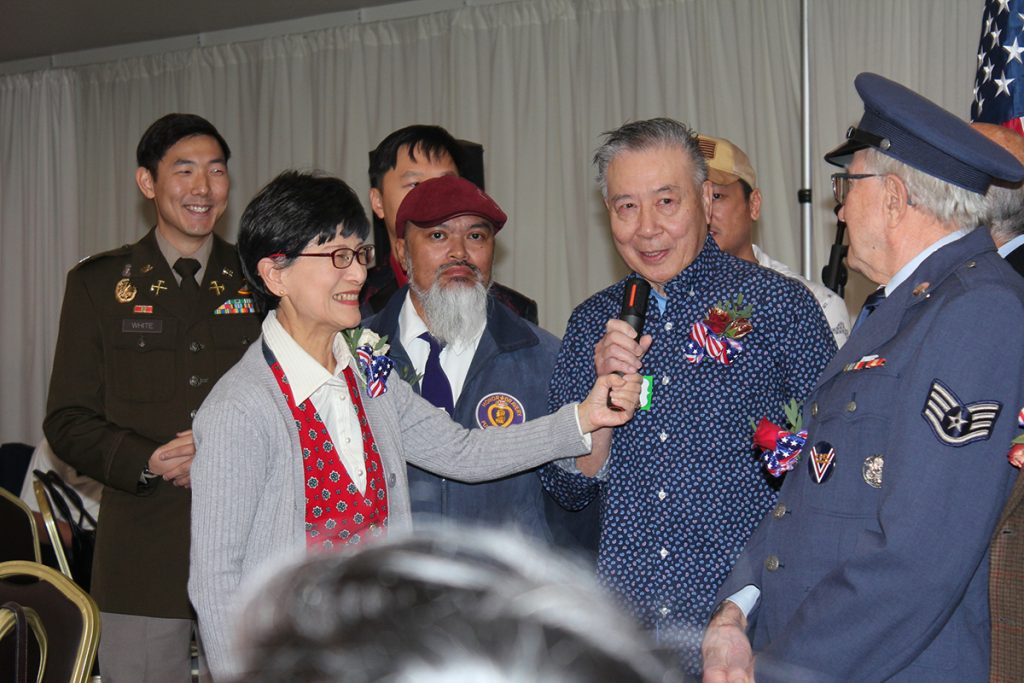
Assunta Ng interviews Jerry Lee, U.S. Army veteran and staff sergeant in the Army National Guard (Photo by James Tabafunda)
“But are you still a good cook now?” Ng asked.
He said, “I tell Charlene (Lee’s wife), ‘I don’t cook.’”
His proudest moment took place during basic training. “They had 2,000 soldiers march by and salute me while I was on the grandstand. That was a pretty cool moment,” he said.
Lee recalled feeding 300 and said that when he fried shrimp, “that’s the only time I saw the officers come.”
Lee is now executive director of the MG2 Foundation. Seattle’s American Legion Cathay Post 186 gave him its Veteran Strengthening America Award in August 2025, citing volunteer work that included starting a rotisserie chicken drive at the Asian Counseling and Referral Service food bank. Charlene Lee accepted the award on his behalf, according to Cathay Post 186.
Wartime service and unequal treatment at home
The history Ng mentioned included the origins of Cathay Post 186, which returning Chinese American veterans formed after World War II because discrimination kept them from joining existing posts. The post went on to assist veterans and support local organizations, including the Wing Luke Museum, and continues to hold a Memorial Day observance at Hing Hay Park in the CID.
Congress found that as many as 20,000 Chinese Americans served in the U.S. armed forces during World War II and that about 40% were not citizens because of laws that denied citizenship to people of Chinese descent. A law enacted in 2018 authorized a Congressional Gold Medal for those veterans collectively, and the medal was presented at a virtual ceremony in December 2020.
A regional ceremony followed in November 2021 at Bellevue’s Meydenbauer Center, with help from Cathay Post 186. Veterans or their family representatives received bronze replicas of the medal.
The military issued its first civilian exclusion order under President Franklin D. Roosevelt’s Executive Order 9066 for Bainbridge Island, according to the National Park Service. On March 30, 1942, the U.S. Army removed 227 people of Japanese ancestry from the island. It again allowed Japanese Americans to volunteer for military service in 1943, and some volunteered from incarceration camps. In October 1944, soldiers of the 442nd Regimental Combat Team helped liberate Bruyères, France, during fighting in the Vosges Mountains.
Ng also cited the treatment of Filipino veterans who served under U.S. command during World War II. The Rescission Acts of 1946 left most of those veterans without “the same benefits as American soldiers.” In 2009, Congress created the Filipino Veterans Equity Compensation Fund to make one-time payments of $15,000 for eligible veterans who were U.S. citizens and $9,000 for eligible veterans who were not.
Filipino World War II veterans received a separate Congressional Gold Medal during a national presentation in Washington, D.C. in October 2017.
Community groups join the luncheon
Pacific Artists Alliance engaged young artists to create handmade appreciation cards as a way to involve them in honoring veterans and service members.
Ma’s Acupuncture & Herbal Medicine contributed wellness education for veterans and their families, including on-site massage services at the luncheon.
Zen Flower Studio provided handcrafted floral boutonnieres for veterans at the luncheon as an expression of respect and gratitude.
The Washington Overseas Chinese Artists Association held painting demonstrations beside the stage.
Music and dance round out the program
Co-emcee Claire Ong introduced five performances. Ba Co Nhac Seattle opened with music from southern Vietnam, followed by Emerald Zhang on the guzheng, a Chinese stringed instrument. The Seattle Eastern Beauty Choir sang “You Raise Me Up,” Fei Chua played the soprano saxophone, and the Korean American Resource Center closed the performance lineup with a K-pop dance.
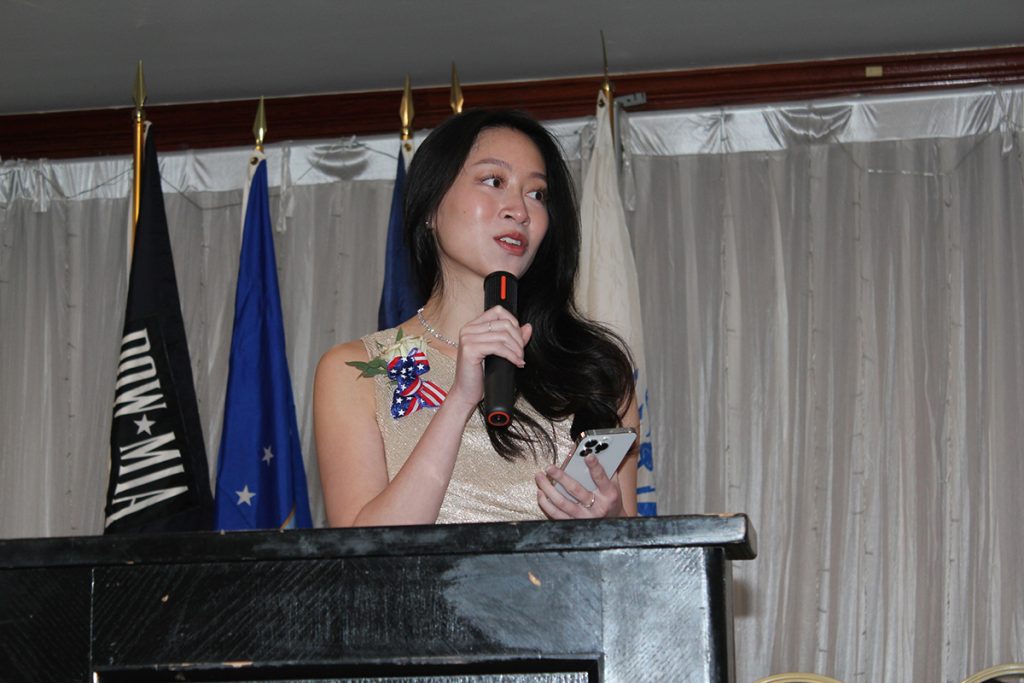
Claire Ong, United Hub luncheon co-emcee (Photo by James Tabafunda)
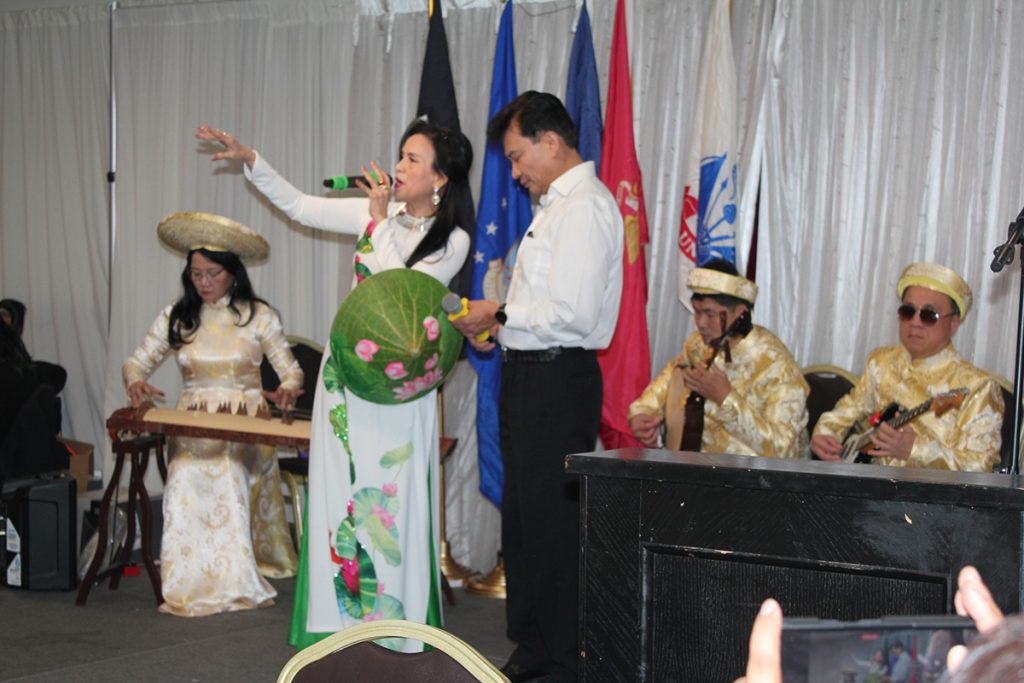
Ba Co Nhac Seattle (Photo by James Tabafunda)
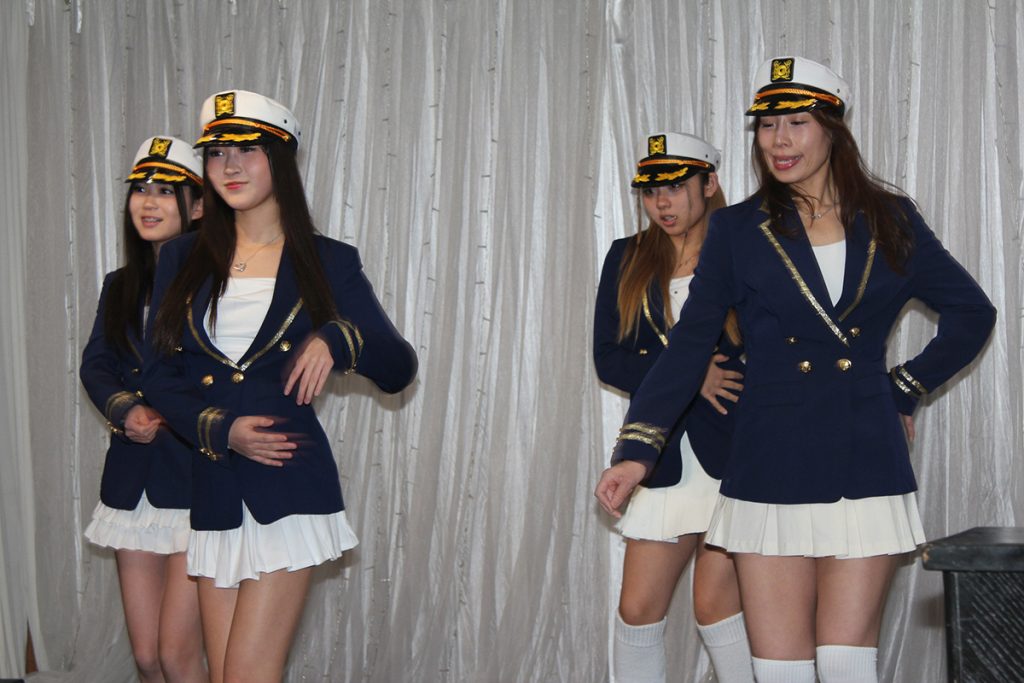
The Korean American Resource Center (Photo by James Tabafunda)
Veterans at the luncheon also received red, white, and blue gift bags.
After the event, Sevilla said he was glad younger veterans had acknowledged those who came before them. He said he wanted that practice to continue as another generation entered military service.
“Just remember the veterans before me,” Sevilla said.
For more information on United Hub, go to www.uhub.ngo.
Leave a Reply