

By Caroyn Bick
NORTHWEST ASIAN WEEKLY
With most of the community casting their midterm votes for Democratic candidates—who gained an overwhelming majority at the federal level, and made substantial state-level gains—Asian Americans, Native Hawai’ians, and Pacific Islanders (AAPIs), said John C. Yang, sent “a clear message” to politicians: “Protect our vote, respect our families, and stand against hate.”
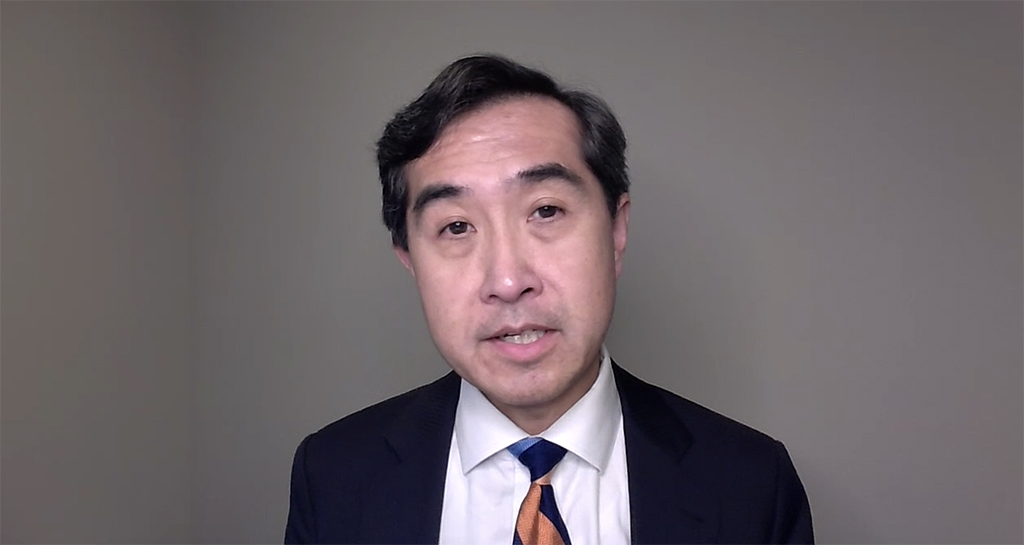
John C. Yang
Yang serves as the president and executive director of Asian Americans Advancing Justice. He was one of several panelists on an American Community Media briefing to discuss the role of Black voters, Indigenous voters, and voters of color in determining the outcome of November’s elections. Panelists represented organizations that collaborated on a 2026 midterm surveying more than 10,000 voters from different communities.
The —which was open starting on Oct. 19 through election day on Nov. 3—specifically made sure to disaggregate the data to get accurate results for the many sub-groups underneath the AAPI umbrella.
AAPIs top concerns are the same as other groups
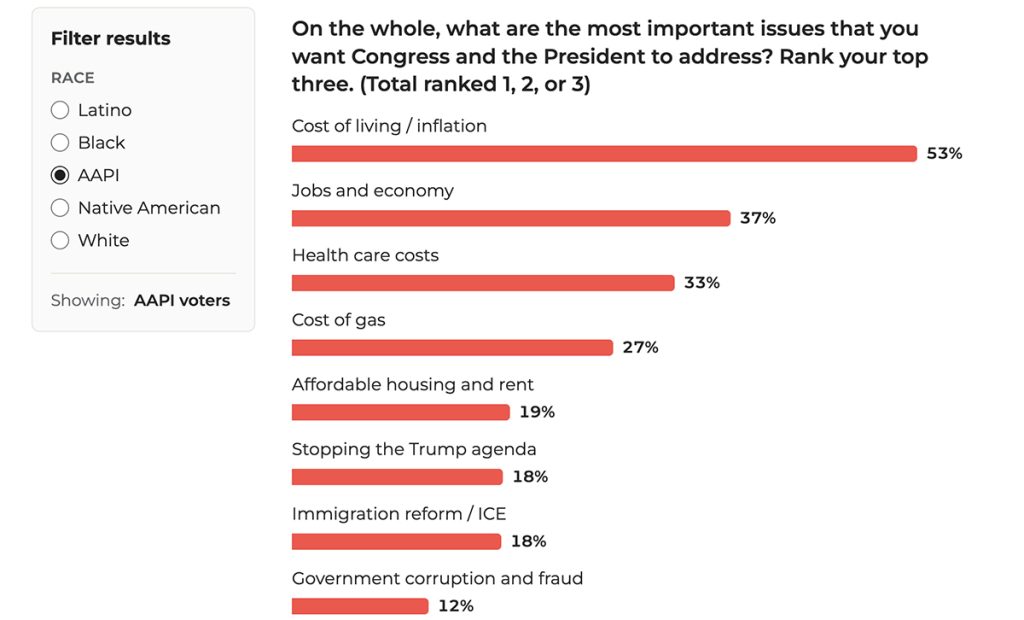
The data from the collaborative 2026 midterm election poll supported the early results of an immediate post-election survey by NORC at the University of Chicago. The collaborative poll showed the top concern among AAPI voters was the cost of living, followed by the economy and jobs. AAPIs’ top concern was the same as all other surveyed voting groups.
Black, Indigenous, and Latino voters shared AAPIs’ secondary concern over the economy and jobs. And while white voters listed the cost of gas as their secondary concern, their third concern by a small margin was also the economy and jobs. Nearly all groups were aligned in their concerns after that, including on issues like stopping President Donald Trump’s agenda, immigration, and government corruption and fraud.
“Oftentimes, people try to use the Asian American community as a wedge, or somehow suggest that we are white-adjacent—that our concerns regarding some of these issues are not as pronounced,” Yang said. “What this survey demonstrates is that we have the same concern around immigration, discrimination, voting, representation, that all of the other communities of color do.”
Like the NORC survey data, the collaborative survey data emphasized that AAPIs are not married to one party or another, and that, as a “movable community,” Yang said, they tend to vote with issues in mind, not along party lines.
Still, right now, he said, the AAPI community sees the two parties differently. While in 2024, between 5%-6% of Asian Americans shifted Republican to vote for Trump, Yang views that shift as “an outlier.” Polling in prior years and polling this year showed a shift away from Republicans.
Immigration, anti-hate, and voting rights
The poll results showed that almost 90% of the AAPI community supports changes to the immigration system in ways that make it easier for families to both get to the U.S. and stay here. About 75% of surveyed AAPIs believe it is important to change the current approach to immigration enforcement to ensure fairness, due process, and family unity.
At the same time, two-thirds of AAPIs surveyed said that they felt hate speech and acts have become “much more acceptable in society today.” The same amount felt that elected officials were not doing enough to speak out against anti-Asian hate, or the people and institutions that normalize the behavior.
“We noted that one specific subcategory, Indian Americans, expressed an outsized concern with respect to hate and bigotry, with 71% of our community expressing this concern,” Yang highlighted. “So this is a reminder that Congress and all elected officials really need to do more and have a responsibility to speak out against hateful rhetoric, harmful policies, and discrimination when it comes to all of our communities.”
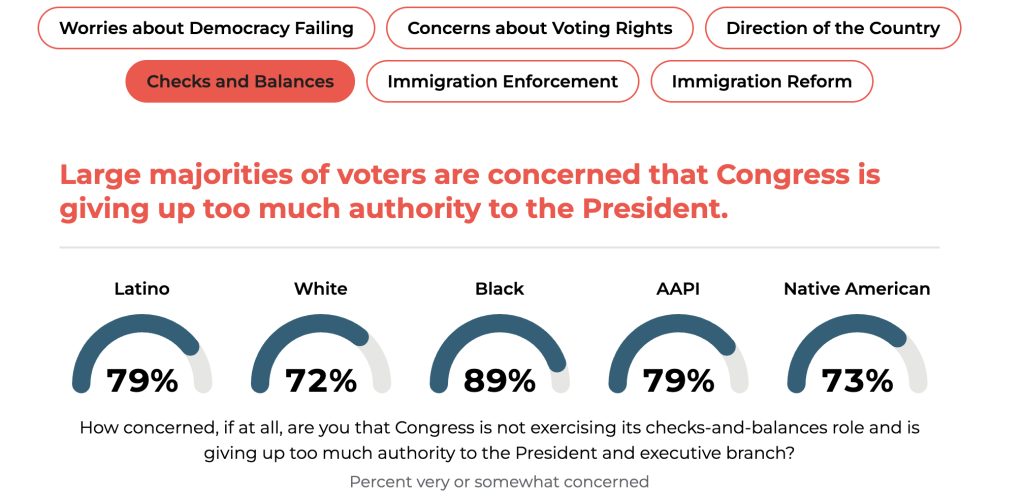
Even though it didn’t top AAPIs’ list of concerns, the community is still concerned about enfranchisement. Yang said that about 80% of the community believes Congress is ceding too much authority to Trump, and failing to exercise its Constitutional power of checks and balances.
About 80% also believe that the U.S. needs to pass a new Voting Rights Act, following the U.S. Supreme Court’s decision to gut the 60-year-old act of its most important non-discrimination and voting protections language in April.
He also noted that many AAPIs still voted by mail, emphasizing the need to both protect voters’ ability to do so, and reassure voters of the security of voting by mail.
Yang highlighted AAPI voters’ opinions about the U.S. Census. Under Trump, the Census Bureau has proposed eliminating important demographic information, including race, ethnicity, and sexual orientation. It would also exclude green card holders.
Many organizations, including AAPI organizations like the Southeast Asia Resource Action Center, have pointed out that eliminating this data from collection would hide socioeconomic and health disparities among subgroups, undermine language access protections, and weaken political power, particularly among immigrants.
Of AAPI voters surveyed, Yang said, 60% felt that “it’s necessary to pass a law to prevent changes to the Census that would reduce the accuracy and exclude residents from being counted.”
“Recently, we had a public comment period and I’m happy to report that over 100,000 comments were submitted with respect to this proposal to exclude non-residents and non-citizens from the census and to exclude any race or ethnicity questions from the census,” he said, indicating AAPIs’ level of engagement on the issue.
As panelists discussing the NORC survey expressed, Yang also felt that the main message elected officials should take away from this year’s midterms is that they “serve at the pleasure of the people—that the people are the ones that are still their bosses. And unless elected officials listen to what the people’s concerns are, then they are not going to be elected.”
“And,” he continued, referencing a tweet from Trump that had just popped up at the beginning of the webinar, where Trump announced Stephen Miller as the new White House Chief of Staff starting at 8 a.m. Eastern on Nov. 9, “as this news about Stephen Miller illustrates, there’s still a lot ahead of us that we will need to continue to work on.”
Leave a Reply