


By Carolyn Bick
NORTHWEST ASIAN WEEKLY
Tuesday’s midterms Democrats emerge victorious in both the House and Senate, flipping several seats in states with longtime Republican incumbents. Early numbers show historic highs of people turning up to vote—and, despite lingering fears of federal immigration agents and plainclothes federal officers at some polling places, early state figures show that Asian Americans and Pacific Islanders (AAPIs) were among those who turned out in record numbers to cast their ballots.
At the same time, these same early results underscore the fact that AAPIs are not a monolith.
On Nov. 4, the day after the midterm elections, AAPI Data and American Community Media (ACoM) held a post-election briefing featuring several speakers from AAPI organizations. This includes those from North Carolina and Texas, battleground states that were among those where voters flipped previously Republican-held seats Democratic. In addition to sharing early data, panelists emphasized the importance of early voting efforts to make sure the AAPI community knows their voices and votes are important, and listed off some challenges AAPI voters faced in getting to the polls.

“The movable middle isn’t a Black or white story”
Drawing on election-day research from NORC at the University of Chicago that surveyed about 3,000 Asian Americans and more than 200 Pacific Islanders, Karthik Ramakrishnan, the founder of AAPI Data, presented some early findings.
Ramakrishnan said most Asian Americans voted for the Democratic candidate in both the House and the Senate. Numbers were incomplete for Pacific Islanders, but some early results show that just under 49% voted for a Democratic House candidate.
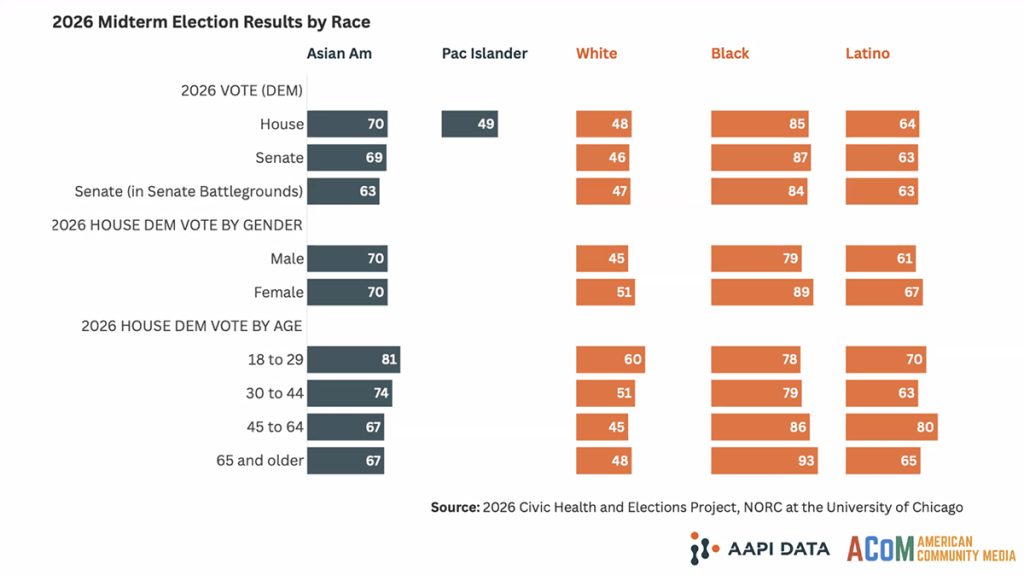
“We see in Pacific Islander vote behavior where it’s more split than the Asian American community, which historically has voted about a two-to-one ratio Democrat over Republican,” he explained, noting that the data represents a “fairly longstanding pattern.”
Compared with other populations, he continued, Asian Americans sat about even with Latino voters, but voted more Democratic than white voters and less Democratic than Black voters. He also highlighted that there wasn’t much crossover between 2024 and 2026. Voters who cast ballots for Democrats tended to vote Democratic this time around; the same was true for AAPIs who voted Republican in 2024. However, early data shows that more AAPIs crossed the proverbial aisle to vote Democrat in this election than the other way around.
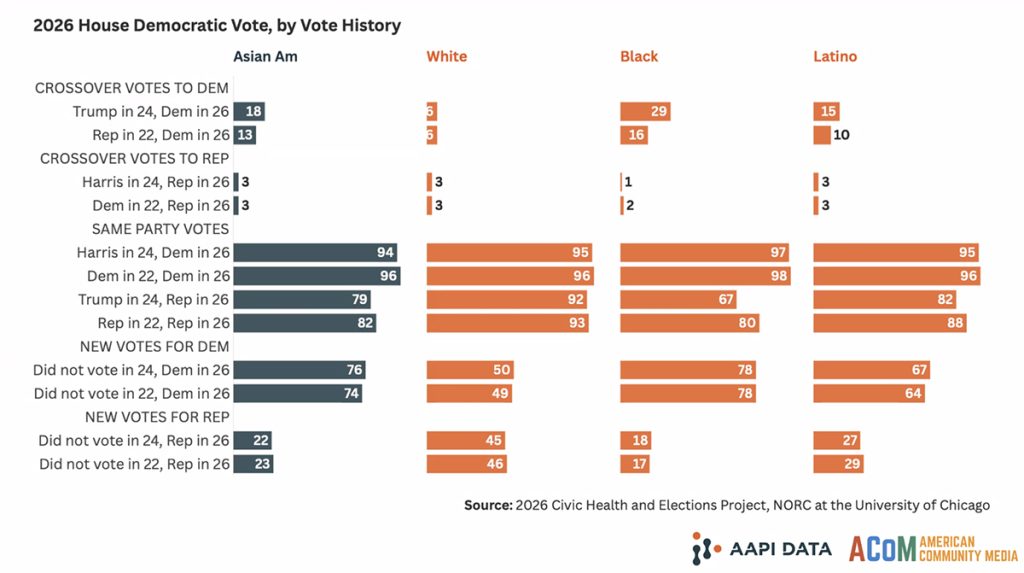
Speaking later, panelist Kevin Hirano, the deputy director of APIAVote, said that this underscores the importance of so-called “middle voters” in deciding elections.
“What you’ll see is white voters are on the right, Black voters are on the left, and in the middle, Latino and Asian American Pacific Islanders. … The movable middle isn’t a Black or white story,” he said. “It is a story of people of color, of Asian American Pacific Islanders, Native communities, and Latino voters. … They voted on the fact that they didn’t get the governance needs for their own communities—the issues that we know our community, Asian Americans, really vote for, motivate them, issues on economy, how to get food on the table, getting my kids to a good school, and health care. … We know what we vote for. We vote when the party in government actually does its job and makes sure that we can find the American dream.”
AAPI voters aren’t tied to one party or another, he continued. Instead, they are tied to specific issues that matter to them. He said that it will be “incumbent” upon future campaigns and legislators to recognize this.
Asian American Power Network Executive Director Mary-Lou Akai Ferguson said that exit polls that exclude AAPIs or undercount them perpetuate the issue of election season campaign neglect.
“When we don’t have information on them, we are not seeing coverage … because we’re often categorized in that other sphere,” she said. The same issue happens with elections infrastructure, she continued, because voter files “severely undercount” AAPIs.
“If we are not included in those numbers, this problem … of candidates and campaigns not reaching out—it continues to compile because we are being undercounted and undercounted,” she explained. And so it’s a much deeper challenge that we want to make sure that our communities are included in the conversation, included in the outreach, and a lot of that really comes down to the data.”
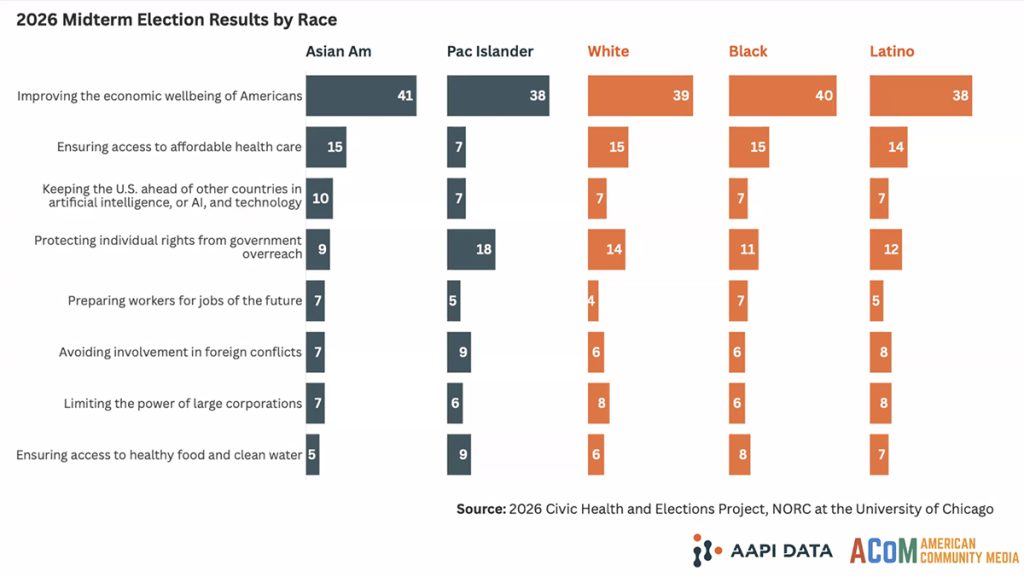
Ramakrishnan shared data showing that a majority of AAPIs surveyed said that they voted the way they did to improve the economic wellbeing of Americans. But the early data showed a split between AAPIs on their second top item. Asian Americans’ second top priority was healthcare, whereas Pacific Islanders’ was preventing government overreach.
Flipped seats
Texas voters delivered an historic win to Democrats, turning the governor’s seat blue for the first time since 1995. Though not all votes had been tallied, as of Wednesday evening Pacific Time, the Associated Press (AP) was reporting that the House was leaning Democratic, too. If the House flips Democratic, it will be the first time since 2002.
Stephanie Cho, the executive director of the Asian American Texas Action Fund, said that the organization knocked on about 50,000 doors and “tried to focus on top ticket. … It really resonated really well with Asian American voters.”
She underscored that the organization’s efforts appeared to have made a difference, as “nobody thought” that Republican Ken Paxton would lose in his home county of Collin County—but that county flipped, helping to hand the Senate seat victory to Paxton’s Democratic opponent, James Talarico, by an historic margin.
She emphasized that the organization’s efforts had begun early and had intentionally focused on investments in youth voters and programming.
“That’s the other piece that’s really clear, is to do the year-round programming, to get people involved, to have different cultural events, not just ‘work, work, work’ kind of stuff,” she said. “It really has made such a huge difference.”
In North Carolina, voters not only re-elected Justice Anita Earls to the state’s Supreme Court, but also broke the state’s supermajority, flipping the North Carolina House Democratic for the first time since 2010.
Shruti Parekh of North Carolina Asian Americans Together, a nonprofit community-building organization, said that the state’s AAPI voters are the fastest growing electorate, with about 150,000 registered voters identifying themselves as Asian in state voter records. And those registered voters helped to more than double the Asian American voter turnout since 2022, she said.
“We also saw that young Asian American voters turned out heavily in early person voting, approximately 145% compared with the 2022 midterm,” she said. She attributed this to “playing the long game,” and said that they were even able to mobilize AAPI voters in areas without a substantial AAPI population.
“We had wins from the top of the ticket down to the state local races, and that was very exciting for us. We’re making sure that we’re engaging youth voters heavily, even before they can vote,” she explained. “In our programming, we’ve … helped people understand that democracy is not something you participate in every two to four years, but it’s a consistent habit that we need to develop.”
Additional hurdles—but some more extreme measures backfired
Still, panelists said, AAPI voters faced some extra hurdles. One major hurdle, they said, was the presence of federal agents, including plainclothes officers from the Department of Justice, and fears that Immigration and Customs Enforcement (ICE) agents would show up.
“The DOJ was in Harris County[, Texas,] in plainclothes and monitoring situations, so we had to deal with that,” Cho said.
Chany Chea, the program director for the Asian American Advocacy Fund in Georgia, said that early focus groups expressed anxiety about potential ICE presence, regardless of immigration status—including those who were born in the U.S. This anxiety carried over into the elections.
“They were hyper vigilant about carrying around with them passports, I.D.s, as [they] were heading to the polls, because they were hearing stuff in the news that there could be ICE presence,” she said. “They were like, ‘Oh, what do I need to bring with me? Do I need to bring all of these other pieces to prove that I am who I am beyond what I just need to vote?’”
Another challenge, Cho said, “was the intense anti-trans, anti-China, anti-Muslim rhetoric that was sweeping all of [the] ads that were happening throughout the South.”
But, she said, this kind of messaging “really soured” voters.
“It was too extreme, is what I was hearing a lot, too. Most people don’t want to hear that. And they were saying these crazy things like, ‘Talarico is going to make your kids trans if they go to school.’ That doesn’t even make any sense. You know what I mean? So I think the extreme racism, the extreme anti-trans rhetoric really backfired, I think.”
Leave a Reply