

By Nina Huang
NORTHWEST ASIAN WEEKLY
For Jim Kirk, martial arts has been a part of his life since childhood. What began as a way to get more exercise and an interest in Jackie Chan eventually became something much deeper—a connection to Chinese culture, a lifelong practice, and now, a new chapter as the owner and instructor of Northwest Wushu.
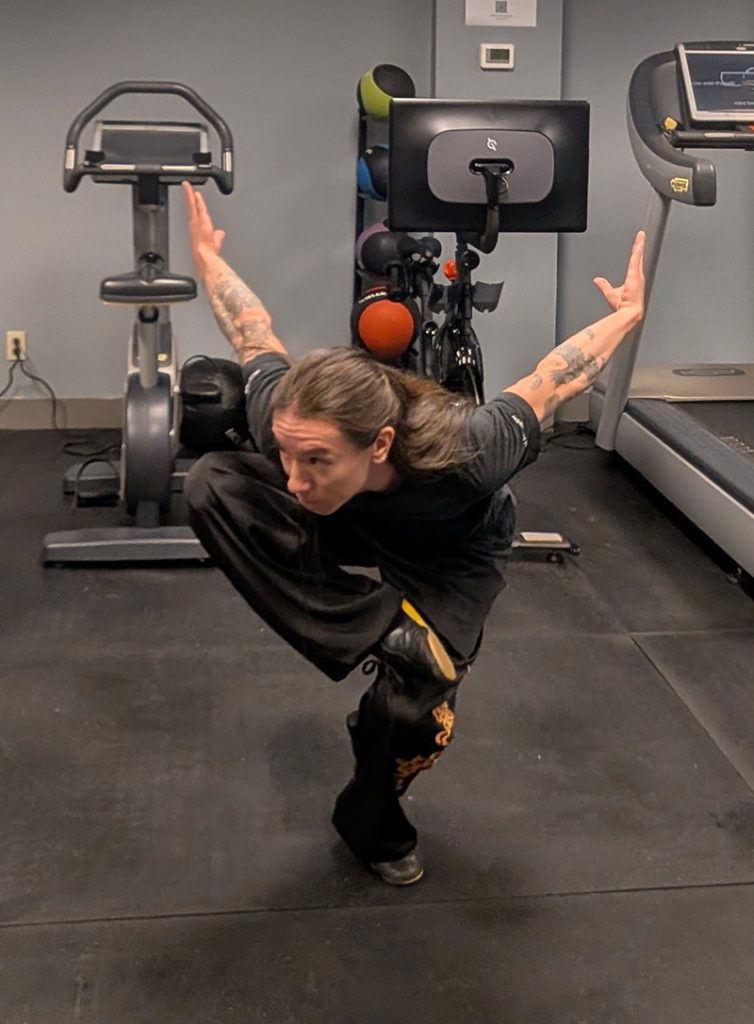
Jim Kirk (Photo provided by Jim Kirk)
Kirk recently reopened Northwest Wushu, a martial arts school originally founded in 2008 by his instructor, Tianyuan Li, in Seattle’s Chinatown-International District (CID). Located at 900 South Jackson Street, Unit 119, in the same building as the Joyale Hotel, the school offers classes for children ages 6 to 12, as well as teens and adults ages 12 and older.
The reopening marks a full-circle moment for Kirk, who first began learning wushu from Li in Japan in 1998. After Li retired from teaching last year, Kirk spent about a year figuring out how to continue the school before deciding to take it over himself.
Childhood inspiration
Born in England and raised in Japan, Kirk has a Japanese mother and Scottish father. His introduction to martial arts came when he was a teenager living in Japan.
“My mom was saying that you have to exercise more,” he recalled.
At the time, Kirk thought, “I like Jackie Chan and kung fu”—which was ultimately how he discovered wushu.
Back then, it was more of a hobby, but he continued doing it until he was 18.
He earned a degree in elementary education and spent about 10 years teaching before transitioning into IT during the pandemic. He now works full-time in IT for Seattle Public Schools.
Even after leaving Japan, however, he never completely stopped martial arts. He continued practicing on his own, and after moving to Seattle, discovered that his former instructor had also relocated to the area.
“I ended up moving to Seattle, and I discovered the instructor who taught me in Japan had moved to Seattle as well,” he said. “I rejoined Northwest Wushu.”
Deeper appreciation for martial arts
It was in his 30s, when he returned to training, that Kirk actually developed a deeper appreciation for the art.
“When I rediscovered wushu, I was in my 30s. That’s when I really fell in love with it,” he said.
“I’ve been doing it more seriously for about six years now.”
Having started as a young student, Kirk already had a foundation in the movements and techniques. But returning to the practice as an adult gave him a different perspective. He began researching the art more extensively and developing his own skills and understanding.
“It felt like fate that I was able to rediscover the art and reconnect with my shifu that taught me back in 1998. It was a complete coincidence. It felt like something that I needed to do at that point.”
For Kirk, taking over Northwest Wushu was a natural next step after Li’s retirement in December. Li, who is now teaching tai chi on cruises, remains supportive of the school’s continuation.
“It is such a great thing that Northwest Wushu can continue to serve our community,” Li said.
“Coach Jim is a very dedicated student and always helpful. I trust him with his ability to make the school help more people with martial arts training.”
Kirk is currently the school’s sole instructor, though he hopes to eventually grow the program and bring in additional teachers. His goal is to recreate the kind of community he remembers from the old Northwest Wushu days.
“I want to go back to that kind of environment, 20 to 30 students doing performances,” he said.
For now, classes are small, allowing Kirk to adjust instruction to each student’s experience and abilities. He welcomes students of all levels, though he particularly enjoys working with beginners and intermediate students.
“It’s easier to impart knowledge to newer people,” he said, adding that advanced students are welcome, too.
Wushu, which literally translates to “martial arts,” is a broad term encompassing Chinese martial arts, including tai chi and other traditional practices. The style Kirk teaches is modern and contemporary wushu, which has evolved into more of a performance sport.
Kirk describes it as “Hollywood kung fu,” emphasizing large, flashy movements, jumps, acrobatics, and choreographed routines. Competitors perform in front of judges, who score them based on the difficulty and execution of their routines.
The school focuses primarily on a style called long fist, known for its extended movements, wide circles, and reaching techniques. Students also learn traditional Shaolin-based movements and animal forms.
Weapons training is another component, with students working with equipment, such as swords, spears, and staffs.
Community involvement
Beyond competitions, wushu also offers opportunities to perform for the broader community.
Northwest Wushu has participated in events such as Sakura-Con, performed at the opening of a Bruce Lee exhibit at the Wing Luke Museum, and taken part in Chinese New Year celebrations.
For Kirk, however, the appeal goes beyond the physical movements.
“It just feels good to do it,” he said. “The aesthetic of it, I like the culture behind it as well, where everybody is pushing everyone else to be their best.”
He particularly appreciates the encouragement students give one another. In Chinese, “jia you” is an expression used to cheer someone on and encourage them to keep going.
“I like that idea of encouraging each other to be their best,” he said. “I have feels when I’m doing it.”
Kirk’s background in education also influences how he approaches teaching. The children’s classes, designed for ages 6 to 12, run for an hour, while teens and adults attend two-hour sessions. Rather than having everyone work through exactly the same material, he adapts instruction based on individual needs and skill levels.
His wife is also supportive of his new venture. She previously studied ballet, and Kirk sees some similarities between the two disciplines.
“Sometimes I refer to wushu as Chinese ballet,” he said, while acknowledging that the two are different.
As he works to rebuild the school, Kirk hopes to attract students who are interested not only in learning the movements but also in understanding the history and cultural heritage behind the practice.
That is a goal shared by Li, who hopes the next generation of students will carry the tradition forward.
“I hope people not only practice the art, but also be able to understand the culture, heritage and perspective, dedication and respect… to carry this ancient traditional art into the future,” Li said.
For Kirk, reopening Northwest Wushu is an opportunity to do just that: continue the work of the instructor who first introduced him to martial arts nearly three decades ago while creating a welcoming space for a new generation of students in the CID.
For more information or to enroll, visit http://northwestwushu.net.
Nina can be reached at newstips@nwasianweekly.com.
Leave a Reply