



By Kai Curry
NORTHWEST ASIAN WEEKLY
Prostate cancer is a silent disease. There are no outward signs to signal that something is wrong and there’s no guaranteed way to prevent it either. A healthy diet and regular physical activity may support overall health, but genetics and access to healthcare access can play a role in one’s ability to get screened.
For Pacific Islander men, especially those older than 65, prostate cancer is a significant concern. But it can affect younger men as well, sometimes without warning.
That was the case with Johnathan Tuiasosopo, a Samoan Des Moines resident who discovered he had prostate cancer when he was 57 years old.
Tuiasosopo went in for an annual medical exam. He was aware that cancer was a leading cause of death among Samoan men and had a family history of the disease, but he had never undergone a screening prior to this appointment, when he was told he, too, had prostate cancer. It was somewhat far along—“on the negative side,” he recalled. With all cancers, though, discovery means a higher chance of recovery.
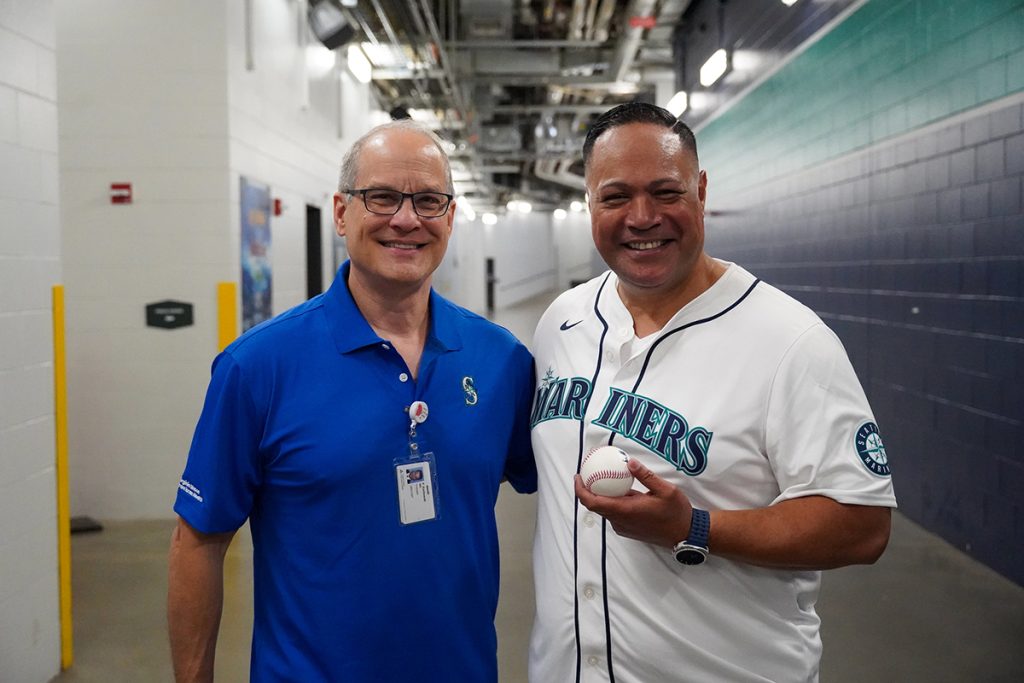
Johnathan Tuiasosopo (right) and Dr. Paul Kozlowski (Photo courtesy of Virginia Mason Fransciscan Health and Johnathan Tuiasosopo)
“When it comes to cancer, one of the things that’s pretty much universal among all cancers is that the earlier you catch it, the better the outcome,” said Tuiasosopo’s urologist at Virginia Mason Franciscan Health (VMFH), Dr. Paul Kozlowski. Johnathan opted for surgery and has been cancer free for over two years. Since his own battle with cancer, he has become an unofficial spokesperson in the local Samoan community, getting the word out about screenings.
Tuiasosopo believes that a lot of people have the wrong idea about prostate cancer and about getting a screening. Usually, a screening is relatively hassle-free; it’s a blood test. Kozlowski recommends that anyone with a history start screenings by the age of 45; if everything is normal, then screening every two to four years is adequate. For Tuiasosopo, unfortunately, everything was not normal. He knew that cancer had impacted his family—his father and more than one sibling were lost due to cancer—yet he still was shook by the news. Although the reasons for contracting prostate cancer are not easy to pinpoint, Johnathan believes that his family became less healthy, as a whole, when they moved to the United States from Samoa. Tuiasosopo himself is at the peak of health, athletic, and the last person anyone around him thought would get cancer.
People will say to him, “You? You have cancer? But you’re so healthy.” The answer that Tuiasosopo gives is: “It doesn’t matter.” Tuiasosopo talked to the Asian Weekly about Samoan culture, which is strong in Christian faith, including his own family and himself. The belief system that many of the elders have, he explained, is to let their faith take the wheel—whatever will happen, will happen. For this reason, many do not go to the doctor routinely, nor do they get screened for cancer. “Out of sight, out of mind,” he quipped. But, “Don’t you want to live for your family?” he asked. Tuiasosopo has participated in several activities since his own diagnosis in order to raise awareness among local Samoans regarding prostate cancer and cancer in general. Notably, he was invited to throw the first pitch at a Seattle Mariners game in June 2026, at which VMFH held free screenings—something VMFH regularly does.

Johnathan Tuiasosopo throws the first pitch at a Mariners’ game in June 2026. (Photo courtesy of Virginia Mason Fransciscan Health and Johnathan Tuiasosopo)
VMFH is “really committed to our community and we’re really committed to early detection of cancer,” Kozlowski said. “We’re reaching out to the community; we’re going to these sporting events…to bring that awareness. We want people to know that ‘Hey, you can screen for this, and it doesn’t mean you have to be treated and if you do catch it early, it doesn’t mean that your life is over. It means you still have a chance of having a high survivor rate and a very long and productive life.” Showing up specifically at sports events, Kozlowski affirmed, helps beat that stereotype, too, that only older men over 65, or only “unhealthy” men, should be screened. In conjunction with the Mariners and a program called Fans for the Cure (https://fansforthecure.org/), VMFH this year screened 90 fans at their 3rd Annual Prostate Cancer Screening at T-Mobile Park. VMFH also shows up to do screenings at Seahawks and Kraken games. For his part, if someone wants to talk, Tuiasosopo talks—to people at his church, at his rugby team, wherever the topic arises.
Tuiasosopo is not the typical face of a cancer patient, both he and Kozlowski acknowledge, yet there’s no reason that should be. Cancer is the second most common cause of death after cardiovascular disease for Asians (which includes Pacific Islanders), and the leading cause of solid tumor death. This has a lot to do—though not everything to do—with the lack of services among Asian communities, and the lack of awareness about screenings, or lack of willingness to get them. Tuiasosopo doesn’t think it’s an avoidance of white doctors or western medicine, but rather an avoidance of doctors altogether. He will sometimes call doctors, “healers,” instead, if that helps his friends, family, and neighbors have a more positive take on the profession. “Jonathan is a very young man to see this,” Kozlowski said. “He’s young, good looking, fit.” With Tuiasosopo, Kozlowski continued, it really “hits home” that cancer can happen to anyone.
Being cancer free doesn’t mean Tuiasosopo is done. Because of his history, he now has frequent screenings and exams. His “PSA” levels (prostate-specific antigen) have to be monitored. “If you’re at that age and you have time, go and do a quick screening,” he urges. It’s usually at no cost and/or covered by insurance. “There’s nothing wrong with doing a screening. Our parents didn’t teach us that.”
For information about cancer screenings at VMFH, visit www.vmfh.org/our-services/cancer-care/cancer-prevention-screenings. To read more about Johnathan and VMFH, go to www.vmfh.org/about-vmfh/news-media/feature-stories/how-men-talk-about-cancer.
Kai can be reached at newstips@nwasianweekly.com.
Leave a Reply