



By Carolyn Bick
NORTHWEST ASIAN WEEKLY
Whether it’s the rising cost of living, lack of affordable housing, severely restricted healthcare options, voting, or increased concerns about federal immigration enforcement, many Asian Americans, Native Hawai’ians, and Pacific Islanders have a lot on their minds in the leadup to November’s midterm elections.
The National Council of Asian Pacific Americans (NCAPA) and AAPI Data held a briefing featuring a suite of experts who addressed these different areas of concern.
Most dove into these areas through the lens of disaggregated data, and underscored how crucial disaggregated data is when it comes to understanding the AAPI experience. They said that the U.S. Census Bureau’s proposed plans to change the census for 2030 will do extreme harm. The U.S. Census Bureau has proposed eliminating its race, ethnicity, and sexual orientation categories. It has also proposed only counting citizens and legal green card holders, and including a question regarding a person’s legal status.
Increasing housing burden
During a brief presentation of the findings contained in the third edition of the State of AANHPIs, Karthik Ramakrishnan, who serves as the founder and executive director of AAPI Data, said that when it comes to economic stressors and cost of living concerns, the overall poverty rate among AAPIs is not a good barometer. Though the overall poverty rate for AAPIs is 10%—lower than the national average—“we still see very high levels in Asian American and also Pacific Islander communities for those who say that cost of living is the most important problem that they face, and cite in particular the cost of groceries, healthcare, and housing.”
Ramakrishnan said that Native Hawai’ians and Pacific Islanders suffer the most from overcrowded housing. However, 64% of all respondents said that housing is the hardest thing to afford, and that addressing the cost of housing should be a high or moderate priority for the federal government.
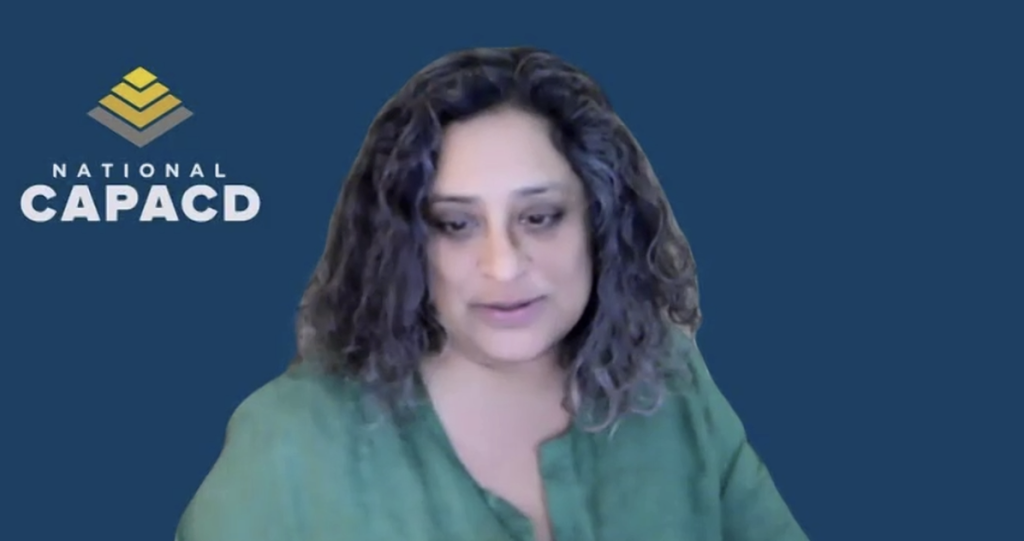
Seema Agnani
Seema Agnani, the CEO of the National Coalition for Asian Pacific American Community Development (National CAPACD), specifically focused on housing issues facing the AAPI community. She emphasized that there was no singular AAPI economic experience, and that using only “aggregate data is definitely not going to really reveal the real story of what’s happening in our communities.”
Research that National CAPACD conducted in partnership with the Urban Institute shows that AAPIs are disproportionately burdened with housing costs, compared with other racial and ethnic groups, she said. A third of Pacific Islanders and slightly less than 30% of Asian Americans face housing cost burdens. Sixty percent of the AAPI community in the U.S. live in the eight most expensive metro areas. This includes the Seattle-Tacoma-Bellevue area, which the report states is home to the largest population of Native Hawai’ians and Pacific Islanders.
“Seattle-Tacoma-Bellevue … poverty rates ranged from 26% (non-Chamorro Micronesian) to 6% (Tongan),” the report reads. “Across all metro areas, for NHPI ethnic groups, non-Chamorro Micronesians had the highest poverty rate at 28%, whereas Chamorro and Tongan communities had the lowest rate at 14%.”
During the panel, Agnani highlighted New York City’s Bhutanese community, which has housing cost burdens as high as 67%, underscoring the need for disaggregated data to show the real picture.
“This has real implications for building wealth. … The ability to buy a home is really impaired, and so we need policies that ensure there’s housing stability,” Agnani said. “That includes everything from supporting tenants in ensuring they’re able to stay in their homes in order to build wealth in the long run. … We also need policies at the national level that encourage things like shared ownership models and increased housing supply.”
Overall insured rate hides the whole picture
Adam Carbullido, director of policy and advocacy at the Association of Asian Pacific Community Health Organizations, said that even though the uninsured rate among AAPIs showed a significant decline, “those top-ranked numbers can obscure very different experiences when we disaggregate the data.”

Adam Carbullido
“Some Pacific Islander communities continue to have huge uninsurance rates, and today, about 40% of Native Hawaiians and Pacific Islanders and 25% of Asian Americans are either uninsured or rely on public coverage, such as Medicaid,” he explained. “That makes some of the recent changes to Medicaid and other coverage eligibility particularly significant for our communities.”
Last year’s H.R. 1, also known as the One Big Beautiful Bill Act, slashed nearly $1 trillion from the healthcare sector alone for the next 10 years. The cut, along with new eligibility requirements, is expected to leave more than 10 million people without health insurance. On Oct. 1, hundreds of thousands of formerly protected immigrants—specifically refugees, asylum seekers, and human trafficking survivors—lost their health insurance under H.R. 1.
Additionally, the steep increase in insurance rates, due to expired enhanced premium tax credits that Congress failed to renew, is expected to result in 5 million people losing their health insurance this year alone.
The changes that have resulted in AAPI communities losing coverage do not mean that they don’t need care, Carbullido said—“it just means that they’re going to show up to community health centers or other safety net providers.”
“And now those providers are being asked to absorb those costs, which is going to leave a significant burden and a lack in coverage for our communities,” he continued. He also highlighted a particular need for sustained investments in culturally responsive programs and research for Native Hawai’ian and Pacific Islander communities. But this can’t happen without disaggregated data. “Our full AN and HPI community are not monolithic [and] have different histories, languages, and health needs.”
Carbullido brought a personal note to his final talking point: the Pacific itself, and how different healthcare looks—and how difficult it is to access—in places like Guam, American Samoa, and the Northern Mariana Islands.
“I grew up in Guam and I worked both on the Hill for the Guam Delegate to the House of Representatives, and now in my role at AAPJO. I see firsthand every day how differently federal health policy operates to the detriment of communities once you leave the continental United States,” he said. “[We] face significant health workforce shortages. We have limited specialty care in our islands, and aging and deteriorating health infrastructure. Yet, we do not always participate in federal health programs the same as the states.”
For instance, he said, the federal government caps Medicaid funding in the territories, rather than providing support for community needs, as it does in the states.
“I really hope that we can move beyond temporary funding fixes and enact equitable, sustainable policies that truly include the territories in our advocacy,” he said.
Increasing immigrant, first-generation populations
The State of AANHPIs report revealed that Asian Americans remain the fastest-growing group since 2020, with a total of more than 26 million people, including multiracial people, identifying as Asian American. A further 1.7 million are Native Hawai’ians or Pacific Islanders.
Among Asian Americans, the largest growth could be found in Indian, Chinese, and Filipino populations. The number of native-born Hmong have now surpassed native-born Japanese Americans.
When it comes to immigrants from AAPI communities, disaggregated data shows that a significant number of residents in Kazakh, Uzbek, and Nepalese communities have arrived within the last 10 years.
The number of people applying for HB-1 visas fell during President Donald Trump’s first term and again during the first years of COVID. They have never returned to pre-Trump levels, Ramakrishnan said.
“When you talk about immigration, it’s also important to talk about enforcement. And in our report, we have recent and reliable data on how much deportations have increased,” he said. “Looking beyond just deportations, what we find through our public opinion data is that immigration enforcement is fundamentally reshaping daily life in our communities, including having 53% of South Asians that are now carrying proof of citizenship or immigration status. … That’s higher than Latinos, and that’s important to know.”
Joanne Paneo of NCAPA briefly touched on the federal government’s mass deportation campaign targeting different states and localities, including sanctuary jurisdictions.
Trump has had sanctuary jurisdictions in his crosshairs since his first presidency. He has recently expanded that scope to include what he deems “sanctuary states”—states that tend to vote Democratic—and has attempted to punish these states and their cities through policy, including cuts to clean energy funding, conditional federal disaster relief support, and cuts to welfare and child care funding. Courts have repeatedly and largely blocked these attempts.
The federal government has greenlit an additional $170 billion for immigration and border enforcement through September 2029, which means that “all that funding will be available even after this administration makes its way out.”
That’s enough funding, she said, to increase arrests and deportations, expand and update surveillance technology, build more detention facilities to detain up to 135,000 additional people at any one time, and hire 10,000 new immigration officers. That is also enough money to fund increased collaboration between immigration authorities and state and local law enforcement.
Voting resources
Amidst the whirlwind of conflicting information and outright misinformation, as well as the federal government’s ramped-up, sustained immigration campaign, many AAPIs have expressed fear and uncertainty about voting.

Ted Lieu
But Rep. Ted Lieu, who serves on the House Judiciary and Foreign Affairs Committees and serves as the vice chair of Democratic Caucus, urged people to vote and vote early.
“It’s clear to me that this administration is going to try to suppress your vote, and the best way to stick it to this administration is to find a way around the obstacles that are put before you,” Lieu said. “The best way to preserve our democracy and preserve our country is to get 10 of your friends or family to vote. And if you see ICE agents or federal agents around your polling area, that should make you even more mad and hopefully you get even more people to go vote. So that to me should be our message. We don’t want people to self-suppress their own vote.”
Christine Chen, who heads up APIA Vote, briefly presented findings from the 2026 AAPI Voter Survey and pointed listeners to the API Voter Toolkit 2.0, which is an updated toolkit based on the 2026 Asian American Voter Survey. She urged voters to use the toolkit and to help their friends and families make a plan to vote.
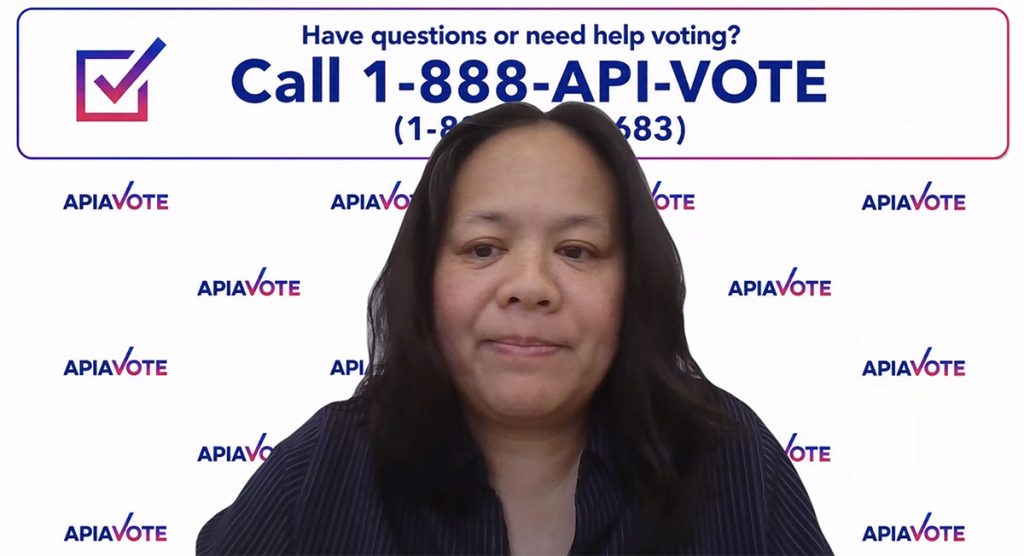
Christine Chen
“Ninety percent of the respondents of our 2026 Asian American Voter Survey have a plan to vote this year. They have the intention to turn out, but we need to go ahead and turn that intention into action and to make sure that they have a plan,” Chen said. “We need to also recognize the challenges and the needs of limited English proficient voters and young voters. These are folks that are typically not reached out to by the campaigns and they have a lot more barriers. So it’s even more important for us how we use the toolkit to actually get them the information that they need and help them make their plan to vote.”
Leave a Reply