




By Carolyn Bick
NORTHWEST ASIAN WEEKLY
In the latest voting rollercoaster, the U.S. Supreme Court last week reaffirmed states’ rights to administer mail-in voting, but this week allowed the federal government to implement a voter eligibility database that states could opt into.
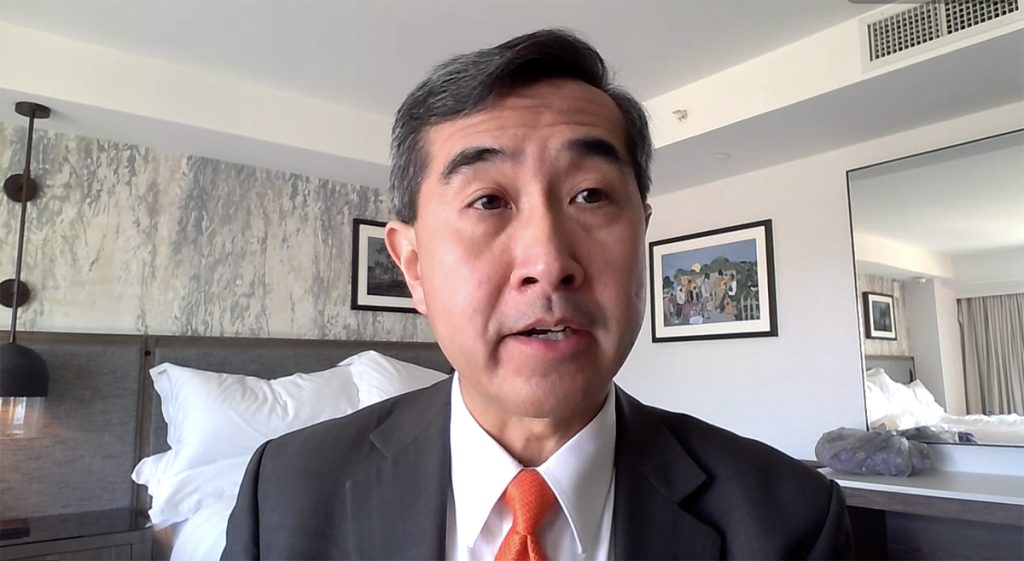
John C. Yang, President and Executive Director, Asian Americans Advancing Justice
States that choose to implement the voter database, said Asian Americans Advancing Justice (AAAJ) President and Executive Director John C. Yang, will likely cause further confusion amongst a public that is already trying to figure out whether mail-in voting is both safe and legal, following President Donald Trump’s rhetorical and policy-driven attacks on the practice—not in the least part because federal databases can be inaccurate.
“I do think that there is going to be harm that comes of this. But at the same time, this harm probably will be regionalized depending on what state election officials are relying on to create their own voter rolls,” Yang said, during a Sept. 25 American Community Media briefing regarding barriers to voting. The U.S. Supreme Court had issued its decision that morning.
“It’s certainly a very disappointing decision. I do not want to mince words about that. But at the end of the day, the voter rolls are still in control of local and state governments. How the local and state governments choose to interact with the federal government is where that friction point is going to be.”
As the head of AAAJ, Yang underscored that voting in November’s elections will be “critical,” particularly since many in the Asian American community are being affected by the federal government’s policies.
For instance, he said, almost half of all eligible Asian American voters prefer to utilize mail-in voting. That method of voting was, until the Court’s decision last week, under threat. He also noted that Asian Americans are affected by the cost of health care. One in five Asian Americans utilize Medicaid or CHIP, both programs that the federal government has severely weakened and under which recipients will have to meet certain work requirements, starting in January 2027.
Yang also highlighted that almost 90% of all Asian Americans are immigrants or the children of immigrants. Given that ICE agents have both killed American citizens and detained Asian American citizens, and have been conducting increasing raids, many in the Asian American community feel an increasing sense of fear.
Recently, there have been rumblings that Immigration and Customs Enforcement (ICE) agents will be at polling stations. This hasn’t been confirmed, and Yang emphasized that these are just rumors, but fear is spreading nevertheless. Yang said that this should not be a deterrent to someone exercising their rights as a citizen.
“When you hear about immigration policies that are being enacted by the federal government, that is something that should concern all of us as well and make sure that we have a voice in this process,” Yang said.
In the event an ICE agent does attempt to detain someone at a polling place, Yang said that there are a number of steps that person can take. First, he said, is recognizing that people should be able to vote without fear or intimidation. Second, people need to keep in mind that they have rights, and that ICE agents cannot detain them without a legitimate reason.
“Unless they give you a clear reason for being stopped, you can always ask, ‘Am I free to go?’ And they should allow you to leave,” he said. “The other aspect of that is being very—and each of us in our own cultures will have to deal with this differently—vocal about it. When ICE is actually there and stopping you, speak loudly so that others [like poll monitors] near you can help to protect you or help to understand what is happening.”
He also noted that it is illegal for people to bar others from voting, based on whether they can speak English.
“Speaking English, reading or writing in English is not a requirement for participating in the election. In fact, under our Federal Voting Rights Act, the fact that you can get language assistance is one of the rights that you have,” Yang explained. “You can bring an interpreter, a translator to the polls with you, as long as they are not your employer or part of your union.”
He also highlighted that there is infrastructure in place to help make people feel safer when they vote. Among this infrastructure is a toll-free hotline specifically for the Asian American community, 888-API-VOTE. The hotline is run in both English and nine different Asian languages. Hotline volunteers can help voters check eligibility and where to vote, as well as provide translation assistance.
“In the event that there is ICE or other actors there that we don’t think belong there, we are looking at all legal means that we can,” Yang assured. “And if that means lawsuits, that will mean lawsuits as well. I want to make sure that people feel like they are protected. Part of this is also thinking about what makes the most sense for yourself. … plan to vote is what I would tell all of our community members. Think about how you want to vote. Think ahead about that.”
And, he said, “Don’t let that fear, don’t let the misinformation dissuade you from voting.
This is your right, certainly, for citizens. This is your right. This is your chance to exercise your voice. Don’t let people that want to purposely scare you into silencing yourself. We are there to help you. Our entire community is there to help you. And these are all the different means that we have at our disposal.”