



By Andrew Hamlin
NORTHWEST ASIAN WEEKLY
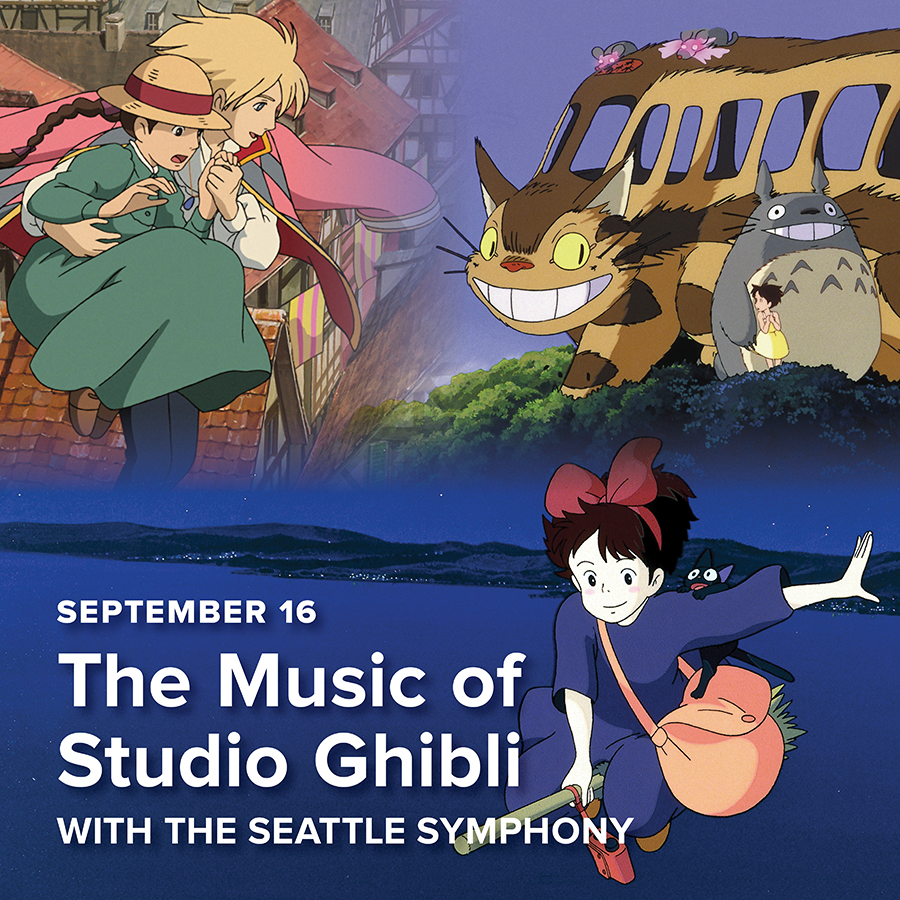 The Seattle Symphony Orchestra’s Sept. 16 presentation of “The Music of Studio Ghibli,” includes musical excerpts (though no visuals) written by composer Joe Hisaishi, from the classic anime films “Howl’s Moving Castle,” “My Neighbor Totoro,” “Kiki’s Delivery Service,” and “Spirited Away,” all products of Japan’s famed Studio Ghibli animation studio.
But two men helping to bring the evening to life, guest conductor Wilbur Lin and narrator Tomo Nakayama, came to Studio Ghibli’s work in their own ways.
“I don’t remember,” said Taiwanese American conductor Lin, asked about how he got into Ghibli titles. “Most likely, I started before grade school. I remember watching ‘My Neighbor Totoro,’ ‘Porco Rosso,’ ‘Princess Mononoke,’ and ‘Castle in the Sky,’ all before I was 10. Particularly the last two I loved so much as a kid.
“My current favorite is ‘The Wind Rises,’ a rare work of historical fiction from Studio Ghibli. To me, an artist’s interpretation can sometimes feel like an even more honest way of telling a story drawn from real life. There is a person choosing a perspective and shaping what we see, and that freedom can bring us closer to the essence of the story than historical footage or factual accounts alone. I love the music as well. It shows Joe Hisaishi’s range and creativity, but what particularly strikes me is his restraint. It’s a different side of his [composing] voice from what we hear in some of his better-known masterpieces.”
Nakayama, a long-time Seattle resident, has his own memories. “I love ‘Totoro,’ of course, and all of [director] Hayao Miyazaki’s films for their environmentalist and fantastical world views. Joe Hisaishi’s music in those films has been a huge influence on me over the years, especially ‘Totoro,’ ‘Spirited Away,’ and ‘Howl’s Moving Castle.’ They have such uniquely recognizable and emotionally moving melodies.
“I was born in Japan and immigrated to the U.S. in the late 1980s as a child, which meant that one of the few ways I remained connected to my native language and culture was through film and TV. Ghibli movies were the most widely available Japanese movies in the U.S., so I loved watching them. They’ve continued to be important links to Japanese culture for my nephews and niece, and I’m excited to share this performance with them.”
Nakayama specifically narrates a section of the performance called “Orchestra Stories: My Neighbor Totoro.” Joe Hisaishi adapted this from his own film score as an educational concert piece, the narrator first introducing the instruments to the audience, then explaining the action in between and during, nine excerpts from the “Totoro” story.
As Nakayama elaborated, “It reminds me a bit of Benjamin Britten’s ‘The Young Person’s Guide to the Orchestra,’ part storytelling and part educational narration, introducing people to the various elements of an orchestra. The narration is entirely in Japanese, and I wrote the translations for the English supertitles, which was also very, very fun.”
Asked about rehearsing the program, Lin notes that, as of last week when he answered his questions, he had not rehearsed the program with the Seattle Symphony.
“We will have one rehearsal before the concert. That sometimes surprises people, but it is a testament to the amazing versatility of American orchestral musicians. An orchestra like the Seattle Symphony might perform a gigantic Mahler symphony one weekend, a thrilling pops concert two days later, then a series of demanding films-in-concert starting the next day, with very limited rehearsal time.
“It is not just about playing the notes, an exhilarating technical feat in itself, but also bringing a deep understanding of style to everything from Baroque music, to pops and jazz. I look forward to experiencing that versatility from the podium!”
The Seattle Symphony presents “The Music of Studio Ghibli” on Sept. 16, at Benaroya Hall, 200 University Street in downtown Seattle.
For prices, showtime, and other information, visit https://www.seattlesymphony.org/en/concerttickets/calendar/2026-2027/27-studio-ghibli.