




By Carolyn Bick
NORTHWEST ASIAN WEEKLY
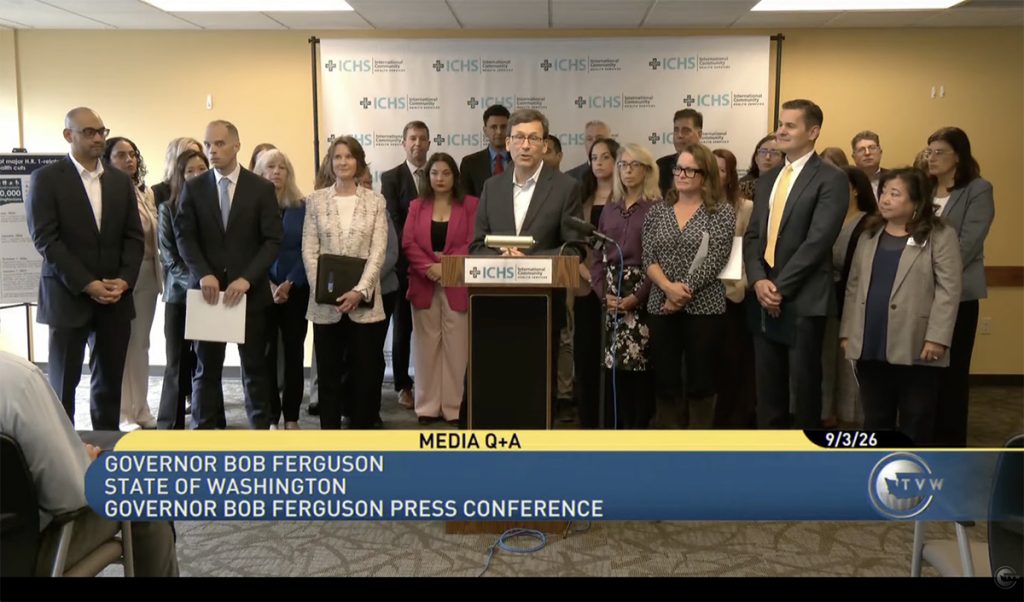 Surrounded by community and state health care officials during a news conference at International Community Health Services (ICHS) in the Chinatown International District (CID), Gov. Ferguson signed an executive order on Sept. 3 meant to fight back against H.R. 1, President Donald Trump’s so-called “Big Beautiful Bill” that has served to gut Medicaid programs across the country and strip health care coverage from immigrants—11,000 of whom live in Washington state—starting on Oct. 1.
“The federal government’s changes are all designed for one purpose. It is thinly veiled to kick people off Medicaid, to make the system as difficult as possible to navigate. We, as a state, are required by law to implement these draconian cuts, and have already been forced to spend nearly $100 million to do so,” Ferguson said. “If Washington state were to backfill everything that H.R. 1 cuts, it would cost us [$3.2] billion in a biennium.”
Among other provisions, the order establishes the H.R. 1 Continuous Medicaid Response Committee. The committee, led by health services agencies in consultation with the Office of the Insurance Commissioner, the state’s Health Benefit Exchange, and other agencies, will serve to monitor impacts of the bill on Washingtonians and the state’s health care system, as well as coordinate response for future changes. The committee will also identify barriers to coverage and coverage disruptions.
The order, which Ferguson signed at the International Community Health Services (ICHS) building in the Chinatown-International District at a news conference on Sept. 3, also directs a coordinated public awareness campaign meant to reach Washingtonians who will be impacted by the changes to Medicaid coverage. The order directs the Department of Health to develop a data accountability system to track who is losing coverage, identify gaps where the state can step in and take action, and use collected data to track the overall impacts of the bill.
Finally, the order also directs the state’s Department of Health and Human Services to work with community partners and philanthropic organizations to reach out to people across the state.
Just a few months ago, the state had estimated that about 14,000 immigrants would lose coverage. But thanks to extensive outreach work, the state has managed to preserve healthcare coverage using different methods for about 3,000 green card holders. Still, 11,000 immigrants will lose their healthcare coverage starting in October.
On Jan. 1, 2027, the bill’s work requirements will go into effect, meaning that certain people covered under Medicaid will have to work at least 80 hours per month. This will affect more than 600,000 Washingtonians, who will also have to apply twice per year to keep coverage.
About 55% of ICHS’ patients rely on Apple Health, the state’s Medicaid program, ICHS CEO Kelli Nomura said.
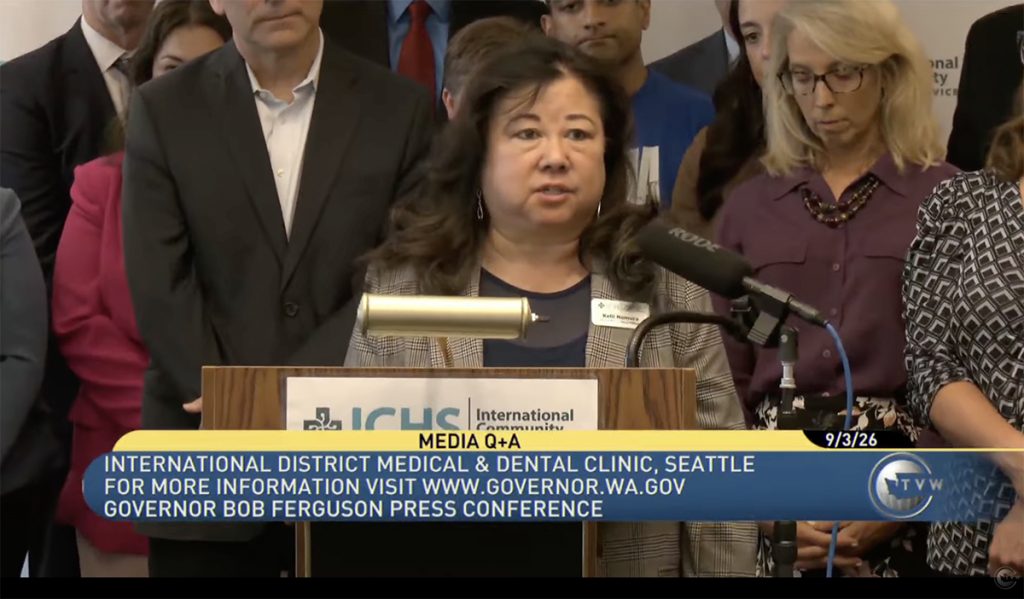
ICHS_ICHS_Kelli Nomura
“Some will lose Apple Health, the coverage under H.R. 1 eligibility requirements. Others will face new hurdles, such as twice yearly annual renewals, shorter enrollment windows, and increased documentation requirements,” she said. “Our ICHS enrollment navigators … will experience major workload increases as we help those impacted by H.R. 1 successfully remain on Apple Health or find affordable alternatives to Apple Health.”
Even those who may not lose health coverage due to new requirements may find that they cannot afford new health insurance rates. More than 250,000 Washingtonians who do not have health insurance through their jobs and who do not qualify for Medicaid will experience “sticker shock” from rate increases this year, said Patty Kuderer, the state’s insurance commissioner. They will also “face steeper rate increases in the coming years due to H.R. 1 and other federal action.”
Thanks to Congress’ decision last year to allow enhanced premium tax credits to expire, 40,000 fewer people enrolled in individual health care plans through the state’s exchange for 2026. This represents the largest drop in enrollment since the exchange began 13 years ago, Kuderer said.
Those who lost coverage due to cost increases include “many lawfully present noncitizens previously eligible but now shut out and people losing tax credits because they’re above the income cap, which is $62,000 per year for an individual. That includes small business owners and pre-Medicare retirees.”
If the state had not worked to reduce the impact of these changes, such as providing additional state financial assistance to low income customers, and restructuring certain plan rates to maximize federal assistance, the number of people who would have lost health care coverage due to unaffordability would have doubled, she said.
There are more hardships to come, though, she said.
“Next week, we’ll announce the final rates for 2027, and I truly wish I had better news. Insurers requested an average increase of 22.4%,” Kuderer said. She explained that, by law, she is required to approve rate increases, if insurance companies can make a successful case for them. “The cost of claims, including hospital and prescription drugs, are increasing, as are the number of claims. These are the biggest factors driving up the premiums. We also know that mergers, acquisitions, and private equity also impact affordability. And the uncertainty coming out of the other Washington isn’t helping.”
Nomura highlighted the importance of proactive and continuing community outreach, and said that ICHS and other community health centers have “been doing this work for many, many months.”
“Our community health centers have patient navigators. These are staff that are out in the community every day, working with existing patients, talking with those who might become patients, and really making sure that they understand what is coming,” she said. “Here at ICHS, we provide services in over 90 languages. So we need to make sure we get out there and speak to our communities in the languages that they speak so that they can understand the impacts of what’s coming.”
In order to reach as many people as possible, the state’s Healthcare Authority is reaching out to people via both physical mail and text messages. “We really encourage folks: please update your information,” Ferguson said. “If you get a piece of mail, please, please open that mail. That is information that is to help you so we can help you get the assistance that you need.”
The state is also looking for help from community organizations to help get the word out, said Healthcare Authority Director Ryan Moran.
“We believe in a community-oriented, a community-based, a community-led partnership in this process. Community messengers are going to be critical for us in this time period,” he said. “They will be our trusted voices, and they will be critical in helping people keep their coverage.”
In his final call to action, Ferguson admitted that he allows himself to get a little angry over what is happening.
“As much progress as we’ve made, it really ticks me off that we’re here. … It’s outrageous,” he said. “It just is. It needs to be said. … It’s morally bankrupt, what Congress and the president have done.”
Leave a Reply