



By James Tabafunda
NORTHWEST ASIAN WEEKLY
Ballots and boba made an unlikely pairing at the Wing Luke Museum, where about 40 Seattle-area voters gathered for an election town hall aimed at making Washington’s vote-by-mail system a little less unclear.
In a 45-minute discussion dubbed “Ballots and Boba Mixer: Elections Town Hall,” King County Director of Elections Julie Wise walked voters through what to expect from this year’s general election on Tuesday, Nov. 3, and urged them to return their ballots early and track them online.
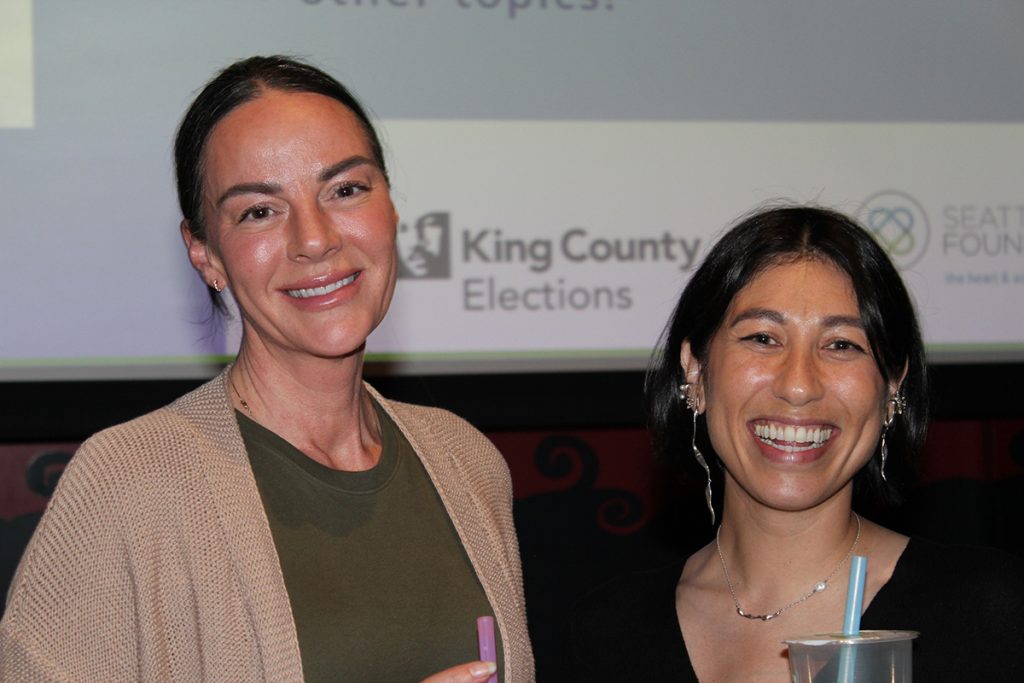
Julie Wise, King County Elections director (left) and Chrissy Shimizu, Wing Luke Museum executive director (Photo by James Tabafunda)
Wise spoke with Wing Luke Museum Executive Director Chrissy Shimizu during the free event at the museum’s Ford Foundation Community Hall on Wednesday, Sept. 16. King County Department of Elections, the Seattle Foundation, the Washington State History Museum, and the Wing Luke Museum were listed as community partners.
“I really appreciate King County Elections for partnering with us this evening to demystify the electoral process,” Shimizu said.
Immigration enforcement concerns
Shimizu asked how voters should respond if they feared U.S. Immigration and Customs Enforcement (ICE) activity near post offices, drop boxes, or voting locations.
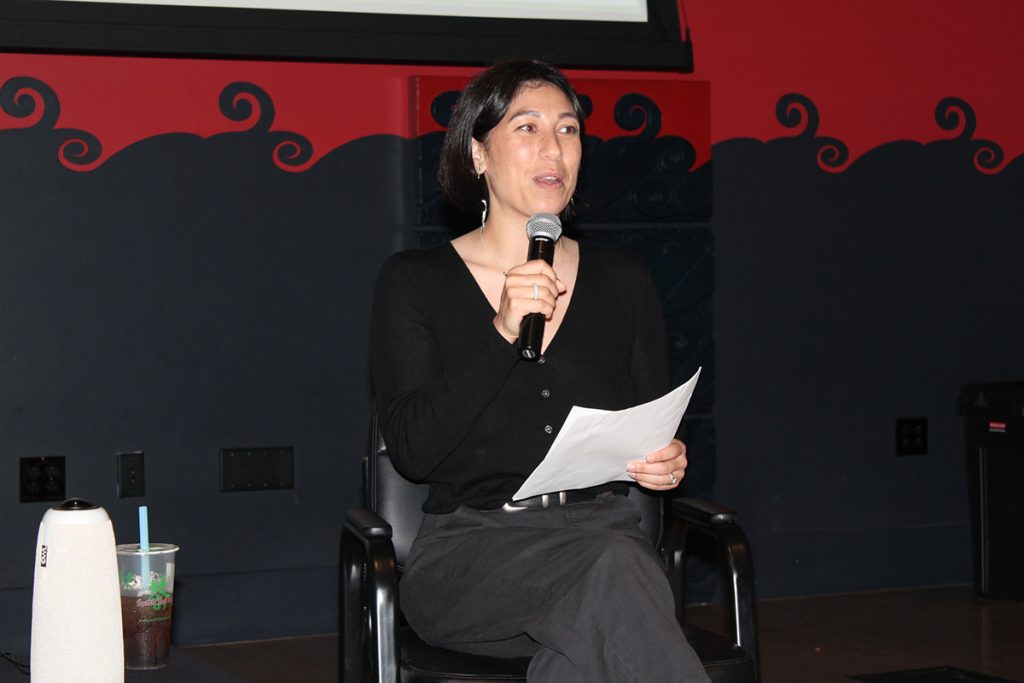
Chrissy Shimizu, Wing Luke Museum executive director (Photo by James Tabafunda)
“I can tell you, as an election administrator, this is a hot topic. I was just in Kansas City for a national elections conference with 600 election leaders from around the country. And we’re talking about issues like this,” Wise said.
“And this is one that doesn’t really have necessarily a feel-good answer. I’ll be honest and transparent about that,” she said. “We can’t keep ICE from public areas, but luckily, the way voting is set up here in King County, we get to vote from home and that keeps a lot of folks safe.”
Wise advised voters who encounter suspected immigration enforcement near a drop box to leave and find another drop box.
Language access and justice
“Language justice is very important” to Asian American, Native Hawaiian, and Pacific Islander (AANHPI) communities, Shimizu said. She then asked Wise how voters who speak other Asian and Pacific Islander languages could get help.
King County provides ballots, voters’ pamphlets, and correspondence in English, Chinese, Korean, Vietnamese, Spanish, Russian, and Somali.
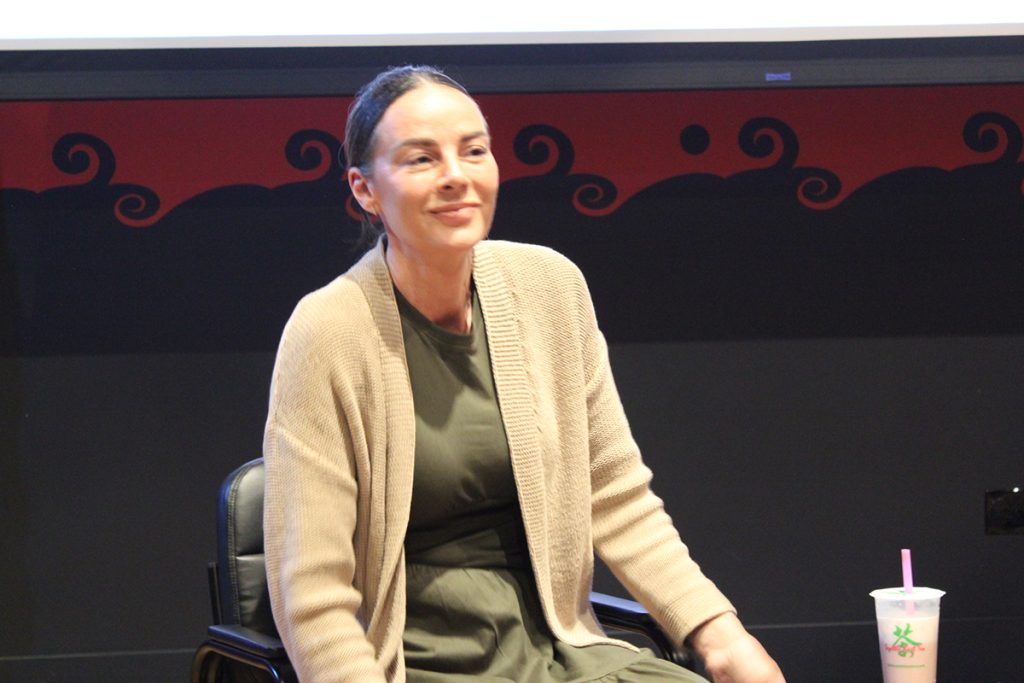
Julie Wise, King County Elections director (Photo by James Tabafunda)
Wise said, “If you give us a call at our office or if you’re at a vote center, we will be able to use the resources of 120 different languages to help us give you the information that you need in language to be able to vote.”
Supporting AANHPI voters
Asked what King County Department of Elections (KCDE) could do better, Shimizu focused her answer on access for communities whose languages are not among the county’s seven fully supported options. Her question pressed KCDE to consider assistance beyond translations already required or funded.
Wise said KCDE reviews the American Community Survey and information from schools, public agencies, courts, and community organizations to identify emerging language needs.
KCDE can seek King County funding to add languages instead of waiting for a federal directive, she said. In 2026, it is gathering information from community organizations like the museum and reviewing demand for interpretation. KCDE is “mindful of what will be the need in five years from now or 10 years from now so that we’re prepared and ready to go for people to have access,” Wise said.
Wing Luke’s example
A small display at the town hall highlighted Wing Luke, who in 1962 became the first Asian American elected to the Seattle City Council. Wise said, “He won by 30,000 votes. Winning by 30,000 votes is a very impressive feat. And you should also know that many local races that we have are decided by five, 10, 20, 30, right?”
She argued that local elections are where progress is made, shaping representation and policy “that reflects our community.”
Voting early without anxiety
Wise repeatedly encouraged attendees to vote early, avoiding “a delay in getting that all-important postmark on the return ballot” and getting more ballots to appear in election-night results. She recommended using a drop box when possible, mailing at least a week ahead otherwise, signing the return envelope, and tracking the ballot through the county’s alert system.
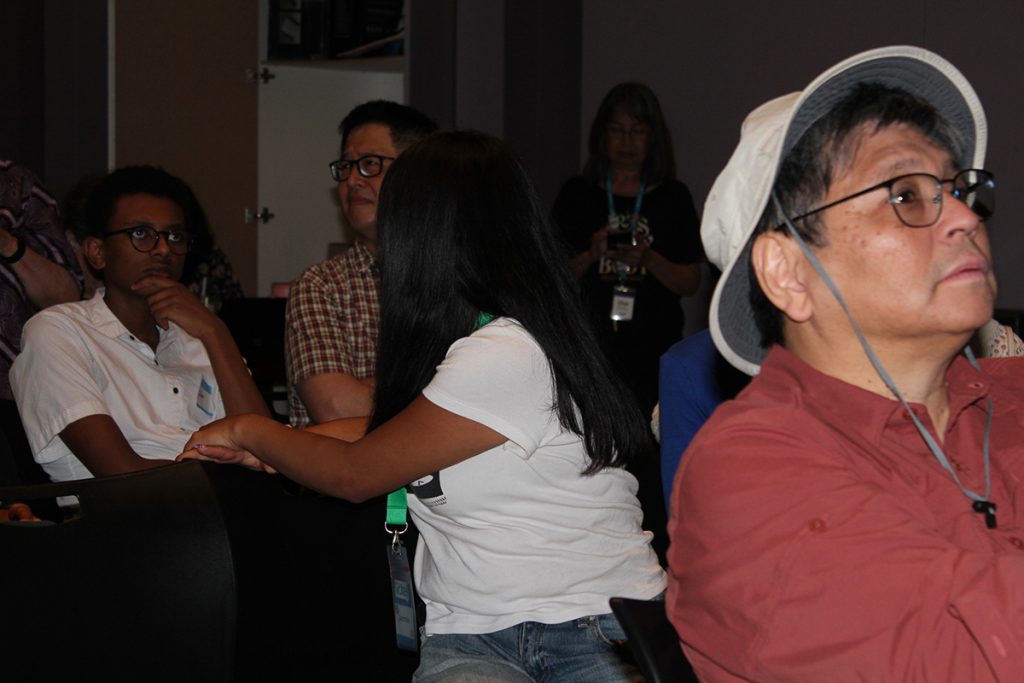
Attendees at Ballots and Boba Mixer: Elections Town Hall on Sept. 16, 2026. (Photo by James Tabafunda)
Wise said local offices and measures affect such issues as public safety and parks funding, even when federal contests receive more attention. Close local races demonstrate that a small number of ballots can determine an outcome. “We really want to make sure that we turn out, make our voices heard on all those really important decisions,” she said. “Your vote can make all the difference.”
She also addressed voters who find judicial contests or ballot measures difficult to understand. Dense legal wording can make the effect of a “yes” or “no” vote confusing in any language, Wise said, adding that election officials are interested in efforts to write measures in plain language.
“We don’t want you to have ballot anxiety,” she said. “It’s not a test.”
Wise said, “You only have to vote on the races that you want to, and that could be just one off of a whole, entire ballot, and we will count it.”
Voting by diverse communities and in November
“I learned that many organizations avoided reaching out to communities of color, immigrant communities, and Asian Americans,” Shimizu said about three, specific communities. “And to me, that felt incredibly unfair.”
“We were low-propensity voters, perhaps because no one was talking to us.”
Wise said the U.S. Supreme Court’s Sept. 14 decision leaving a lower-court injunction in place meant new U.S. Postal Service (USPS) ballot requirements would not apply this November. The blocked rule would have required special envelope features and voter data submissions to the USPS. Justice Brett Kavanaugh wrote that officials lacked enough time to implement it for the midterms.
“It is voting as usual for voters, and it’s business as usual for election administrators,” she said. Still, she warned that delays in obtaining postmarks have occurred in parts of Washington state. King County’s election calendar lists ballots will be mailed Oct. 14, drop boxes will open Oct. 15, and ballots must be postmarked by Election Day or deposited in a drop box by 8 p.m.
Wise said King County expects to have 100 drop boxes available by Election Day, placing 97% of voters within three miles of one. She advised anyone using the mail to send a ballot one week before Election Day. Voters who do not receive a ballot by Oct. 19 should call KCDE.
Ballot alerts can notify voters when a ballot is mailed, received, and cleared for counting after signature verification. KCDE’s vote-by-mail process compares the signature on each return envelope with signatures in the voter’s registration record and contacts voters whose ballots have questioned or missing signatures.
Wise described drop boxes as 1,000-pound “steel tanks” bolted into cement and equipped with fire suppression and tamper detection. “They’re even slanted on the top so that rain or snow can’t pile up. The door is even designed so that when it’s not locked, it’s going to hang open,” she said.
Two-person teams collect ballots under checklist protocols, Wise said. Returned envelopes are sorted—40,000 ballots per hour—and scanned, and KCDE workers review each signature before separating the envelope from the ballot to preserve secrecy. County rules require returned mail ballots to remain sealed and securely stored when they are not being processed.
KCDE uses a digital scanning system to record votes and a stand-alone computer system to tally those votes, according to King County Canvassing Board rules. Wise said tabulation equipment is not connected to the internet and access to the room is tightly restricted. Election results are transferred to an internet-connected computer for release after 8 p.m. on election night.
The November ballot will include state legislative and congressional races, judicial contests, county races, a Seattle City Council seat, and state and local measures, depending on a voter’s address.
Wise recommends that voters compare information from several sources, including the official voters’ pamphlet, candidate forums, news coverage, trusted community leaders, and endorsements, particularly when evaluating complex issues or ballot measures.
Candidate statements in the voters’ pamphlet are submitted by campaigns. “We don’t edit them. We don’t correct anything,” Wise said. “It’s also going to have their contact information so you can follow up with them and ask questions that you may have.”
Wing Luke Museum’s short-term plans
“There’s a forum in the works for October 20th for the November general election so please mark your calendars,” Shimizu said.
At the close, she invited artists, crafters, chefs, writers, musicians, performers, poets, and culture bearers to connect with the museum. “We want to work with you to bring civic engagement knowledge to our communities through your art,” she said.
For more information on voting in King County and changing your language preference, go to kingcounty.gov/elections or call KCE at 206-296-VOTE.