

By Carolyn Bick
NORTHWEST ASIAN WEEKLY
Photos from BAYAN WA
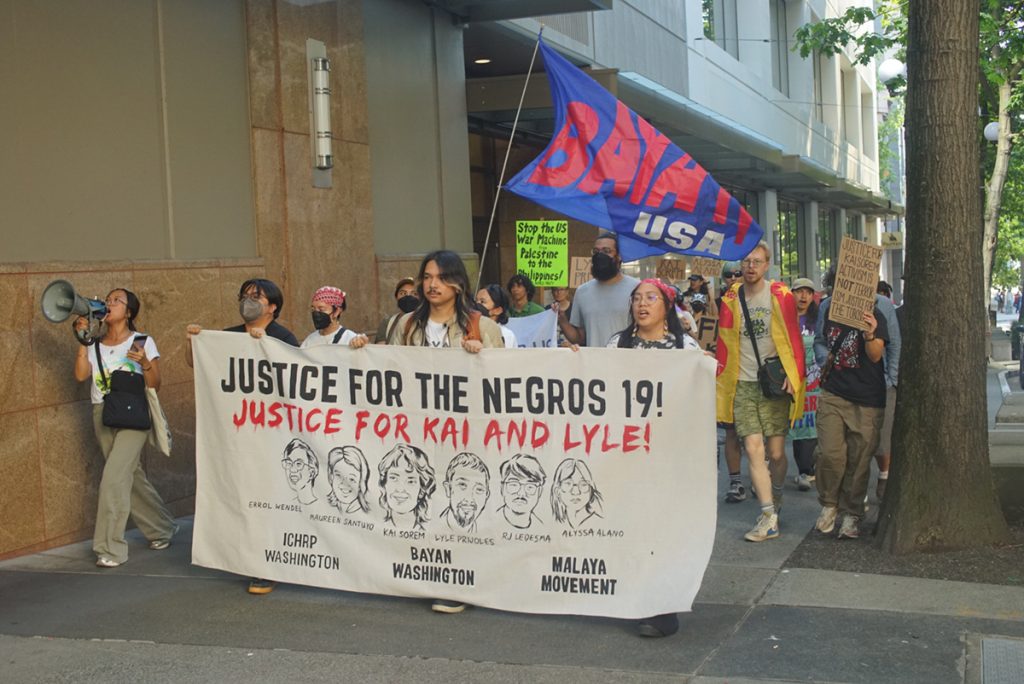
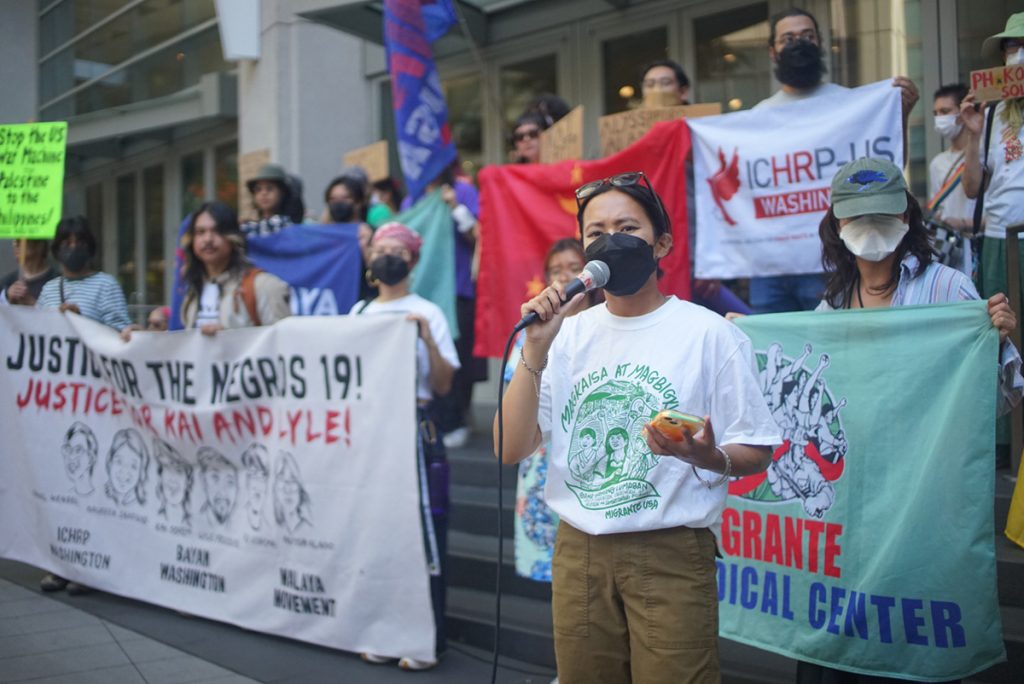
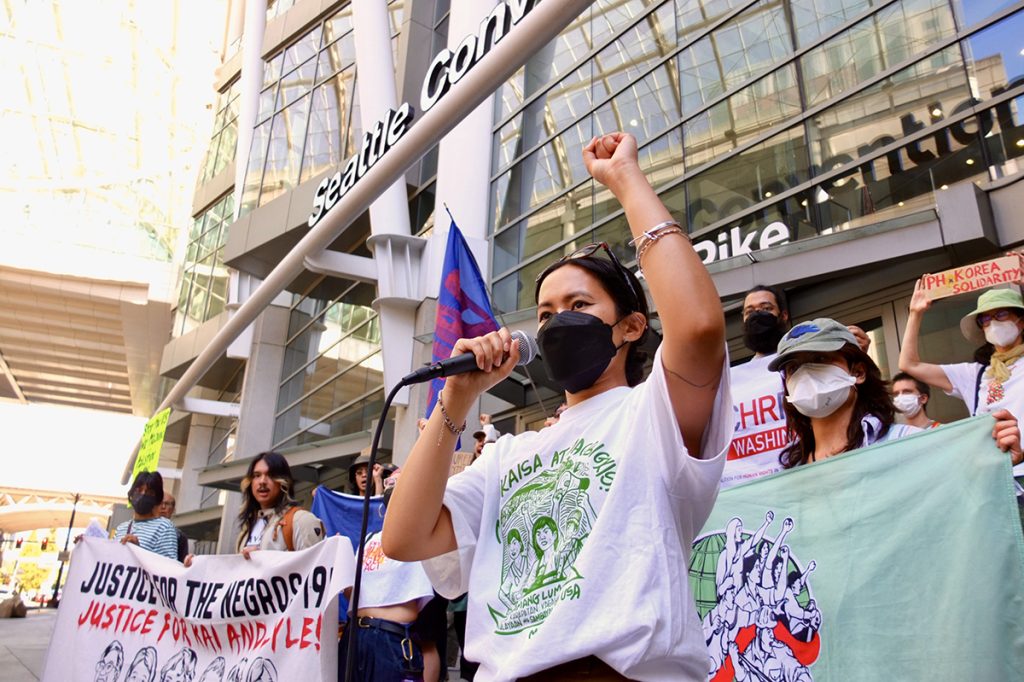
A group of about 50 Filipino activists, educators, lawyers, nurses, and community members held a rally outside the Philippine Consulate in Seattle on Aug. 19—four months after Philippine soldiers shot 19 people to death in Toboso in the province of Negros Occidental, Philippines.
One of these people was Kai Sorem, a Seattle-based Filipino American educator and activist. She was 26 years old. Another two were Filipino teenagers.
The rally called on the Consul General Henry Bensurto to answer for his lack of action or answers.
The Philippine government has labelled the entire group terrorists.
But this does not appear to be true.
Photos from BAYAN WA
A 117-person group composed of several local, national, and international organizations, including Manindigan Negros, Defend Negros, and Karapatan, went on a fact-finding mission in May, a little less than month after the killing.
The group recently issued a report from this mission that appears to dispute Philippine officials’ version of events. But neither Philippine nor U.S. officials have acted.
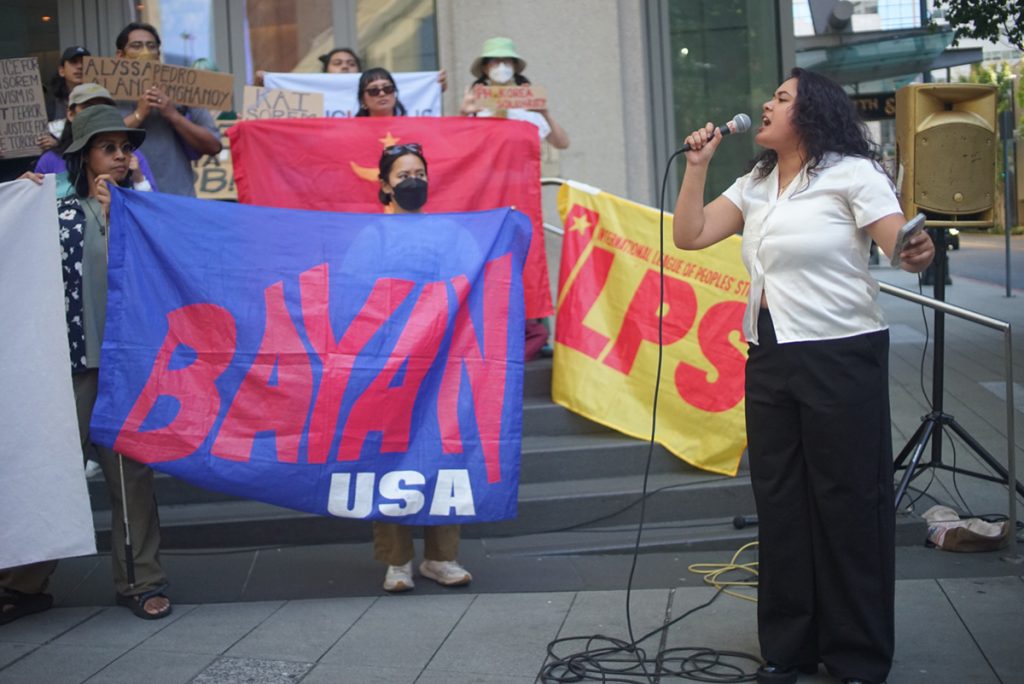
At the Aug. 19 rally, the group notified consulate officials that they were there to hand-present Bensurto a congressional sign-on letter from Rep. Pramila Jayapal to Philippine Ambassador Jose Manuel G. Romualdez calling for “an independent, impartial, and credible investigation” into the killings.
Photos from BAYAN WA
Bensurto did not come out—but, over a loudspeaker, members of BAYAN WA, the Seattle Educators Association union, Malaya Movement, the ICHRP WA, and PUSO shared the details of the report.
The report paints a gruesome picture of what unfolded that day in April. Not only does it allege that soldiers carried out extrajudicial killings on people who did not pose a threat, in apparent violation of the Geneva Convention and international humanitarian laws and codes, but also that they left their bodies to burn and bloat in the sun. When the bodies were finally brought to a morgue and then released to families, some families got the wrong bodies.
Photos from BAYAN WA
According to village residents the fact-finding group interviewed, soldiers also allegedly raided homes and used villagers as human shields.
Neither Bensurto nor the Philippine Consulate responded to emailed questions or request for comment.
Background
To create the report, the fact-finding group and local volunteers interviewed about 30 area residents; consulted with a UP College of Medicine forensic pathologist, who performed autopsies on five of the 19 dead, including Sorem; and searched the area of the killing and gathered local reports. They also worked with the Children’s Rehabilitation Center through an activity that gave children who had experienced repeated violence and witnessed the events that day a chance to express their feelings and speak about their situation.
Of the dead, nine were civilians, two of whom were teenagers, Ron, 17, and Melissa, 15, and two of whom were American citizens, including Sorem. The other American was Lyle Prijoles, a journalist from California.
Several people spoke about Sorem at the Aug. 19 rally outside the Philippine Consulate. Isaura, local Seattle teacher and member of the Seattle Educators Association (SEA), spoke at length about Sorem and her contributions to the Filipino American community in the area, and shared a letter from the association.
Sorem was a founding member of grassroots Filipino youth organization Anakbayan South Seattle and an advisor to Rainier Beach High School’s Filipino American Student Association. She also participated in the SEA’s Save Our School campaign advocating for ethnic studies courses, including a Filipino American history class, within Seattle Public Schools. She also showed up to school board meetings to provide testimony for important issues, and joined educators when they went on strike in 2022.
“[Sorem] was dedicated to the safety of our schools and our kids,” Isaura said. “And I am indebted to her and our schools, indebted to her labor for making sure that ethnic studies continue. … Students were so moved by Kai’s commitment to her people and fortified … to keep learning.”
Residents the fact-finding mission interviewed also described the group, highlighting that “they had never seen these individuals carrying firearms when they visited the community.”
“They fondly remembered Alyssa (Alano) as a lawyer. They said Kai, Lyle, and their companions helped with farming activities, including planting bananas. Youth residents described Roel Sabillo as cheerful and always smiling, and said he frequently made vlogs and rode his large motorcycle around the area,” the report reads. “Residents identified RJ Ledesma as a journalist and said that his visits to communities such as theirs were consistent with his work of documenting and learning about local conditions. They therefore expressed disbelief at claims that RJ and the other individuals were members of the [New People’s Army] NPA.”
The family of Ron and Melissa also denied that the children were involved with the NPA.
The remaining 10 people were members of the NPA, the armed branch of the Communist Party of the Philippines (CPP). The parties formed in response to several factors, including what they see as the U.S.’ continued political, military, and economic influence over the Philippines; the feudalism that persists in the country; and the culture of the country’s elites enriching themselves while most of their fellow countrypeople struggle to make ends meet.
The island where the killings occurred has been an epicenter of strife and unrest, following several iterations of governmental agrarian reforms that have resulted in famine and hardship for farmers and Filipinos.
Both the Philippine government, currently headed by Bongbong Marcos, and the United States government have labelled the NPA and the CPP as terrorist groups. The Philippine government has refused to hold peace talks with the NPA; and reported evidence shows that, even without a formal legal order, longstanding, operational posture in the field appears to be that soldiers kill or disappear NPA members.
Civilian killings
The Philippine government has since justified the killings, claiming that all the people they killed were members of the NPA, and therefore terrorists. They also claimed that they were all armed combatants.
This does not appear to be true, and the autopsy report of one of the civilians appears to show that soldiers had the option to take them into custody.
According to her autopsy report, Alano, an unarmed civilian and student leader the soldiers killed, appears to have survived the initial shooting. Soldiers shot her in the knee.
But it wasn’t the shooting that killed her. It was a lack of medical attention. The autopsy report determined that she bled to death.
“Alyssa’s case indicates that the soldiers had the option not to kill the victims. They had the capability to simply incapacitate them and render them unable to fight. As defined in [the UN’s code governing right to life], the use of lethal force is the last resort and may be employed only after all other options have been exhausted,” the report reads. “In this case, there was no need to use lethal force. The victims could have been easily captured. The soldiers and their superiors should likewise be charged and prosecuted for violation of the Revised Penal Code for Murder and other crimes.”
Furthermore, the report notes, when firing on NPA members and civilians, the soldiers did not distinguish between the two, which is a violation of the Geneva Convention.
Area residents described witnessing soldiers firing “indiscriminately” towards retreating NPA members and the civilians who were with them. Based on where the soldiers were positioned, they could see who was armed and firing back, and who was not. The soldiers used high-velocity weaponry.
“Instead of exercising caution, the soldiers fired at will without distinguishing their targets,” the report reads. “As a result, nine civilians were unnecessarily killed.”
Additionally, Jayapal’s letter notes that, in the case of 30-year-old Filipino journalist RJ Nichole Lesdesma, one of the civilians the soldiers killed, “his colleagues have raised concerns that evidence at the scene may have been staged.”
NPA members’ killings
In addition to the nine civilians the soldiers killed, the report alleges that the remaining members of the NPA appear to have no longer posed a threat to the soldiers, despite Philippine officials’ reports to the contrary.
The report alleges that one NPA members’ killing, in particular, stands out, because it appears to be a violation of International Humanitarian Law, and represents at least one extrajudicial execution.
According to Rule 47 of these laws, a person is deemed “hors de combat,” or “outside of combat,” and therefore no longer a threat or a combatant, if they are rendered incapable of fighting back in any way. Under this rule, it is illegal to attack a person in this state.
According to the report, NPA members were allegedly retreating through waist-deep, muddy water, which slowed down their escape. They were armed, but, due to their surroundings, were allegedly unable to use their weapons. The Philippine soldiers, on the other hand, were positioned on higher ground and had an unobstructed line of sight—and fire—towards the group.
“By reason of their condition, the armed NPA members had transitioned into hors de combat and could have been easily captured,” the report reads. “But the intention was obvious. The order given was not to take prisoners. This resulted in the killing of nineteen (19) individuals who were no longer in a position to fight back.”
Drone footage that the Philippines government previously circulated six days after the killing, but took down shortly after, allegedly shows Roger Fabillar (also known as Ka Tapang), the NPA’s commander of the Northern Negros Front, alive, but submerged in a nearby fishpond.
“Despite being defenseless and effectively under the control of military forces, Fabillar was subsequently declared by the military to have been ‘killed in an encounter,’” even though drone footage allegedly shows him as hors de combat, the report reads. “This strongly indicates an extrajudicial execution rather than a legitimate combat fatality.”
Area residents
Residents the fact-finding mission interviewed shared that Philippine soldiers began arriving about three days prior to the killings, and began interrogating residents at gunpoint.
On the day of the killings, some residents reported waking to gunfire in the early morning. Others witnessed the incident. Soon after, soldiers began raiding houses, and again interrogated people, including children, at gunpoint.
In another area, close to the site of the killings, soldiers accosted a male resident, a 14-year-old boy, and the boy’s mother. The soldiers questioned them about NPA members’ presence, but the three knew nothing. Soldiers brought the group uphill, ordering them to stand beside a tree. Four soldiers remained to guard them.
“At around 10:00 a.m., the male resident reported seeing soldiers firing toward the direction of the fishponds. The soldiers ordered the three civilians to lie on the ground. The 14-year-old boy reportedly screamed in fear,” the report reads. The soldiers again questioned the male resident about the whereabouts of NPA members. When he denied knowing anything, the soldier allegedly struck him on the shoulder with his rifle butt. “The commanding officer reportedly warned him against filing a case, saying that the soldiers would return for him if he did so.”
Residents also said they saw several drones flying around, and “reported that cellphone and Wi-Fi signals were unavailable or disrupted on April 19, preventing them from conducting Facebook Live broadcasts. Some residents believed that the signal disruption was caused by the drones they observed, which they described as approximately the size of large black water jugs.”
The military remained in the area for several days.
“The continuing military presence has affected residents’ sense of safety and their livelihood activities. Residents reported that they now avoid leaving their homes after 4:00 p.m. and are reluctant to go out alone for fear of harassment or being caught in crossfire,” the report reads.
Wrong bodies released to families, unclear identification
The soldiers allegedly left all the bodies out in the open for about a day. In that time, the bodies burned and bloated from exposure. They eventually took the bodies to two different area morgues.
A few days after the killings, a Quick Reaction Team composed of about 40 people from different groups, including Philippine rights-specific organizations, environmental organizations, and youth and religious groups, went to the Philippines to assist in returning bodies to their families. The team, associated with the fact-finding mission, also worked to gather information and reports about the killings.
In their efforts to return remains to families, the team found themselves repeatedly subject to Philippine police and military surveillance and aggression. Funeral home staff also refused to unseal remains, and only showed photographs of the bodies.
Following the release of a body supposedly belonging to civilian Errol Wendel, his family noted that the body released was significantly taller than Wendel. The forensic pathologist assisting the fact-finding mission subsequently concluded that the funeral home had released the wrong body to the family.
The NPA members’ bodies were treated in a different manner. Officials originally brought all 10 bodies to one of the area’s morgues, where Philippine Scene of Crime Operation (SOCO) staff conducted post-mortems. Staff there subsequently decided to split them up, and sent some to another morgue.
That second morgue’s staff “stated that the bodies arrived naked, with their clothes and personal effects wet, foul-smelling, and wrapped in plastic.” The morgue staff alleged that the bodies arrived with no identification tags, and instead assigned their own identification based on photographs and number tags they later used to show families retrieving remains. However, morgue staff later contradicted themselves, stating that SOCO personnel had “visited the funeral home the day before and instructed them to ensure that the bodies were transferred properly and with proper identification tags.”
The first funeral home’s owner maintained that his morgue’s staff had handled all 19 bodies correctly. But when he was asked to describe the identification tags and their markings, “he could provide no specific details and was uncertain of their location, describing them only generally as similar to hospital identification tags placed around a patient’s wrist.”
“The owner also claimed that the bodies were fully clothed when received from SOCO,” the report reads. “However, some bodies appeared naked in the post-mortem photographs shown to the team. The team was further informed that the victims’ clothes had been cut off during embalming and subsequently burned.”
Jayapal letter
On July 21, Jayapal wrote a letter to Jose Manuel G. Romualdez, Ambassador to the Philippines. In the letter, she calls for “an independent, impartial, and credible investigation” into the killings. Several other members of Congress signed onto the letter.
Her office did not respond to the Northwest Asian Weekly’s request for comment, but her letter to Romualdez details several concerns.
Though the Philippines’ Commission on Human Rights is currently investigating the incident, Jayapal wrote, the group of legislators were concerned that these efforts have been “hobbled by a lack of cooperation from security forces and other systemic barriers.”
Jayapal’s letter details conditions that appear to mirror those the independent fact-finding mission encountered.
“Security forces routinely deny the Commission access to official records and other evidence in the custody of the military and police that are essential to an independent and thorough investigation,” she wrote. “Without access to such evidence, the Commission has previously had to cite uncorroborated Army accounts of incidents under investigation.”
Additionally, she noted, Philippine security forces, “often the same units involved in the killings,” usually accompany Commission investigators when they try to interview witnesses and visit communities where the killings took place. “This compounds the existing climate of fear and distrust of government investigators among communities in areas like Toboso that are heavily militarized.”
The unit responsible for the killings maintained control of the crime scene, and denied independent investigators access. The killings also occurred in the broader context of the state’s use of policies aimed at suppressing free speech, and labelling anyone who disagrees with the government as a terrorist or a rebel, she wrote.
“[This] is used to justify not only baseless criminal charges, but also extrajudicial killings, arbitrary detention, assets freezes, and violations of due process, free speech, and peaceful assembly,” she wrote in closing. “We are deeply concerned that with such fundamental barriers to an independent investigation, the result of the Commission’s investigation may absolve security forces of wrongdoing, notwithstanding the facts surrounding the incidents. We urge the Government of the Philippines to ensure an independent, impartial, and credible investigation into these killings.”
Though Bensurto did not come out of his office on Aug. 19, activists declared they would return: “Philippine Consulate, we will be back. We will be back demanding justice.”
Leave a Reply