



By Andrew Hamlin
NORTHWEST ASIAN WEEKLY
When Frank Abe stepped to the podium last Sunday, Aug. 16, at the International District/Chinatown library, a tall black-and-white poster on a stand stood to his left. The poster, designed by local artist Frank Fujii (1930-2016), summoned folks to the original Day of Remembrance for the Japanese concentration camps, a ceremony and caravan held on Saturday, Nov. 25, 1978.
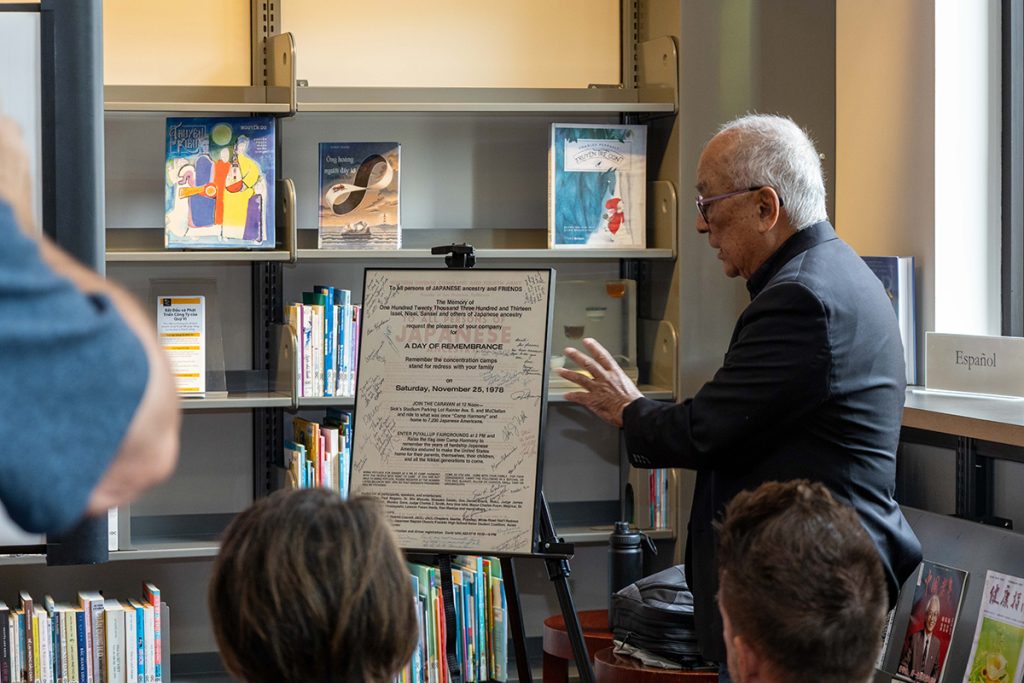
Frank Abe with his signed poster (Photo by Stephanie Araiza)
But Abe, a longtime writer and activist in the local Japanese American community, pointed out a special twist in his framed poster. Brought from his home, this copy featured handwritten remembrances and signatures, from the other main activists involved in that first Remembrance; many of them, sadly, since deceased.
He presented his history of Remembrance and related history as part of the “Out of One, Many” initiative sponsored by Washington state as part of the state’s observation of America’s 250th anniversary. The initiative invites museums, and other public facilities, to “partner with their communities to identify and exhibit an object, image, or artwork from their collections that reflects the American experience.”
Abe took the podium after introductions from Warren Chin of the International District/Chinatown staff, and Maya Hayashi of the Densho project, dedicated to preserving historical documentation of the Japanese American experience during World War II. He began by expressing thanks to the library, noting that public libraries sit “under siege” these days, from book-banning drives and other movements. He also noted, with a smile, that he wrote parts of the graphic novel, “We Hereby Refuse,” set during World War II, at that very library, on breaks from a day job.
His lecture began with a discussion of local author John Okada (1923-1971) and his novel “No-No Boy” (1957), which Abe praised as “the great Japanese American novel, the great Nisei novel.” Okada, as Abe pointed out, walked up and down those very streets along which the library sat, spending a great deal of time at the now-defunct Pacific Hotel, which his parents managed.
The end of “No-No Boy,” Abe argued, pointed the way towards the idea of government redress for the concentration camps. Still, he continued, for many years after the war, Japanese Americans “did not have a way of talking” about the camps, the racism, and the disruption of lives.
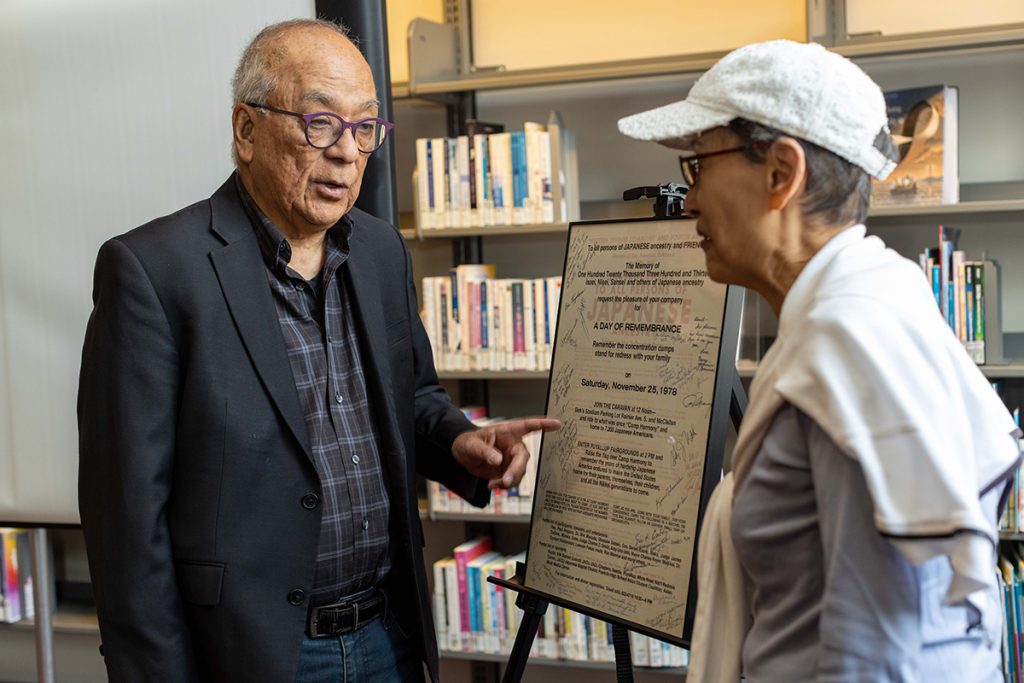
Frank Abe with Northwest Asian Weekly founder Assunta Ng, who just happened to drop in to pick up some books. (Photo by Stephanie Araiza)
That language came from, among others, Shosuke Sasaki (1912-2002), Seattle resident and broker-turned-activist, who went from imprisonment at the Minidoka camp, to helping develop, in the 1970s, the “Seattle Plan,” the first comprehensive plan for redress.
“No Japanese American had ever talked like this,” summed up Abe about Sasaki. But more help came from, oddly enough, a Chinese American, Frank Chin (born 1940 and no relation to Warren Chin), who wrote an article about Sasaki and the activists around Sasaki, for the “Seattle Weekly.” Chin went on to work with the people he chronicled, and helped organize that first Day of Remembrance.
That first gathering, at the parking lot of Sicks’ Stadium in Rainier Valley, traveled to the former location of Camp Harmony, in Puyallup. This became a national news story,though the way ahead was not always clear or easy. Ten years later in 1988, President Reagan signed the Civil Liberties Act, a formal apology from the U.S. government, together with financial redress to surviving incarcerees.
“I wish I could end on a high note,” said Abe, winding down his speech. But he pointed to sadness, to a great deal of prejudice, racism, and discriminatory practices towards American racial minorities, under the Trump administration. “Our collective memory is shorter than I had hoped,” he concluded.
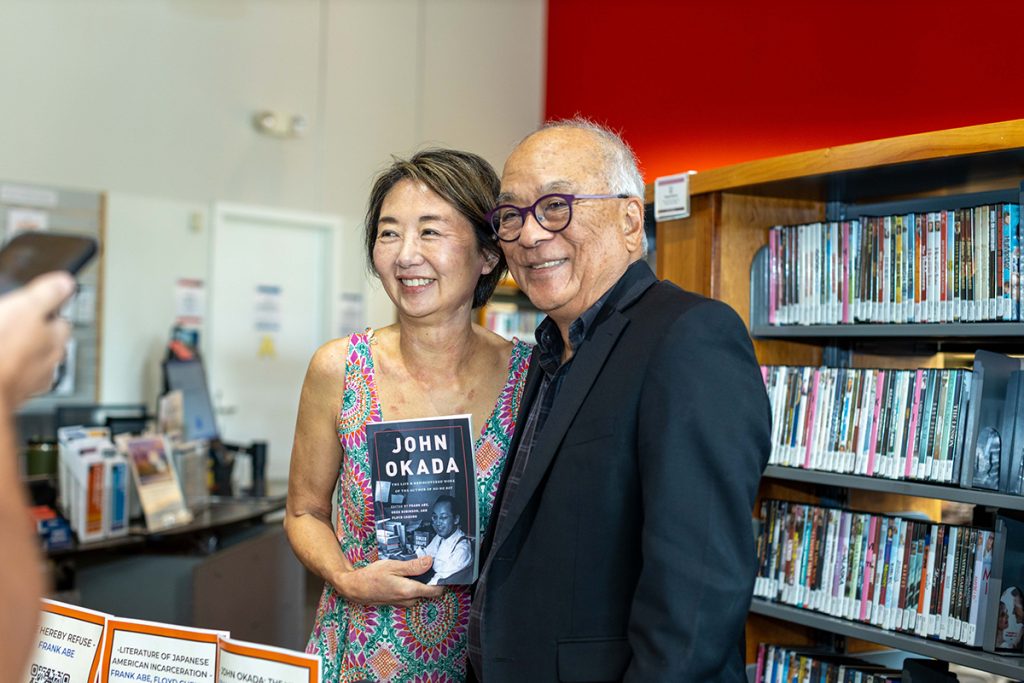
Frank Abe posing with Tacoma author Merilee Tanbara (Photo by Stephanie Araiza)
Still, a few bright spots of optimism presented themselves. Abe introduced, from the audience, Tacoma writer Merilee Tanabara, who’s preparing a novel addressing the historical Tacoma incarceree experience. He also introduced Mayna Tyrell, a Densho intern who’s also working with Tsuru for Solidarity, a movement to abolish concentration camps across the U.S., and which plans a protest march from Puyallup to the Northwest Detention Center run by ICE, in Tacoma.
After wishing the audience well, Abe joined in a discussion, book signing, and arts and crafts making to commemorate the day.
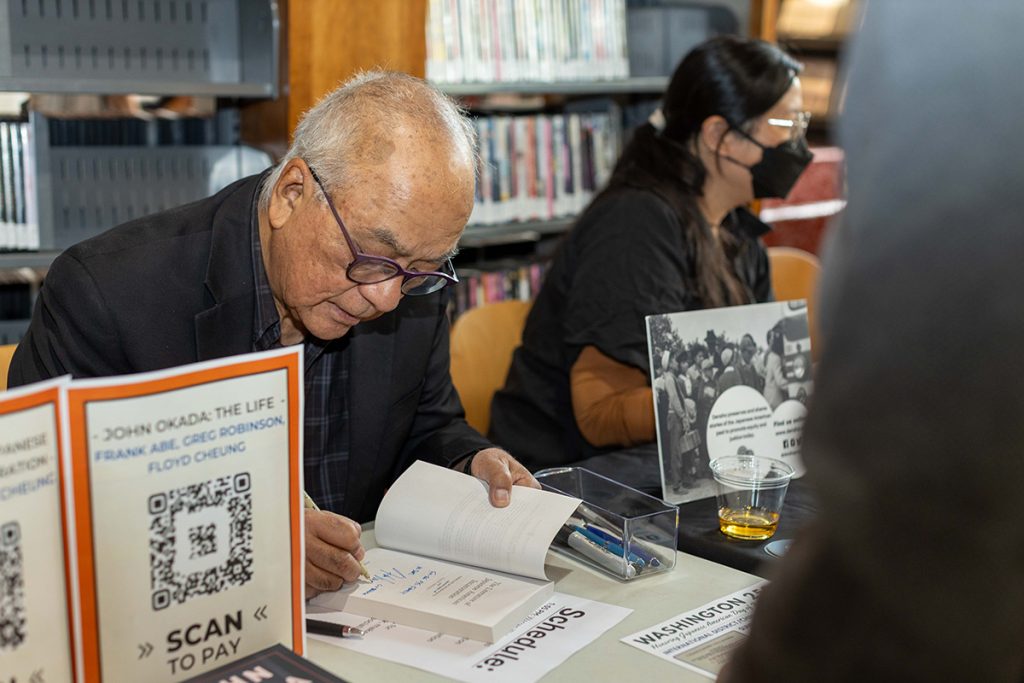
Frank Abe signing books (Photo by Stephanie Araiza)
A mini-exhibit commemorating the first Day of Remembrance gathering and march shows at the International District/Chinatown library, 713 8th Avenue South in Seattle’s International District.
For more information, visit www.spl.org or call 206-386-1300.