



By Carolyn Bick
NORTHWEST ASIAN WEEKLY
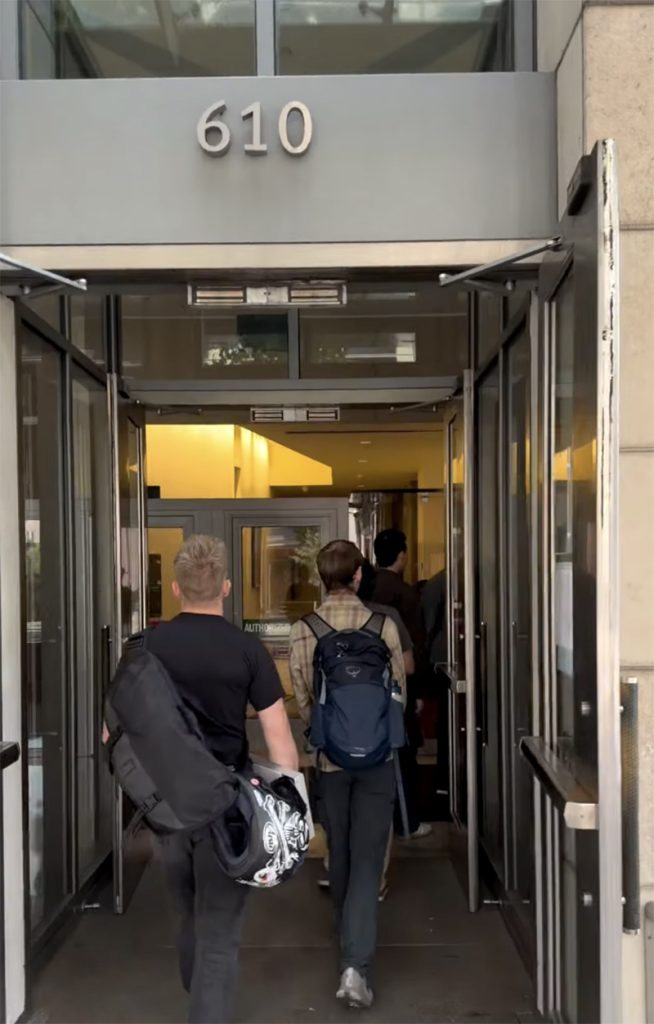 Advocates toured the Seattle Police Department’s (SPD) Real Time Crime Center (RTCC) on the morning of Aug. 17 to understand how the surveillance cameras located around the city worked and how the data these cameras collect is stored and used.
The City has a contract with data broker and tech company Axon, which manufactures police and surveillance equipment. Per Axon’s own website, the Axon dashboard cameras SPD officers use in their cars, which have automated license plate reader software, appear to continue running, unless the vehicle is powered off. Police may also be deleting videos in violation of the law.
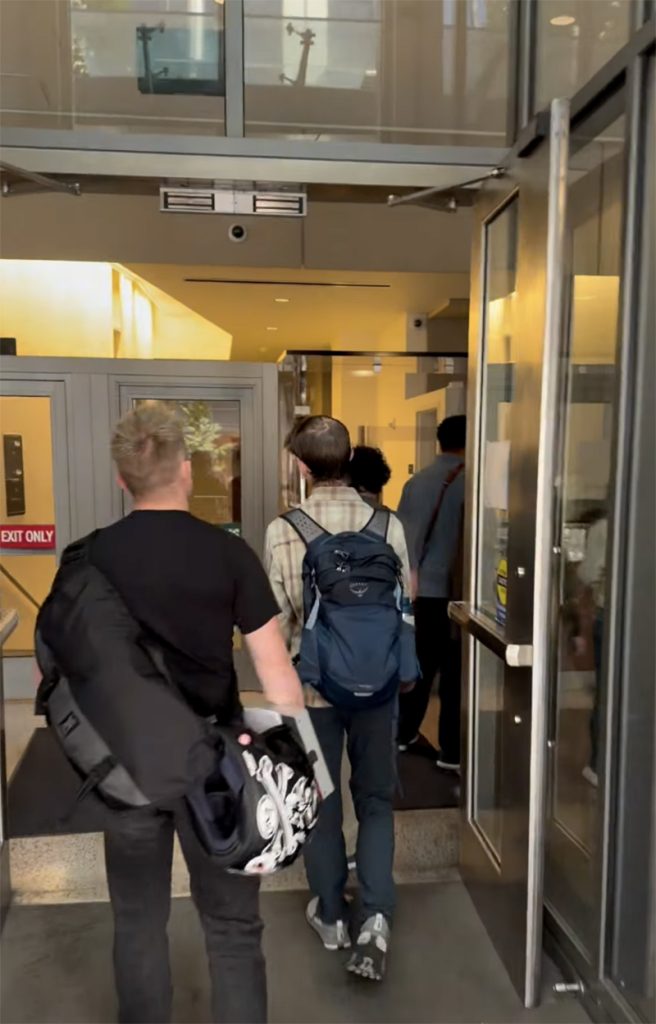
They went in hoping for some reassurances—but they left with heightened concerns, including that it appears easy for the federal government to get ahold of the data these cameras collect and that they may be able to do it without City officials’ knowledge.
Finally, an in-progress masking program that is meant to prevent the cameras from peering into residences also does not appear to work well, an advocate who toured the RTCC told the Northwest Asian Weekly.
“A Swiss cheese system”
“This is a Swiss cheese system,” said Cliff Cawthon, a local policy professional and part-time educator, during a news conference after the tour. “It is riddled with holes and procedural commitments and promises. … Despite the commitment of the city to not cooperate with ICE and border control, that despite these commitments … this can be litigated, information can be subpoenaed. We were told straight up that with a subpoena, there’s a cool-off period, but they can provide this information. And there are a number of other loopholes that the federal government can utilize to get around sanctuary city policies as well.”
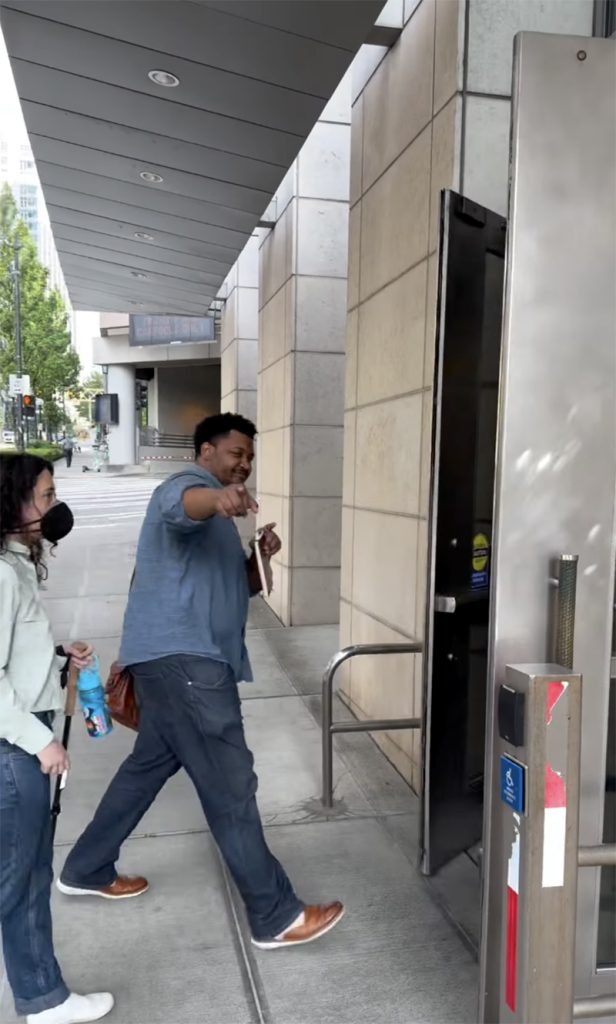
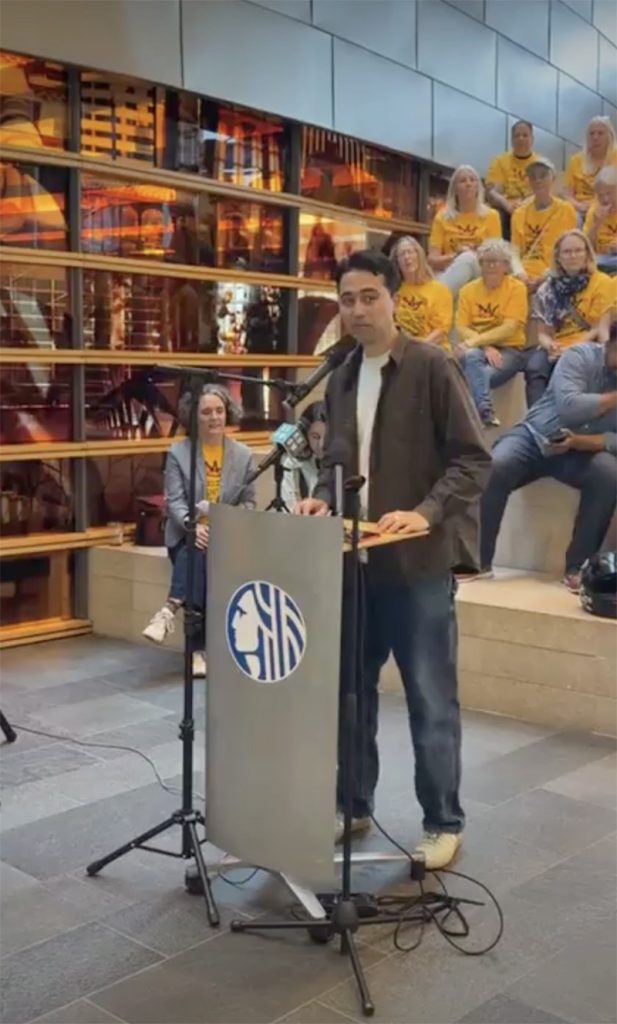
Cawthon spoke alongside fellow advocates from Community Not Cameras, a grassroots group composed of organizations and individuals from diverse backgrounds. The group held a news conference after the RTCC tour, and once again urged Mayor Katie Wilson to turn off Seattle’s surveillance cameras.
A.J. Randall, a cybersecurity engineer who previously worked with Axon, said that both SPD and ICE have contracts with Axon. He said that this makes the cameras’ usage dangerous, given that ICE has been targeting immigrants across the nation, including recently in Seattle.
“Both store and utilize data in Axon’s cloud platform, Evidence.com. So, how exactly these cameras are not assisting the Trump administration in its overtly racist deportation program that is tearing families apart in this community and murdering people across our country every day is lost to me,” he said. “We know that all of the data collected by surveillance companies like Axon and Flock are used to train their AI systems to recognize cars, clothes, faces, and even people’s walking patterns. So, vague reassurances from SPD’s leadership that these cameras aren’t helping [Immigration and Customs Enforcement] ICE is both dishonest and, quite frankly, f—ing insulting.”
He also highlighted that there appears to be no comprehensive monitoring or auditing process to make sure the police are only using the cameras for legal, justifiable purposes. He cited recent law enforcement agency reviews in Georgia that revealed police using Flock cameras in ways unrelated to police work.
“The Savannah, Georgia, Police Department fired six officers after they found a variety of policies designed to protect civilian privacy and even state law being violated repeatedly. Misuse is not just line-level concern,” he said. “The police chief in Braselton, Georgia, was arrested [in November 2025] for obsessively tracking his ex-girlfriend’s movements via the [Flock] camera network and then sending her creepy messages about where she had been.”
Flock is a different surveillance company than Axon, and specifically creates cameras to track license plates. Last year, researchers at the University of Washington revealed that ICE and Customs and Border Protection agents had been getting into different jurisdictions’ Flock camera systems throughout the state, sometimes without the jurisdiction’s knowledge.
License plate readers might still be recording data
This doesn’t mean SPD does not use Automatic License Plate Recognition (ALPR).
As part of an effort to raise awareness around open source project DeFlock’s “National Week of Action Against ALPRs,” advocates also spoke about police vehicles’ automated license plate readers. The ALPRs the police department uses are supposed to be on pause, in compliance with state law.
But Phil Mocek, software engineer and civic technologist, said that the agreement the City signed with Axon means the cameras aren’t actually off.
“When I look at Axon’s website for the Fleet 3 system that all the police cars in Seattle use, it says you cannot turn off the ALPR system once you subscribe to it. Even if you’re a dashboard camera. Nowadays it’s not a separate ALPR, it’s part of the dash cam,” he explained. “Once you subscribe that vehicle to the service, Axon says it will keep running even if the dash cam is off. I don’t believe that they’ve actually turned them off. And I believe the mayor’s office probably doesn’t even know that they’re designed to stay on.”
Axon’s website states, “Unless your agency terminates its subscription, ALPR is functioning whenever Fleet 3 is powered on. Even if Fleet Dashboard is not running or the MDT is off, ALPR will function and the Dual-View camera will still produce audible alerts.”
An Axon Fleet 3 user manual mirrored on ManualsLib states the same: “ALPR is on whenever Fleet 3 is on.”
Mocek said that has been “bamboozled by this one vendor who is working nationwide—and now even outside of the nation, and even in private places—to slurp up every bit of information they can.”
“Axon is not a police equipment company, they’re a data broker. And our city is selling our public data about where we’re going—yes, in public, but automatically, with hundreds of cameras,” he said. “Nobody knows what was in the surveillance impact report, because that doesn’t seem to matter. They just bowled right past all the processes we have in place to keep this stuff under control.”
He also said that Dr. Lee Hunt, SPD’s executive director of crime and community harm reduction, whom the group met that day in the RTCC left the room multiple times “in a huff,” because “he was angered at questions we were asking.”
“He stormed out of the room twice, somewhat like someone else who left here recently,” Mocek said, referring to former SPD Chief Shon Barnes. “But they were not gotcha questions. We were asking questions that, in the end, I said, how come nobody has asked these questions? I understand why … the people who were in the room at the time didn’t have the answers. But why has nobody asked?”
Mocek also highlighted that SPD may be destroying videos in violation of the state’s records laws—but no one in the RTCC could answer whether they were doing this.
“They’re purging the video after five days, and I know that the Attorney General’s Office says you have to keep video for 20 or 30 days unless you have an exception that is in writing from the Attorney General’s Office,” he said. “They don’t know if they’re doing that. I think they’re destroying videos that they’re not even allowed to destroy. I would like it if they didn’t like to record them. It’s unclear who’s in charge or who knows what’s going on or how it works other than Axon. And we’re all being asked to trust them.”
A hackable system
Transit Riders Union (TRU) member and software engineer Noah Williams said that the system in the RTCC is hackable. The TRU helped get Wilson elected.
At the meeting, he said, he asked about group-level access to the cameras in Seattle. The answers were “very scary.”
“When the SPD and the Mayor’s office and city staff tell you that the footage lives on our servers until it is called up, that is true. They’re not lying to you,” he said. “The problem is that the control plane, which governs access to that entire system, decides when the footage can be uploaded and by who, is managed by a cloud vendor app controlled exclusively by Axon, the company. It does not live on our hardware.”
This means that Axon can make software upgrades, push through configuration changes, stream Seattle’s footage to the Axon cloud platform all “without telling us. And if they can do it, so can anyone who hacks them, and so can the federal government. And the city will have no idea.”
He also said that when City officials say that the cameras are not Flock cameras, “they’re telling the truth for now, what is true today. But Flock is a big company, and if they were to purchase Axon tomorrow, a very plausible scenario in this vertically integrated surveillance state world, those would all become flawed cameras. It is for this reason that I believe that this system is structurally dangerous.”
“That these cameras are just physical manifestations of a larger surveillance state with exceptional power,” he continued. “And that the illusion of control that we have, with this footage being hosted on our hardware, is just that.”
Many cameras in the CID
Police in the RTCC told advocates that there are between four and five cameras in each of the 64 designated locations throughout the city. Harald Hyllseth, legislative candidate Tatiana Brown’s campaign manager and a mixed-race Native and Filipino Seattleite with ties to Filipinotown, later told the Northwest Asian Weekly that, during the tour, when officers were scrolling through cameras operational throughout the city, he saw that there are several camera towers in the CID, each with four or five cameras on them. According to the City’s map, there are 20 camera towers in the CID. Hyllseth said that the towers’ cameras are positioned for 360-degree views of an area.
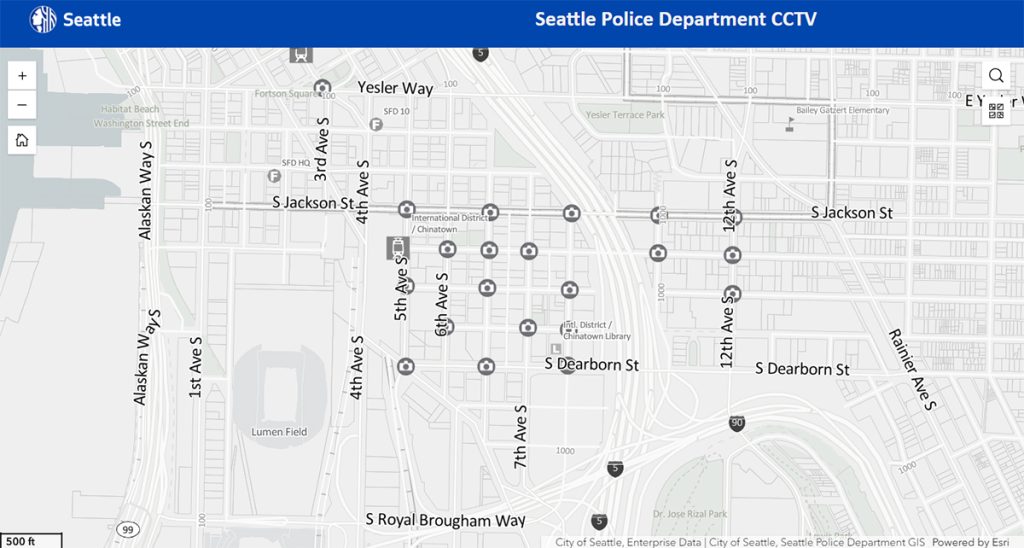
Police were showing advocates the internal system and how it worked, Hyllseth said. In the system, cameras that are on are represented by little green icons. Each of the icons on the towers in the CID were green.
Hyllseth said that the first camera police pulled up was in the CID. The group touring the RTCC watched as an elderly couple walked along the street, carrying groceries.
“[The camera] was on the corner where Bush Hotel is,” Hyllseth said. “I’ve got a couple friends who live in the Bush Hotel and … I’m looking at live recordings of an uncle and an auntie walking with their groceries. I could see across the street and see what’s going on there.”
He said that he wasn’t trying to push blame onto the officers who showed them—“we asked them to show us how it works”—but it made him uncomfortable.
“I know [the CID is] not a monolith. We’ve also heard some older folks that are okay with the cameras, want the cameras,” he said. “I get that as well, but there was just something that didn’t sit right with me about being able to look at those random two [people].”
A little later, he said, police showed them further up on 12th and Jackson, “and you could just see everyone on the corner, whether or not there were folks that are on the corner or are unhoused or homeless and living on the street on the corner, or shop owners.”
“You could see into second floor buildings for programs—[the] masking program they’re working on to prevent the cameras from seeing into residential spaces … worked in Chinatown. It was still kind of weird, but it worked down there,” he said. “And then we went to Little Saigon, and they scrolled in on the building directly across the street from the Seattle Indian Health Board, and it wasn’t working, and then it finally pixelated.”
He said that right now, the software may not be used in “nefarious” ways, “but it seemed like there was a slippery slope, especially if I could just look at some elders walking out of Bush Hotel.”