



By Carolyn Bick
NORTHWEST ASIAN WEEKLY
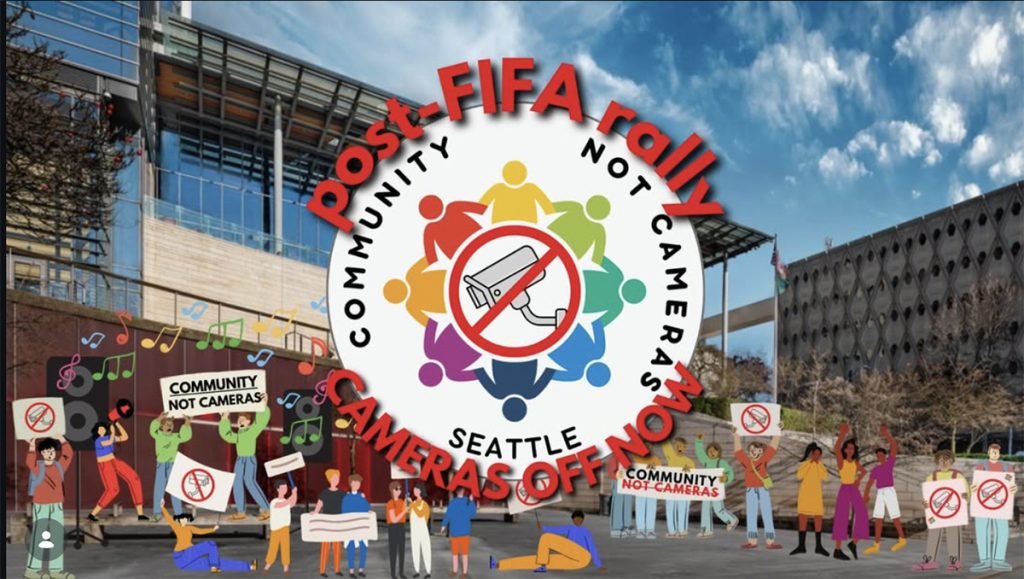
Screenshot from Community Not Cameras Instagram
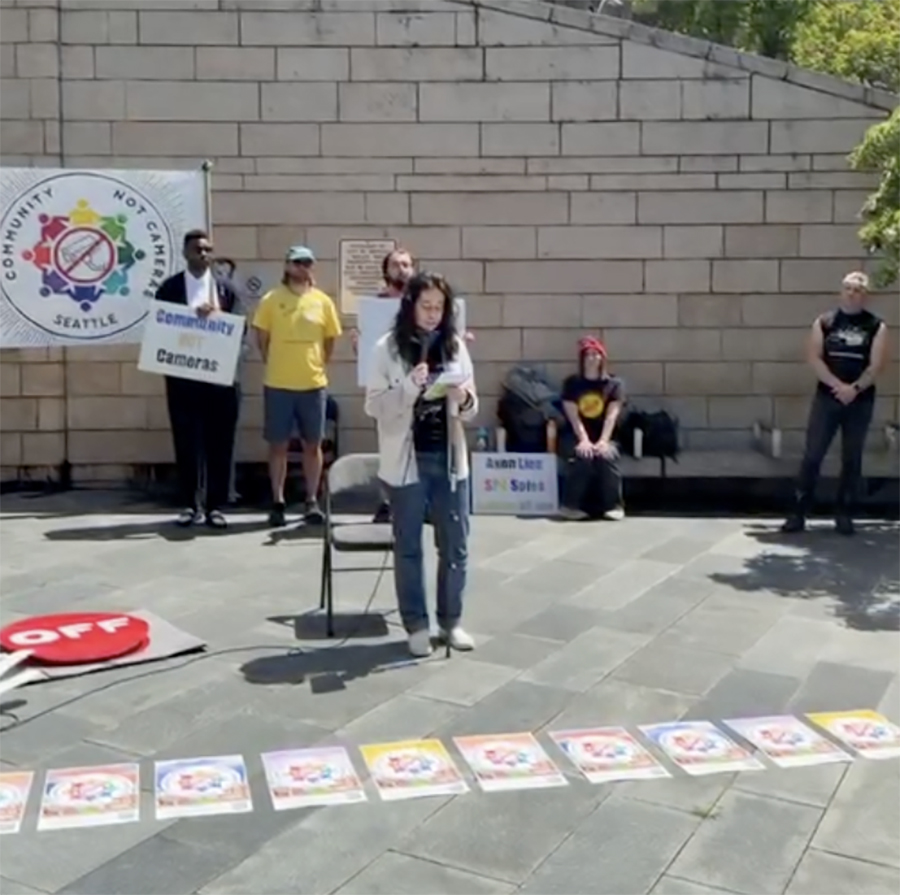
Mayor Katie Wilson may have turned off the Axon-operated cameras in the Stadium District, following the end of the World Cup games—but that doesn’t mean the cameras around the stadium can’t still be turned back on, speakers at a rally demanding the citywide shutdown of cameras, including those in the Chinatown-International District, pointed out. Wilson has also promised a full audit of the city’s camera system.
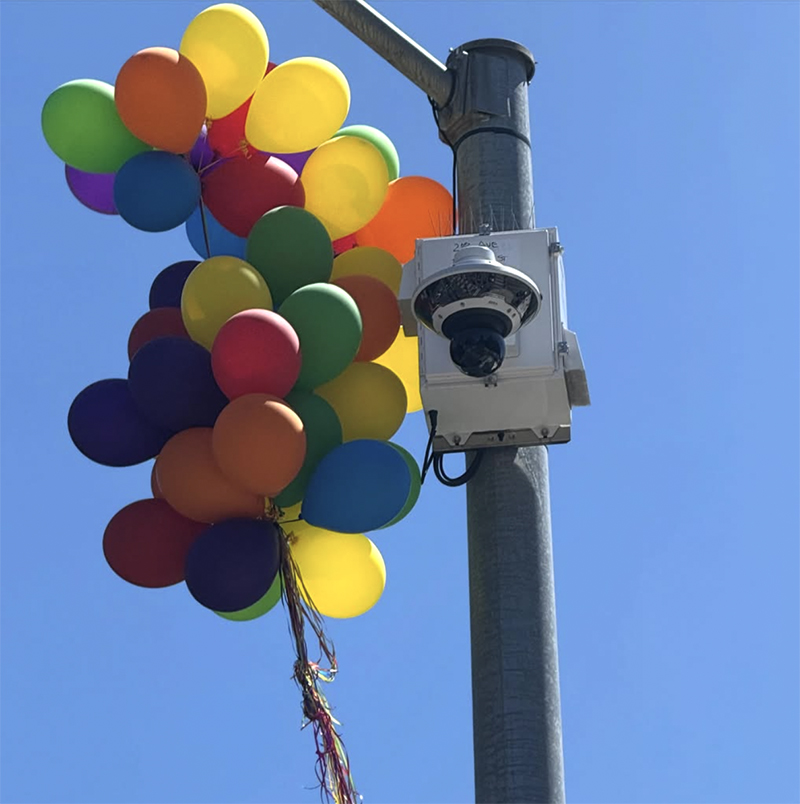
Screenshot from Community Not Cameras Instagram
Those who spoke at a “Cameras Off” afternoon rally in front of City Hall on July 7 came from diverse backgrounds, including a member of the community organization, Transit Riders Union (TRU), that Wilson herself used to belong to. Speakers also included a member of Tsuru for Solidarity, state Rep. Shaun Scott, 37th legislative district candidate Tatiana Brown, Seattle City Councilmember Alexis Mercedes-Rinck, and two security and technology engineers.
Surveillance doesn’t work, these speakers said, and agencies ranging from local police to the federal government tend to use it against already marginalized and vulnerable communities. They asked that Wilson unplug the stadium cameras by the end of the day, and physically take them down by the end of the week.
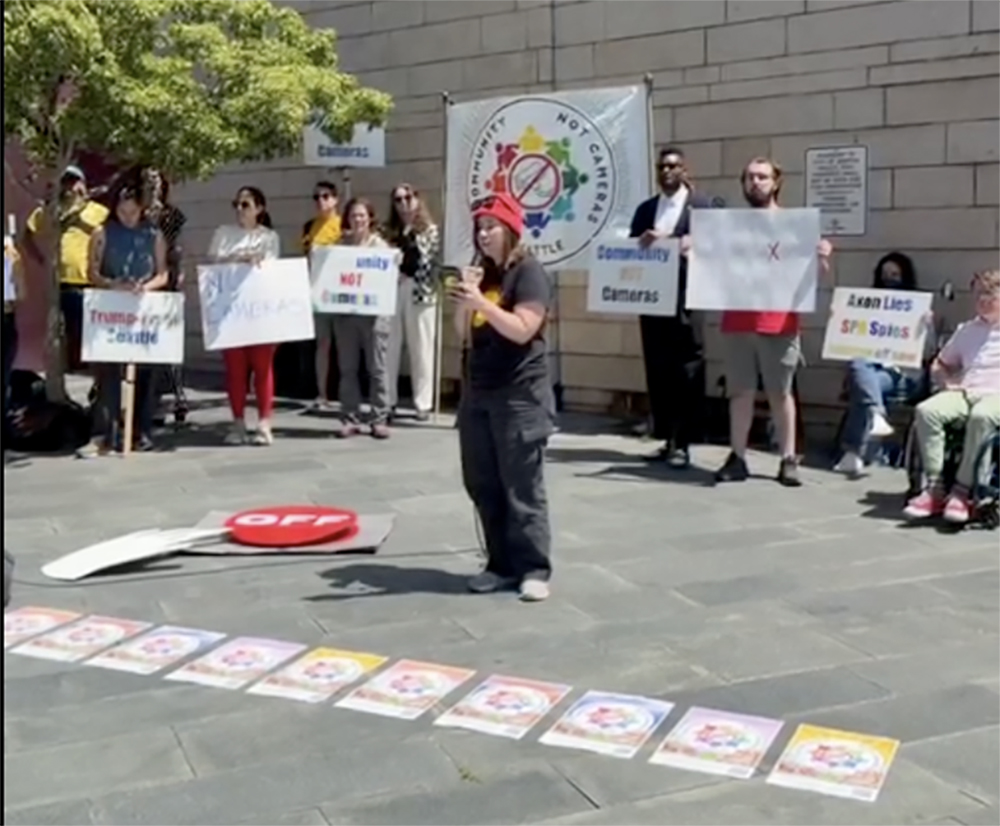
Kiku Hughes
Kiku Hughes, a Yonsei, or fourth generation Japanese American whose ancestors were incarcerated during WWII, said that Tsuru for Solidarity speaks out against surveillance like this, because the Japanese American community already knows what it can lead to.
“Immediately following the bombing of Pearl Harbor, December 17th, over 1,200 Japanese immigrants, community leaders were arrested by the FBI. Eventually, over 5,000 Issei men would end up held in DOJ prison camps,” she said. “They were not allowed legal representation and they were charged with no crime. They were school teachers, Buddhist priests, prominent businessmen, and owners of community newspapers. And this swift action was only made possible by years of FBI surveillance, which had long targeted communities of color in the name of national security.”
Today, she continued, that same kind of surveillance has just been given a sleek, new, technological face.
“Surveillance technology is being sold to us as a safety measure. We are told that these cameras are for our own protection. And many of us believe that we have nothing to fear from this because we’re not criminals,” she said. “But my grandmother woke up one day to find that it was a crime to be Japanese American. Marginalized communities throughout this country know how easy it is for your very existence to be declared unsafe.”
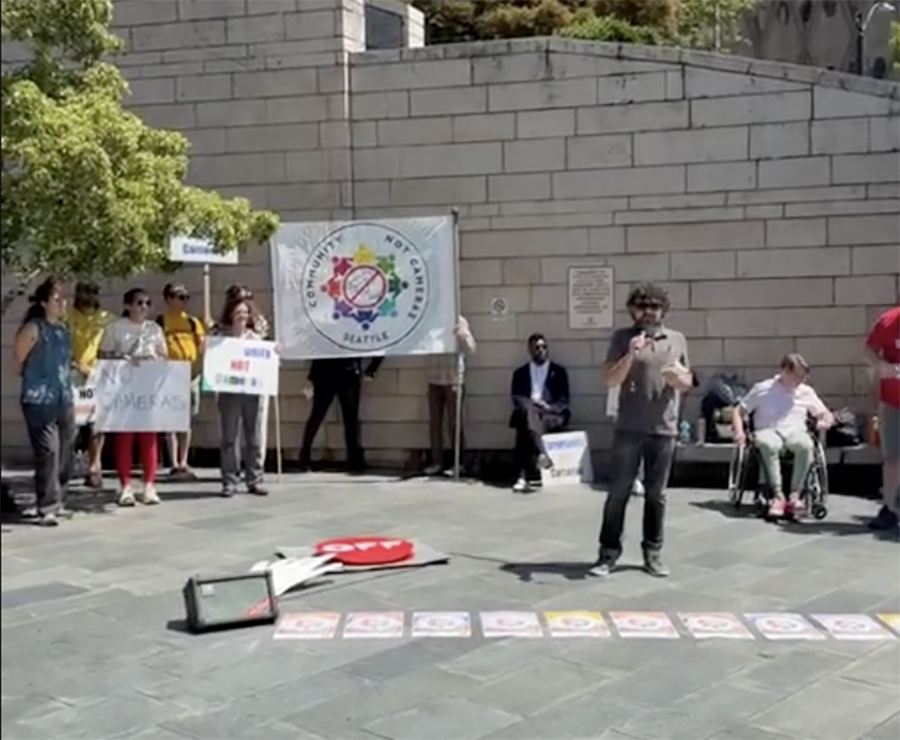
Phil Mocek
Technologist Phil Mocek, who also started the Seattle Privacy Coalition, underscored the fact that these cameras are not CCTV—closed circuit television—devices. Thanks to advances in surveillance technology, these cameras send information, down to the most minute details.
“This is a class of intrusiveness [for which] I almost don’t need the other side of the equation. It’s similar to, should we let the police go door to door and search everyone’s houses? Should we turn over our medical records just voluntarily in case anyone who’s interested can look at them?” he questioned. “There’s a lot of things we could let the police do that we don’t, because we live in a society ostensibly where we don’t have to prove our innocence to the cameras.”
The cameras “clearly” don’t deter or stop crime, he continued. The real power in using them is to gather data and information on every single person who walks by them. The argument about whether they stop crime, he said, is “sort of a distraction, I think, from the dragnet nature of this situation.”
“This is a network. … They’re probably on the internet because they’re stored. All the images are stored by Axon, by a third party,” he said. Axon may be a vendor of police equipment, but they are really a data broker, he said. They originally started out as Taser, and, Mocek said, are currently trying to move into other spheres, including private businesses and healthcare spaces.
“They’re trying to convince healthcare workers to carry cameras for everyone’s safety.
That’s what they sell it as: safety. But the cameras don’t buy us safety. Once in a while, it’s useful. I don’t deny that they’re ever useful. It’s just not worth the risk,” he said. “Public surveillance advocates often say that we should have no expectation of privacy in public. And the slogan sounds good. People hear it and they believe it.
But it’s not true. If you’re sitting on a park bench having a quiet conversation with your friend, you shouldn’t have to assume that there’s a parabolic microphone up there on a rooftop somewhere recording you. It’s private, even though you’re out in public.”
Unlike cameras, he said, if a stranger passes a person on the street, the stranger forgets.
“And that’s community. … It is an entirely different class of viewing you when a permanent record is made of your whereabouts by a central authority,” he said. “The real risk, in my mind, is the long-term effect of cataloging where we go all the time. It’s terrifying to me. And it is Orwellian. I think we have a short period of time to do something about it. The mayor needs to complete the audits.”
Leah Salerno
Surveillance can also create and prolong trauma. Leah Salerno, a member of Seattle Solidarity Budget, shared how the police killed their brother, who was in the midst of a mental health crisis. Afterwards, the video, captured on the police officer’s body-worn camera, became public. A decade on, that video still hasn’t been taken down.
“There’s this myth that a video can provide answers or closure, that it can lead to some sort of justice. And sometimes in the shock right after something happens, it seems like it just might, but it doesn’t. It can’t. And years later, I can say it won’t,” Salerno said. The video “didn’t tell us anything we didn’t already know. His body in the morgue told us what happened. The bullets in his body told us what happened. The shattered glass of the storefront behind him where some of the bullets hit and endangered even more people inside told us what happened.”
“The officer who killed him even told us what happened,” Salerno continued. “He saw a brown man in a hoodie and he thought that the weather was a little too nice for that. He saw him walking in a particular manner and looking strange. … We didn’t need a video of that. But this video being public did mean it was used to blame him for his own death. He looked strange to people, and so they said they understood why the officer would kill a disabled brown man.”
Noah Williams, who handles communications for the TRU, the organization to which Wilson used to belong, said that he teared up, listening to Salerno speak. He spoke about how he and a friend intervened to save a man’s life, while the police stood by.
“A man standing in front of me and my friend attempted suicide by self-immolation at First and Pike. The cops didn’t stop that,” he said. “My friend, an Amtrak conductor who has witnessed dozens of suicides in front of his trains and didn’t want to be party to another, helped me intervene. I grabbed the fire extinguisher and he took the man’s lighter fluid and lighter.”
“The cops didn’t save him. The community saved him,” Williams continued. “At the same time, a right-wing grifter had his cell phone out streaming with a selfie stick and a microphone. That didn’t make the guy safer. That didn’t save his life. Oh, and that video being on the internet wouldn’t have helped at all. It would have hurt him and hurt his family and hurt everybody who knew him.”
Williams said that the TRU feels “a sense of responsibility for what this mayor does because she came from our organization. Surveillance state expansion is not what we want to see.”
“I am glad that the mayor has taken meaningful action to turn off the surveillance cameras in the stadium district. … We still want these cameras taken down. Not just the ones in the stadium. All of them,” he said. “The sunken cost of removing them and of canceling the cost of Axon is what it is. We understand that the mayor can’t uninvest money that the council appropriated. … Our call on not just the mayor, but the council as well, is to keep moving in this direction, accept the sunk cost, disinvest from the cameras, invest in communities, invest in mental health support, tell SPOG to go f*** themselves with their contract, and never trust Axon or any of these vendors again.”