



By Kai Curry
NORTHWEST ASIAN WEEKLY
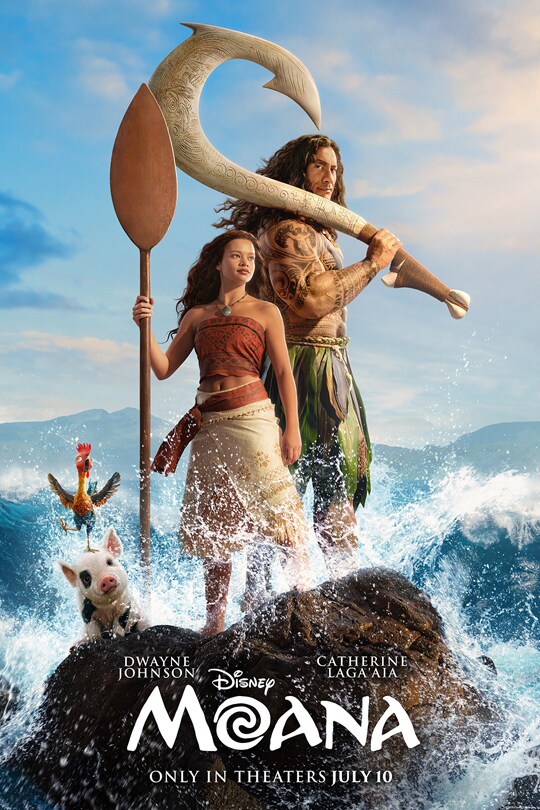
Live-action remakes of animated films can be goofy or good. Disney’s new live-action “Moana” is good. Starring Dwayne Johnson in his original role as “Maui” and newcomer Catherine Laga’aia as “Moana,” the film represents a landmark in Pacific Islander representation in Hollywood. Sadly, it has done poorly at the box office so far, while at the same time being abundantly celebrated amongst people of Polynesian ancestry. Here’s why you should watch it.
The groundwork had been laid for a great Pasifika blossoming in popular film. I say “popular” because there is already a gorgeous array of films coming out of the Pacific Islands themselves and has been for some decades. But on the mainland, as the contiguous United States is called, exposure has been minimal. Despite the large population of Hawaiians in the Pacific Northwest and Nevada, for instance, despite blockbuster movies and television by the likes of Jason Momoa and Johnson himself, knowledge and appreciation of Polynesian culture is still low outside of the Islands. This live-action film could change that. A near replica of the original animated film, but with some alterations to better suit the live-action format, “Moana” celebrates and educates.
“Moana” is remarkably true to the cultures it represents. A fusion of more than one, it primarily draws from the stories and traditions of the islands of Tonga, Samoa, and Tahiti. The movie is rich in visual, thematic, and aural tributes to these places, and to all of Polynesia. Let’s take the music as just one example. The movie begins with “Tulou Tagaloa,” an invocation chant that gets us into the spiritual “vibe” of the Islands. “Where You Are” faithfully details multiple aspects of Polynesian island life, from the making of bark cloth to the growing of taro, a dietary staple. “We Know the Way” is a majestic tribute to the “wayfinding” tradition of Polynesians, who originally sailed from other parts to reach the Islands in the first place. While some of the songs are more spoken than sung—that’s kind of a Lin-Manuel Miranda thing—nothing detracts from the impact, which is heightened by the visuals: the ocean, the tropical foliage, the tattoos.
Johnson is Samoan from his mother’s side. With the release of this movie, we suddenly see him more often introduced with his Samoan name: Seiuli. We more often see him representing his culture in a way that maybe he has never done and always wanted to do. Johnson is a stoic type and maybe that has made it hard for a lot of the public to be drawn to him outside of his wrestling career. He has been showing up for “Moana.” Multiple times in interviews for the film, he has mentioned how emotionally touched he has been during this journey. He and Laga’aia have been attending premieres of “Moana” dressed in traditional Samoan clothing and have even danced the taualaga, an important Samoan dance, on the world stage. This, as far as I can tell, is unprecedented in Hollywood.
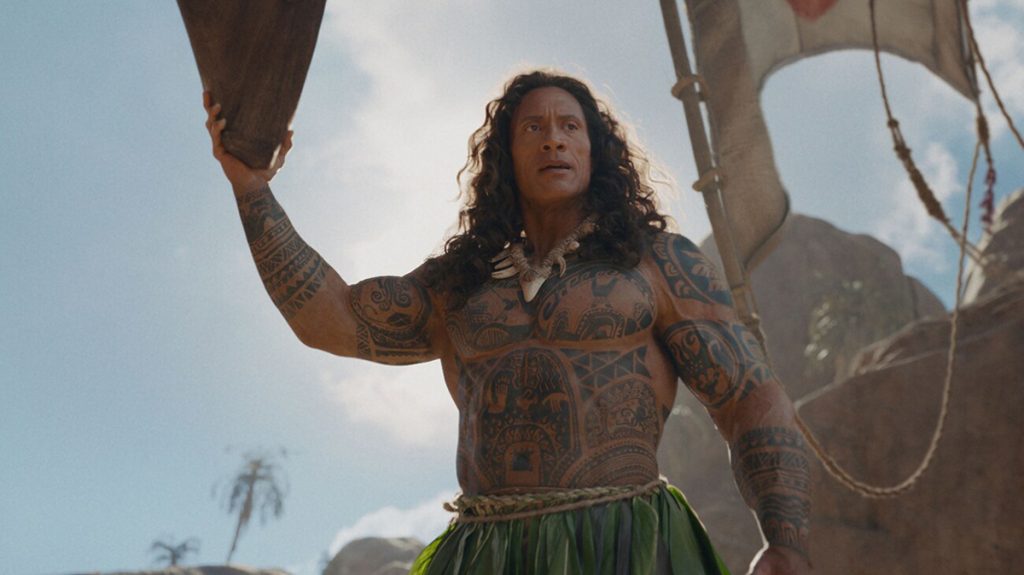
Dwayne Johnson as Maui in Disney’s live-action MOANA. Photo courtesy of Disney. © 2026 Disney Enterprises, Inc. All Rights Reserved.
Johnson has stated that the inspiration for his role of “Maui,” the trickster demigod of Polynesian folklore, was his grandfather on his mother’s side, Peter Fanene Maivia, who was also a professional wrestler and maybe the only professional wrestler of Polynesian descent in the ring on a worldwide scale at the time. As for Laga’aia, this is her film debut. Originally from Sydney, Australia, and only 17 when chosen to play “Moana,” she has confirmed that her grandparents are both Samoan. In an official Disney statement, she explained that her grandfather comes from Fa’aala, Palauli, in Savai’i and her grandmother is from Leulumoega Tuai on the main island of ‘Upolu in Samoa. “I’m honored to have an opportunity to celebrate Samoa and all Pacific Island peoples, and to represent young girls who look like me,” she said in that same statement. Many in social media have remarked that there was no one better to dance the taualaga on behalf of Samoa, and that Laga’aia might be one of the few young actors who would even know how. The rapport between Laga’aia and Johnson is wonderful both on and off screen. In the movie, they are kind of like colleagues or distant relatives who work together to achieve a shared objective. There’s no weird father-daughter vibe or even weirder romantic vibe—Moana doesn’t crush on the muscle-y Maui at all. They figure out how to respect each other and in the end, Maui departs without any great sadness—very refreshing—as after all, he’s just around the corner at any given moment.
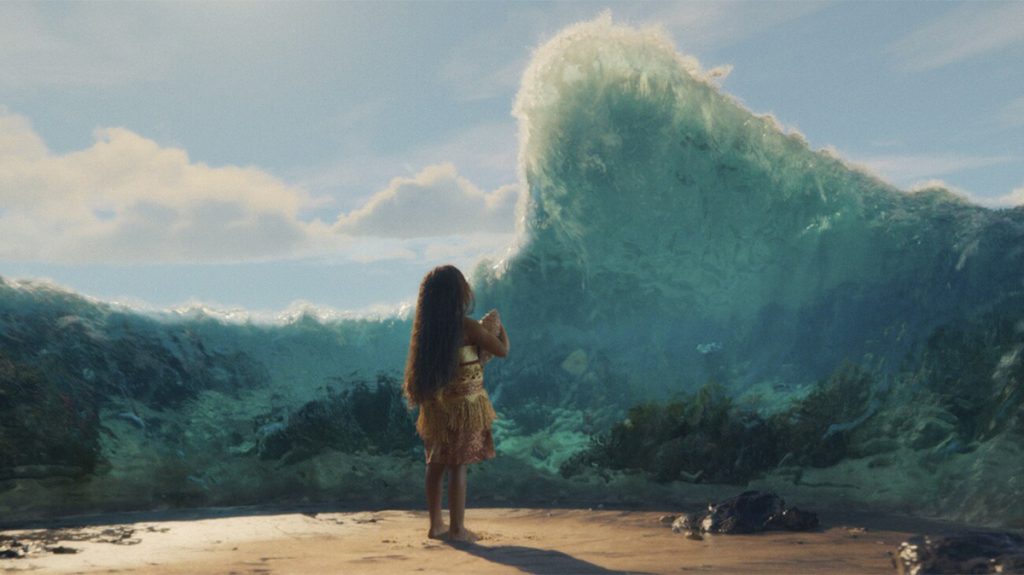
Moana was called by the ocean from an early age. Photo courtesy of Disney. © 2025 Disney Enterprises, Inc.
This movie is about family, tradition, and figuring out who and what you are meant to be. Of course, there is a life or death situation going on: Moana’s homeland, the island of Motunui, is dying. Moana is meant to be the new chief, but she is drawn again and again to the ocean—a realm that has become a place of fear for her people, instead of their natural highway. Moana must brave the ocean in order to find Maui and retrieve the heart of the goddess, Te Fiti. It is a coming-of-age story, as Moana embraces all aspects of her culture, past and present; and it is a redemption story for Maui, a great helper of humans who hasn’t been appreciated so much since he stole the heart (for the sake of humans, he says). One of the most intriguing lines in the film is said by Moana’s grandmother, played by Rena Owen, who tells her that “who you wish to be” is not always the same as “who you are meant to be.” This line is a bit of a puzzle. In fact, it turns out that Moana is able to become both—the wayfinder and the protector of her home.
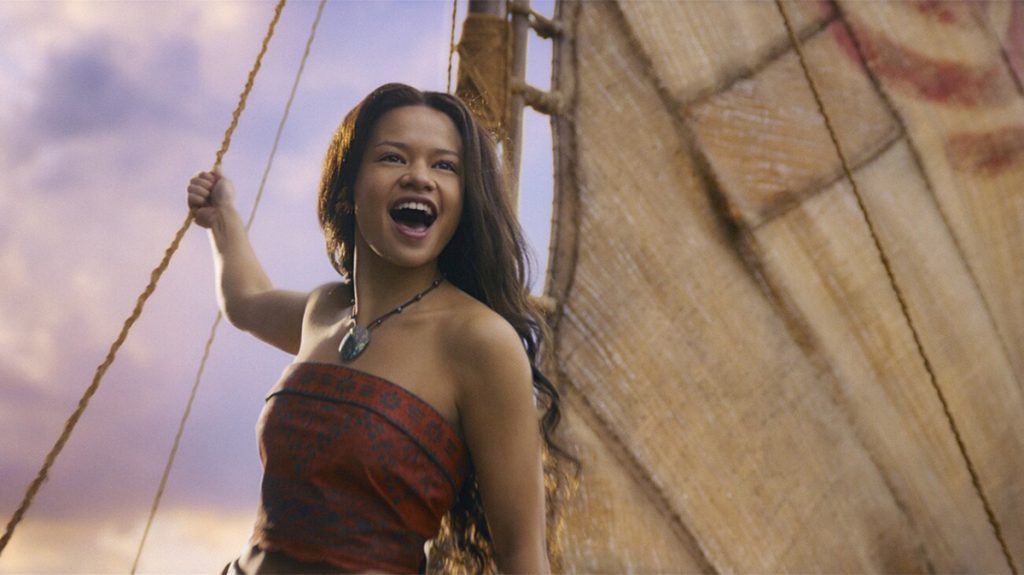
Moana (Catherine Laga’aia) learns to be a wayfinder. Photo courtesy of Disney. © 2026 Disney Enterprises, Inc.
The response to “Moana” among Pacific Islanders has been an outpouring of love and appreciation. Social media abounds with influencers listing the many cultural accuracies in the film, such as the way that the characters show affection by touching noses. Maybe there was some skepticism that a live-action “Moana” could deliver and yet it has, 100%.
Kai can be reached at newstips@nwasianweekly.com.