




By James Tabafunda
NORTHWEST ASIAN WEEKLY
About 40 Chinatown-International District (CID) advocates, small business owners, and senior residents marched to the main entrance of Seattle Stadium (Lumen Field) on July 6, waving signs and distributing neighborhood guides to soccer fans streaming toward the FIFA World Cup 2026 Round of 16 match between the United States and Belgium—a peaceful, 33-minute demonstration that voiced a stark economic divide separating Seattle’s two closest stadium neighborhoods.
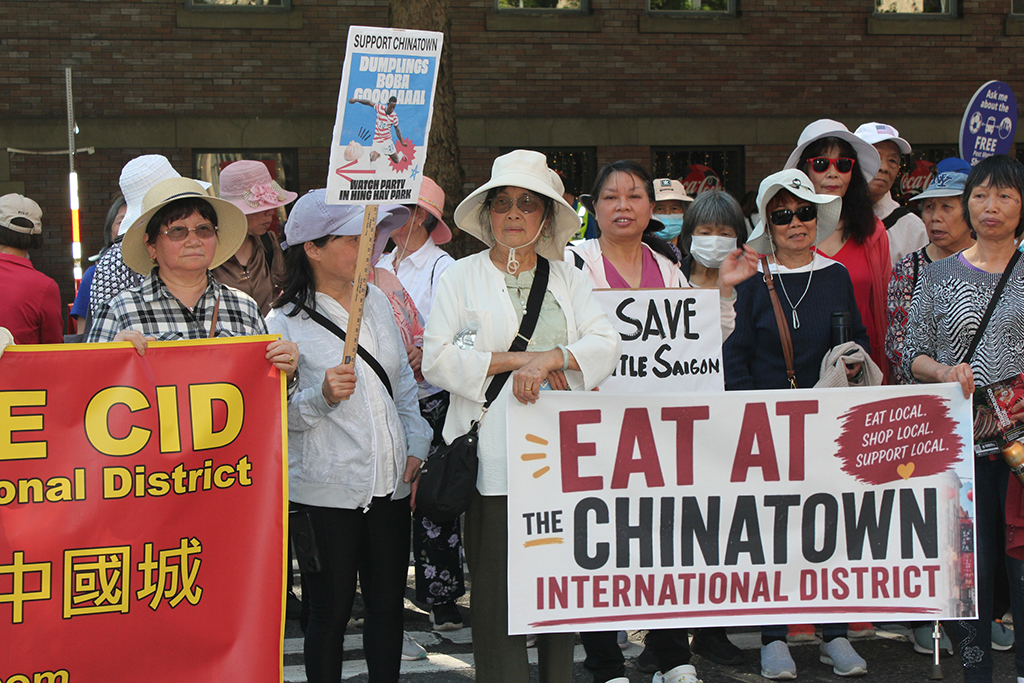
ID advocates, small business owners, and senior residents arrive at the intersection of 2nd Avenue South and South King Street (Photo by James Tabafunda)
The “Come to the CID” rally began at 4:15 p.m. at Hing Hay Park. Marchers walked west on South King Street, turned north on 5th Avenue South, then west on South Jackson Street before arriving at the intersection of 2nd Avenue South and South King Street—the main fan corridor leading into Seattle Stadium.
‘We absorb the burdens’
Tanya Woo, a CID community advocate, framed the march as a direct response to the lack of a shared economic windfall.
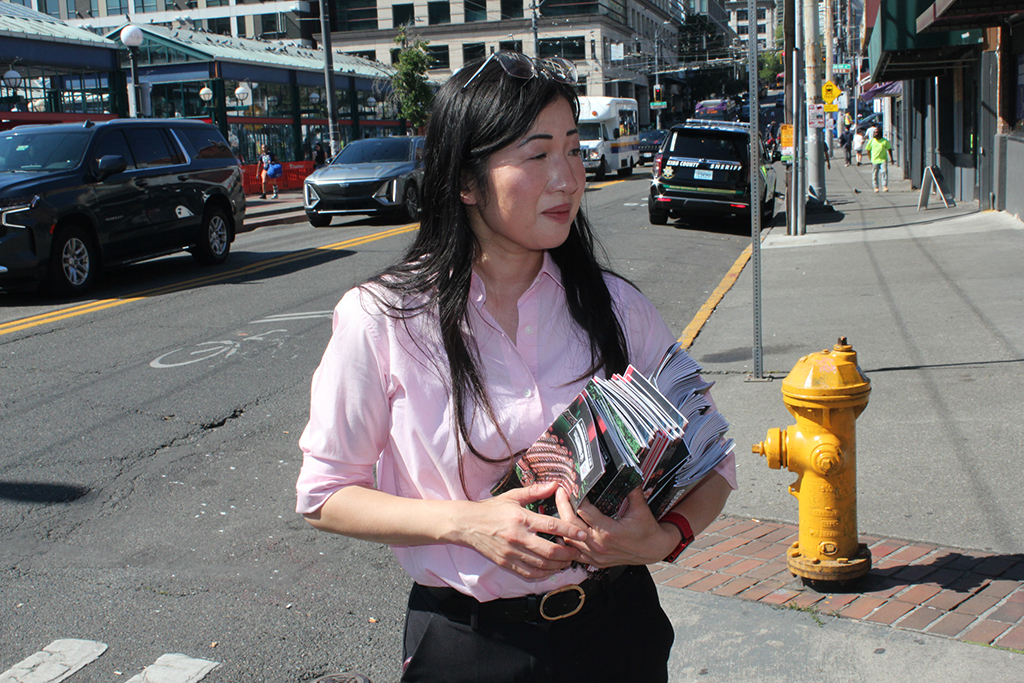
Tanya Woo, CID community advocate, carries “Neighborhood Guide: Chinatown-International District” booklets to hand out during the march to Seattle Stadium (Lumen Field). Photo by James Tabafunda.
“We feel that we absorb a lot of the burdens due to the stadium events, but don’t have the adequate resources to thrive,” said Woo, who also serves as a CID business owner.
The rally, organized in response to sales losses reported by CID businesses throughout the World Cup’s group stage, came on the final match day for Seattle’s six scheduled games—matches that organizers currently anticipate will now generate as much as $846 million for the King County region. The July 6 Round of 16 match represented Seattle’s highest-profile game of the tournament.
“This is the biggest sporting event our city has had this year and in a long time,” Woo said. “We were hoping and expecting to see some of that benefit our community. Unfortunately, we are deemed the ride-share zone, so we see a lot of congestion, a lot of parking spaces taken—not a lot of our locals coming into our community.”
Sales down while Pioneer Square boomed
The disparity Woo described had been documented throughout the tournament. CID businesses reported sales declines of anywhere from 5% to 22% compared to the same period last year—even as Pioneer Square, located just blocks from Seattle Stadium, recorded some of its strongest business results in years.
Rich Burton, owner of Locus Wines in Pioneer Square, told KOMO 4 News that the World Cup had generated more business than any major event he could recall—ranking it above the Major League Baseball All-Star Weekend, the National Hockey League Winter Classic, Seahawks playoff games, and Taylor Swift’s Eras Tour stop in Seattle.
“We did four times the revenue on Friday during the U.S.-Argentina game than we did for Taylor Swift,” he said.
The CID, by contrast, sits approximately a 10-minute walk—about a half-mile—from Seattle Stadium. Its businesses had been specifically urged by the city, universities, and nonprofits to staff up, increase inventory, and prepare for the World Cup surge.
“We are gathered here today on behalf of all the small businesses, the residents, community members, to bring light to the situation that even though Pioneer Square, downtown, Seattle Center is brimming with people, you look around and we have maybe 10% of that,” Woo said. “Most of our businesses are struggling.”
‘The worst sales day of my entire life’
Vince Vu, owner of Anh O’i Bake Shop—a Vietnamese American bakeshop in the CID’s Japantown—became one of the most prominent voices describing the neighborhood’s economic pain. In a Facebook video posted July 5, the day before the rally, he said World Cup match days had produced the worst sales of his career.
“I think the World Cup games in Seattle caused my business to have the worst sales day that it’s ever had,” Vu said. “And talking to many other business owners in the International District, it really hurt for them, too.”
He said he believed the core problem was a fundamental mismatch between sports tourism and culturally specific businesses. “I think there’s very little overlap between sports tourism and culturally specific, culturally resonant businesses,” he said. “Bars? Absolutely. Fast-casual American food like pizza and burgers? Slam dunk. But for me, a business whose literal value proposition is to uplift local bakers, local people in the local area—I never stood a chance.”
Vu added that locals appeared to have left the downtown core entirely on match days, a dynamic he said effectively removed the CID’s core customer base.
“It feels like the wild, aggressive energy of sports tourism repeals locals—the people who live here, who work here, who play here,” he said.
‘We demand to be heard’
State Rep. Sharon Tomiko Santos, who represents the 37th Legislative District encompassing the CID, joined the march and distributed copies of the “Neighborhood Guide: Chinatown-International District” to fans walking toward Seattle Stadium. Santos arrived back at Hing Hay Park with just one guide left in hand, having given away the majority of the booklets to fans walking to the stadium.
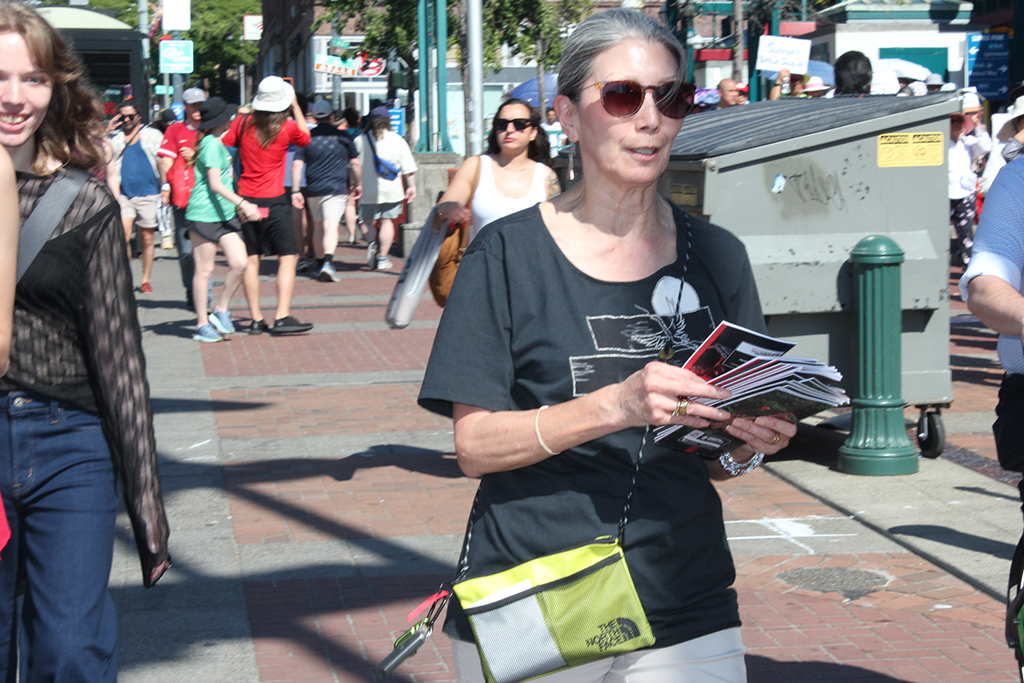
State Rep. Sharon Tomiko Santos hands out copies of “Neighborhood Guide: Chinatown-International District” to FIFA World Cup 2026 fans (Photo by James Tabafunda)
“Come to the CID for dinner after the game,” she told fans as she passed out guides. “Join us in the CID.”
When Woo and the 40 marchers reached the main stadium entrance on 2nd Avenue South at South King Street—surrounded by thousands of fans in red, white, and blue—she delivered the rally’s most direct appeal.
“Come out to Chinatown-International District and come to our small businesses,” she said. “Businesses are seeing a loss in sales anywhere from 5 to 20% from this time last year for a worldwide event that was supposed to help us.”
Woo said the march represented both a call for equity and a public reckoning. “This is us showing resistance. We are doing a peaceful protest to let people know that we exist, that we are here. We demand respect,” she said.
Standing at the intersection as fans streamed past, Woo pointed to the crowd difference as evidence of what the rally sought to change. “The people here in the stadium are getting ready for the USA versus Belgium game. And we are here. We are strong. We are a force to be reckoned with, and we demand to be heard.”
The march remained welcoming throughout, consistent with the rally’s stated mission of inviting FIFA World Cup 2026 fans to visit the CID rather than staging confrontational protest.
An invitation to the neighborhood
The march concluded before the game began, when marchers turned north on 2nd Avenue South and began the walk back to Hing Hay Park, where a large crowd had gathered for a free watch-party screening of the USA-Belgium game on a large screen.
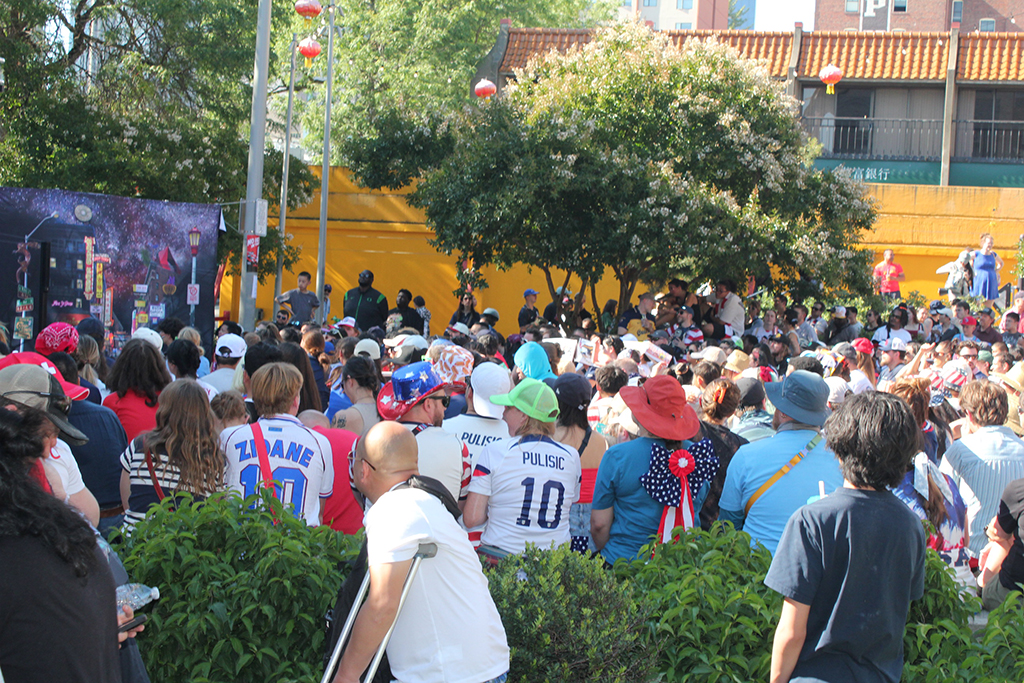
FIFA World Cup 2026 fans attend the free watch party at Hing Hay Park (Photo by James Tabafunda)
Gary Lee, a former co-chair of the Chinatown-International District Public Safety Council, extended the evening’s final invitation to any fan willing to make the short walk from Seattle Stadium.
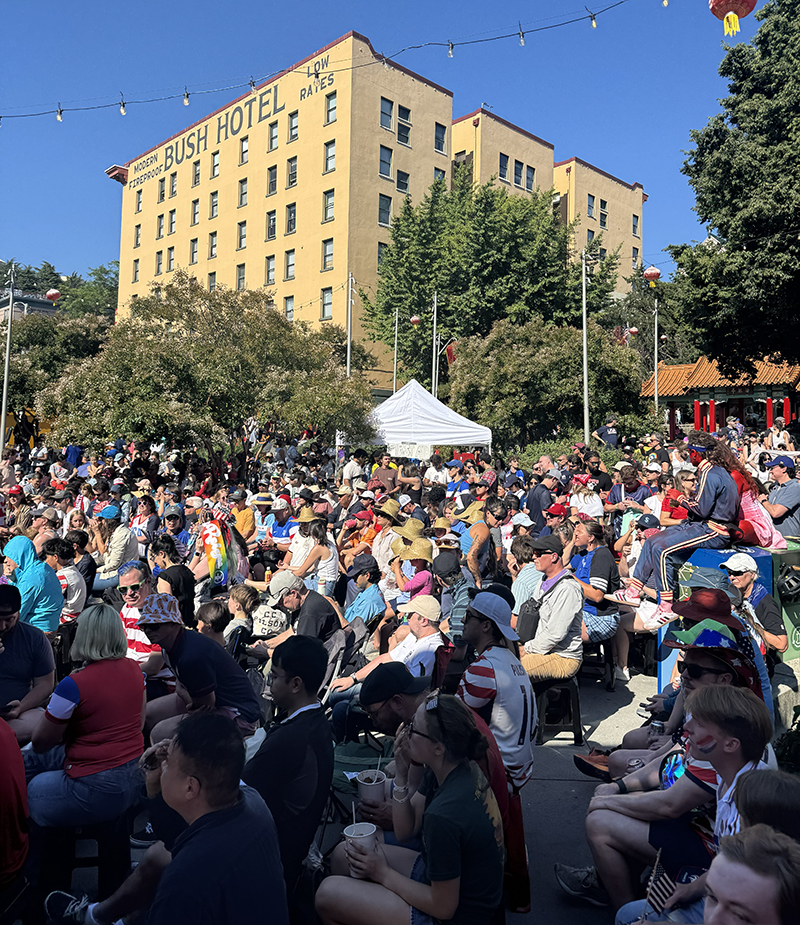
A crowd gathers at Hing Hay Park for a free viewing party to watch the FIFA World Cup 2026 match between the U.S. and Belgium (Photo by Becky Chan)
“There’s a watch party in the park right now,” he said. “It’s free. And it’s a little bit less crowded than what’s going on up there. So if you don’t like gigantic, massive crowds, come over to the park and get some boba, get some dim sum. If you’re going to the game, come over to Chinatown and spend some money when you’re done because we’re going to be open.”