




By James Tabafunda
NORTHWEST ASIAN WEEKLY
As tens of thousands of soccer fans walked south on 2nd Avenue South toward the entrance of Seattle Stadium (Lumen Field)—loud drum beats accompanying singing, chants rising from the crowd ahead of Belgium’s Round of 32 knockout match against Senegal—a group of about 30 people stood at the corner of 2nd Avenue South and South King Street holding their ground and a message.
Their large red banner read: “SAVE THE CID – Chinatown International District.”
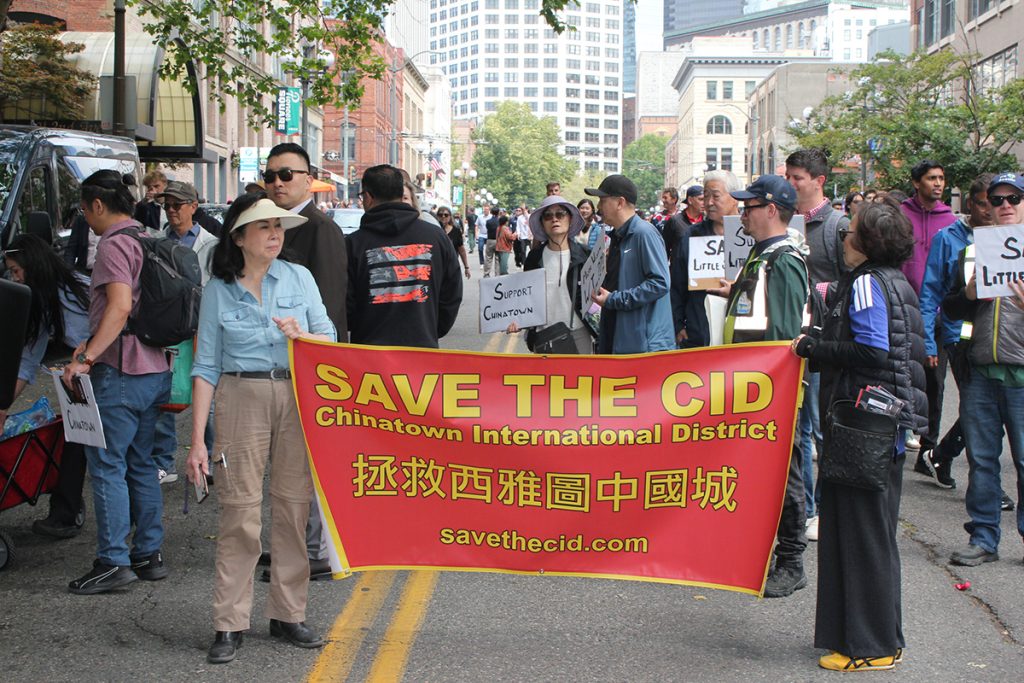
A group of about 30 CID community members and supporters arrived at 2nd Avenue South in Seattle on July 1, 2026. (Photo by James Tabafunda)
Missing World Cup boost made public
While the stadium filled and Pioneer Square buzzed with World Cup energy just blocks away, advocates for the CID gathered at a media conference on July 1 to deliver a stark finding: on Day 17 of FIFA World Cup 2026, the neighborhood’s small businesses are not sharing in the economic benefits that other areas near Seattle Stadium are experiencing.
Community leaders said CID businesses have reported sales declines of as much as 22% over the past two months compared to the same period last year—even as Sound Transit set an all-time single-day ridership record of 280,000 riders on June 19, driven by World Cup fans attending the USA vs. Australia match at Seattle Stadium.
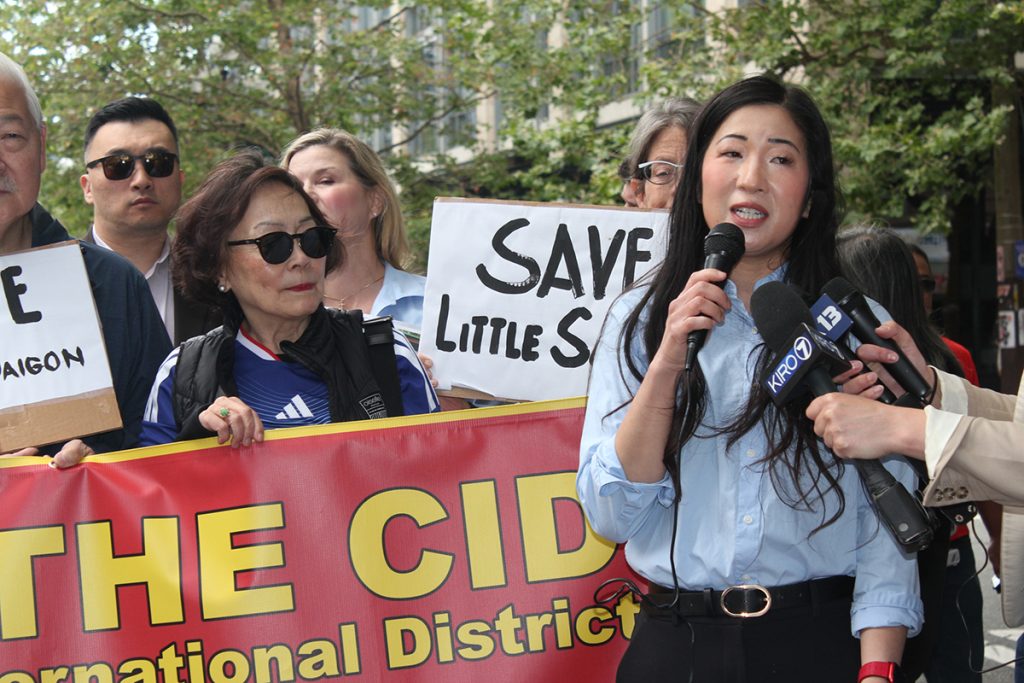
Tanya Woo, CID community advocate, addressed the media and community members. (Photo by James Tabafunda)
“The FIFA World Cup is a once-in-a-generation opportunity, and we are so excited,” said Tanya Woo, a CID community advocate and media conference’s first speaker. “We believe it would bring new customers, new energy, and new economic opportunity to our neighborhood. But instead, our businesses are reporting that sales are down.”
Woo noted that the contrast between the CID and nearby areas has been jarring. “The stadium is full. Pioneer Square is full of people. The waterfront is crowded. Yet in Chinatown, there’s nothing but empty tables,” she said. “How is that possible?”
A Washington Retail Association report dated June 25, 2026, titled “World Cup visitors drive strong sales for Seattle retailers,” states that business organizations in Pioneer Square reported several establishments recording their strongest sales performance in recent years. The CID, located approximately a 10-minute walk from Seattle Stadium, has not seen comparable results.
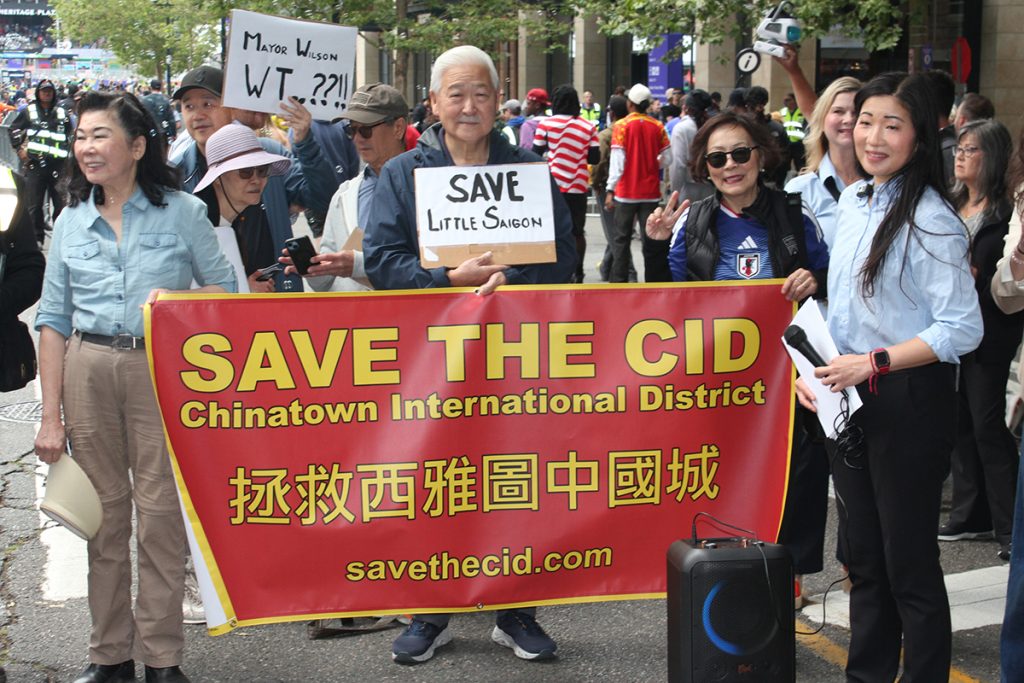
Photo by James Tabafunda
Ongoing safety concerns and economic strain
For years, the CID has been battered by persistent open-air drug dealing, homelessness, and what many business owners describe as a lack of consistent enforcement. Those challenges have already eroded the neighborhood’s economic vitality. Instead of providing relief, many business owners report that FIFA match days have resulted in lower sales, with thousands of visitors not visiting the neighborhood despite its close proximity to the stadium.
Advocates said the failure of World Cup foot traffic to reach the CID is compounding an already dire situation for small business owners and residents who had pinned hopes on the tournament as a turning point. They emphasize that a global event like FIFA World Cup 2026 should be an opportunity for these businesses to grow, not another setback.
CID advocates call for equity and direct action
Gary Lee, a retired planner and former co-chair of the Chinatown-International District Public Safety Council, said the situation has exposed what he called a failure of city leadership. “Why us? Seriously? Why us? … We believed Mayor Wilson,” he said. “The corner of 12th Avenue and Jackson Street is worse than ever. Instead of coming up with a plan to drive traffic our way, she sent homeless drug addicts into our community so soccer fans would not have to see them in downtown, the waterfront, or Pike Place Market.”
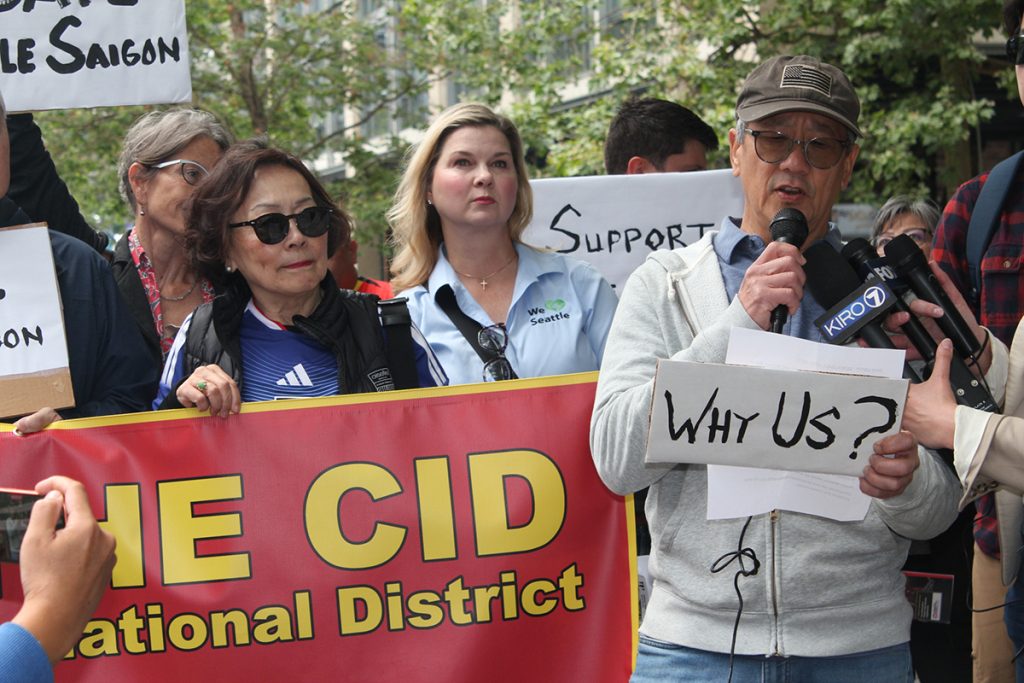
Gary Lee, retired planner and co-chair of the Chinatown-International District Public Safety Council (Photo by James Tabafunda)
Lee accused Mayor Katie Wilson of failing to follow through on promises she made to the Asian American community. “Wilson claims to be an advocate for marginalized communities of color, but all she did was turn the CID into a human dumping ground,” he said.
Woo said the neighborhood’s exclusion from the World Cup’s economic benefits is not just a business issue. “This is bigger than one tournament. This is about equity. It’s about economic justice,” she said. “For too long, we know we’ve been quiet. But now we are going to fight back.”
She carefully framed the community’s media conference not as opposition to the World Cup itself, but as a demand for equal treatment. “We are not here to protest against FIFA. We welcome the World Cup. We welcome every visitor to Seattle,” Woo said. “Our protest is to call on the city, its tourism leaders, event organizers, and every fan: Don’t overlook the Chinatown-International District. Come to Chinatown. Eat here. Shop here. Stay a while.”
Andrea Suarez, founder and executive director of We Heart Seattle, a grassroots nonprofit focused on cleaning up public spaces and connecting people struggling with homelessness and addiction to treatment, offered a first-hand account of the public safety crisis worsening in the CID and neighboring North Beacon Hill. She announced a direct-action cleanup and outreach event planned for July 3.
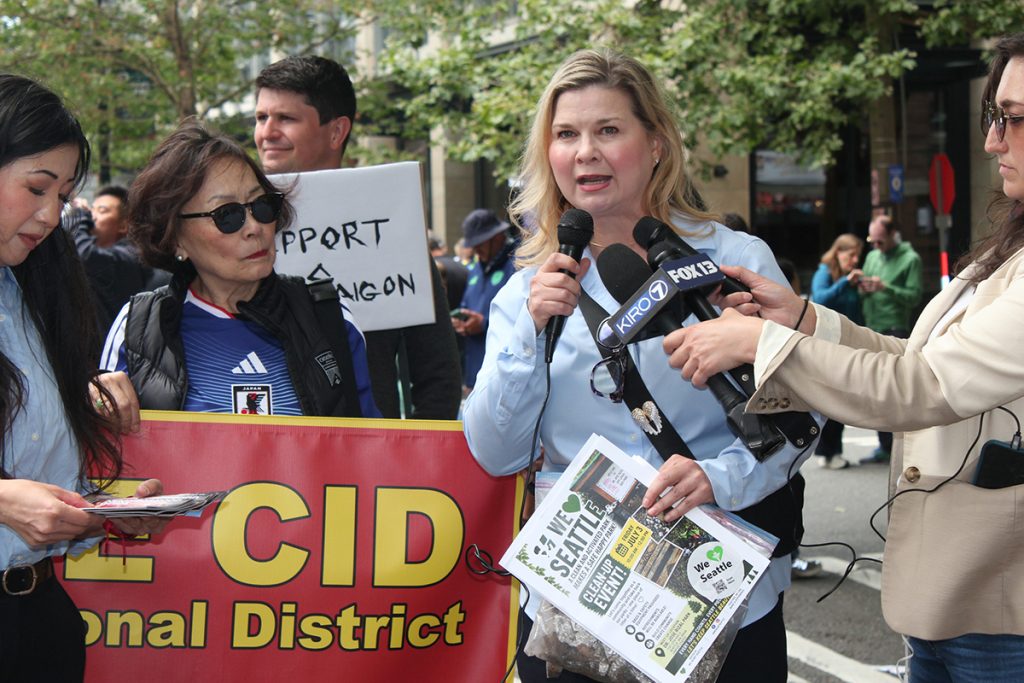
Andrea Suarez, founder and executive director of We Heart Seattle (Photo by James Tabafunda)
“We’re inviting the entire community to come join North Beacon Hill in unity with the Chinatown-International District to reclaim our parks,” she said. “We have picked up hundreds of thousands of fentanyl foil, and we’re going to pick up thousands more on Friday.”
Suarez said the event would bring people in addiction recovery to help connect unhoused residents to services. “We are going to ask the drug dealers to get out of our parks,” she said. “If you are addicted, come work with one of the providers that will be there on Friday and seek the help that’s available for you.”
“So come join us from 10 to 12 at Dr. Jose Rizal Park and reclaim our parks once and for all where our government has failed us.”
Media conference cut short
The media conference began at 11:34 a.m. and ended at 11:42 a.m., lasting just eight minutes before a Seattle Police officer asked the group to clear 2nd Avenue South to make room for a Belgium rally march to Seattle Stadium.
A call-to-action to visit the CID
The community will gather again for the “Come to the CID” rally, timed before the FIFA Round of 16 match at Seattle Stadium. Participants plan to carry signs, distribute neighborhood maps and business information, and invite visiting FIFA World Cup 2026 fans to support the CID’s restaurants, shops, and cultural institutions.
“We will no longer be silent,” Woo said. “We’re not allowing for our community to be overlooked, and a successful World Cup should leave every neighborhood stronger, not just those surrounding the stadiums.”
The “Come to the CID” rally is scheduled for Monday, July 6 at 4:00 p.m. at Hing Hay Park.