




By James Tabafunda
NORTHWEST ASIAN WEEKLY
When more than 75 people heard the sound of taiko drums and watched a lion dance accompanied by live music and exploding firecrackers, they knew the return of a Japanese American cultural institution was finally taking place. Orange street cones were placed around a small area at the corner of Eighth Avenue South and South King Street as Seattle’s Bush Garden held its ribbon-cutting ceremony, officially reopening the beloved Chinatown-International District (CID) restaurant.
A long-awaited return
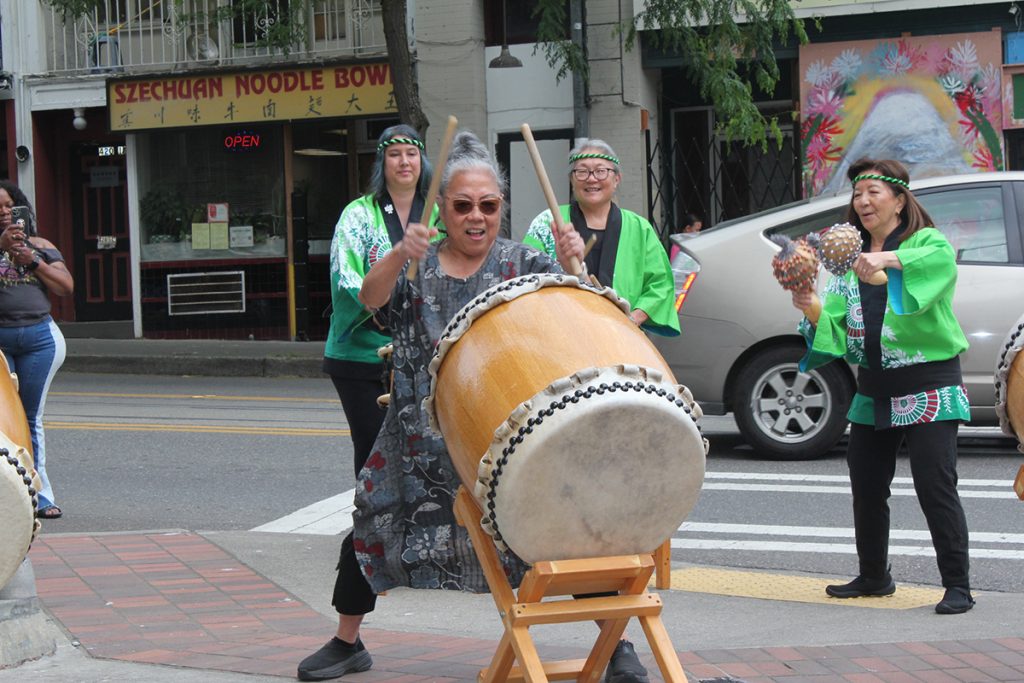
Karen Sakata, Bush Garden owner, plays taiko drum during the ribbon-cutting ceremony. (Photo by James Tabafunda)
During the taiko drum performance, owner Karen Sakata joined the ensemble and played alongside the drummers. The performance gave way to a lion dance by the Mak Fai Dragon and Lion Dance Association, Seattle’s premier lion dance troupe established in 1974 by Grandmaster Mak Hin Fai.
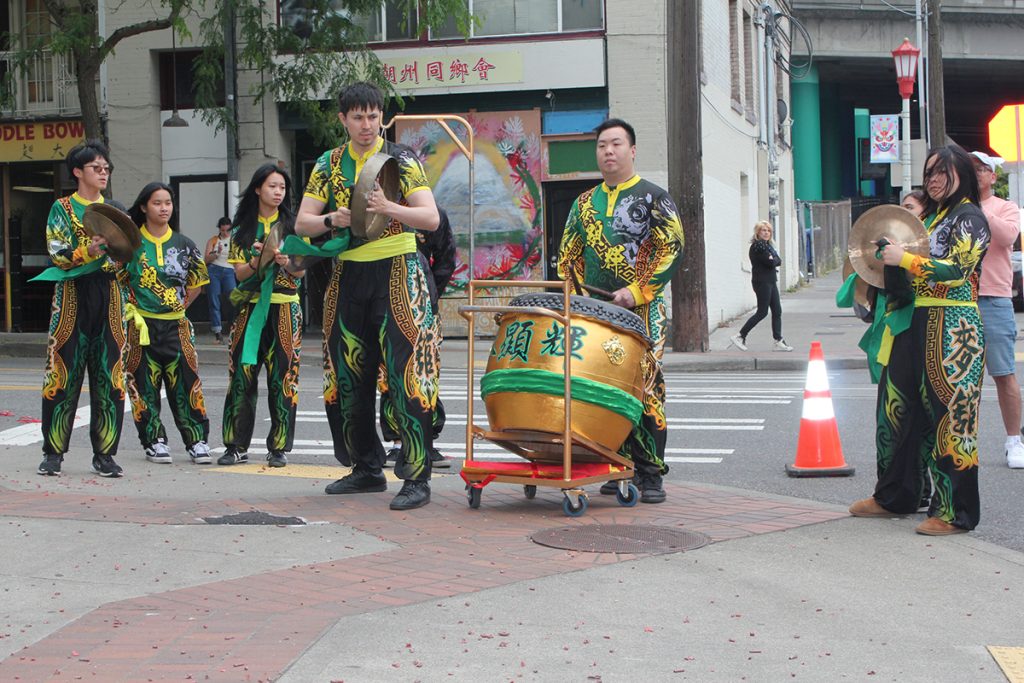
Mak Fai Dragon and Lion Dance Association (Photo by James Tabafunda)
During the performance, the lion consumed a head of green leaf lettuce near the restaurant’s entrance—a traditional Chinese ritual known as cai qing, or “plucking the greens,” symbolizing the spreading of wealth and good fortune to all present. In Cantonese, the word for certain leafy greens sounds similar to the word for “wealth,” making the lettuce a visual stand-in for prosperity.
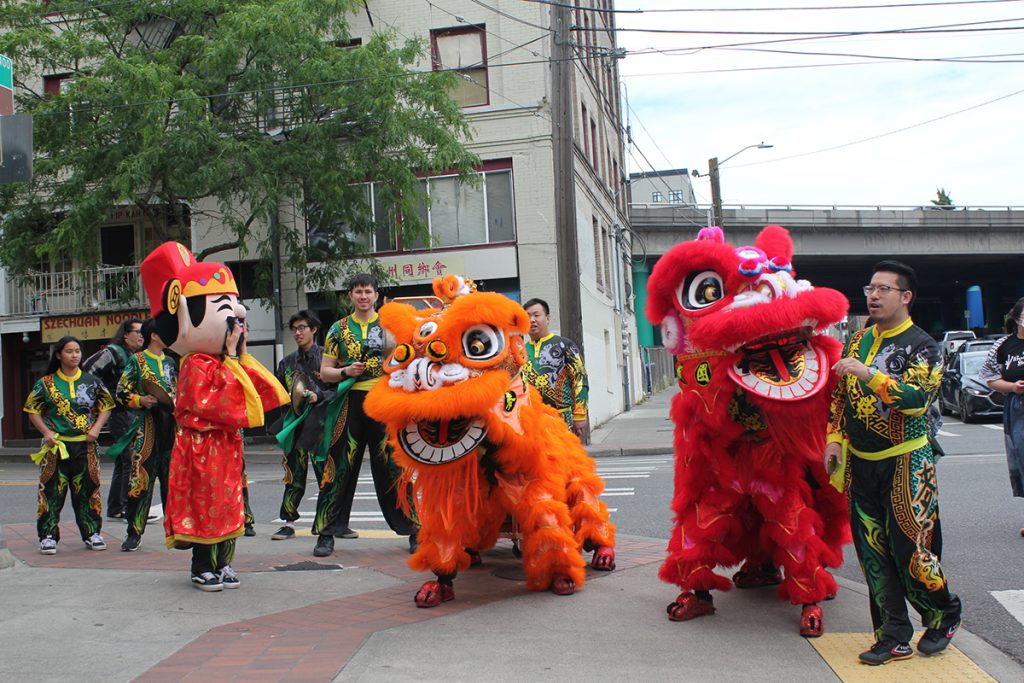
Mak Fai Dragon and Lion Dance Association (Photo by James Tabafunda)
Seattle Deputy Mayor Brian Surratt read aloud an official proclamation from Mayor Katie Wilson declaring June 3, 2026, “Bush Garden Day” in the city.
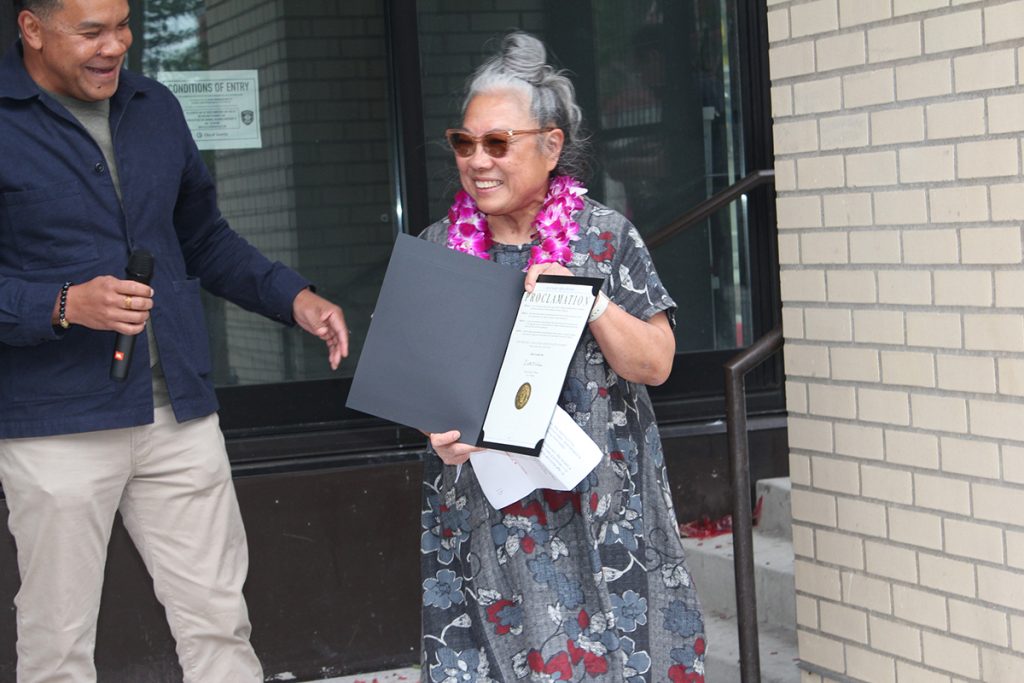
Karen Sakata, Bush Garden owner, receives Seattle proclamation “Bush Garden Day” from Seattle Deputy Mayor Brian Surratt (Photo by James Tabafunda)
“Whereas for over 70 years, Bush Garden has been a staple in Seattle’s Chinatown-International District, a community-rooted space providing food, entertainment, and a place to belong,” he read, before adding his own words to the crowd. “This is such a treasure. And I want to give credit to Karen for being such a stable force to make sure that this happened.”
‘It really belongs to all of us’
Sakata, who has guided Bush Garden through its COVID-19 pandemic closure, relocation planning, and years of construction delays, addressed the crowd with the full force of the restaurant’s history behind her.
“Bush Garden opened in 1953, and it was the vision of Kaichi and then his son and extended family,” she said. “It was born out of a time when people came back after World War II and after having been forced to incarceration camps. Japanese Americans had to come back into town and really reestablish themselves and the community.”
Sakata described the challenge of carrying the emotional legacy of the original space into the new one, noting that the new location features windows the original never had. “When we first started this project, when we came into the empty space before anything was built out … how are we going to bring all the energy that filled the walls of the old space and bring it into this new space?” she said. “By the time you leave, you’ll have infused your new energy and memories into this new space. You’ll make it your own because it really belongs to all of us. I’m just the conduit for helping get it started.”
Founded in 1953, rooted for generations
Bush Garden was founded by Kaichi Seko in 1953, initially operating inside the Bush Hotel on South Jackson Street. In June 1957, as the restaurant’s popularity outgrew its original space, Seko relocated the business to 614 Maynard Avenue South, where he partnered with his son, Roy, and Roy’s future wife, Joan. That Maynard Avenue location operated for more than six decades, becoming home to its famous karaoke bar and a gathering hub for the city’s Japanese American community, civic leaders, and activists.
Sakata began her relationship with Bush Garden as a child dining there with her family, later worked there as a busser, and married sushi chef Masaharu Sakata in 1999 before eventually becoming sole owner.
The restaurant closed during the COVID-19 pandemic in 2020, after the Maynard Avenue building changed hands in 2016. Since then, community members organized fundraising campaigns and preservation efforts to help relocate the business to its new home inside Uncle Bob’s Place at Eighth Avenue South and South King Street.
A neighborhood’s fight against displacement
The reopening is the product of years of deliberate, community-driven effort to keep a culturally significant institution rooted in a neighborhood facing challenges and sustained development pressure.
InterIm CDA Co-Executive Director Leslie Morishita, whose organization developed Uncle Bob’s Place, credited the project’s success to a shared commitment that transcended contracts and formal agreements.
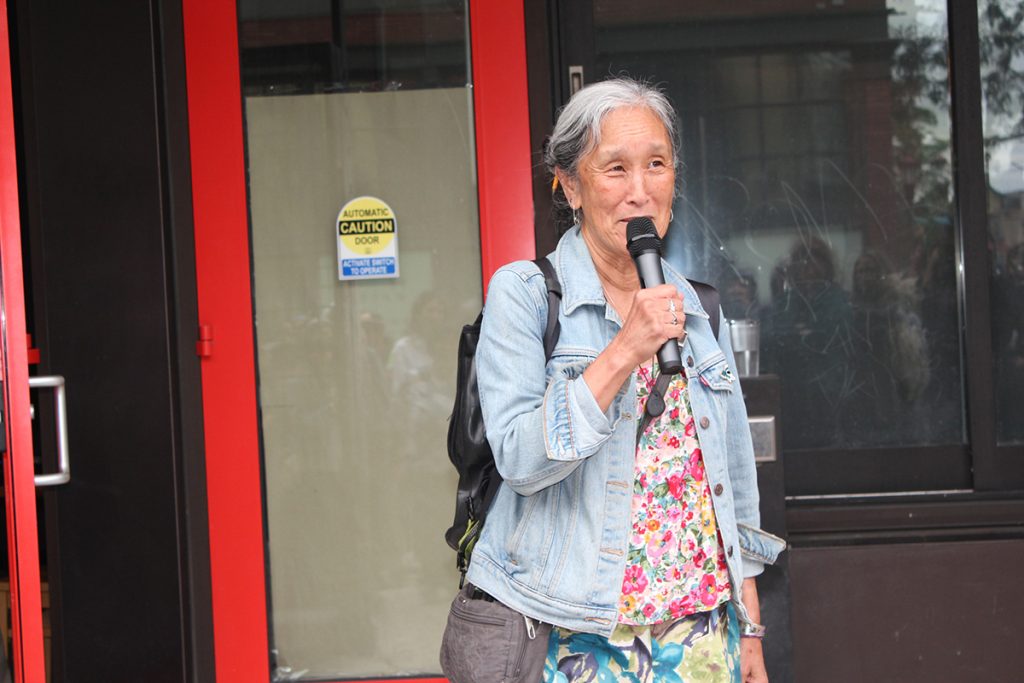
Leslie Morishita, InterIm CDA co-executive director (Photo by James Tabafunda)
“We thought of this a bunch of years ago. We had nothing in writing. It was all built on trust and love for this community,” she said. “Every entity, every person who was involved did it out of love for this community. We all wanted the same thing. We all wanted to see it open.”
Morishita gave particular recognition to the city’s Equitable Development Initiative, which provided public funding for the project.
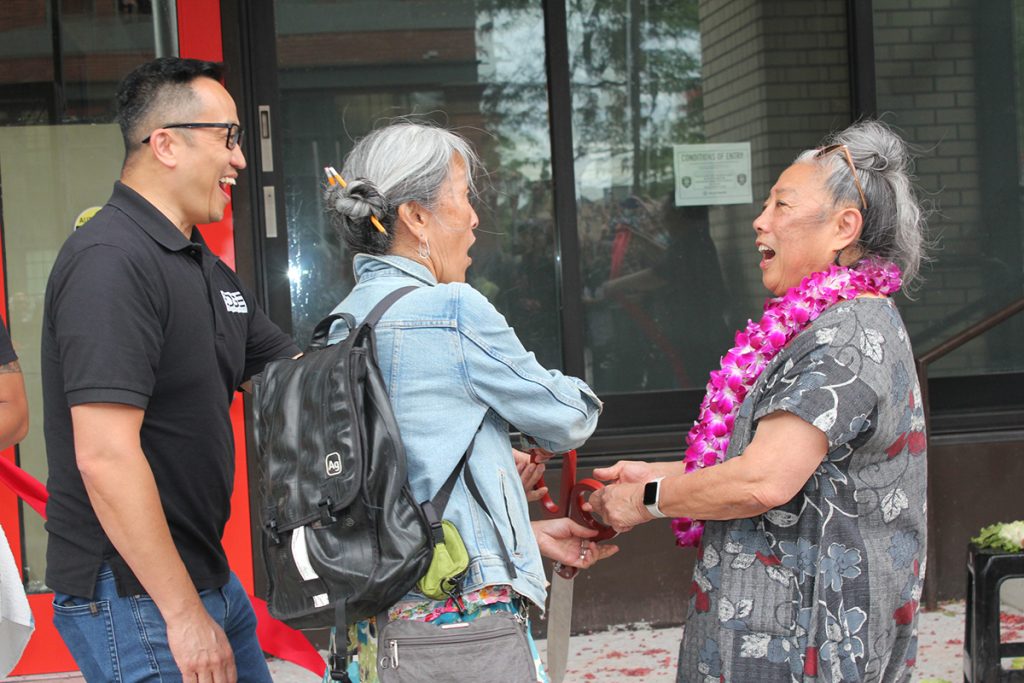
From left: Evan Chan, Leslie Morishita, and Karen Sakata (Photo by James Tabafunda)
“Without them—I mean, the money is important,” she said. “They really helped us push the envelope of what we can do, how public funds can be put to use to truly serve the community. This program is all about fighting displacement in high-displacement communities, communities of color in Seattle. It’s a vital, vital, vital resource for communities like ours.”
A legacy site built on legacy relationships
The new Bush Garden occupies the ground floor of Uncle Bob’s Place, a mixed-use affordable housing development built by InterIm CDA and named in honor of the late Robert “Uncle Bob” Santos.
Santos, a Filipino American community organizer and longtime Bush Garden regular who died in 2016 at age 82, is sometimes called the “unofficial mayor of the CID” and used the original restaurant as an after-hours organizing hub for decades.
The building sits on the former site of the Four Seas Restaurant, a property that had been owned by the Chan family, who also operate Tai Tung Chinese Restaurant—in continuous operation since 1935 and one of the CID’s oldest institutions.
Evan Chan, a principal at Edge Developers and a member of the family that previously owned the Four Seas property, reflected on the layered history embedded at the intersection where the ribbon-cutting ceremony took place.
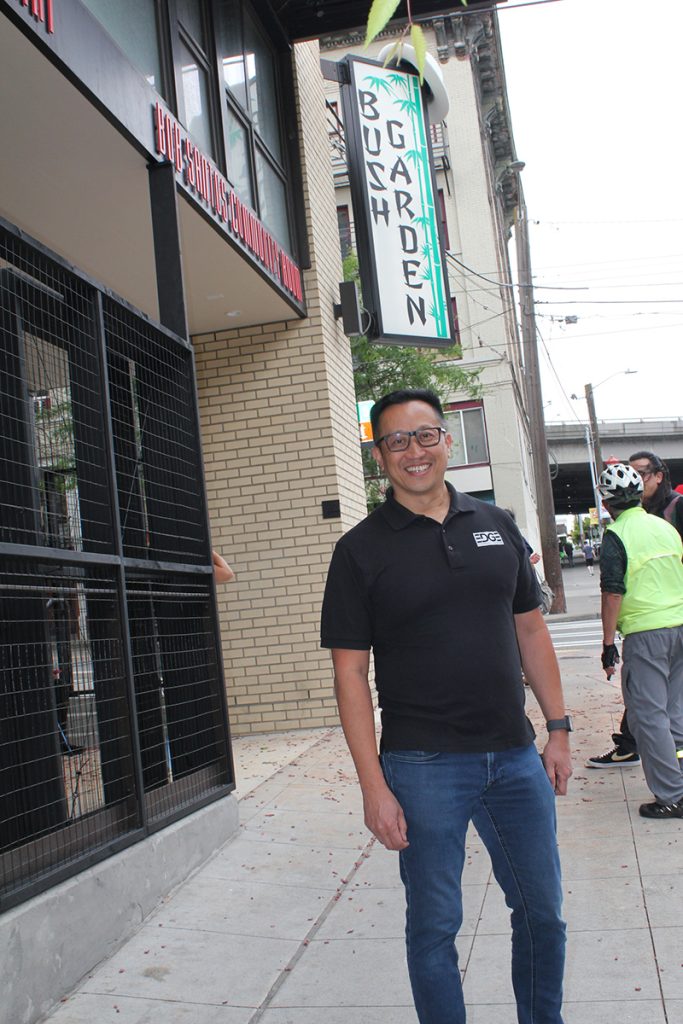
Evan Chan, Edge Developers principal (Photo by James Tabafunda)
“Our family—the Tai Tung Restaurant—was the owner of this property for the Four Seas Restaurant,” he said. “We worked with InterIm and sold the property and had them develop the project into Uncle Bob’s Place. And then we came back and actually purchased the retail space. To have another legacy business come back—one that’s been around since 1953—what a great opportunity.”
Chan said the two-year development and planning process—extended further by the requirements of government funding—was worth the additional time.
“To bring one back that’s been around since 1953, I think it’s a huge feat for the neighborhood,” he said. “And plus, this anchors the east end of the neighborhood.”
Artifacts, artistry, and architecture
The interior of the new Bush Garden incorporates elements salvaged from the Maynard Avenue location that community members spent days and weeks preserving before the old space was surrendered. Shoji screens, ranma transom carvings, and the irimoya decorative roof from the original bar were transplanted to the new location, now visible above a flat-screen television for karaoke lyrics.
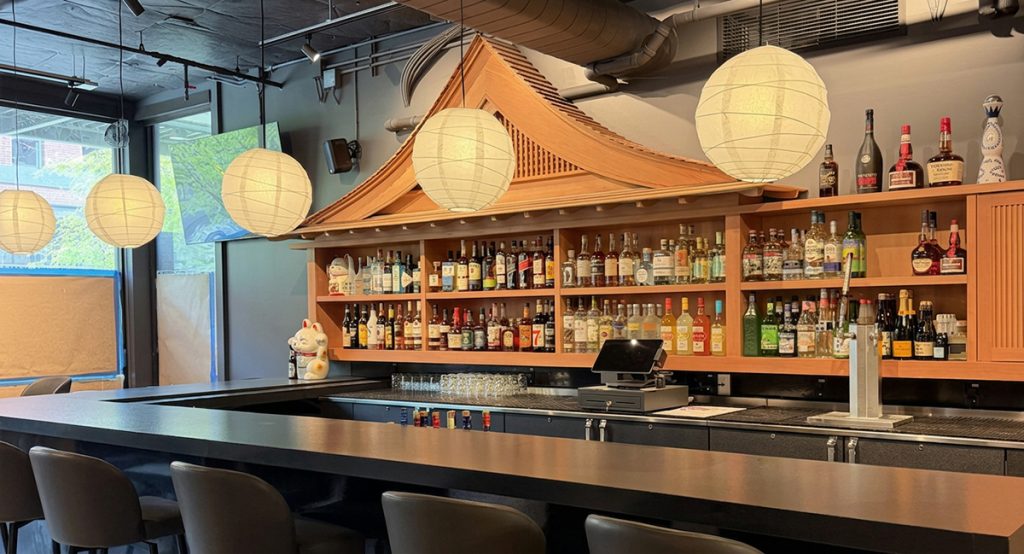
Bush Garden bar with the irimoya decorative roof from the original bar at 614 Maynard Avenue South (Courtesy: Karen Sakata)
Sakata said, “When you come in, you’ll get to see a lot of pieces that came from the old Bush and hopefully, it will instill and bring out memories that you have.”
Floor mosaics pay tribute to Santos’ love of salmon, his favorite dessert, and his pastime of boxing—one glove inscribed with the word “JUSTICE.” A sculptural hat mounted atop the Bush Garden sign, fabricated by Haskett Works and designed by InterIm CDA, serves as a permanent tribute to Santos’ signature Panama-style hat. A mural in the entryway depicts Santos, microphone in hand, honoring his identity as both a karaoke regular and a civil rights leader.
‘Bush Garden Day’ and what comes next
The new Bush Garden accommodates about 140 guests and adjoins the Bob Santos Community Room, which can open via a retracting wall to expand capacity for neighborhood events, celebrations, and meetings. The restaurant operates as a family-friendly venue from 3 p.m. to 9 p.m., before transitioning to a 21-and-over karaoke and late-night dining experience from 9:30 p.m. to 1:30 a.m. Bush Garden remains closed on Tuesdays.
Tiger’s Eye pop-up chef Alisha Davis and longtime Nijo chef Ed Tang lead the kitchen as Bush Garden continues serving Japanese food and a karaoke legacy that made it a neighborhood fixture.
Bush Garden is located at 714 South King Street in the CID. For more information, go to www.bushgardenseattle.com.