



By Carolyn Bick
NORTHWEST ASIAN WEEKLY
Continuing our collection of interviews with panelists who will speak following the premiere of Strawberry Fields Forever—a new documentary about the surviving berry picker cabins on Bainbridge Island’s once-thriving berry farms—Joann Oligario reflected on growing up in an Indipino farming family deeply rooted in the island’s agricultural history. The daughter of Filipino farmer Alipio Membrere Oligario and Indigenous mother Kathleen Margaret Letsos, Oligario recalled life on her family’s strawberry farm and greenhouse operation, where berry picking, shared labor, and a close-knit Filipino community shaped daily life on the island.
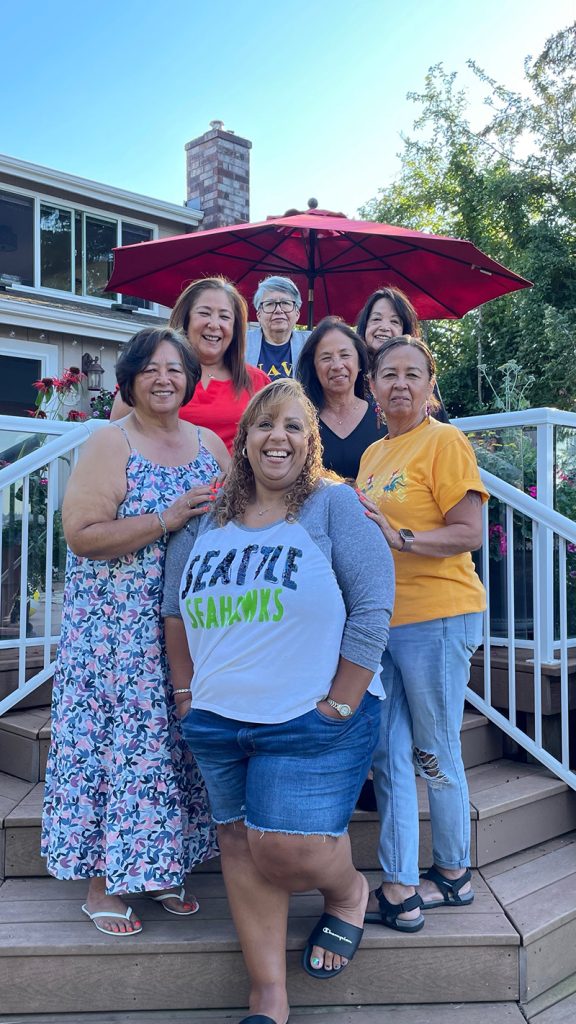
Joann Oligario (back center) and her sisters. (Courtesy: Joann Oligario)
This interview has been lightly edited for length and clarity.
My dad is Alipio Membrere Oligario. He came from Bacnotan, La Union, Philippines, in 1928 with his cousin, Max Oreiro, Sr. and Eulogio Oligario. … [My father and Eulogio] were pensionados because they were to go to school here in the United States and then go back to the Philippines to become civil servants.
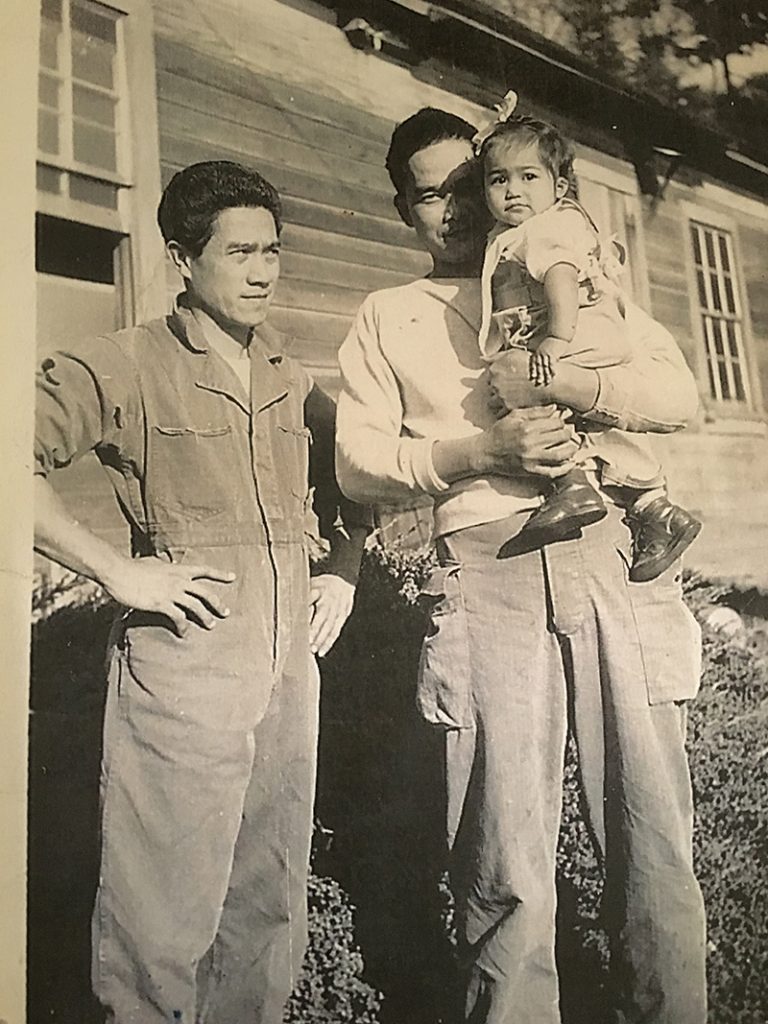
From left: Tommy Oreiro, Alipio Oligario, and baby Joann Oligario stand in front of a packing building for produce. (Courtesy: Joann Oligario)
My dad, when he first came to this country, lived in Chinatown with some of the elder Filipinos there on the island because there were like three certain hotels that they would all go to when they came to this country. They would share rooms.
My uncle Phil … came down to the island and they were at the Kitamoto farm and they were all staying in the bunkhouses there. My dad came, and they were working there with the Kitamotos for a while. Eventually, my dad and Uncle Philip went to work at the Pleasant Beach Gardens, which was presently our farm and greenhouse business.
At some time, my dad met my mother. He met her at my Uncle Anacleto’s farm. She and Gina [Corpuz’s] mom, Deeney, were working at Dan Book’s Strawberry Farm in Winslow. Uncle Anacleto would have a little gathering of Filipino men and native women and they would have a little dance.
Some of the men had instruments and on Uncle Anacleto’s top floor, he had a little dance floor to his house. And my dad saw my mom there, and he said, ‘Oh, I’m going to marry her.’ So they got married, I think, in August of 1944.
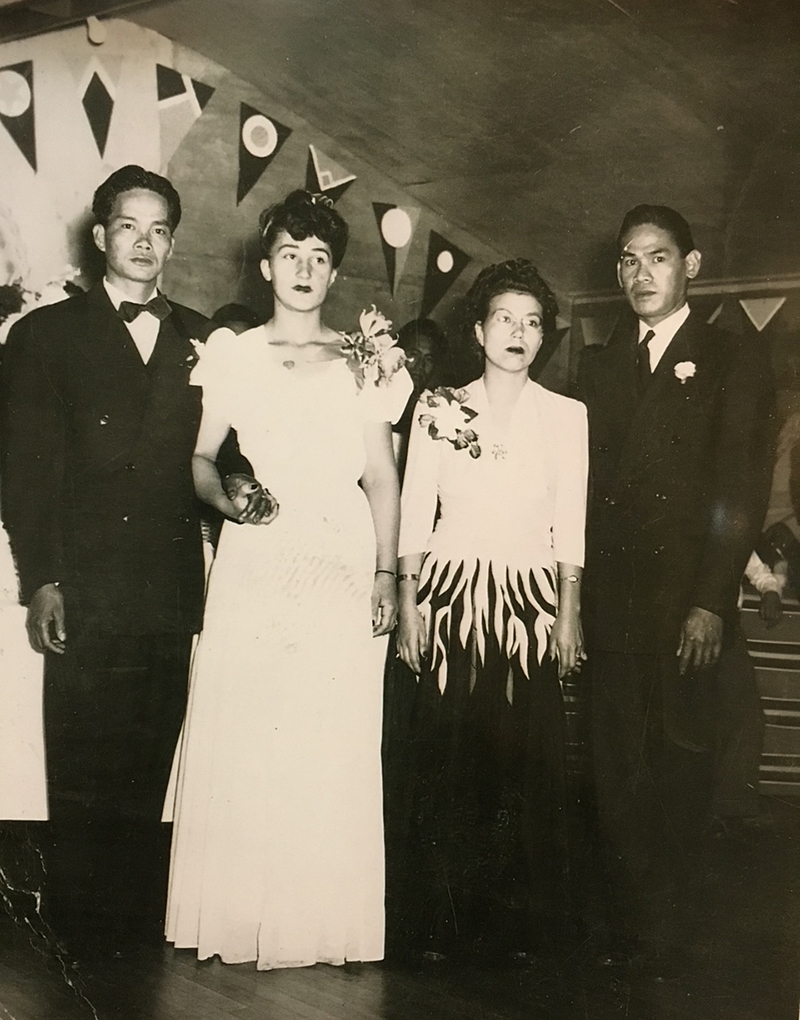
Joann Oligario’s parents’ wedding, 1944. (Courtesy: Joann Oligario)
My mother is Kathleen Margaret Letsos. She’s Native [Squamish and Sechelt] and Greek. Her father came from Nestani, Greece, and she grew up in British Columbia. She was one of several women that used to come down to Bainbridge to pick strawberries for income and whatnot. She was really a talented woman. … She came and they lived there on the farm, and it was kind of duplex style. Uncle Phillip lived on one side with his wife, Eunice, and we were on the other side. So the greenhouses were like eight big, huge hothouses.
There were tomatoes, cucumbers, and beautiful flowers, and had a big boiler room that fed the big pipes to heat up the greenhouses. There were eight big hothouses and a small starter house, and there was a big, huge packing shed that they used to long tables to cut the flowers and get them to be sent over to Seattle or whatnot. The bathhouse was kind of like a Japanese sento.
And we had a chicken house also, and we had eggs. In all, we had about 20 acres there of strawberries. We used to plant three varieties. We had Marshalls, Northwest, and Delizz.
In the morning, we used to get up earlier to go and pick the market berries, which we would deliver to Judd Huney’s down in Lewis, and to Town & Country, the Nakata store. And then we would pick the cannery berries that we would bring. At first, they were being delivered to the Filipino Hall. There was a place where we would deliver them, and they would be sent to the cannery. Before the Filipinos came, the Japanese had a little area where they took care of them. I don’t know what exactly, but they had an area where they prepared berries to be shipped to the cannery.
There were nine of us [brothers and sisters], and ours was a typical farm. We would help on the farm. We’d go up and weed or prepare the runners.
As a kid, I had a little tree house. I would go up there once in a while because I had to go and switch the water faucets. We had long water faucets that came down from our well, which we had to go up, from time to time, to prime. And there was that same well with water that fed down to our houses, and down to the house, and to the greenhouse.
It was beautiful up there. It’s an old hillside property. Our property sloped in the southern part of the island. I remember when we’d go up [to the bunkhouses], there was a pump, an old-fashioned pump where you could pump water. There were about six houses there, six rooms to a bunkhouse. And each one had maybe a couple bunk beds, tables, and chairs, and a real old-fashioned stove. They’re antiques now. It was a wood stove that you could cook on, and it was for heat. I wish we had kept them.
From the hillside there and from the strawberry fields, you could see the ferry boat going to Bremerton. It was beautiful.
It was kind of neat growing up on the island there, on our property, because you could just walk and walk and walk.
My mom used to make huckleberry jam, which was yummy. She really took care of how to prepare food. She would have a pantry.
We’d go to Wapato, and she would get some fresh fruit and whatnot. We had relatives in Wapato, also a big Filipino community over there that had farms. During the planting season, I remember the farmers would go around and help each other plant, and our mothers would do the cooking.
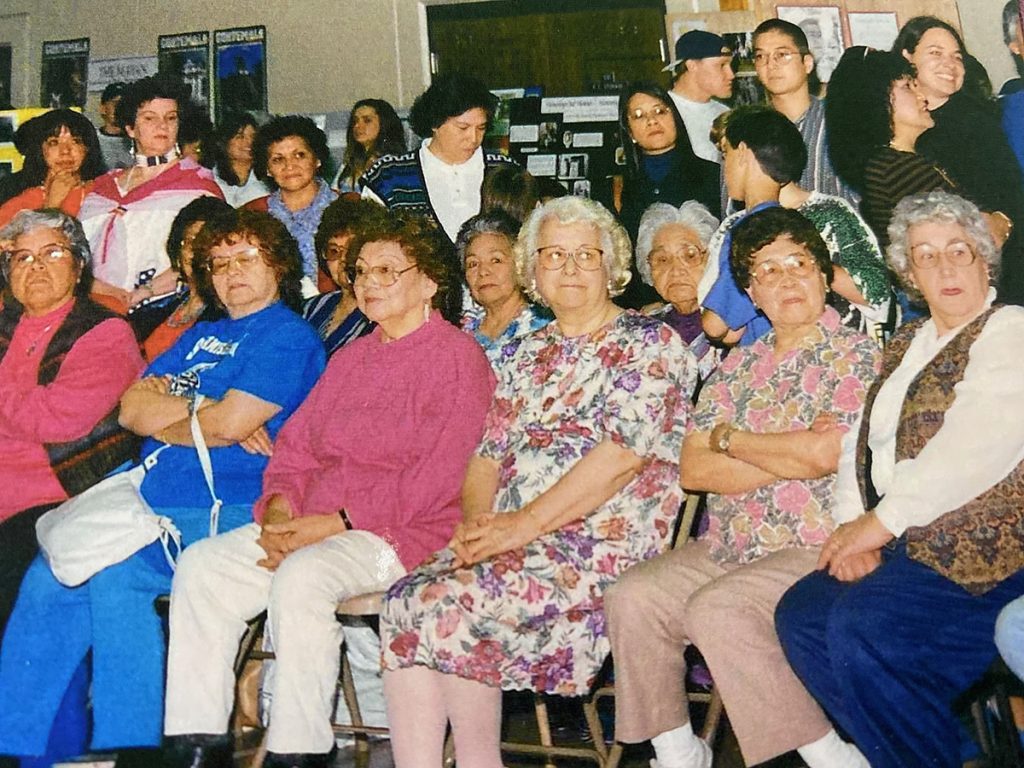
A photograph of Native mothers at a powwow in their honor on Bainbridge Island circa 1992. (Courtesy: Joann Oligario)
…
Even after work, we played outside a lot until dark, until our mother called us in. We played baseball out in the pasture.
Sometimes, Blackie would let us ride. He was our dad’s horse. We had a barn that was on the other side of the greenhouse where he was, and it was divided.
There was a little area where he slept, and the other side was all these piles of hay. His harness and his straps, could still smell the leather. My dad used to do the old-fashioned way of plowing the fields.
He would use Blackie to plow the rows. Sometimes, Blackie would let us ride him. We played baseball, and the blackberries were wild.
It was nice. In between playing baseball, we’d go pick a few blackberries, and they were delicious, the wild ones.
We used to just go for long walks on the property. When I was younger, I used to ride my bike all the way from our house, all the way to Point White. We would have our [Filipino Youth Activities] meetings, our youth group.
…
The Filipino community, we took care of each other. Everybody knew each other. Even when there was a time when a funeral happened and people weren’t very rich, someone from the community would go around to the Filipino community members, and they would all chip in to bury somebody that had passed away. Sometimes it’s kind of hard to put into words about how difficult it was over there being poor.
…
I tell you, I miss our property. I miss that sense of freedom, just to walk on your own land. I miss the scent of the strawberries and the raspberries, too.
Strawberry Fields Forever premiers at the Bainbridge Island Museum of Art on May 17 at 2 p.m. Readers can find more information here.