




By Carolyn Bick
NORTHWEST ASIAN WEEKLY
Before sprawling development replaced many of Bainbridge Island’s berry fields, generations of Filipino and Indigenous families built their lives around farming, hard labor, and community. Sisters Gina Corpuz and Lorraine Hale—daughters of Filipino immigrant farmer Anacleto Corpuz and Indigenous mother Deeney Evelyn Williams—grew up working one of the island’s largest raspberry farms, where picker cabins housed seasonal workers and meals were shared family-style. This article is one in a small collection of interviews with panelists who will speak after the premier of Strawberry Fields Forever, a new documentary about the original berry picker cabins on the once-numerous berry farms on Bainbridge Island.
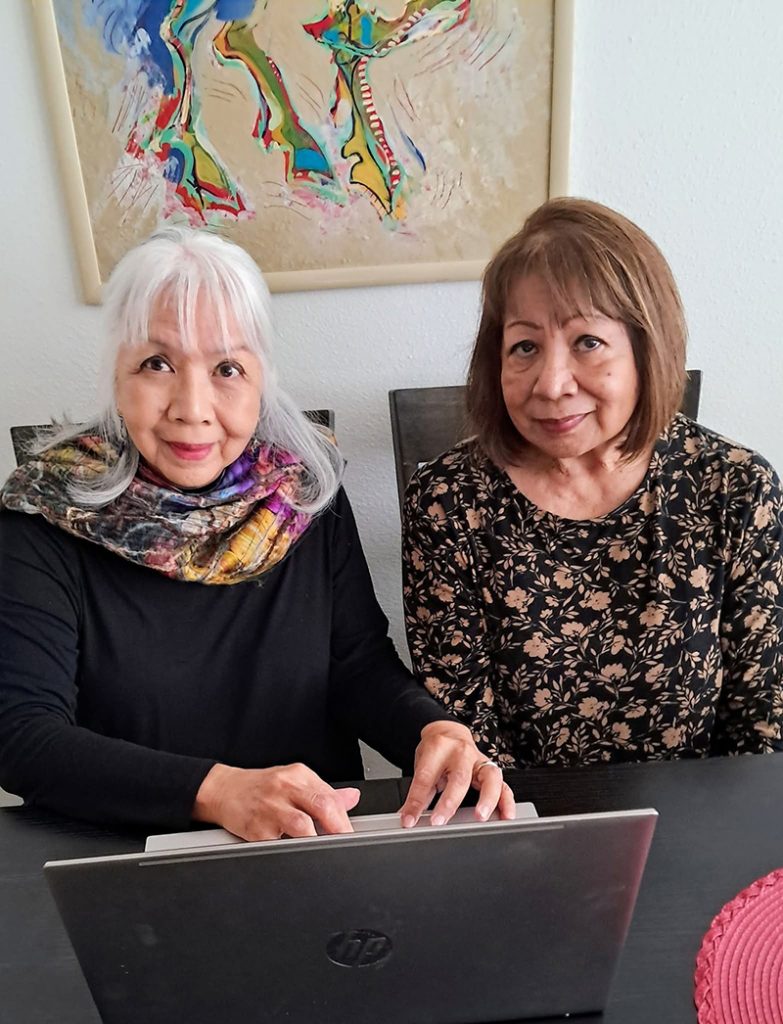
Gina Corpuz (left) and Lorraine Hale (Courtesy of Gina Corpuz)
This interview has been lightly edited for length and clarity.
Gina Corpuz: We started with the original Filipino pioneers who came to Bainbridge Island in the late ‘30s, early ‘40s, who came to Bainbridge with 8th grade education from the Philippines. They came with the American Dream because they were educated in the Philippines in American modeled schools, taught by American educators who said, ‘When you come to America, you will be moving into a democratic society where anybody can become president.’ And then they stepped off the ship at the port of Seattle and saw signs that said, ‘No Filipinos welcome here.’ So that was their welcome to America.
Those were the Filipinos who moved to Bainbridge. Those were our fathers.
We are agricultural people. We are the berry pickers. We are the children of the fathers who cleared the land to grow strawberries and raspberries.
…
Out of 100 berry farms, there’s very few picker cabins left—less than 10 picker cabins. And at one time, there were probably 500 pickers on Bainbridge during the height of the berry season.
But all the buildings have been demolished because once berry season ended and nobody was growing berries anymore, of course, the tax assessor kept taxing those buildings, but they weren’t being used. So the farmers started demolishing the buildings because they couldn’t afford to pay the taxes anymore. But there are a few.
A lot of those picker cabins were built from the salvaged lumber from the Port Blakely Mill. … Nobody went out to the lumber yard and bought lumber to build a picker cabin. They probably went and bought a can of nails for $2. But you couldn’t afford to buy lumber. Nobody built beautiful picker cabins. You could hardly afford to build your own house.
…
Our picker cabins had bunk beds, little dining room tables, a little potbelly stove. They were furnished. And our dad built a shower house and it had a hot water heater that was heated by a wood stove that he kept going all day, so that they would have a warm shower. And there was a men’s side and a women’s side.
It wasn’t like the big corporate farmers now who make their migrant workers live in their cars. Our father took care of our pickers. And even at like 11 o’clock in the morning, our father would say to us, ‘Go in the house and start cooking rice and start cutting up vegetables.’
So Lorraine and I would have to start cooking, because we even cooked for our pickers. And we’d say, ‘Come and eat,’ because we wanted to make sure that they were fed, they had a good night’s sleep.
We didn’t have a small farm. We had one of the biggest farms on Bainbridge. We had a 20-acre farm.
A lot of the Filipino farms were two acres, three acres, five acres. But we had one of the bigger farms, and we grew raspberries where most of the farmers grew strawberries, so we got all the pickers that were done picking strawberries. They came to pick our berries because raspberries were after strawberry season. Our pickers were sometimes First Nations people from Canada, but mostly it was our relatives and mostly it was us.
Lorraine: Yeah, we had to work the farm.
…
Gina: We really lived off the land. We very seldom went to the grocery store, because we, obviously, live on an island, and we lived by the tides. Every time it was a low tide, we got our buckets and went to the beach and picked up snails and dug clams and picked up seaweed and then we had our vegetable garden.
But we loved going to the grocery store, which wasn’t very often.
Lorraine: No, I can’t remember even going. I mean, there was a little corner grocery store that we would go down to and maybe get, when there weren’t fresh vegetables available, we would get the canned vegetables.
Gina: Not very often.
Lorraine: But not very often, because we had corn and peas and potatoes. We had chickens and a goat and a pig. So that’s what our meat was.
…
Gina: Our fathers quit farming—aged out—and the children, unfortunately, were not interested in farming, because we didn’t want to be poor. We didn’t want our children to grow up poor. That’s mainly the reason that the berry fields more or less went away. Berry farming died with the Indopino generation.
Many of us tried to hang on to the property, at least. We managed to because two of our sisters still live on the land. They’re not berry farmers. Very few of the families still live on the land. Most of the farms have been sold off.
The City of Bainbridge Island bought my uncle’s berry farm. It is being farmed, but it’s being farmed by farming interns and mostly not Filipinos and not Indopinos. Most of the farming that’s going on on Bainbridge right now is by white farmers, but at least it’s being farmed. … It’s still agricultural.
Strawberry Fields Forever premiers at the Bainbridge Island Museum of Art on May 17 at 2 p.m. Readers can find more information here.