




By Ruby Storey
NORTHWEST ASIAN WEEKLY
Writer and translator Tiffany Tsao felt a hum of excitement around Indonesian literature when she started translating Indonesian writing for English-speaking audiences in 2015. Around the same time, Indonesia was preparing to serve as the guest of honor at the Frankfurt Book Fair, the largest international book fair for publishers.
By the time she saw a prominent American publisher say “publishers aren’t looking for you, they’re looking for Indonesia,” in a 2017 interview with the Jakarta Post, Tsao was uneasy about whether the interest was genuine.
Tsao shared in a guest lecture last month at the University of Washington (UW) that her uneasiness about publishers’ intentions has grown — and she is not alone. Many translators and writers are pushing back against English-language publishers who flatten international literature into cultural representations rather than promoting writers’ unique voices.
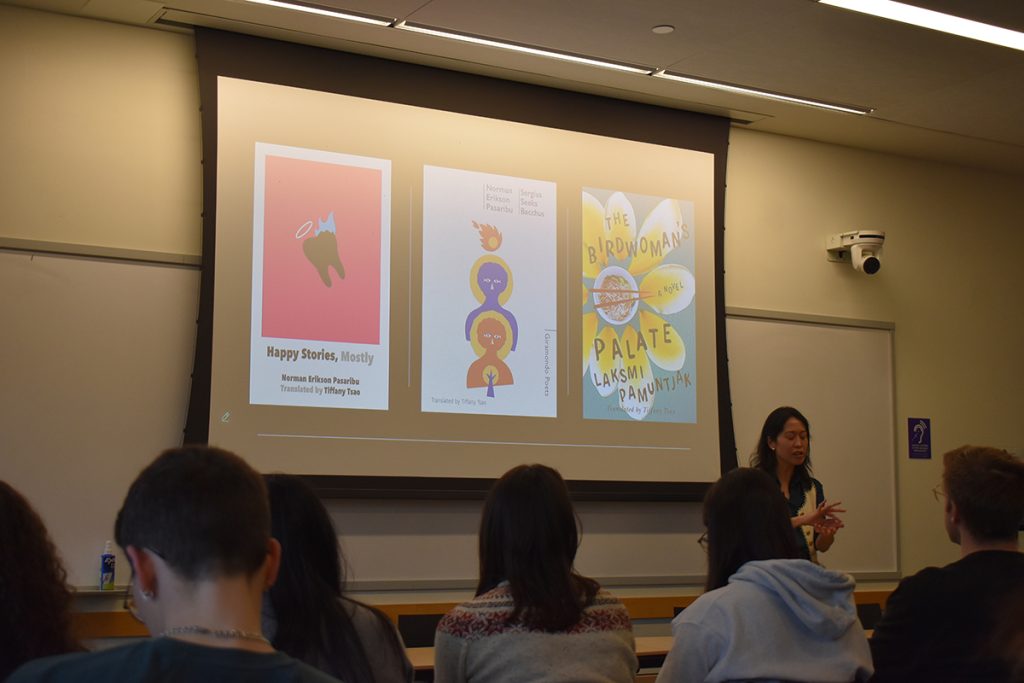
Tiffany Tsao speaks at the University of Washington, Seattle on April 14, 2026. Tsao has three English translations of Indonesian books coming out this year. (Photo by Ruby Storey)
In her April 14 UW visit, Tsao said that until very recently, most people who translated Indonesian literature were focused on Indonesian culture, not the style and stories of the writers themselves.
This choice to represent a nation rather than an individual means a less diverse range of literature from other countries is available to English-speaking audiences, Tsao added. Already, less than one percent of literary fiction and poetry published in the United States are translations, according to the University of Rochester’s translation program.
Tsao has noticed the disservice this choice does to both writers and readers. She grew up in Singapore and Indonesia, earning her doctorate in English at the University of California, Berkeley before transitioning to writing and translating literature in 2015. After translating eight books from Indonesian to English and writing four novels of her own, Tsao was invited to be the UW Translation Studies Hub’s translator-in-residence this year.
“Nuance is lost. . . if you’re just viewing (a writer) as a representative of, let’s say, the Chinese community in Seattle, then you’re viewing them for a thing that they’re supposed to represent,” Tsao said. “You’re not really necessarily connecting on the same level.”
She recently worked closely with author Norman Erikson Pasaribu on an Indonesian-to-English translation of Pasaribu’s book “Happy Stories, Mostly.” Tsao spoke about Pasaribu’s experience of being put on a panel about Indonesian religion and politics although they are a writer, not an expert on these topics. It is confusing, Tsao said, to be a writer who is expected to represent their entire country just because they happen to be a part of that culture.
Nazry Bahrawi, a Malay-to-English translator and assistant professor of Southeast Asian literature and culture at UW, shares Tsao’s concerns.
Instead of translating creative, quality stories from other countries, publishers often want books that display the aesthetics of a culture or study the traditions of a country, Nazry said.
Shelley Fairweather-Vega, who translates Russian and Uzbek literature in Seattle, said she has had difficulty getting people interested in a translated book when it doesn’t focus on national culture.
“I don’t want people to see the things I write as only interesting because they’re from Uzbekistan,” Fairweather-Vega said. “I want them to say, ‘this is interesting, and it’s from Uzbekistan, and I wonder what else might be interesting from Uzbekistan.’”
Fairweather-Vega acknowledged that it may feel riskier for English-language publishers to promote work from lesser known countries, like Uzbekistan or Indonesia.
“I wish publishers were a little more willing to embrace that risk and discover what they might discover,” she said. “But that’s part of what our job is as translators, to push that stuff on them and to encourage them to take those risks, and show them what’s out there.”
Translating works from one language to another is a delicate balance between retaining meaning and creating a translated work with the same feel and rhythm as the original. When a piece of literature is translated, a new version of an author’s story is brought to an audience who may have no other introduction to the source language or country.
“I do think that fiction and poetry do transport you in a way, and have you step into different perspectives and shoes, and suspend disbelief or belief about certain things,” Tsao said.
When English-speaking readers see only one kind of literature from a country, they lose the nuanced, challenging and complex perspectives coming from a wide range of writers.
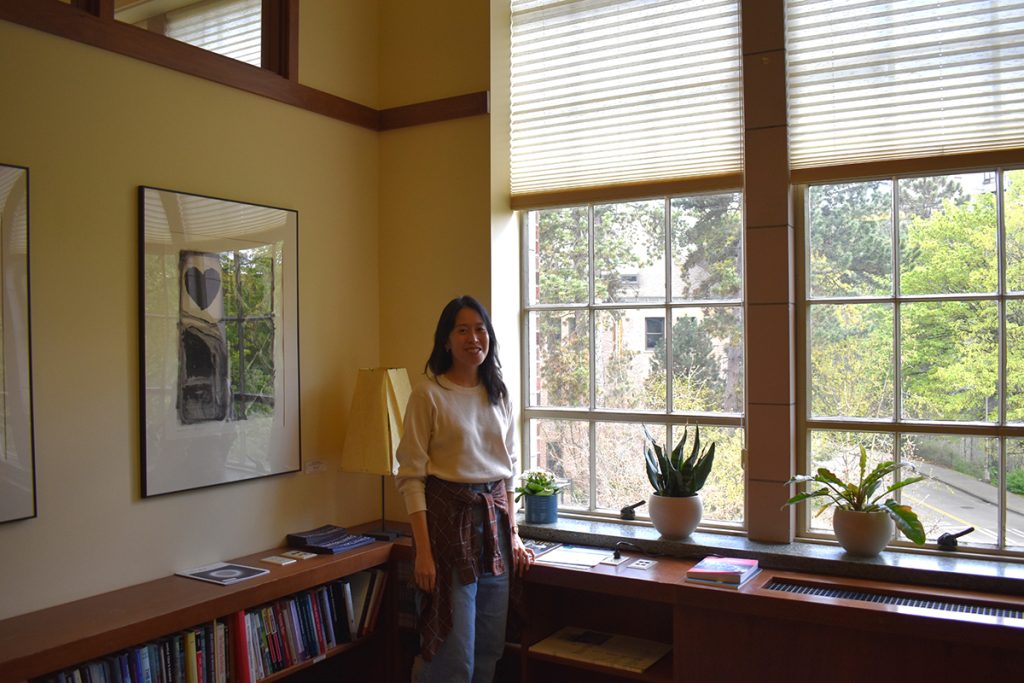
Tsao at the University of Washington’s Simpson Center for the Humanities on April 17, 2026. The Simpson Center for the Humanities funded the UW Translation Studies Hub between 2019-25. (Photo by Ruby Storey)
“If we keep stories in boxes, if we prize them primarily for being of X country’s make, or Y country’s origin, we never open the boxes and read the stories for themselves and let the writers who wrote them touch us on an emotional level,” Tsao continued.
English-language publishers’ surface-level interest in Indonesia has given more visibility to Indonesian writers, but has also allowed them to keep writers in these cramped boxes Tsao describes.
“In an ideal world, I would just want greater volume of people translating from Indonesian into English and translating well, and being able to place it with good publishers who will be able to do a great job with distribution,” Tsao said.
In 2022, Penguin Random House published Tsao’s translation of Indonesian author Budi Darma’s “People from Bloomington.” Darma wrote the book while he was living in Bloomington, Indiana as a graduate student in the 1970s. Though it was originally written in Indonesian, Tsao said Indonesia, the country, hardly appears in the book.
Tsao said she specifically fought to find this book a home in the English-language publishing world because its focus is not on Indonesia. She thought of “People from Bloomington” as a landmark translation because it is not a study of one people, place or culture, but about humans. Darma’s writing itself became the highlight of the book, not his heritage.
Translations like these, Tsao said, are one step towards properly representing the diverse plane of Indonesian literature to English-speaking audiences.
“It’s my hope that the stories I render into English will be appreciated and digested and internalized,” Tsao said. “Not to just tick a diversity box, but because of the power that those stories possess.”