



By James Tabafunda
NORTHWEST ASIAN WEEKLY
An individual from China’s ancient Kaifeng Jewish community sat down with Seattle’s Asian American Jewish community for an intimate dinner that organizers called a rare opportunity to hear a living voice from one of the world’s most isolated and historically significant Jewish communities.
The May 4 event—attended by 10 people and titled “Visiting Voices: Dinner with a Kaifeng Jew”—was co-organized by the LUNAR Collective (LC), the first and only national organization by and for Asian American Jews, and the Sino-Judaic Institute (SJI), a nonprofit founded in 1985 to promote understanding between Chinese and Jewish people.
On the partnership arrangement between the LC and SJI to organize the event, “I really give so much credit to Rabbi Anson Laytner,” said Grace Elizabeth Dy, Seattle fellow at the LC.
Kaifeng Jew declines media
The visiting Kaifeng Jewish guest refused a media interview and photographs at the event due to security concerns. Rabbi Laytner, president of the SJI, said the restrictions reflected the precarious position of the Kaifeng community inside China.

Rabbi Anson Laytner, president of the Sino-Judaic Institute (Photo by James Tabafunda)
Rabbi Laytner said, “I am happy to answer any questions you might have about the Kaifeng community or the Sino-Judaic Institute.”
A community under government pressure
The Kaifeng Jewish community—China’s only native Jewish population with more than 1,000 years of history—has faced increasing government pressure since 2015, when Chinese authorities intensified their efforts to monitor unauthorized religious activity. Judaism is classified as an unauthorized religion in China.
Rabbi Laytner, who has worked with the Kaifeng community since 2019, described the consequences of that pressure. “The crackdown was intended on unauthorized Christian and Muslim churches and mosques, but this little Jewish community got swept up in that as well,” he said. “Our school got closed down. The museum exhibits were also closed to the public so the community came up with an alternate strategy, which was to meet semi-secretly, but nothing public. And they’ve been existing in that way ever since.”
Rabbi Laytner estimates the Kaifeng Jewish community numbers a maximum of 2,000 people and said their religious practice is deliberately inconspicuous. “They will gather, a number of families will gather for a dinner together or for a Jewish holiday and light the candles and say the blessing over bread and wine,” he said. “But for all intents and purposes, it’ll look just like a gathering of a couple of families having a good time together.”
A three-week U.S. tour
The visiting Kaifeng Jewish guest arrived in the United States on a three-week trip fully funded through private donations raised by the SJI. The guest’s itinerary included New York, Los Angeles, and Las Vegas—where the visitor met with the Jewish outreach organization Kulanu and the East Asia desk of the American Jewish Committee and spoke with Asian Jewish student groups at Yale University—before arriving in Seattle.
In Seattle, organizers brought the visitor to the University of Washington, which holds rubbings from the ancient Kaifeng synagogue steles. Rabbi Laytner said the visit was significant because the visitor had never seen the stones. “They were in a part of the Kaifeng Museum that was closed to Chinese people,” he said.
The most emotional moment of the tour came in New York, when the visitor saw a Kaifeng Torah scroll—an artifact the visitor had believed lost—at the Jewish Theological Seminary.
Bridging Asian and Jewish identity
For Rabbi Laytner, the dinner went beyond historical education. He said the Kaifeng community offers a model that Seattle’s Asian American Jews can draw on as they navigate their own dual identities.
“On some level, the Kaifeng Jewish community represents a successful model that synthesized Jewish ideas and Chinese ideas, and Asian American Jews struggle with how to combine their Asian identities and their Jewish identities,” he said. “So I think this is a good learning experience for them to see that it is possible to do and to do successfully, because this Chinese community survived for a thousand years.”
Rabbi Laytner noted that he sees specific qualities in the Kaifeng Jewish community’s faith. “I have been struck by the tenacity of the people and how they have clung to their faith,” he said. “And now with the situation not as open, they are maintaining their Jewish life independently.”
Asian American Jews find community
For the LC and its Seattle hub, the event carried particular meaning. May is both Asian American, Native Hawaiian, and Pacific Islander Heritage Month and Jewish American Heritage Month—a calendar overlap that Dy said Asian American Jews feel personally.

“It’s really great to connect with the Jewish community at large. May is a really special time for Asian Jews in particular,” she said. “So really getting to live into the complexities of our identities and getting to understand the full range of the Asian Jewish experience is always such a delight.”
Dy, who is of Taiwanese and Filipino descent, currently serves as the first Jewish chaplain at Seattle University, a Catholic institution, and is preparing to enter rabbinical school at Hebrew Union College.
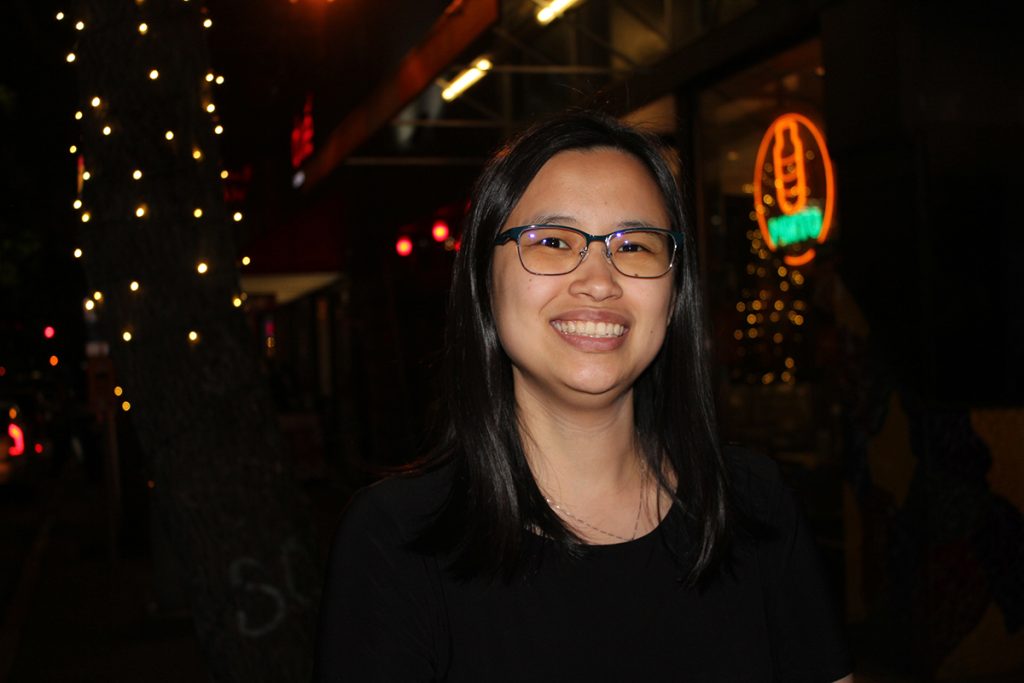
Grace Elizabeth Dy, Seattle fellow at the LUNAR Collective and Jewish chaplain at Seattle University (Photo by James Tabafunda)
“I was really lucky to be raised in a mixed faith, mixed heritage home,” she said. “Just being an inheritor very graciously of such rich traditions, different languages at home, different religions at home as well was what really sparked a curiosity in me to get to know religions.”
“I really came to it as a comparative religion major in college and really fell in love with Judaism there.”
She adds the visiting Kaifeng Jewish guest’s story deepened her thinking about who belongs in the Jewish narrative.
“Just how long Jewish history is,” Dy said. “Which Jewish stories get to be told? And getting to broaden who we think of when we think of Jewish.”
The LC was formally launched in 2022. Dy helped launch the Seattle hub, which drew more than two dozen attendees to its first event—a number that surpassed her expectations.
“Before getting involved with LUNAR, I knew exactly one other Asian Jew, and that was completely by accident,” she said. “When we were envisioning what would happen with the Seattle hub, I was like, if even one more person shows up, I will be ecstatic to know that there are three Asian Jews in Seattle. And we had 25 come out for our very first event, and it was just so transformative.”
Dy said the organization exists because Asian American Jews often find themselves isolated in two communities at once. “We can very often be the only Asians in Jewish spaces, or the only Jews in Asian spaces,” she said. “And really getting to know that we’re not alone—I think that’s really important in our own sustainability.”
Rising hate, a call for inclusion
The dinner took place against a backdrop of rising hate targeting both communities. Dy said the moment demands that those living at the intersection of Asian and Jewish identity be part of the broader conversation.
“Specifically in this time, especially in the last five years, we’ve seen an uptick in anti-Asian hate and anti-Semitism,” she said. “And especially including those of us who live at those intersections in the conversation as well.”
For Rabbi Laytner, the dinner reinforced the importance of the SJI’s work even as its activities inside China remain limited. The institute, currently in what he described as “hibernation” given restrictions on sending teachers or visitors to Kaifeng, is waiting for a change in Chinese government policy.
“I hope that it will give them encouragement so that they will continue to meet and explore their diverse Asian heritages in a Jewish context,” he said of the dinner’s impact on Seattle’s Asian American Jewish community. “I hope that it will help this small organization to grow here in Seattle, and more people will find out about it and connect up with it.”
For more information about the Sino-Judaic Institute, go to sinojudaic.org. For more information about the LUNAR Collective, go to www.weareasianjews.org.