



By Nina Huang
NORTHWEST ASIAN WEEKLY
On any given evening in the Seattle area, you can find pockets of community forming in unexpected places: the rhythmic thud of lion dance drums in a kung fu studio, the steady pop of pickleball paddles at public courts, or the quiet focus of climbers scaling indoor walls. Across these spaces, Asian Americans are not just working out—they’re building connection, identity, and belonging.
Carrying tradition forward through movement
At Mak Fai Kung Fu Dragon & Lion Dance Association, community is as central as the craft itself.
“Our group’s been around for 52 years. I took over back in 2018–2019 from SiFu,” said co-owner Royal Tan. “We teach a lot of kids martial arts in the community, as well as lion dancing—kids and teenagers and adults from all over. It’s a place for them to stay connected with their culture.”
The studio has about 100 members and draws a wide age range, from young children to older adults.
For many families, the benefits go beyond cultural preservation.
“Kids nowadays are on their phones, iPads… it’s a good way for them to participate in activities to avoid all their time being on electronics… it’s a good way to build teamwork,” Tan explained.
“Even if it’s a martial arts school/business, it’s a very family-oriented environment. We treat them like family.”
That sense of family is deeply felt by members like instructor Chris Hoang, who has been part of the group for over a decade.
“Mak Fai has always been a second family to me,” Hoang said. “All of the terms carry weight and meaning, such as the term for the head instructor, ‘Si Fu,’ which does not necessarily mean ‘master,’ but more accurately as ‘teacher father’… with the students addressing each other as brothers or sisters, this further deepens the familial bonds.”
Hoang added that the studio’s mission extends beyond performance.
“From the beginning, I’ve personally witnessed Mak Fai open its doors to anyone in the community who wishes for a safe place to learn, grow, and express themselves through movement… a group full of future leaders and representatives who’ll continue to carry the torch of tradition.”
Instructor Han Eckelberg has seen that impact firsthand.
“Many of my friends were already members of the troupe and asked me to participate,” he said.
“I have been part of the team for 10 years now.”
“From our young kids learning kung fu, to our older members coaching lion dance, we all feel a deep sense of responsibility because of our ties to the community,” Eckelberg said. “Community pushes us forward and we are thankful in every show to represent.”
The rise of pickleball—and social circles
A very different kind of community is forming on pickleball courts across the region.
For Polly Hoang, she was inspired by her brother.
He started playing at the pickleball courts in Shoreline last year and quickly made friends. Polly and her husband joined and they would play during the summer evenings and formed a group of at least six people.
What began as a shared activity quickly expanded into something more. “We also started doing game nights, dinner parties, birthdays together,” Hoang said.
The group now includes about 10 people, ranging from their early 20s to late 30s, representing a mix of Asian backgrounds—Chinese, Korean, Burmese, and Taiwanese. Even when the weather shifted, the connection remained.
“We have a group chat and Discord to stay connected… and it’s active every day,” Hoang added.
Part of pickleball’s appeal is its accessibility.
“I love that pickleball is easy to learn and not expensive to start,” Hoang said. “Now that we have an established group, we just do those things with this group.”
Nghi Le echoed that accessibility. He used to play tennis, but pickleball was easier to pick back up due to the lower barrier of entry and the social element.
Le plays at Rally Club in Auburn and actually sponsors the club. He made the investment because they offered him a lifetime membership. He described the vibe there as top notch, and plays four to five times a week for two hours at a time; mostly before work on the weekdays.
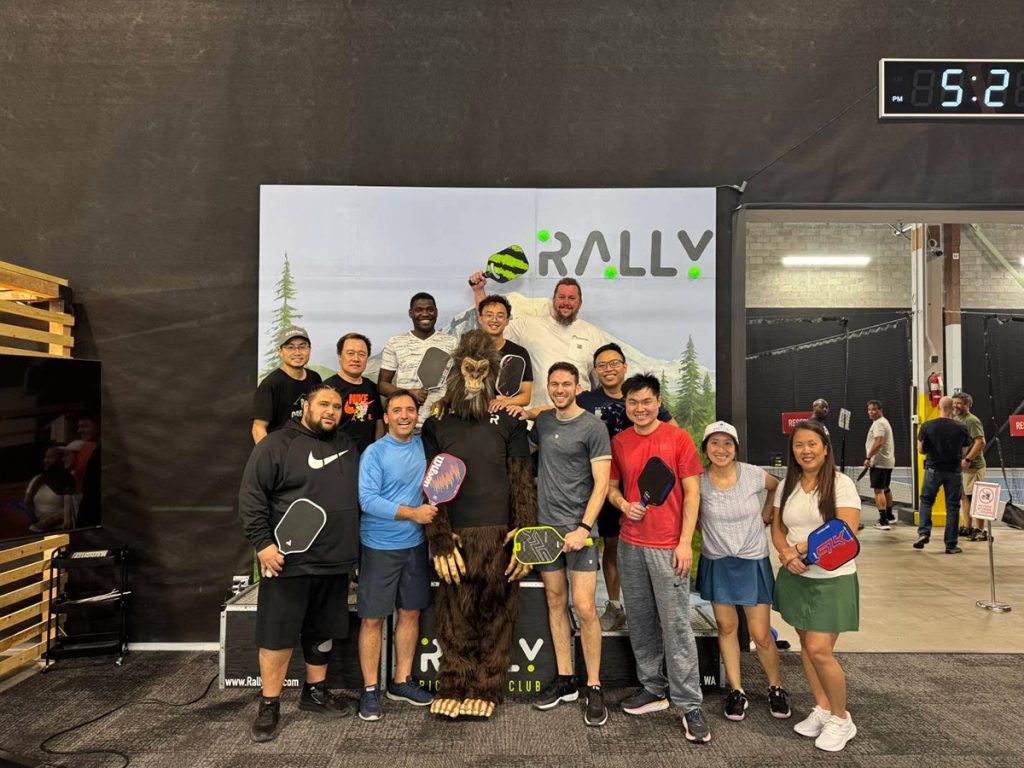
He’s also in the real estate community and started to host monthly real estate meetups at the pickleball club.
“I’m constantly thinking about how to blend my worlds together. It’s so cool to introduce new people to pickleball, and I think people get addicted really easily,” he said.
That social ease extends beyond local courts. “I went on vacation last week—I asked if I could join them. I feel like I’m reconnecting with old friends, meeting new friends,” Le said. “It’s so cool to introduce new people to pickleball. I think people get addicted really easily.”
For others, like Richard Sun, the sport offers flexibility during life transitions.
“I ruptured my Achilles tendon playing basketball and felt like my joints were getting too fragile,” he said. “The second reason was because I had a baby… pickleball is very easy to drop in and play for an hour or so anytime.”
Sun now plays multiple times a week. He usually plays between 90 minutes to three hours.
Climbing, circus arts, and creative expression
In climbing gyms and aerial studios, community often forms through a shared challenge.
Serene Chen first discovered climbing a decade ago.
“It was a great workout and also an awesome mental break. You can’t really get distracted by work thoughts or to-do lists when you’re focused on hanging onto a wall,” she said.
Since then, climbing has shaped her life across cities and milestones.
“In both London and Seattle, I’ve met lifelong friends at climbing gyms,” Chen said. “My first date with my partner was actually at [a gym].”
Even major life changes haven’t disrupted that connection.
“Since we had a baby, we’ve met a whole group of baby climbing friends,” she said. “We climb nearly every week.”
For others, like Midori Heckman, climbing strengthens existing relationships.
“It hasn’t necessarily helped us find a new community, but it has helped us bring a hard-to-get-into sport into our current community,” she said. “We always invite our friends who have no experience.”
Climbing also offers a different kind of physical engagement.
“It really builds upper body and lower body strength while doing something fun and challenging,” Heckman added. “We love taking our kids. We go camping around climbing spots.”
Meanwhile, aerial arts provide an even more expressive outlet.
Angela Chu, who teaches aerial silks at New Moon Movement Arts in Greenwood, describes it as both physically demanding and creatively freeing. “Big fabric that hangs from the ceiling 20–30 feet up… doing circus acrobatics on it,” she said.
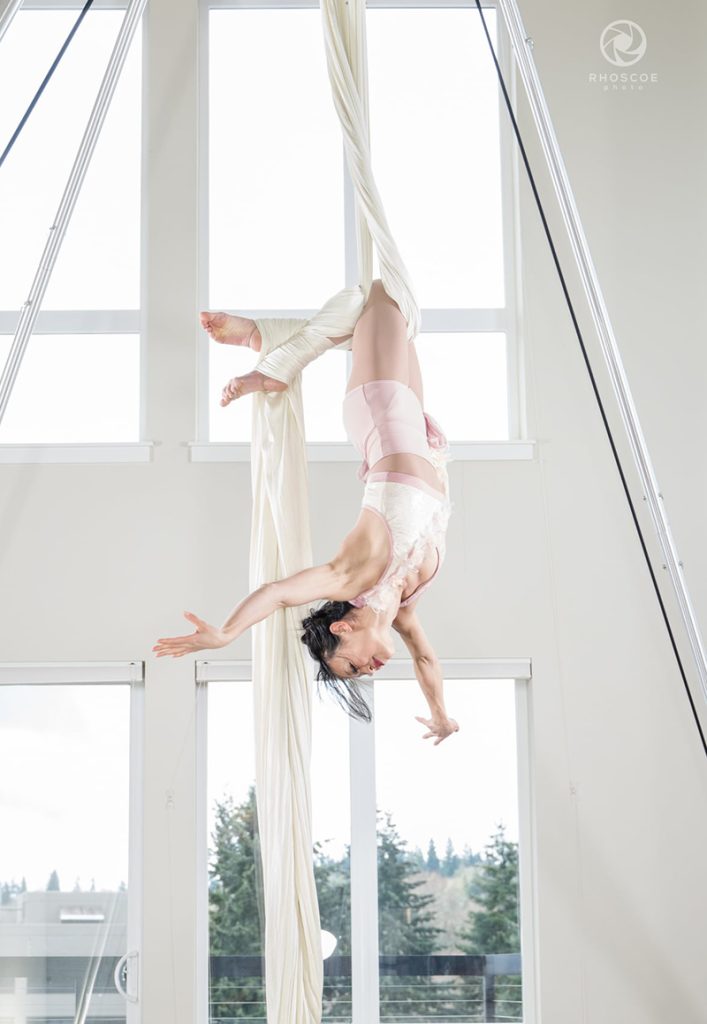
Angela Chu (Credit: Rhoscoe Coquia)
“I’ve been doing it the last 15 years or so and I found a ton of community because it seems to attract people who are interested in making friends, doing something challenging together,” Chu explained.
For many Asian American women in particular, the art form offers something culturally rare.
“It tends to attract a lot of Asian women. It’s a form of physical creative expression that we don’t tend to get,” she said. “This tends to have an outlet that’s more freeing, creative, expressive in different ways.”
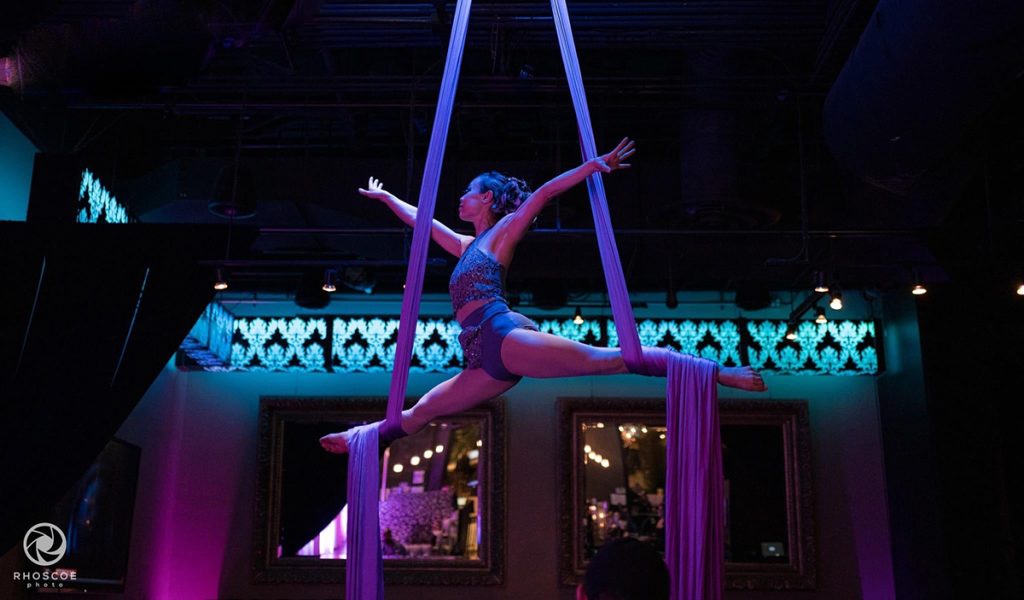
Credit: Rhoscoe Coquia
More than movement
The activities themselves may be different, but the reason people stay often sounds the same.
It’s the friendships formed after practice. The mentors who become family. The group chats that stay active long after everyone leaves the gym. The feeling of walking into a space and immediately knowing you belong.
For many Asian Americans across western Washington, movement has become a pathway not only to fitness, but to community.
Nina can be reached at newstips@nwasianweekly.com.