



By Samantha Pak
NORTHWEST ASIAN WEEKLY
SPIT: A Life in Battles
By Jonnie Park and Donnie Kwak
Third State Books, 2026
 Born in Argentina to South Korean parents, and smuggled across the U.S.-Mexico border at the age of 3, Jonnie Park grew up in Koreatown in L.A.—amidst his father’s violent alcoholism, turbulent protests, and the riots of the early 1990s. In search of a place to belong, Park discovers the highly competitive world of underground battle rap. And thus, Dumbfoundead—one of the few successful Asian American rappers—is born.
Told through a series of battles he’s fought throughout his life, Park doesn’t hold back in sharing his story—from tiptoeing around his father’s rage and the expectations that come with the model minority myth, to overcoming addiction and dealing with the pressures of fame.
As an Asian American hip-hop fan, I really enjoyed Park chronicling the culture’s impact on our community. But one area I wasn’t too familiar with before this was the battle rap scene, where Park honed his rhyming skills among the freestyle cyphers of South Central L.A. It was fun to gain insight into another aspect of a world I’ve appreciated my whole life, and see how Park came up in the scene as one of the few Asian Americans in the predominantly Black hip-hop culture.
“SPIT” isn’t just a glimpse into Park’s life. It’s also a glimpse into modern Asian American history. From the Rooftop Koreans during the L.A. riots, to the kimchi circuit on which Asian American musicians toured and performed at colleges around the country, he touches on parts in our community’s history that I was aware of, as well as parts I had no clue about. One thing I appreciated was how Park imparts this knowledge with his distinct voice, so it feels more like a friend recounting a story, rather than a dry text book. And being the same age as Park, I also felt seen with his very millennial references that were very specific to what it was like coming of age in Asian America in the 2000s.
Death in the Cards
By Mia P. Manansala
Delacorte Press, 2025
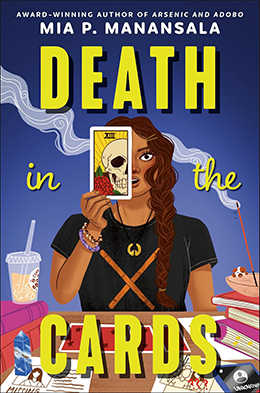 With a private investigator mom and mystery author dad, Danika Dizon is a natural problem solver. She uses her skills to offer guidance to her classmates who come to her for advice and tarot card readings between classes.
But when one of her clients vanishes within a few days of a reading, the girl’s younger sister, Gaby, confronts Danika and begs her to figure out what happened. Danika takes on the case as it’s the perfect way to prove to her parents that she should be officially part of the family’s detective agency—instead of working for free.
Things start off as just a challenge to find Gaby’s sister, but grows into something much bigger and darker as they discover the missing girl may have been living a secret life. One that could be more dangerous than anyone was expecting.
As her young adult debut, “Death in the Cards” has Manansala’s signature “it takes a village to solve a case” quality. Danika may be the protagonist, but she constantly checks in with her parents and other relatives, asking them for advice as well as practical help. Not only is this realistic in that even law enforcement will form task forces to tackle a big case, but it also makes sense for a teenager to not have all the answers while investigating.
And like many young adult stories nowadays, there is a love triangle. But what I found refreshing—and also very entertaining—was the fact that Danika doesn’t even realize there’s a triangle in play. She may be smart at figuring out clues about what happened to Gaby’s sister, but Danika has no clue when it comes to her own personal relationships. Like the other characters in the book who know exactly what’s going on, I just wanted to lovingly shake Danika to open her eyes and see what (and who) is right in front of her. I also appreciated how Manansala handled the triangle in the end—which is very different from other stories I have read.
Ms. Mebel Goes Back to the Chopping Block
By Jesse Q. Sutanto
Berkley, 2026
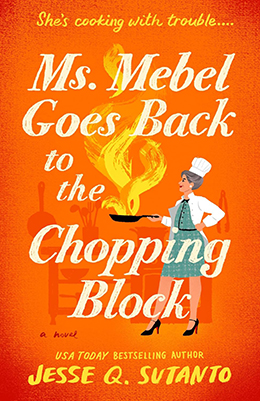 Meet Mebel. As a member of the Chinese Indonesian community in Jakarta, she was raised to be a trophy wife. Meaning everything she has done, and does, is to find and keep a husband. At 63, her job in life is to cater toward her husband of more than 40 years. But rather than retiring and taking her on trips to Santorini or Dubai, Henk tells Mebel that he’s leaving her for their 24-year-old private chef, Wendy.
In order to win her husband back, Mebel comes up with the perfect plan: enroll in culinary school so she can be a wife who can cook for him (because why else would Henk leave her?). She signs up for culinary school in Paris—the most romantic country in the world—only to learn upon arrival that she actually enrolled in the school’s satellite location in England, in the small village of Cowley.
Determined to make the best of her situation—after all a trophy wife is nothing if not adaptable and able to handle anything life throws at her in the name of pleasing her husband—Mebel decides to stick it out and actually learn how to cook. Along the way, she befriends the program’s breakout star, Gemma, as well as a whole group of Gen Z classmates who teach her lessons beyond the kitchen.
Sutanto is known for writing about women of a certain age, and she continues to shine with Mebel, who is very different from any other character of hers that I’ve read before. She may have never had a job, but that doesn’t mean Mebel doesn’t know how to work. Throughout the story, she shows readers how you really shouldn’t judge a book by its cover, both when it comes to how people have underestimated her her whole life, as well as when she has judged others who have ended up surprising her.
I love a confrontation and reckoning scene and there are two in this story and each one will have readers cheering on Mebel and the other characters as they stand up for themselves. It shows it’s never too late to do what’s right for yourself.