




By Carolyn Bick
NORTHWEST ASIAN WEEKLY
Every time Dr. Derald Wing Sue gives a lecture, he can count on at least one well-intentioned white person to engage him in conversation at the end of it. And at the end of that conversation, “they will say something to me like, ‘Professor Sue, you speak excellent English.’”
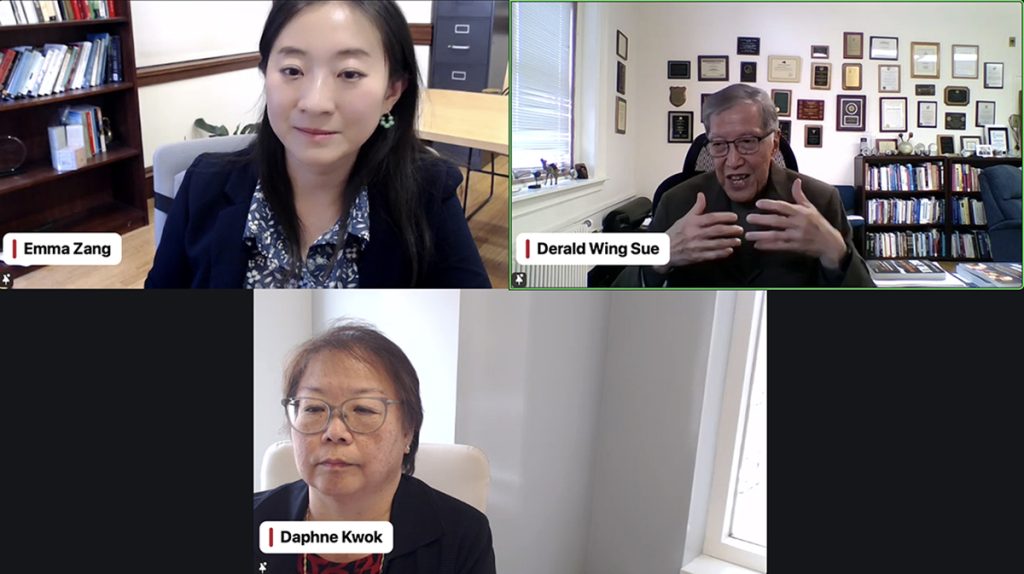
“Now, I usually respond by saying, ‘Thank you. I hope so. I was born here,’” Sue, cofounder of the Asian American Psychological Association and a professor of counseling psychology at Columbia University, told participants at the Committee of 100’s May 13 discussion dissecting the origin and harms of the model minority myth. The discussion—between Sue and Emma Zang, an associate professor of sociology at Yale University, and moderated by Daphne Kwok—was the third of four highlighting the findings in the organization’s State of Chinese Americans survey results.
“What is happening here is that that is a microaggression—but the metacommunication delivered to me that is not conscious in the mind of this well-intentioned individual is that you are a perpetual alien in your own country,” Sue continued. “You are not a true American.”
These kinds of microaggressions are the kind that keep the model minority myth alive amongst Asians. Despite looking like a good thing on the surface, this myth actually does deep harm to individuals and communities as a whole, especially when paired with other forms of discrimination.
The origin of the “model minority” myth
Sue explained that the idea of the “model minority” came from a white sociologist, William Petersen, in 1966. Peterson focused on Japanese Americans, noting that they were successful members of American society, tending to have a higher level of education and income than even their white counterparts. Expanding that out, Sue said, these statistics appeared to hold—or did they?
“When I was in graduate school [in 1969] … I remember Newsweek having articles like … ‘Chinese Americans out-whiting whites,’ [and] ‘Asian Americans are a success story,’” Sue remembered. “I began to ask myself, ‘Was this actually true?’”
It was not true. The statistics, it turned out, lumped together all Asian Americans regarding everything from educational attainment to income to mental health outcomes to successful marriages. But this not only skewed the data towards higher educational attainment, it completely erased distinct differences amongst the many communities labeled as “Asian American,” and effectively hid them and their needs from sight.
For instance, when compared with white families, Asian American families often have more workers in the household who contribute to income, thereby raising the per-household income level. Mental health resource utilization and divorce rates looked lower on paper, Sue said, because things like mental illness and divorce have cultural stigmas attached to them.
“In essence, thinking that marriages among Asians or the Chinese are happier is a myth,” he said. “It is just that they are less likely to divorce because of cultural factors that are occurring here.”
So, Sue and his brother, Stanley Wing Sue, set out to disprove these myths. In 1975, the pair published a paper attempting to debunk the myth, but the damage had already been done. The myth persisted, and persists to this day.
The idea of the model minority has also been used against Black people, especially during the Civil Rights Movement of the 1960s, in order to divide cooperative efforts between Asian American and Black communities, Sue said.
“It was socially conditioned and it served a political narrative. If you can show, for example, that a ‘minority group’—and I use that term in quotes—can succeed in this society. It affirms the myth of meritocracy—that any group who works hard enough can succeed in this society,” Sue explained. “It came out during the Civil Rights Movement, when we were compared to African Americans. African Americans were told, ‘Look, the reason why you can’t succeed is you don’t have the right family values. You’re unintelligent. You’re lazy. You’re not motivated.’ It produced a divide and conquer situation where even today, many of my Black brothers and sisters tell me, ‘You’re almost white.’”
“People came up with this narrative to use as a weapon to be against Black Civil Rights claims. It’s not really about Asian Americans,” Zang agreed. “It’s not really about us—actually, it’s never really about us. In my own research, I found many policies passed in the U.S. related to Asian Americans, but it’s actually never really about us.”
Psychological toll
While Sue didn’t elaborate on the effects this kind of messaging had on him psychologically, the Committee of 100’s report revealed some of the damage the model minority myth deals to individuals. The report, “Praise Can Be A Prison,” used data from NORC’s Amplify AAPI and the AmeriSpeak panels, surveying a little more than 2,000 people.
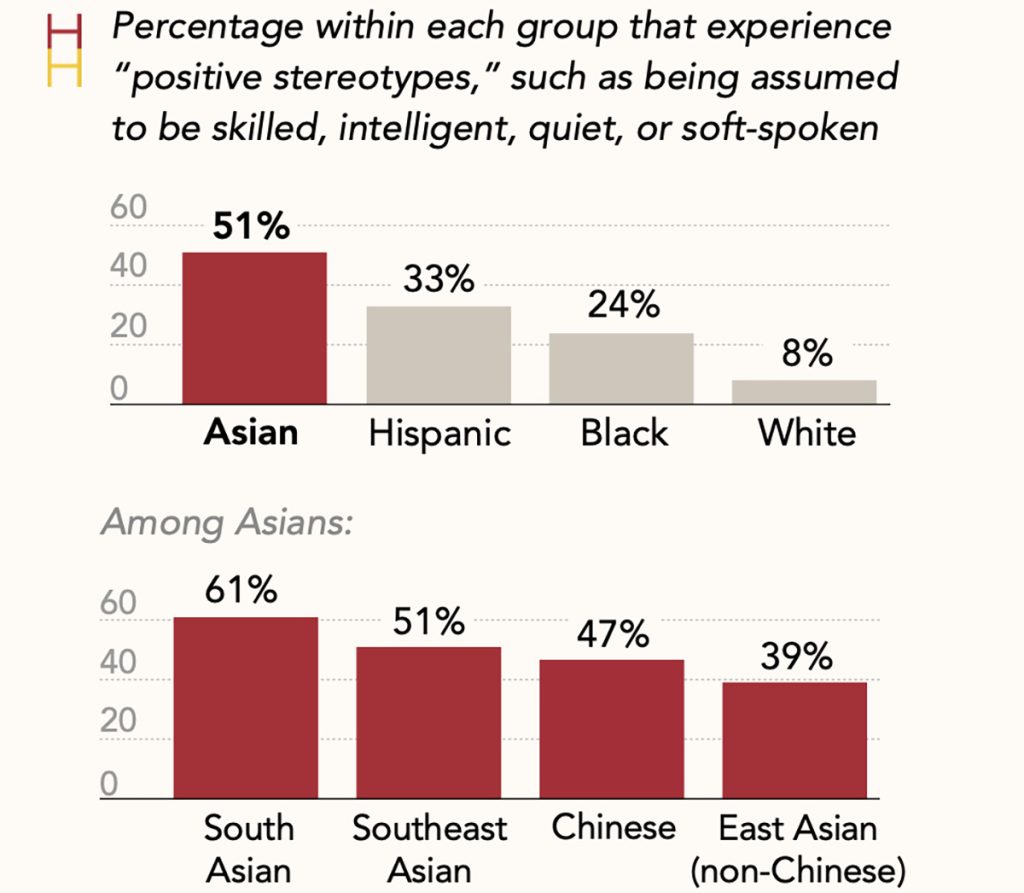
In everyday life, Zang told discussion attendees, as she presented the survey data, more than half of all participants surveyed said that they experienced the model minority stereotype every day.
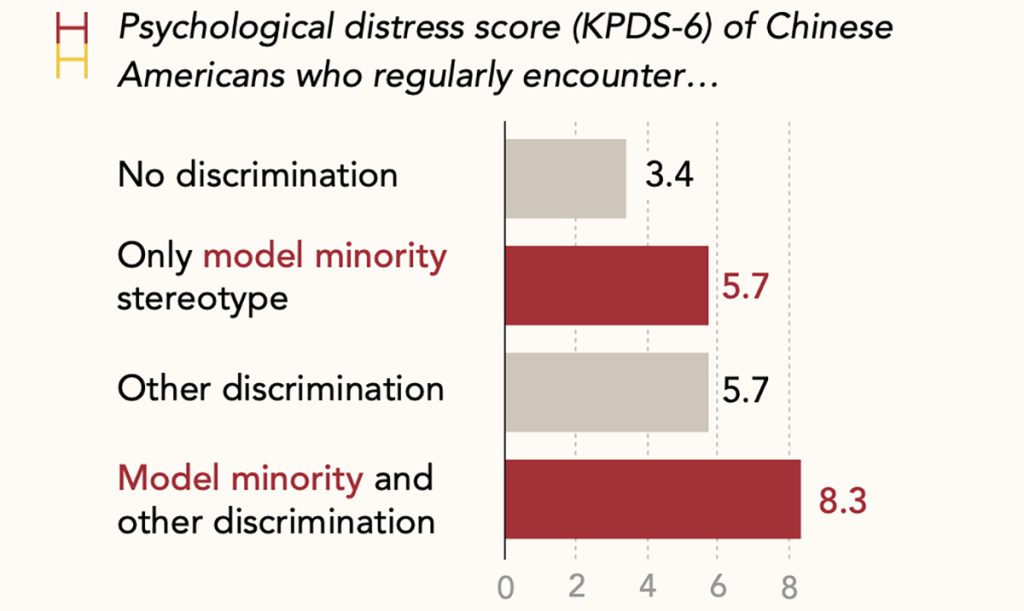
Psychological distress measurements using the Kessler Psychological Distress Scale showed that Chinese Americans measured at a 5.7, when exposed to the model minority stereotype. When that stereotype was combined with other forms of discrimination, that number rose to 8.3, indicating moderate distress.
“Being seen through a stereotype, even a flattering one, is not neutral,” Zang said. “It suppresses individuality, creates performance pressure, and discourages help-seeking.”
The ways this stereotype can show up vary, Sue said. For instance, his high school counselor told him to take advanced physics classes. When Sue expressed worry about the workload, his counselor said, “You people are good at that.”
“Now, it struck me as, shouldn’t I be grateful? This person is having faith in me—and yet, it made me feel trapped, that I didn’t have a choice, that I had to live up to an image,” Sue remembered. “It trapped me until my sophomore year in college when I realized I’m not good at math. I don’t like the sciences.”
Zang highlighted her research, and explained how American policies regarding who gets to study here and receive visas, coupled with the myth of the American Dream, serve to keep the model minority myth alive.
“Who ended up here in the United States is not a random sample from the home countries. It’s a consequence from the immigration policy, which disproportionately selects highly educated and high achievers from Asian countries,” she said. “It’s really a consequence of the immigration policy, and that the American Dream can be achieved by people.”
The cascading negative effects of a “positive” stereotype
Kwok said that she had heard some people say that having a positive stereotype attached to a community is better than a negative stereotype, and that some studies in economics and sociology appear to point to better outcomes for Asian children, because of it. But is this the whole picture?
While some report benefitting from this stereotype, Zang explained, these benefits don’t come without a price.
“The question isn’t whether these benefits exist, it’s what they cost, who pays, and what they are contingent on. The benefits are really conditional on narrow [career] domains in academics, in technical fields,” Zang said. “If we step outside of the stereotype, it turns around very fast. For example, in political fields or in some kind of creative fields, positive narratives rarely give you any benefits.”
And not every Asian American benefits from the stereotype, she continued. For instance, less educated Asian American men have worse overall outcomes, including income potential and health, even compared with other racial ethnic groups, conditional on socioeconomic status and resources they have available, she said. But because of the model minority myth, their needs are often overlooked.
The myth, she continued, “is also very gendered in underexplored ways. The stereotypes are typically smart, quiet, deferential, hardworking—these stereotypes map very differently onto Asian American men and women.”
“For women, it overlaps with existing gender expectations in ways that can make it harder to detect as racialized at all. It just represents a woman being a certain kind of woman,” Zang said. “But for men, the same traits get read as socially weak or sexually undesirable. A lot of my work actually shows that Asian American men are at the bottom of the dating market or marriage market. The desexualization of Asian American men is a documented phenomenon with real psychological consequences that almost never gets discussed in the model minority literature. I think that’s also an area that needs more work.”
This bias very clearly stems from American stereotypes of Asians, and is not a product of Asian culture, Sue said.
“What I experienced was that when I had neighbors who came from China or Asian countries … they did not have this concept of the model minority myth. They did not sense their own inferiority,” Sue said. “When I talked about Asian American personality identity, internalizing bias, inferiority that was going on, they didn’t know what I was talking about because they never experienced that. I would tell them that you may not have that going on with you, but the truth of the matter is that your sons and daughters will because they will be born and raised in the United States exposed to an environment that makes them feel inferior, deviant, and pathological.”
Moving away from the “model minority”
With such a pernicious myth that is so deeply entrenched in the minds of so many Americans, fighting it might seem impossible. But that’s not the case.
Zang said it is important to trust what you feel and not believe you are simply being overly sensitive. She also highlighted the report’s findings, which don’t simply rest on being reactive to racial stereotyping and bias. The report recommends expanding culturally competent mental health care that acknowledges both explicit and implicit discrimination; training educators, healthcare providers, and public officials to recognize and understand the cost of racialized expectations; and invest in tools to disaggregate data and explore the experiences of Asian Americans, in order to better understand the impact of marginalization.
Sue said that he believes people should speak up, because “silence and inaction is complicity. As long as you’re silent and don’t act upon when these stereotypes and microaggressions occur, you are going along with the issue and the problem.”