



By Nina Huang
NORTHWEST ASIAN WEEKLY
On a recent evening at a brewery in Capitol Hill, dozens of young Asian Americans gathered around mahjong tables, laughing over tiles and reconnecting with friends they first met through the game.
Across the Seattle area, Asian American community spaces are expanding beyond bars and nightlife. Bubble tea shops, mahjong clubs, bookstores, cafes, and creative hubs are increasingly becoming “third places”—spaces outside of home and work where people gather, build friendships, and find cultural connection.
For many young Asian Americans navigating Seattle’s infamous social freeze, these spaces are filling a need that goes beyond entertainment.
“I already try really hard to make friends, and it’s been hard due to the Seattle freeze,” said Sooyoung Ahn, 30, who regularly attends Emerald City Tile Club events. “For me, the fact that there’s an activity at the same time, it’s been great to make friendships.”
Ahn said the recurring nature of the mahjong club helped relationships develop organically.
“We’d keep meeting each other at biweekly events and these eventually led to deeper friendships and opportunities to hang out outside of tile club,” she said. “The space is really precious to me.”
Mahjong instead of the bar
Emerald City Tile Club (ECTC) launched in early 2025 after founder Sean Herrera noticed a lack of mahjong spaces geared toward younger Asian Americans in Seattle.
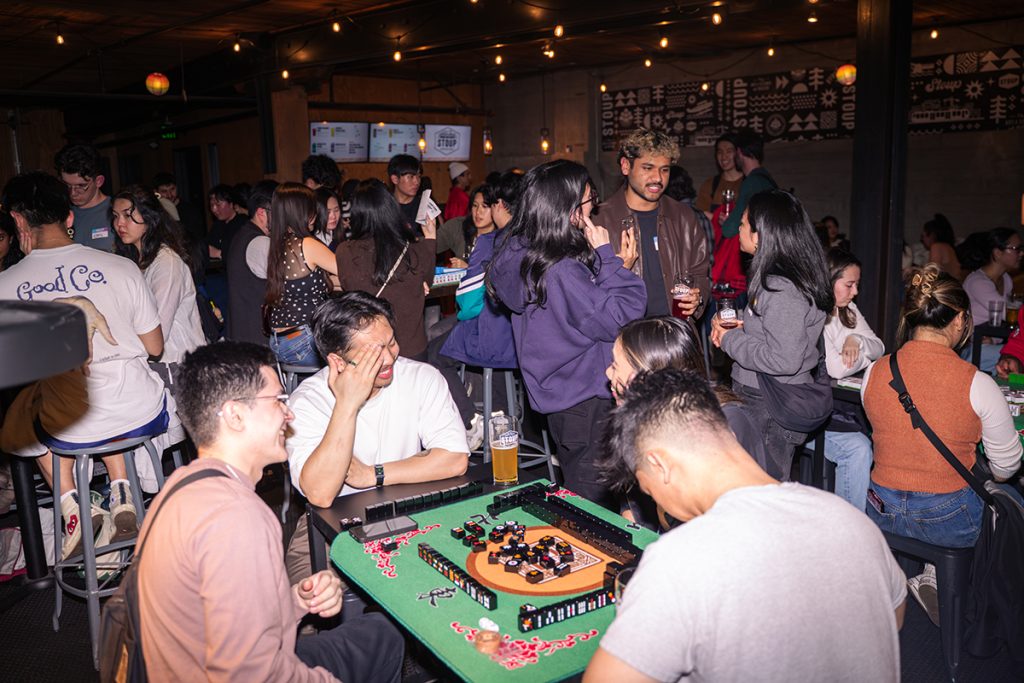
Photo provided by Sean Herrera
“We are a mahjong social club dedicated to curating a vibrant third place for the Asian American community in Seattle,” Herrera said.
The club now regularly draws 100 to 200 attendees, many between ages 21 to 25.
“We pride ourselves in being one of the youngest demographics—100 to 200 young folks congregating around a board game instead of a bar,” Herrera said.
Herrera said he was inspired after seeing younger mahjong communities emerge in cities like New York.
“I played with my dad and wondered if there was an equivalent space for it,” he said. “There were a few of them like Wing Luke Museum and Seattle Riichi Club, but not one that curates a space for young people.”
He cold-emailed Capitol Hill brewery Stoup Brewing with his vision. The venue agreed, and the club quickly grew through biweekly events and word of mouth.
“Selfishly, I just wanted to make friends,” Herrera said. “It’s really growing into something beautiful.”
As attendance expanded, Herrera began noticing friendships forming outside the events themselves.
“Walking around Capitol Hill and seeing them hang out, they met through ECTC—I never expected to have conversations outside of the club,” he said.
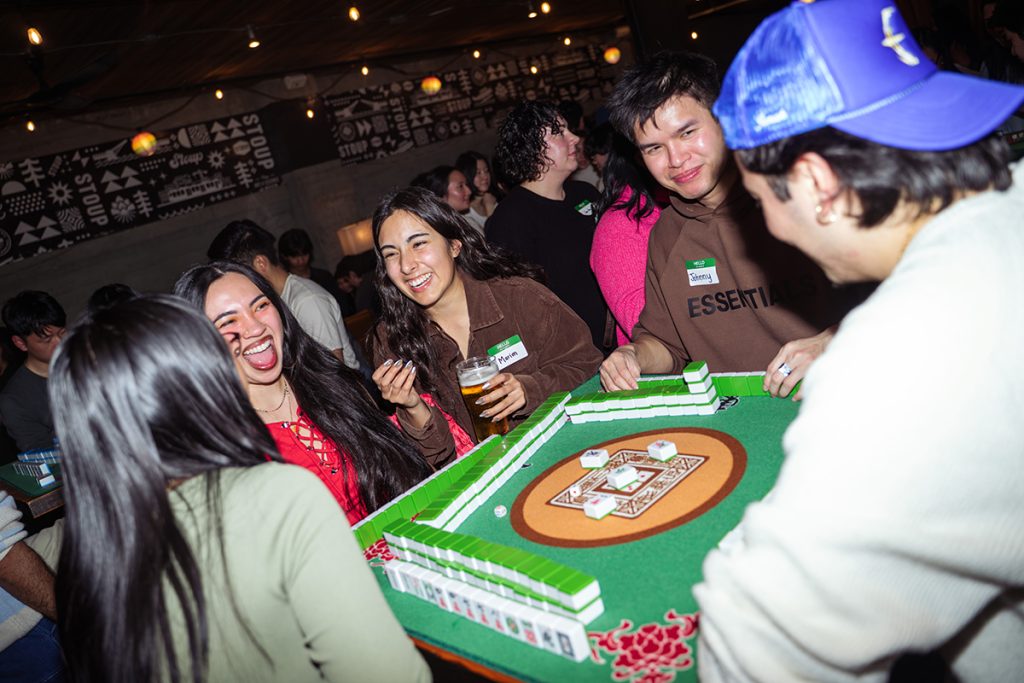
Photo provided by Sean Herrera
Herrera sees the rise of mahjong clubs as part of a broader movement of Asian American community-building in Seattle.
“I get a lot of community help from other community organizers creating Asian third places,” he said, pointing to groups like Seattle Chinatown Book Club, Mixed Pantry, and queer-focused QT Mahjong Club.
Bubble tea shops as after-school hangouts
While mahjong clubs create intentional social spaces, bubble tea shops have increasingly become informal gathering spots for younger Asian Americans.
“The bubble tea industry has been growing exponentially over the last few years,” said Theo Dai, owner of DIY Tea Lab, which now operates six locations across the Seattle area. “Post-pandemic, we don’t really have to advertise anymore. The audience is very diverse now.”
Dai, who emigrated from China’s Yunnan province at age 16, said the company intentionally expands beyond heavily Asian neighborhoods.
“We look for locations outside areas with large Asian populations,” he said. “We want the menu to appeal to everybody.”
Though rooted in Taiwanese tea culture, Dai said shops also adapt to younger customers through colorful drinks and social atmospheres.
“We try to stay as authentic as possible,” he said. “But we also create vibrant drinks that attract younger generations.”
Customer demographics shift by neighborhood. In suburban locations like Newcastle, Mill Creek, and Kirkland, students often gather after school. In neighborhoods like Fremont and Northgate, the clientele tends to skew older toward college students and working professionals.
For many teens, boba shops function as low-pressure gathering spaces close to home.
High school sophomore Cameron Vongdara visits a boba shop near his home in Lacey about once a week with friends after school, often staying for hours to play board games and hang out.
Building intentional community spaces
Other organizations are creating multipurpose gathering spaces centered around culture, creativity, and community care.
Little Saigon Creative, operated by Friends of Little Saigon, opened during the pandemic in late 2020 and now functions as a hybrid community venue, art space, cafe, and event hub.
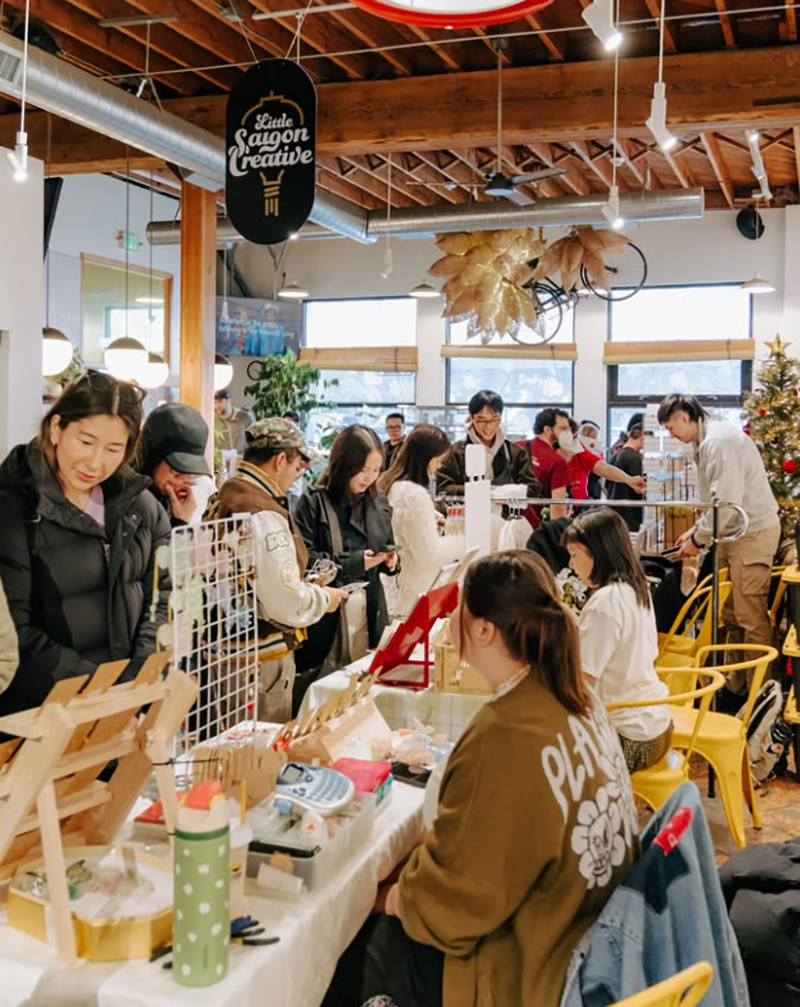
“We really try to create an environment where Asian American youth, adults, families—everyone can feel welcome and have activities to do, gather, and make friends,” said Anh Nguyen, Arts & Culture Program Manager of Friends of Little Saigon.
The space regularly hosts book clubs, mahjong nights, workshops, and art exhibits through partnerships with other local groups.
Nguyen said the organization hopes to expand those efforts through a future landmark development project planned for 10th Avenue and Jackson Street.
“We really want the landmark project to be a place for everybody,” Nguyen said.
“More than a book club”
Seattle Chinatown Book Club began in late 2023 inside Mam’s Bookstore after organizer Mitchell Keo struggled to connect with other book clubs in Seattle.
“I had been to several book clubs in Seattle trying to see if I could click,” Keo said. “They weren’t really sticking.”
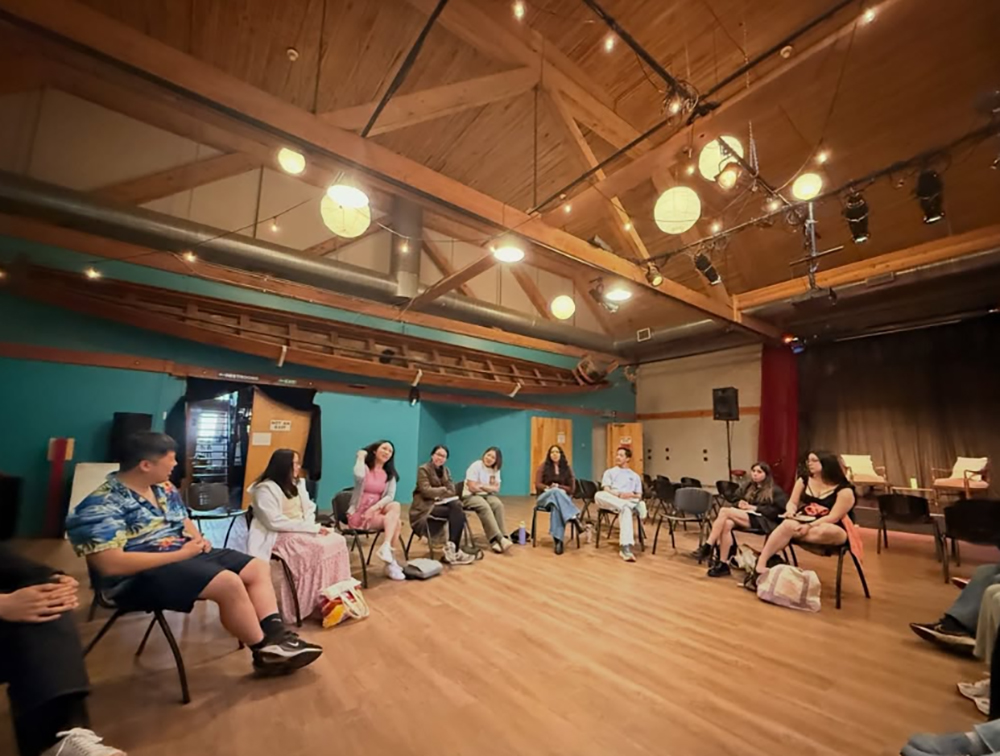
After conversations with bookstore owner Soka Danh, Keo helped launch a new club focused on Asian literature and community connection.
Attendance quickly grew from roughly 25 people to events drawing as many as 80 attendees.
Although the club centers Asian authors and perspectives, Keo said accessibility and warmth are core priorities.
“I never want it to feel like an academic school setting,” he said. “I want it to be a friendly, warm, and open conversation between people who are friends and people who have never met.”
The club intentionally chooses books by authors of Asian descent spanning genres and perspectives, from Cathy Park Hong’s Minor Feelings to romantic comedies and international fiction.
“We try to keep a good amount of variety,” Keo said.
But the organization’s goals extend beyond literature.
“We did come up with the motto: ‘more than a book club,’” Keo said. “The overall goal is to build a community for people to share resources and support in the CID to help each other out.”
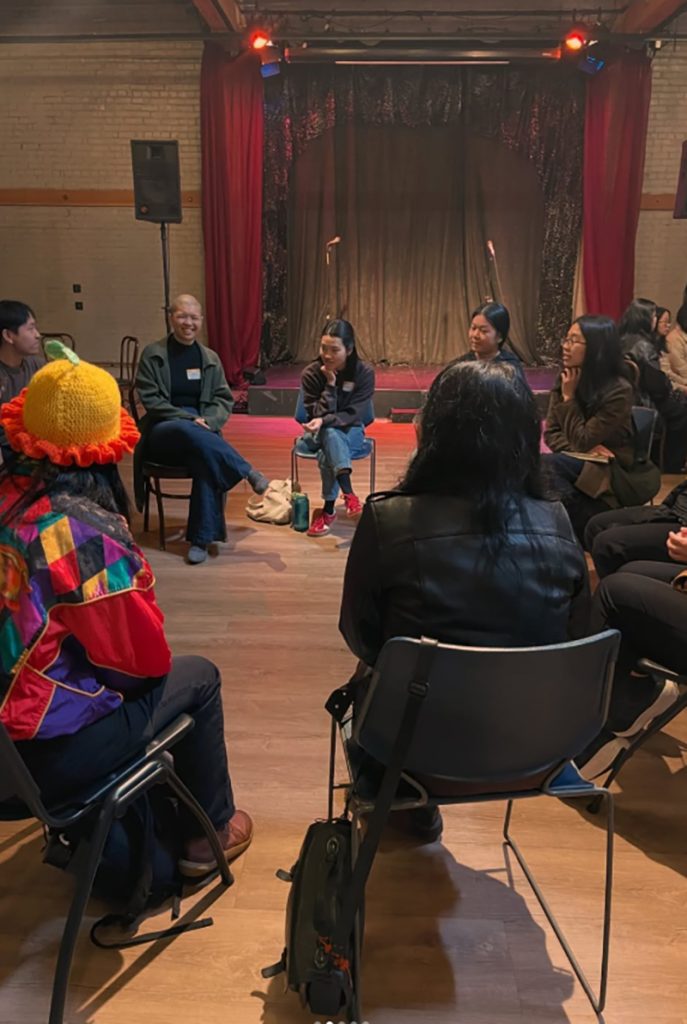
That support network now includes a WhatsApp group where members share mutual aid resources and information.
“When you come to the book club, you’re tapping into a larger pool of people who take care of each other,” Keo said.
Noel Malpaya discovered the book club by coincidence when he went to Mam’s to pick up a book he ordered online. He decided to check out the following month’s meeting even though he didn’t read the book. The group talked about The Manicurist’s Daughter by Susan Lieu, and Malpaya said it was a wonderful discussion about food, culture, and family. The questions were general enough that he was able to share his own experiences despite not reading it.
Now, he regularly helps host events ranging from board game nights to karaoke and open mics.
“It really is more than a book club to me,” he said. “It’s a place of home.”
For many participants, that sense of intentional community is what makes these emerging third spaces feel distinct.
At ECTC, Ahn said cultural exchange often happens naturally around the mahjong table.
“I’m Korean, but I have Chinese, Indonesian, Malaysian, and Filipino friends through the club,” she said. “Even mahjong itself has different rules depending on the country. We exchange perspectives from the ways we all grew up differently.”
As Seattle’s Asian American third places continue to grow, organizers say the goal is not simply to recreate nightlife in a different format, but to create spaces where people feel seen, welcomed, and connected—whether over mahjong tiles, books, milk tea, or conversation.
Nina can be reached at newstips@nwasianweekly.com.