



By Nina Huang
NORTHWEST ASIAN WEEKLY
As Asian American and Pacific Islander Heritage Month spotlights the growing influence of AAPI leaders, workplace expert Aiko Bethea is asking a deeper question: Who actually feels safe at work—and why?
Provided by Aiko Bethea
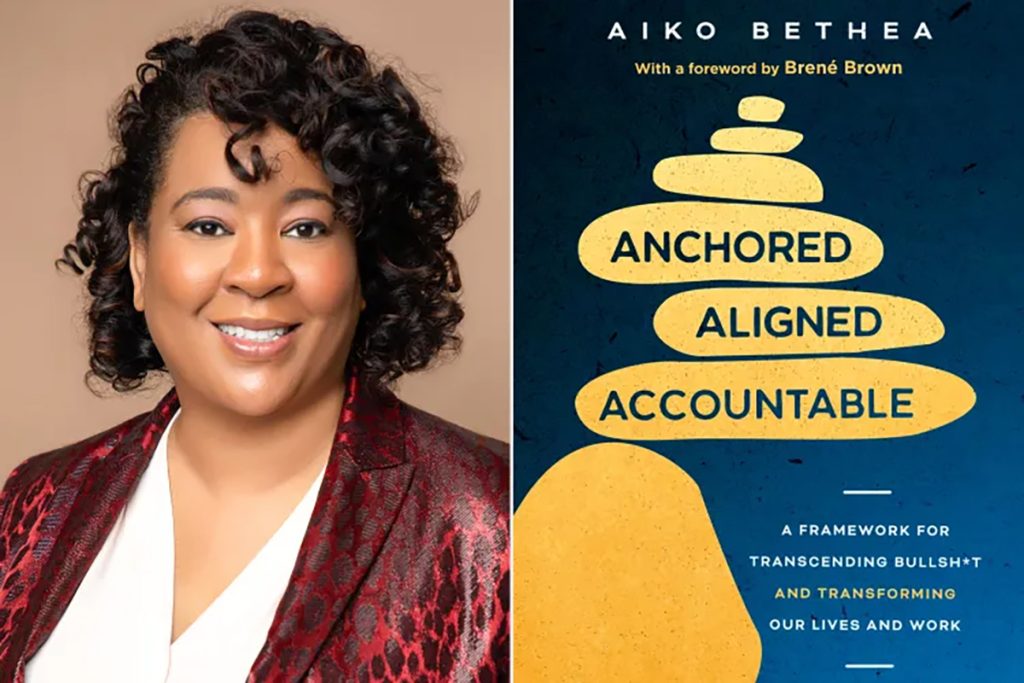
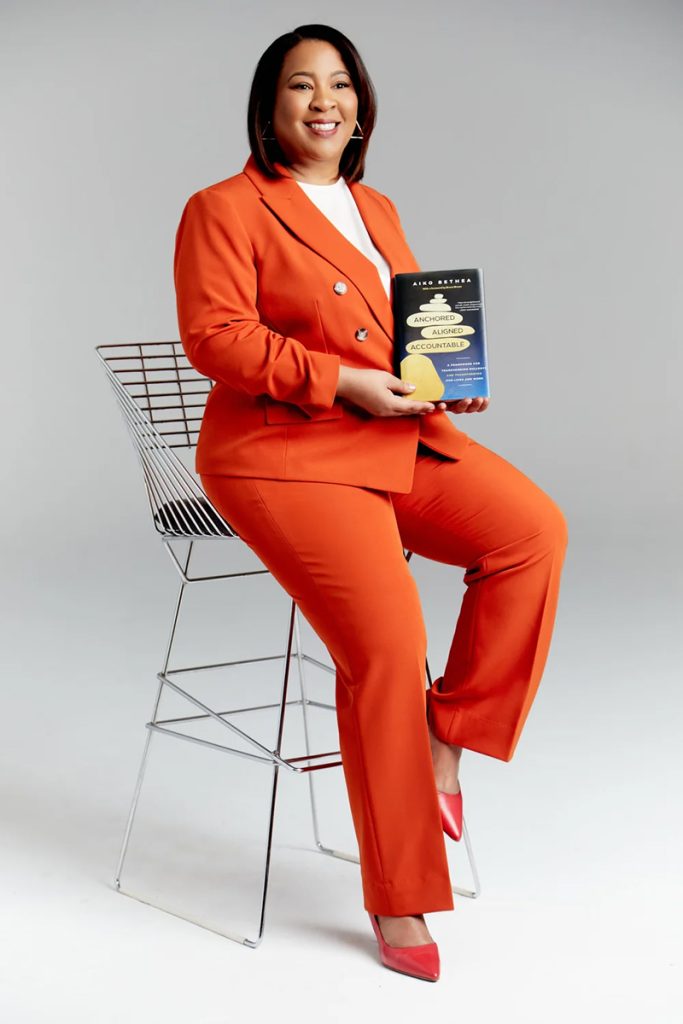
In her new book, Anchored, Aligned, Accountable (Random House; April 21), Bethea challenges widely accepted leadership concepts like psychological safety, arguing that they often overlook the realities of identity and power.
“Most leadership books don’t talk about power or identity,” Bethea said. “They’re always in the voice of dominant culture… they don’t talk about the power and identity of the marker of power.”
For many Asian professionals, that gap is familiar. Cultural expectations around respect, harmony, and deference can clash with workplace norms that reward directness and self-promotion—creating tension that often goes unspoken.
A multiracial upbringing across cultures
Bethea’s perspective is rooted in her own upbringing across multiple identities and environments.
She grew up in South Carolina and spent her high school years in Long Island, New York, in what she describes as a unique cultural blend. “I was raised in a Japanese-speaking household, but we were also very poor in an all-Black neighborhood.”
That contrast, she says, became a gift. “Usually when we’re multiracial, if you were well off, a lot of the time you’re not raised around Black people—it was the best of both worlds.”
Raised by her Japanese mother and grandmother, Bethea learned cultural values that would later shape how she navigated professional spaces—and the friction that can come with it.
“In Black and Japanese communities, you don’t boast,” she said. “Even though you busted your butt… culturally, you don’t self-promote.”
From law to leadership coaching
Before becoming a leadership consultant and founder of RARE Coaching & Consulting, Bethea built her career in law and public service, including work in Atlanta and later as a deputy director at the Bill & Melinda Gates Foundation in Seattle, where she lived for 11 years.
Today, she leads a team of 30 executive coaches and works with leaders across industries, helping them navigate complex organizational dynamics.
Her new book marks a shift from contributing to others’ work—such as Brené Brown’s You’re Your Best Thing anthology—to publishing her own framework.
Bethea has a desire to write fiction books, but because her work is focused on leadership development, she realized there was a need she had to address.
Rethinking accountability
At the core of Anchored, Aligned, Accountable is a redefinition of accountability—one that moves away from blame and toward curiosity.
“Most people don’t know how to hold others accountable,” Bethea said. “Accountability doesn’t have to mean blame or consequence.”
Instead, she emphasizes curiosity as a powerful tool. “Say you said something… that was hurtful. Instead of saying, ‘I can’t believe you said that,’ say, ‘Hey, tell me what you meant by that.’”
That shift requires intention. “It requires you to pause… be more open than you want to be… self regulate, be aware, be curious,” she said. “Curiosity is care.”
But slowing down is often the hardest part.
“We end up acquiescing to a false sense of urgency—faster, faster, produce more,” she said.
“Versus understanding how we can be more impactful.”
Provided by Aiko Bethea
Listening for connection
One of Bethea’s key frameworks is what she calls “channel surfing” in communication—three distinct ways people listen.
“Listening to respond, listening to understand, and listening for connection,” she said.
The third mode, she argues, is where transformation happens.
“When clients shift, even the cadence of how people talk changes,” she said. “Eye contact is longer, the words are different.”
In that space, “we’re centering the person in front of us,” she said. “It shifts everything.”
Navigating cultural conditioning
Bethea also explores how deeply ingrained cultural norms shape workplace behavior—especially for those from immigrant or collectivist backgrounds.
“You don’t behave a certain way in public… saving face,” she said. “Even though they’re wrong, you never say it… directness isn’t appreciated.”
These patterns can carry into professional settings, sometimes limiting people’s ability to advocate for themselves.
“When I show up at work, I could end up deferring to that,” she said. “I can’t push back against authority.”
At the same time, she acknowledges that these behaviors can serve a purpose.
“Conflict averse—might feel like more people like it,” she said. “But there might be a cost; resentment might grow.”
Her goal is not to reject those cultural values, but to examine them.
“You can’t change what you’re not aware of,” she said.
Creating space for reflection
Throughout the book, Bethea encourages readers to reflect on their own behaviors and beliefs—without judgment.
“I want people to have more agency and permission to show up in ways that are honest to them,” she said. “To have conversations with themselves that they haven’t in other spaces yet.”
One chapter is designed as an interactive experience, presenting real-world scenarios and asking readers to choose how they would respond.
“I want people to feel physically activated,” she said. “Because this is what it truly feels like.”
A timely conversation
As conversations about leadership evolve, Bethea hopes her framework will resonate beyond traditional diversity discussions.
“One of my concerns was that this is a DEI book versus a leadership book,” she said. “It isn’t.”
Instead, she sees it as a broader call for more human-centered leadership.
“We are the most complex machines that exist,” she said. “Yet we focus on tech, versus understanding how to master this complicated machine we’re in.”
That means building emotional awareness, slowing down, and learning to lead with intention.
Bethea will return to Seattle on May 18 for a public talk presented by Elliott Bay Book Company and held at the Seattle Children’s Theatre, along with a private event at the Gates Foundation.
For her, the work continues—through coaching, teaching, and now, writing.
“I really enjoy the work that I do,” she said. “I really love working with people who are trying to do this work.”
With Anchored, Aligned, Accountable, she’s offering a guide—not just for navigating the workplace, but for showing up more fully within it.
To learn more about Aiko Bethea and order her book, visit aikobethea.com.
Nina can be reached at newstips@nwasianweekly.com.