





By Carolyn Bick
NORTHWEST ASIAN WEEKLY
In the wake of police and fire department raids on five Asian-run massage parlor businesses in Bothell last week, the Massage Parlor Organizing Project (MPOP) and fellow labor and immigrant safety organizations say low-income workers are facing growing pressure from rising living costs and preparations for the upcoming FIFA World Cup.
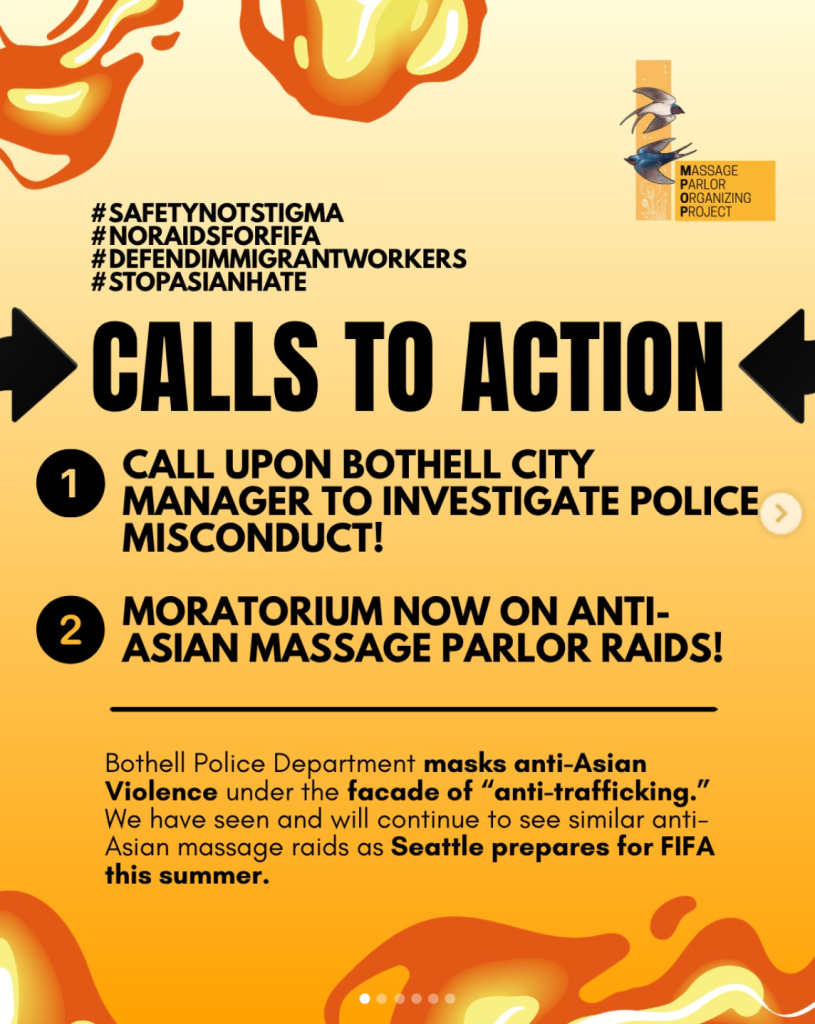
They held a protest outside the King County Jail in Seattle on Monday to highlight what speakers called a targeted attack on Asian-run businesses.
“Asian massage is not the same as trafficking. We want everyone to take away this message wherever you are,” said emcee and MPOP member J.M. Wong, speaking alongside organizers from Whose Streets? Our Streets, Red Canary Song, and International Migrants Alliance.
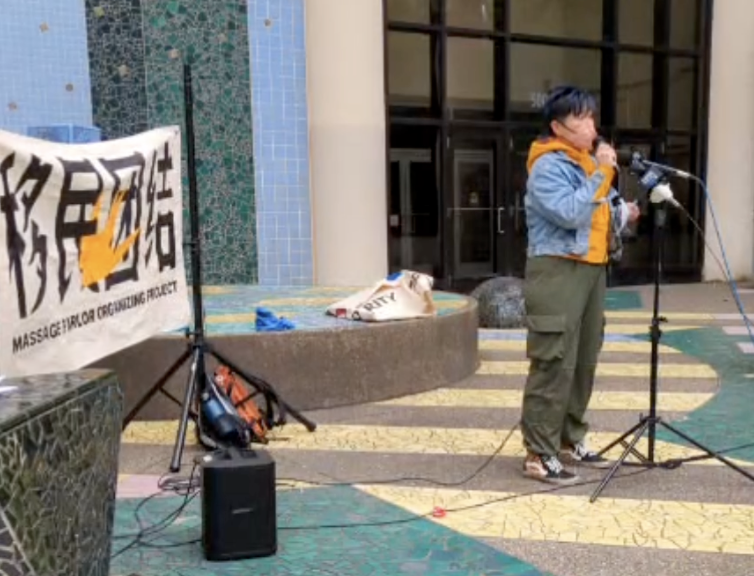
J.M. Wong speaks at a Seattle news conference on April 20, 2026, outside the King County Jail after Bothell massage parlor raids. Screenshot from Instagram/@mpop_sea
The Bothell massage parlor raids, Wong continued, are just the latest in a string of anti-Asian attacks under the guise of law enforcement. “This is a pattern that we have seen in this country, in this region and we are here to say no. … These raids actually make Asian workers way more vulnerable to state violence. … We call on King County and Seattle elected officials to declare a moratorium against anti-Asian raids of massage parlors.”
MPOP is a Chinatown-International District (CID) and Seattle area grassroots organization whose mission is to support the rights of massage workers and create better working, safety, and living conditions for workers. The organization has already held a handful of demonstrations since January, kicking off the year with a protest against the state’s Human Trafficking Summit that included at least one speaker from the Department of Homeland Security and regulatory agencies, like the police, but shut out community service providers.
Five years ago, Wong said, the country witnessed the horrific massacre of six Asian massage parlor workers in Georgia, an anti-Asian hate crime fueled by racism and fetishization of Asian women. MPOP held its fifth anniversary vigil this past March. This was only possible, Wong said, “because of the climate of systemic institutionalized racism against Asian people.”
“That was during the COVID era. Today, we are seeing the systemic violence that made that vigilante violence possible,” Wong continued. “We want to say loud and clear that the collaboration between the Bothell Police Department and the Bothell Fire Department attacking these massage parlors are creating the conditions of anti-Asian violence and we’re here to call on that to stop.”
Criminalizing Asian massage parlor workers
During the raid, said an MPOP member named J.H. Chen, reading from an MPOP group statement, police and fire department officials allegedly “violently” raided the massage parlors, and “ripped out security cameras, tore art off walls, knocked doors off their hinges, and seized money from workers.” Bothell officials also put Stop Work orders on the front doors, alleging fire code violations, including improper cooking appliances, no fire extinguishers, and sleeping occupancy.
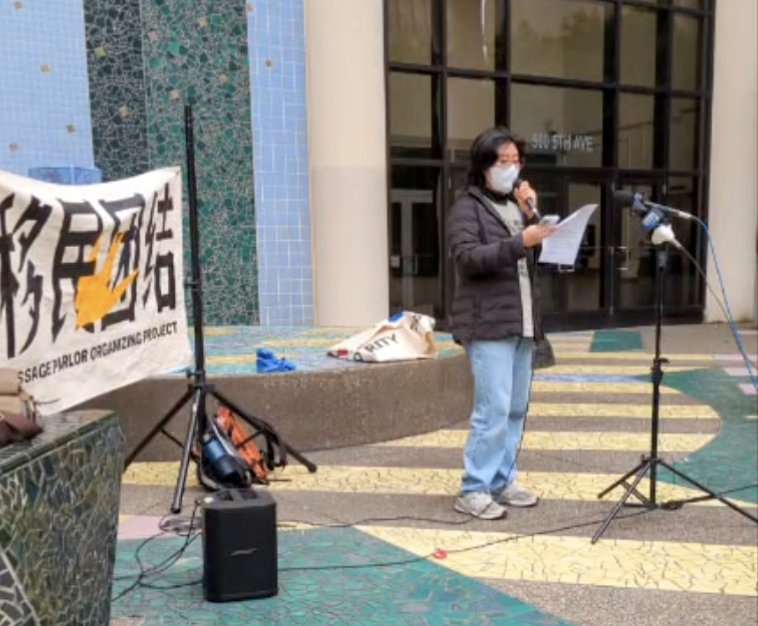
J.H. Chen of MPOP speaks during a news conference outside the King County Jail on April 20, 2026, addressing police raids on Bothell massage businesses. Screenshot from Instagram/@mpop_sea
“When is the last time you heard of a business getting their doors kicked in for this? We’d like to point out the irony that when people sleep outside, they get caught up in encampment slips and if they sleep in their own businesses, they get rated on fire code violations,” Chen said. “To the executives of King County Cities and Bothell: Where are people supposed to sleep if they can’t afford high rent in cities that are tearing up for FIFA? Operating a fire code safe business is important and so is being protected from targeted state violence. That includes protection from police being allowed to destroy your livelihood as a low-income immigrant worker because you don’t have a fire extinguisher.”
“The police like to say that they are cracking down on quote illicit massage parlors because they are supposedly hotbeds for human trafficking and do a PR tour after traumatizing Asian workers,” Chen continued. “If they were truly rescuing these workers, why must they use fire code violations to address human trafficking?”
In the organization’s years of outreach—MPOP has been operating since 2018—organizers have spoken with hundreds of Asian massage workers, none of whom have said trafficking is an issue they face, Chen said. Raids like this only serve to reinforce the narrative that all Asian massage workers, who are predominantly women, have to be “saved,” and that Asian massage parlors are simply fronts and hotbeds of human trafficking.
Such raids also ultimately hurt the workers, according to the workers themselves. J.H. read a statement from a massage parlor worker about the Bothell raids.
“‘Allowing police to enter massage businesses based on any complaint does not protect us. It encourages violence and abuse. Some bad customers already threatened to report workers to avoid paying or tipping, exploiting our fear of police and deportation. We live with the constant fear of armed robberies,’” Chen read. “‘Many of our sisters have been injured and some have lost their lives. This system makes workers less safe, not more.’”
The state’s current system of massage licensure already criminalizes workers, J.H. said. The lack of language accommodations is deliberate, they said, and “forces Asian workers to pay exorbitant training fees of upwards of at least $13,000 and pass an English-Spanish only exam.”
“This intentional exclusion of Asian immigrant workers’ cultural and professional expertise leads to compelled unlicensed practice, which the police ironically use to justify their raids,” they continued. “To again quote a worker, ‘The more prohibitions and inspections there are, the more hidden and the more severe the exploitation and the fewer choices we have.’”
Chen listed MPOP’s six demands: equitable access to massage licensure; recognition of culturally informed bodywork; stopping the criminalizing of survival work; labor rights for informal workers; safe and accessible housing; and access to immigration legal support.
“Raids are going to become more common as we approach the FIFA World Cup this year,” they noted. “Big sporting events have historically been used as an excuse to clean up this city. We’ve already heard of raids and targeted inspections of massage parlors in Shoreline, Kirkland, Bellevue, and Tacoma. We need to stand up for our neighbors and stand up for migrant workers to keep our cities running.”
Chen also directed listeners to a letter they could sign demanding support for migrant massage workers.
Performative progressives
Maria, from grassroots safety policy organizing group Whose Streets? Our Streets, said that, as a Black and Filipino woman, she is used to seeing pink hats and the progressive-sounding signs in front yards, like “Black Lives Matter.” More recently, those signs have come to include, “ICE is not welcome here” and “Immigrants are welcome here” messages. But that’s all feeling a bit performative, she said, and she isn’t feeling as hopeful as she has in the past.
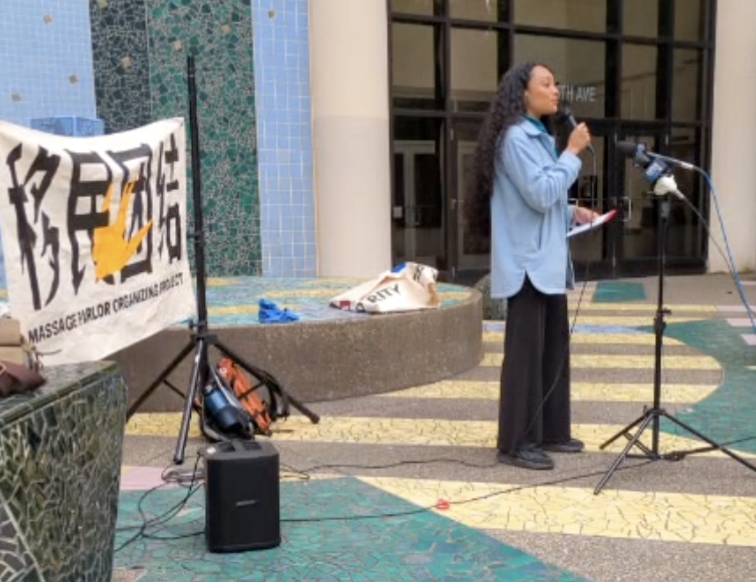
Maria, an organizer with Whose Streets? Our Streets, speaks outside the King County Jail on April 20, 2026, at a news conference on Bothell raids. Screenshot from Instagram/@mpop_sea
“We’re not talking and walking the same things. What I feel we have created in our county and in our city is surveillance cities,” Maria said, referring to the City of Seattle’s decision to increase its surveillance cameras. “We have a surveillance city, a surveillance state that is run by police departments, by leaders, by Axon, by our mayor, by our governor. And that surveillance is not keeping us safe.”
Instead, she continued, the city has simply created more tools for Immigration and Customs Enforcement (ICE) to use, and the state’s own Department of Licensing continues to share drivers’ personal information with federal immigration agents. Neither of these things keeps immigrants safe.
“We’ve created conditions where kidnappings and raids are our normal. Fear, violence, destruction—all for our protection,” she said. “That’s what it feels like our normal is right now. And it’s frustrating. I’m angry at the county, our city, our state.”
But, Maria said, she is also “angry at each other.” As she was reading up on what had happened in Bothell, she came across a KING 5 story wherein the station interviewed a business owner who runs a furniture store across the street from one of the massage parlors the police and fire departments had raided.
“And I want to quote what that person said. He said, ‘For some odd reason, we have a lot of massage parlors and nail salons and stuff around here. And I never put one and two together,’” Maria said, reading the owner’s quote. “One and two together, huh? So there must be some math here. So he’s saying massage parlors and nail salons, one and two together, that equals what? … It’s saying that when you have immigrant Asian women and you have businesses and you put one and two together, you’re supposed to have trafficking. You’re supposed to have prostitution. I don’t believe that. I don’t believe in that math. I think that that’s stigma. I think that that is disgusting. I think that that is fetishization.”
This kind of stigma is what allows violence against Asian women and Asian business owners to persist, Maria said.
“People should just be able to have their businesses like anybody else,” she said, but “[t]his is the normal that we’ve created. … This is the normal that is not woven into the pink hats that we wear or the signs that we see across the city. It’s the same normal that lets you turn a blind eye to neighbors shivering on the streets and in the jails and in the detention centers.”