


By Carolyn Bick
NORTHWEST ASIAN WEEKLY
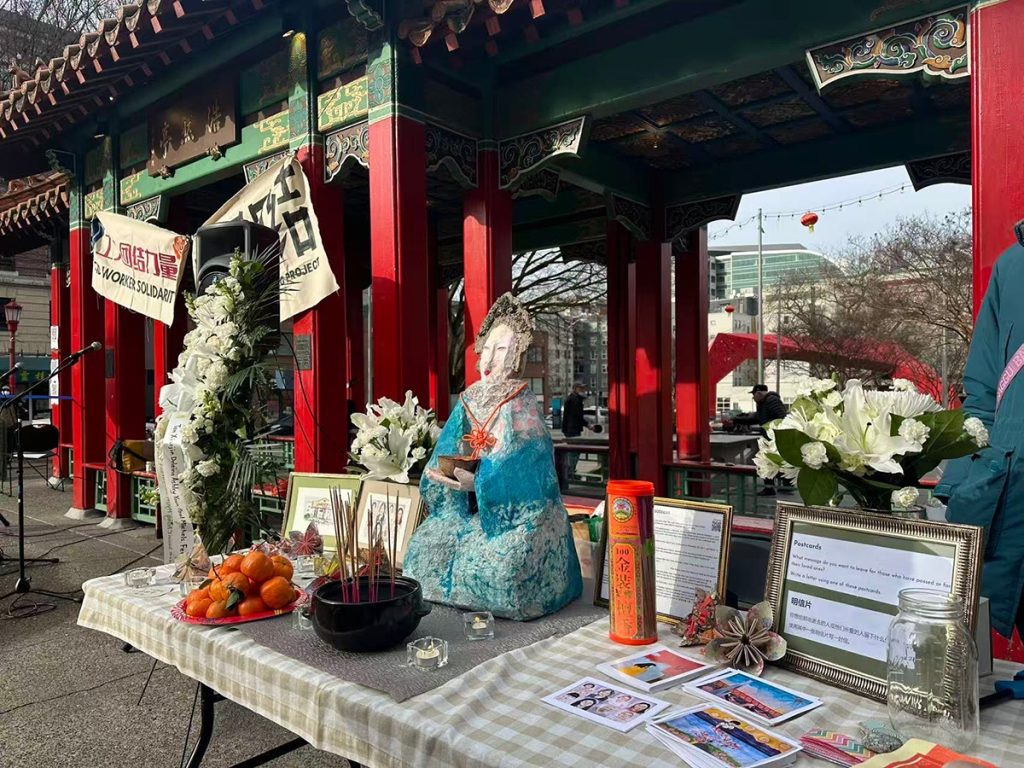
Photo courtesy of MPOP
“We gather here today to grieve and remember, to honor the dead, and fight like hell for the living,” said Rachel Sun, standing just in front of the Grand Pavilion at Hing Hay Park in Seattle’s Chinatown-International District, as she addressed attendees at Massage Parlor Outreach Project (MPOP)’s vigil on March 15 to honor the eight people a gunman killed in Atlanta in 2021.
The Atlanta shooting was an anti-Asian hate crime attack, with the attacker specifically targeting Asian massage parlors. Of the eight people the gunman killed, six were massage parlor workers. The gunman said he was doing it to rid himself of “sexual temptation.”
“He saw Asian massage workers as nothing more than sexual objects responsible for inciting his violence. We name what the police refused to admit, let alone condemn: This was a racist hate crime driven by the fetishization of Asian women, Asian massage workers, and the utter devaluation of their care labor, lives, and communities,” said Sun, who serves as MPOP’s media contact. “We say their names: Kim Suncha. Park Soon Chung. Hyun Jung Grant. Yue Yong A. Tan Xiaojie. Delania Ashley Yaun. Paul Michaels. And Feng Daoyou.”
A grassroots organization of Asian and Asian American community members, MPOP formed in response to the shootings, with the goal of supporting Asian massage parlor workers, sex workers, and care workers in the Seattle area.
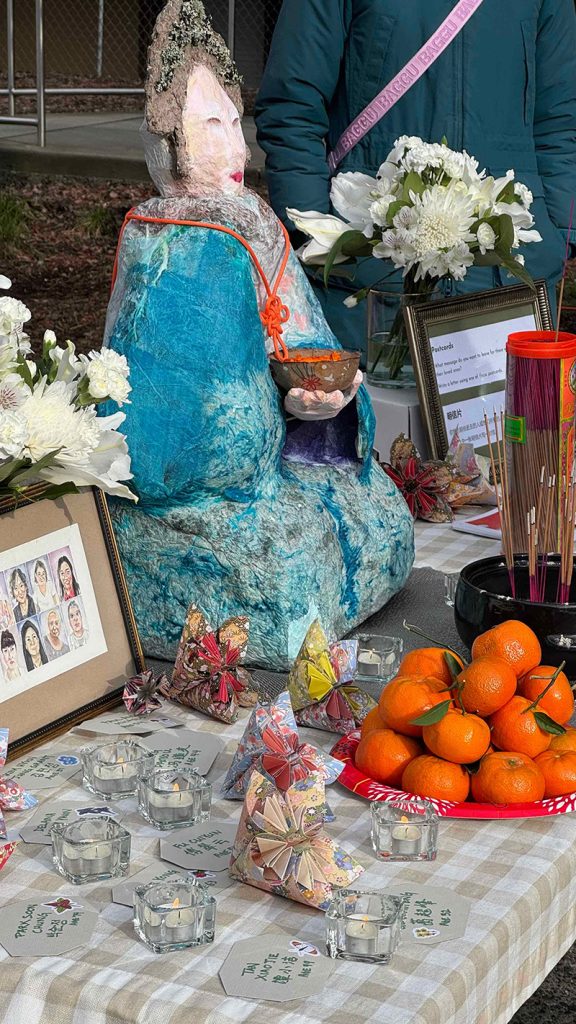
Photo courtesy of MPOP
Safety, Not Stigma
MPOP has continued to grow and advocate for massage workers’ rights, and fight against carceral responses to massage work. Most recently, the organization protested the state’s Human Trafficking Summit at the Hotel Murano in Tacoma. The summit, MPOP said, iced out service providers, did not appear to include input from survivors, and focused on law enforcement and punitive solutions to trafficking.
At the vigil on Sunday, MPOP announced the launch of the Safety Not Stigma campaign to advocate for safe and dignified working conditions.
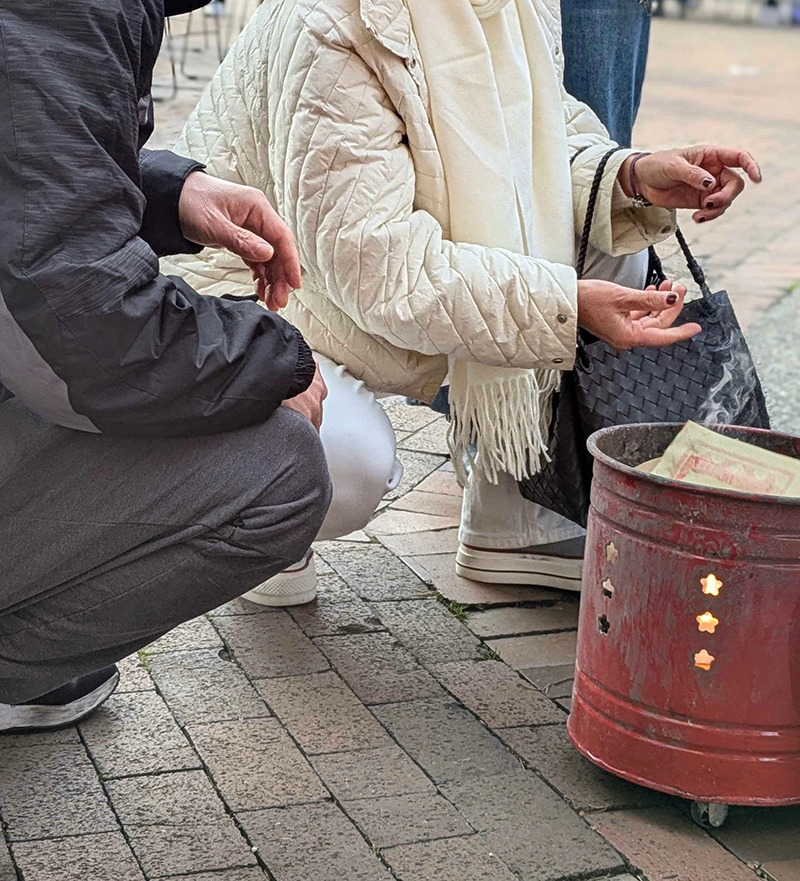
Photo courtesy of MPOP
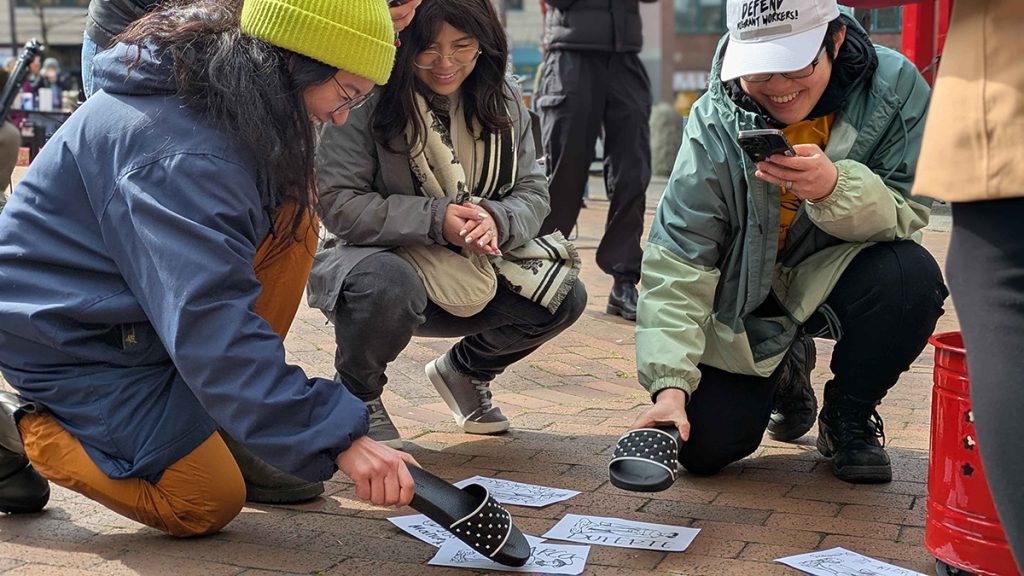
Photo courtesy of MPOP
The list of demands includes diversified access to licensing for Asian massage workers—many of whom are excluded by the lack of language access and the exclusive regulation of the licensing process by the Federation of State Massage Therapy Boards (FSMTB), which MPOP says has expressed anti-Asian sentiments and which shares applicant and licensee data with law enforcement. The FSMTB was one of the hosts of the January Human Trafficking Summit, and has ties to the U.S. Department of Homeland Security (DHS).
The list also includes an end to punitive and carceral responses to trafficking, which the organization says is just another method to target and harm already exploited workers. Criminalizing the work, the campaign list states, only drives people further into “precarious work and living conditions that increase their vulnerability to trafficking, especially labor trafficking.”
“Carceral anti-trafficking actors use unlicensed massage, caused by racist language and financial barriers, as ‘evidence’ of human trafficking,” the demand item reads. “They raid, arrest, and charge workers, displacing them from their places of work and homes, seizing their money and belongings, all in the name of ‘rescuing’ them.”
“But we know that workers are actually the ones who know their own conditions and who will be able to change them. And that is really through speaking from their own perspective and telling their own story,” said Alex, a member of MPOP, addressing the crowd. “So, when workers say they want safety, they mean real safety. Safety that can only be created through themselves leading a mass movement that is fighting for just working and living conditions to end the roots of the systemic violence that they face.”
To that end, MPOP is also calling for safe, affordable housing in its campaign. The organization underscored the fact that people become more vulnerable to trafficking, when faced with increasingly difficult financial circumstances and housing instability.
The need for safety in places workers can actually afford to live has only increased in the face of federal immigration raids across the country, and the fact that multiple reports show local police have helped federal agents arrest immigrants. Most of the people federal agents arrest have no criminal charges.
“We do not believe that police give us safety. There are many attempts in this neighborhood that equate safety with police presence. At MPOP, we know that’s not true,” MPOP member JM Wong asserted. “We know that’s not true because workers tell us that police organize raids under the pretext of rescuing them from trafficking—this hysteria around anti-trafficking that relies on law enforcement collaboration with DHS and ICE (Immigration and Customs Enforcement) to ‘rescue’ workers from Asian massage parlors. What we hear from workers is instead that they get arrested because many of them are unlicensed massage workers. What we hear from them is their money gets stolen. We hear from them that they actually are victims of state violence.”
MPOP also highlighted the fact that the state’s Department of Licensing continues to share drivers’ information with both ICE and Customs and Border Protection agents.
The state’s 2019 Keep Washington Working Act is supposed to protect immigrants by prohibiting this practice across all Washington agencies. In February, people protested the department’s data-sharing practices, and called on Gov. Bob Ferguson to stop the department from doing so.
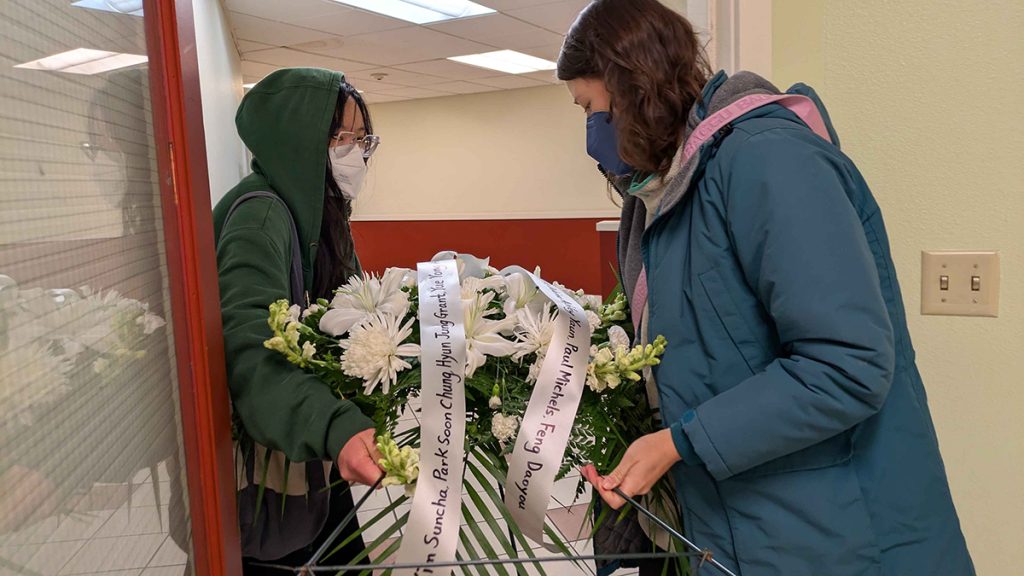
Photo courtesy of MPOP
Speaking out
“There’s a challenging irony when our federal administration prioritizes its anti-trafficking efforts towards shutting down ‘illicit massage businesses’ and actively chooses to criminalize migrant workers, while wealthy businessmen and politicians who allegedly engage in widespread national sex trafficking and child sexual abuse are not being investigated or held accountable,” Nikki Huang, a board member with API Chaya, said during the vigil. API Chaya is a grassroots organization that works to protect survivors of sexual violence and trafficking.
“If our administration is truly against human trafficking,” she continued, “then their attention should be directed towards justice and accountability for the survivors of Epstein’s alleged sex trafficking and human rights violations.”
“Violence, be it gender-based violence, domestic violence, sexual assault, and human trafficking is about patterns of power and control,” she continued. “When our institutional systems enable human trafficking while simultaneously blaming, criminalizing, detaining, and deporting migrant workers, it’s important that our communities call attention to this blatant abuse of power and control. Migrant workers are not the problem, but prioritizing workers’ rights and holding traffickers accountable can be a solution.”
MPOP worker leader Evelyn shared her experience of hearing about the shooting, and the lasting impacts it had on her.
“Five years ago in Atlanta, eight lives were taken in one single day. Six of them were Asian women. Many were immigrants, mothers, and daughters. People who, like many of us sitting here today, worked hard with their hands and struggled to build a life,” Evelyn said through a translator. “The gunshots that day were not just a tragedy for one city. They deeply shook countless immigrant workers fighting for their future far from home.”
Evelyn said that even now, she feels “very heavy-hearted,” and believes that the violence massage therapists face is “actually related to the long-term prejudice in society.”
“Many people have a rigid impression of the massage industry, Asian women, and immigrant workers. They look down on us. They even feel that they can offend or hurt us at will. These things also show that in real life, many immigrant workers are not really protected. … So many workers can only endure silently, instead of being protected by a truly safe and fair system.”
She said that the best way to help Asian massage parlor workers is to treat them as ordinary workers, instead of linking them to a criminal industry, stigmatizing them, and treating them as lesser-than.
“What most workers need is very simple: A safe work environment, respect for our basic rights, and a way to seek help when we have problems without fearing punishment because of our status or our job,” Evelyn said. “If I could say one thing to policymakers, it would be, ‘When you discuss how to protect Asian massage workers, please listen to the workers’ own voices, first.’”