



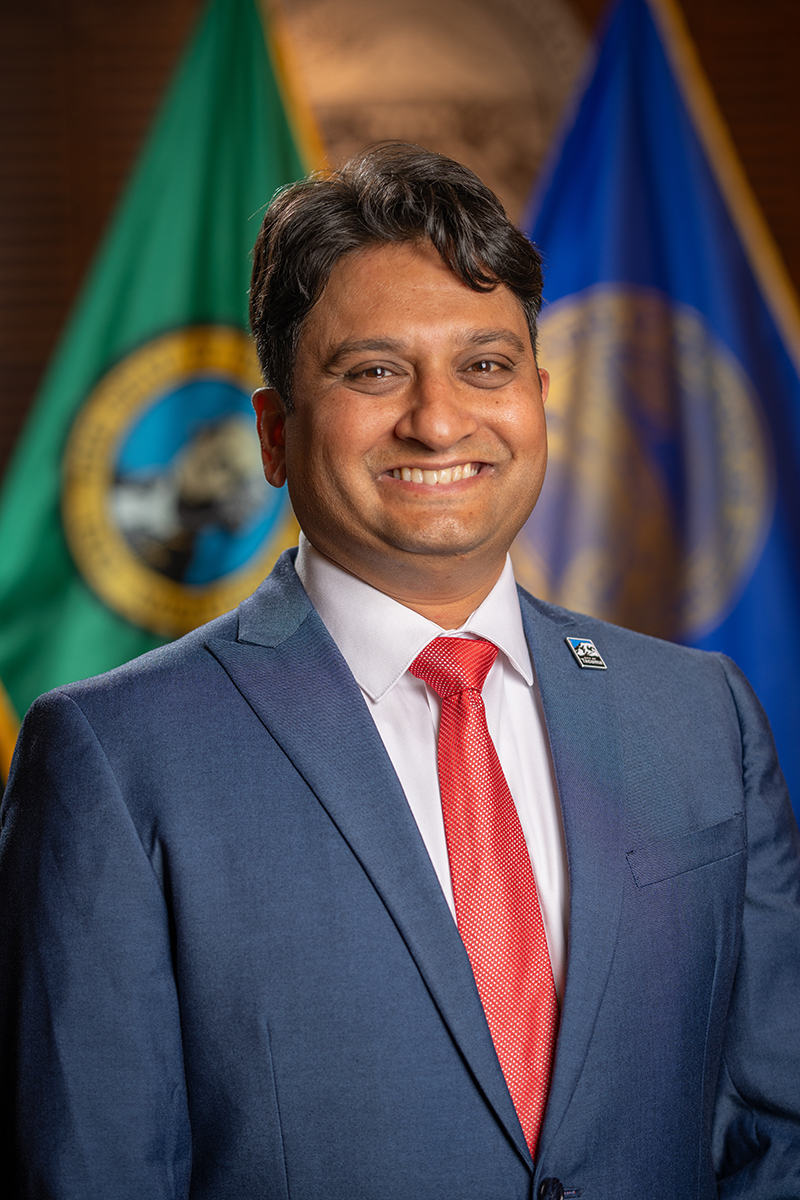
Sandesh Sadalge
A Tacoma city council member is urging regional transit leaders to center equity as they consider whether to delay a major light rail project serving the city.
District 4 Council Member Sandesh Sadalge —the first South Asian to serve on the Tacoma City Council—said the Sound Transit Board faces a pivotal decision as it works to address a $34.5 billion budget shortfall. One option under consideration is delaying the Tacoma Dome light rail extension—a move he said would disproportionately affect working-class communities.
“Honestly, I was pretty pissed off,” Sadalge said, referring to recent discussions at Tacoma City Council meetings. “I was angry for our region, our city, my district.”
Sadalge said his frustration reflects a broader concern about how public investments are prioritized when funding is limited.
“When resources get tight, the same pattern tends to repeat itself,” he said. “Communities with more access and opportunity are taken care of first, while others are asked to wait.”
The debate comes as Sound Transit continues expanding light rail service across the region, including the recently opened Crosslake line linking Seattle and Bellevue—a connection that significantly improves access between the two cities.
Against that backdrop, Sadalge said communities in Tacoma’s Eastside continue to face long commutes and fewer transportation options.
According to U.S. Census Bureau data he cited, only about 11% of Tacoma Eastside residents can work remotely, compared with roughly 40% in areas farther north. In addition, 63% of residents travel outside Tacoma for work, with most relying on cars and high-occupancy vehicle lanes along Interstate 5.
“For my district, light rail to the Tacoma Dome is not a convenience,” Sadalge said. “It is an economic necessity.”
He described East Tacoma as a “richly diverse, majority-BIPOC area where 33% of residents speak a language other than English and where the median household income is only two-thirds that of the north.”
Those factors, he said, make access to reliable, high-capacity transit especially critical.
“This is a moment where the decision really matters,” he said. “Do we continue the same patterns, or do we actually close the gap?”
The Sound Transit Board has not yet made final decisions on how it will address the budget deficit. Officials are expected to weigh potential project delays and other cost-saving measures in the coming months.