




By Carolyn Bick
NORTHWEST ASIAN WEEKLY
It’s been eight weeks since President Donald Trump and Israeli Prime Minister Benjamin Netanyahu began a war with Iran, fundamentally reshaping everything from international trade to markets to policy, to say nothing of the many lives the war itself has taken.
But there’s another shift happening, too. The war has seen China’s role in the world change, Thomas Krueger, a senior policy advisor at Akin Gump with expertise in international affairs and national security, explained in a Committee of 100 webinar on April 21. But, he explained, this doesn’t necessarily mean that the war is to blame for how many in the U.S. treat or perceive Chinese Americans when it comes to suspicions regarding loyalty.
Increasing tensions, increasing mistrust
In the wake of the war, the Chinese government has taken the opportunity to position itself as a responsible global leader, Krueger said, doing its best to display non-interventionist policies from a fundamental perspective of stability. One way to see this in action is the language government officials, including President Xi Jinping, are using.
“They’re using language that we’ve seen, like the ‘law of the jungle,’ for instance, in multilateral affairs,” Krueger said, referring to a term for a ruthless global environment, where only the strong and those without morals survive, which Xi recently used. “They’re setting themselves as being the restrained responsible party in this conflict. They also point to U.S. actions as a violation of international law. … Even though they don’t talk about intervention and support Iran directly, they do speak about state sovereignty as being very key. They’ve also spoken out strongly about unilateral military action without U.N. authorization, and they reject the whole concept of regime change.”
So, he said, what the Chinese government is trying to do is “take advantage of this particular conflict to kind of show that China and the Chinese Communist Party is the responsible actor on the world stage at the expense of the United States.”
“They clearly do not want to help the United States get out of this conflict. They really don’t have to do anything,” Krueger continued. “The U.S. and the administration is, in a lot of ways, from their perspective, shooting themselves in the foot. And they’ll just allow the U.S. to kind of bumble through this, so to speak. … China is not going to be so quick to support Iran either, because it has a lot of equities and a lot of strong relationships with Gulf countries.”
For instance, on Monday, Xi also called for the Strait of Hormuz to reopen, without specifying which party—the U.S. blockade or Iran—is responsible for making that happen.
“When you see the whole picture, they’re playing a very delicate game in terms of how they’re managing this diplomatically,” Krueger said.
Taiwan
There have been rumblings of China’s potential invasion of Taiwan since early this year, following the U.S. capture of Venezuelan President Nicolas Maduro and his wife, Cynthia Flores. Then, experts pointed out that the couple’s capture violated international norms, and may have opened the door for China to justify invading Taiwan.
Those rumblings haven’t gone away. As an addendum to an attendee’s question, moderator Ben Wu asked Krueger whether he thinks China President Xi Jinping will “put Taiwan on the table,” if he’s trying to court Trump for a friendlier U.S.-China relationship.
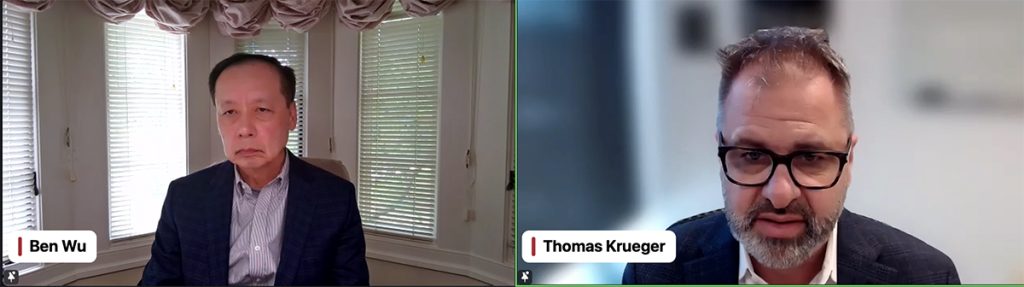
Ben Wu and Thomas Krueger
Krueger said that, right now, he believes the Chinese government is simply “observing,” in order to take away lessons about how the U.S. engaged militarily with Iran and adjust their own strategies accordingly, in case they need to plan for military engagement in any capacity with the U.S.
One possible use of this intelligence gathering is in the event Xi decides to invade the Strait of Malacca. While this strait, which connects the Indian Ocean to the South China Sea, hasn’t made top headlines lately, it nevertheless remains an important geographic weak point for China, as 80% of China’s needed oil passes through that strait.
But Krueger doesn’t think the Chinese government would opt to invade Taiwan. Instead, he thinks the government would use an “economic stranglehold to take Taiwan.”
“[Xi] is really monitoring the domestic situation in Taiwan to see if there’s a softening towards China or if there’s a hardening towards China,” Kruger explained. “I think a military invasion of Taiwan would be very, very disruptive—not only globally and make China look less responsible [as a potential world leader]—but also I think it’s going to lead to a lot of internal political instability.”
Any strait invasion, he continued, would create a lot of Chinese casualties. He doesn’t believe “China is used to having so many Chinese people being killed over a military operation. And there would have to be a calculation on how that would impact the regime stability itself.”
Perception matters
Krueger said that he wasn’t aware of any specific changes regarding perceptions of Chinese Americans directly related to the war itself. Instead, he said, the most divisive and harmful rhetoric already exists within the sphere of technological and scientific security.
“There are more perceptions that I think are not helpful, [like] the idea that if you hire Chinese nationals, especially into advanced semiconductor manufacturing or something like that … somehow that technology, if it’s going to a particular individual, is going to find its way back to China,” he said. “I think in terms of export controls, particularly, that narrative is out there. Yes, there are examples of IP theft. Yes, it is true that people of Chinese descent have done that, but that gets painted as a broad brush to everybody. And I think that creates a narrative that I think is unhelpful.”
He said that the public has to keep an eye out for these kinds of narratives that only serve to suppress and marginalize Chinese Americans. These narratives, he said, “at the same time hurt U.S. industry and the advantages that Chinese Americans actually bring to key sectors of the economy. … I go to export controls right away because we know there’s a licensing requirement for people of certain countries that work in these tech sectors. And we need to have a much more nuanced view of that so we don’t start broad-brushing people.”