


By Carolyn Bick
NORTHWEST ASIAN WEEKLY
Amidst the rapidly changing immigration and legislative landscape, the Asian Pacific Directors Coalition hosted a discussion to highlight specific challenges certain Pacific Islander communities face, report on the fate of a few items from the 2026 legislative session, and give a brief update about Jose Rizal Park and Filipinotown in the Chinatown-International District.
Trouble accessing REAL ID
Many Pacific Islanders from the Federated States of Micronesia, the Republic of the Marshall Islands, and the Republic of Palau don’t live in their home islands anymore, because of nuclear waste the United States left behind in the Pacific region, as a result of its atomic testing decades ago.
Those countries are part of the Compacts of Free Association (COFA), a treaty signed with the U.S. in part to compensate for islanders’ loss of life and health, as well as land and resources. The treaty allows people from these countries to live and work in the U.S. without visas, and receive Medicaid benefits.
But now, under President Donald Trump, many communities from these islands are increasingly concerned that immigration agents will come for them, despite their legal right to live and work in the country without the documentation usually required for workers from other countries. They—as well as U.S. nationals from the island of American Samoa—are having difficulty accessing the licenses that the country made mandatory in 2025 to fly anywhere, Adrianna Suluai, UTOPIA Washington’s policy and advocacy director, told meeting attendees. These pieces of documentation, which include U.S. passports, green cards, and enhanced drivers licenses (which are only available to U.S. citizens), are known as REAL IDs.

Adrianna Suluai
Suluai said that many of these communities have gathered together to start having conversations about what risks they face, especially after last year saw Immigration and Customs Enforcement (ICE) agents deport 40 Marshallese from the U.S. ICE sent at least one Marshallese man to Guantanamo Bay, the U.S.’s detention camp in Cuba meant to hold suspected terrorists, before diplomats could finalize his repatriation.
Guantanamo Bay—also known as GITMO—is notorious for its harsh conditions. Last January, Trump expanded operations at the detention center to create “additional detention space” for alleged “high-priority criminal aliens.” A majority of people the Trump administration has scooped up for deportation don’t have criminal records.
“That became one of the urgent concerns with a need to navigate and mobilize our community to have that conversation with our lawmakers about what is a solution that ensures the safety and wellbeing of our COFA communities and also allows them to travel and not be limited to just their nation’s passport,” Suluai said. Last year, she said, the state allocated $300,000 to Washington State Commission on Asian Pacific American Affairs (CAPAA) to help provide support to impacted people from COFA communities. That money was split amongst five organizations that work in areas that have a high number of people from Marshallese, Palauan, and Micronesian communities. She noted that they have asked the state to increase the budget, and that “it is on its way, so hopefully that gets signed in soon.”
“That funding is being used not only for outreach education, case management navigation, but also to provide financial assistance for folks who qualify for state benefits,” Suluai said. The communities, she said, “have been leaders in terms of advocating for themselves and with the [Native Hawai’ian and Pacific Islander] and Asian American communities. CAPAA assisted and helped to create the COFA Islander Healthcare Program and then expanded it to include dental coverage.”
“And then now of course, REAL ID is having a tremendous impact,” Suluai said. “They don’t need a work visa to be able to work in the U.S.—but they also don’t have a pathway to citizenship because they would have to go through the green card process. It is a very gray area when it comes to the immigration laws with the … COFA nations, specifically with how it was written. They can travel to the U.S. without visas and be able to live and work here. For any pathways to citizenship, they would have to go through the green card process. But if they married someone, they would then have a different pathway.”
Janice Deguchi, the executive director of human services agency, Neighborhood House, that contracts through UTOPIA to provide services, said that they have been working with Customs and Border Protection (CBP) to help people obtain their I-94s, special forms that show one’s documentation status in the U.S.
Janice Deguchi
“We … had to escalate to our members of Congress and things like that,” Deguchi said of the process with CBP. “So it has really been a hardship for people to access just basic benefits, employment, things like that.”
CAPAA legislative session report
On the legislative side, CAPAA members have been hard at work, and have tracked several bills that affect the community—chief among them the bill that would have mandated Asian American, Native Hawai’ian, and Pacific Islander histories, and Black and Latino histories, be taught in schools. That bill, which grassroots educational organization Make Us Visible Washington helped champion, failed to pass for a second legislative session.
“We … plan to return in the upcoming session with a more robust plan to bring in other communities to support this bill,” Nam Nguyen, CAPAA’s interim executive director, said. “It’s no longer an AANHPI-only bill. … There’s a need to get other community leaders, especially the education realm, more active in pushing this bill through.”
Nam Nguyen
CAPAA also advocated for a suite of other bills, including the successful bill banning immigration agents from covering their faces, and the so-called “millionaires’ tax” bill that implements a 9.9% tax on people making more than $1 million per year. The bill comes into effect in 2028, and is expected to generate around $3–$4 billion per year starting in 2029.
While Gov. Bob Ferguson has not yet signed the bill, many expect him to. However, Nguyen noted, “There is already actually a ballot initiative against the bill to repeal the bill and a court challenge on the way. So stay tuned. … A previous court has ruled that an income tax in Washington state is unconstitutional. It is unclear whether with this current makeup, the state Supreme Court will do the same.”
The organization also backed other bills meant to strengthen workers’ rights, defend democratic participation, defend immigrants’ rights, and provide comprehensive behavioral health support.
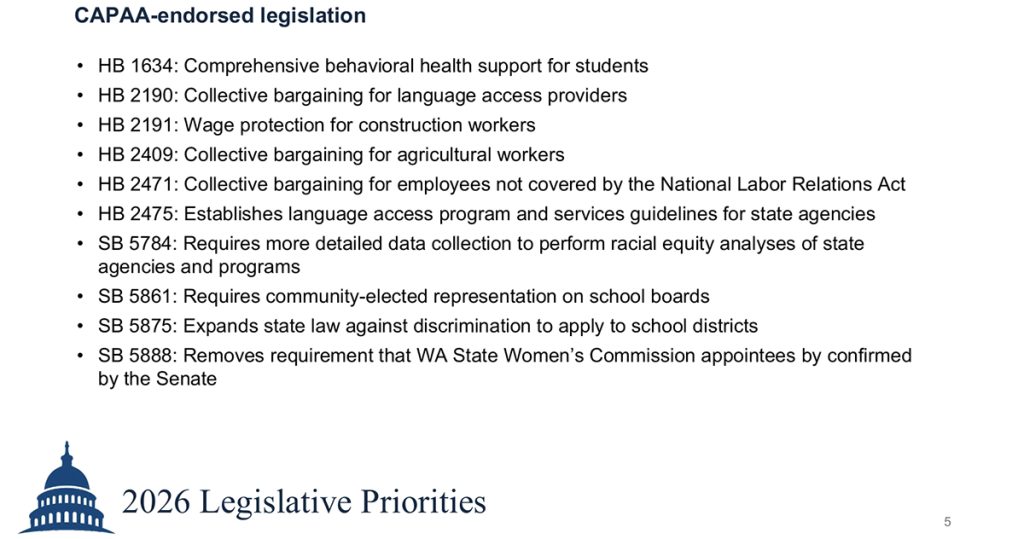
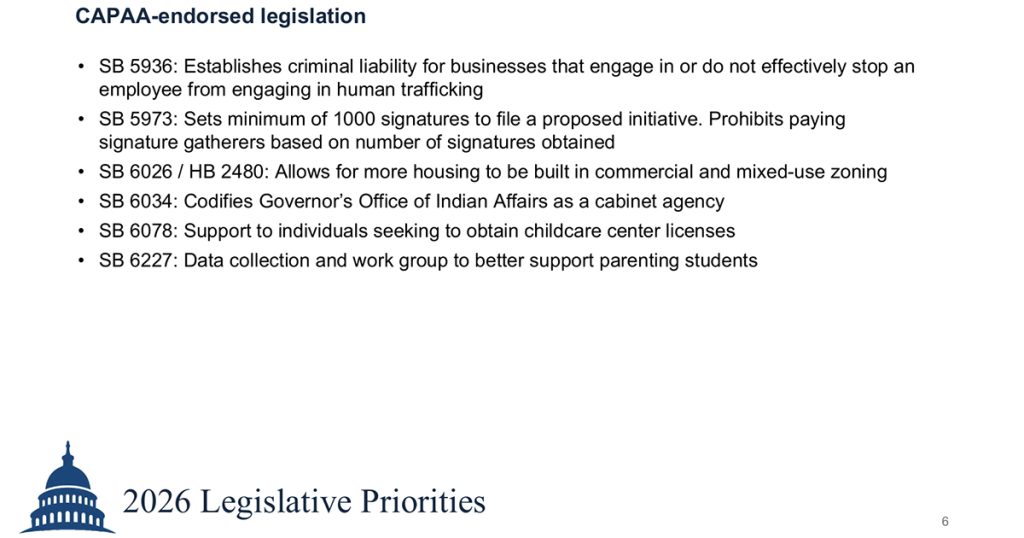
Now that the legislative season is over, Nguyen said, CAPAA will be sending out surveys to get a feel for what the community wants the organization to focus on. It will also be holding a small business seminar for the AANHPI community with the Washington Women’s Commission in May.
Filipinotown and Jose Rizal Park
Jose Rizal Park will finally see some renovations, following vandals striking in both October 2024 and February 2025.
In the 2024 incident, vandals pried off multiple bronze plaques beneath the sculpture of Jose Rizal—a piece renowned Filipino sculptor Anastacio Caedo created specifically for the park, installed in 1989—and stole a time capsule inside the sculpture’s pedestal. An ophthalmologist-turned-writer, Rizal advocated for political reform towards the end of Spanish colonization, and is widely considered a Filipino national hero.
In the 2025 incident, vandals graffitied “FML”—“f— my life”— on the back of the sculpture’s base.
“The stolen metal has been recovered,” Filipinotown’s Executive Director and Founder Devin Cabanilla said. “It took us a very long time to get [the Seattle Department of Park and Recreation and the Seattle Department of Neighborhoods] to collaborate. We’re also renovating the park, so we’re seeking artists on that, too. There’s going to be a full renovation plan that we’re informing through Parks.”
The Parks department will have a community meeting on March 30 at 12 p.m., he said.
Cabanilla also highlighted a survey regarding where to put the Filipinotown street sign in the Chinatown International District. Respondents will be entered to win a $25 gift card.
Leave a Reply