


By Kai Curry
NORTHWEST ASIAN WEEKLY
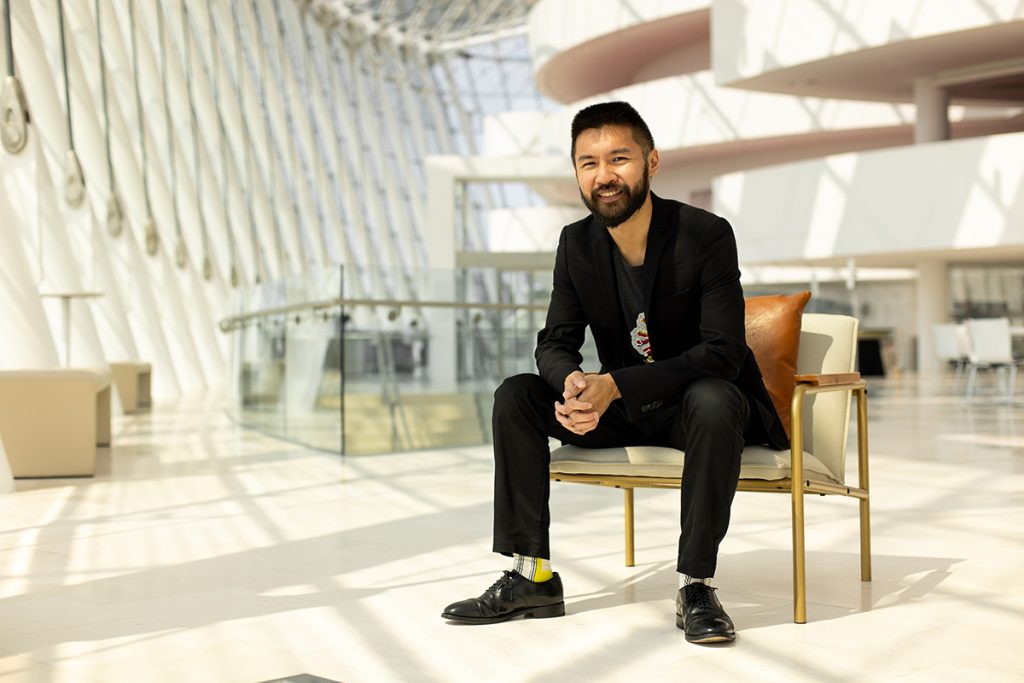
Conrad Tao (Credit: KCS Marketing Team)
There will be piano. There will be poetry. There will be renowned pianist and composer, Conrad Tao, reading a poem and then playing the piano. Tao returns to Seattle on March 8 at Seattle Symphony’s Benaroya Hall. This recital, titled “Conrad Tao Plays Poetry & Fairy Tales: Brahms, Ravel & More,” was carefully curated by Tao himself to provide the optimum experience.
“Putting together programs, for me, is about trying to put the right arrangements of things together, so that we might experience something surprising, unexpected, expressive,” Tao told the Northwest Asian Weekly. “There’s lots of intention, but there’s also room for the audience to experience it on their own terms.”
Tao’s words could describe both poetry and music. Both are created with intention. Both have meanings developed by the composer, or poet, that reward further exploration. Both can be enjoyed without seeking that greater understanding because both are open to interpretation. Both can be intimidating. “Sometimes that intimidation takes a similar shape,” Tao agreed. “I understand that anxiety. People often want to feel like they have a handle on what’s going on…But the irony, of course, is that sometimes when you’re so attached to needing the explanation, you run the risk of denying yourself the actual experience.”
Credit: Kevin Condon
This advice and understanding on Tao’s part should give anyone the confidence to attend a recital that will be musically appealing and also philosophical—the latter, if you want. Close your eyes and let whatever associations come to mind travel through you, be they the dark and fantastical images intended by the artists chosen for this program, or images of your own. Open your eyes, and watch Tao, master pianist and performer, as his fingers fly across the keys. “Poetry is the closest analogue to music,” Tao told us, which makes combining both in this program intriguing.
“Conrad Tao Plays Poetry & Fairy Tales” includes one of Tao’s favorite composers, Frenchman Maurice Ravel (1875-1937), and Ravel’s work, “Gaspard de la nuit” (Gaspard of the night).
“I would feel pretty confident calling it the most important piano work of the 20th century,” Tao said. “Gaspard” was the most challenging piece he prepared for the recital, he added. “I can’t overstate how incredible it is. We’re really lucky that we get to have it in our repertoire as pianists.” Tao also appreciates how Ravel’s piece brings together all of the fantastical, poetic themes of the recital. “Gaspard” features three poems put into music. Each has a different, haunting image, Tao explained. Ravel created the piece with these images in mind.
“Gaspard” means “treasurer” in Persian, so “Gaspard” is the treasure of night things. In essence, he is the devil. The first movement, Conrad continued, is the story of “Ondine,” a mythological mermaid-like figure who lures men to their deaths, yet is also a romantic victim herself. The second movement, and image, is literally a hanging corpse, on a gibbet, or gallows. The third movement of “Gaspard” features a “demonic, dancing beetle,” Tao said, “for lack of a better word.”
That’s what we have to look forward to in this dark yet delightful fantasia of imagery, words, and music. Two of the pieces on the program were specially written for Tao: Todd Moellenberg’s “Leg of Lamb (after Bernadette Mayer)” and David Fulmer’s “I have loved a stream and a shadow.” For Tao, these two pieces were the impetus for the program. A poem by Mayer will be read by Tao prior to his playing the associated music. The title of the second comes from a poem by Ezra Pound. “It’s incredible music and it brings together all these themes of the program because there’s such a wonderful poetry to this music,” Tao said.
Credit: Kevin Condon
Tao has been with us in Seattle a couple of times before, once last year, and for a previous run of “Celebrate Asia” at the Seattle Symphony. A protégé of piano who also composes his own music, Tao has been playing since he was 18 months old—when he was already playing by ear—and he gave his first piano recital at the age of 4. When Tao was 9 years old, his family moved from Illinois, where Tao was born, to New York, where Tao still lives. Tao’s recognitions from the music world keep adding up, from being on the PBS TV series, “From the Top – Live from Carnegie Hall,” at the age of 13, until today. He is most excited this year to visit and perform for the first time in Japan. Last year, he said, his greatest joy was just having some time to stay home. Although he won’t have much leisure time in Seattle during this visit, Tao plans to do what he considers the best thing to do in Seattle: walk around and visit with friends.
Tao has several of his own compositions debuting to the public soon. A new work for strings will be debuting next year. A solo piece that he wrote for piano should premiere this year in Los Angeles. It’s a solo piano piece that Tao wrote for someone else, “a lovely and rare experience,” he said. He will also be at the Oregon Bach Festival on July 9, at the University of Oregon in Eugene, with his own arrangement of a Bach Fantasia. That same evening, which is titled “American Tapestry,” will additionally feature Tao on piano for George Gershwin’s beloved “Rhapsody in Blue”; a portion of Aaron Copland’s “Appalachian Spring Suite”; and an interesting work by early 20th century female composer, Margaret Bonds, titled “Credo.”
“I’m interested in doing things that I think music is uniquely capable of doing,” Tao told the Northwest Asian Weekly. One of those things is combining words and images with sound. There is a freedom in music that is also found in poetry, Tao said. Whether you prefer to sit back and let the music wash over you or whether you enjoy digging into the stories and the meanings of the music and the poems, there will be ample opportunity for both at this recital. “We expect poetry to inspire the unexpected. And I think that music can often very much do the same thing,” said Tao. For me, this is one of the most amazing qualities of music.”
For information about Tao’s March 8 recital, visit www.seattlesymphony.org.
Kai can be reached at newstips@nwasianweekly.com.