
By James Tabafunda
NORTHWEST ASIAN WEEKLY
A steady downpour of rain and gusting winds did not deter community members of different ages and ethnicities from gathering to confront a dark past of racism, xenophobia, and resentment.
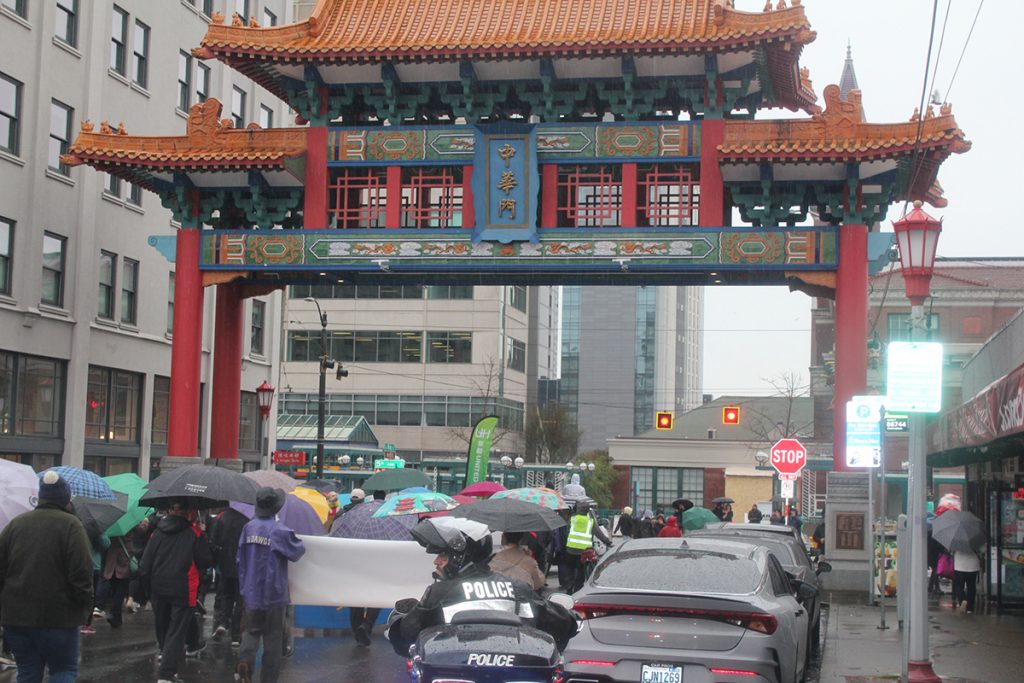
Photo by James Tabafunda
About 100 people rallied on the morning of Feb. 7—exactly 140 years to the day—at Hing Hay Park in Seattle’s Chinatown-International District (CID), where community groups, civic leaders, and residents marked the anniversary of the 1886 expulsion that forced more than 350 Chinese residents from their homes and businesses at gunpoint.
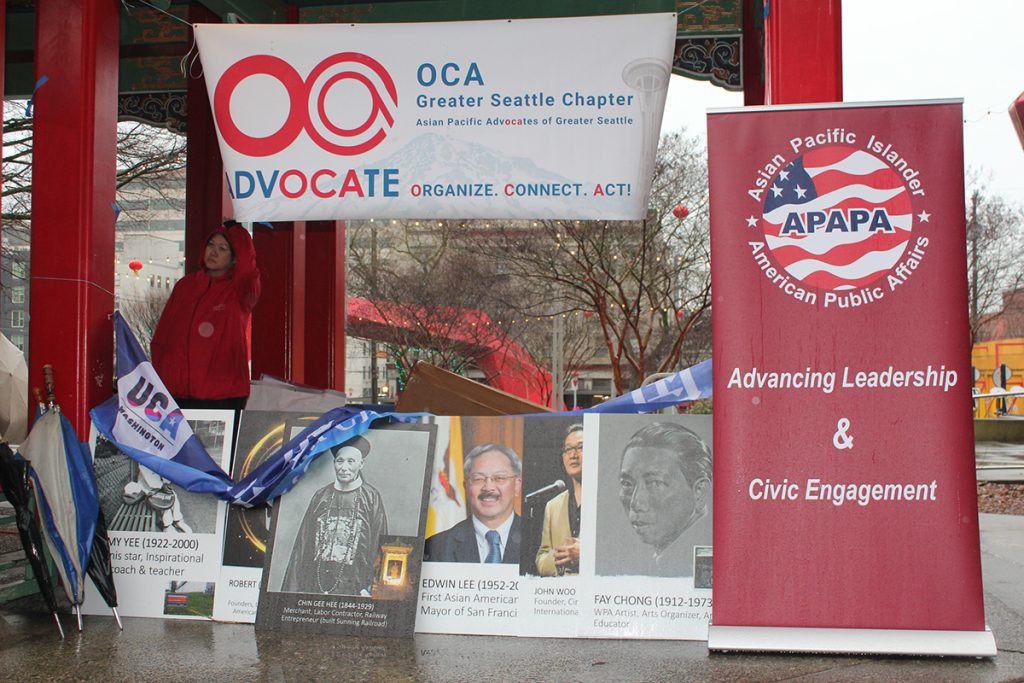
Photo by James Tabafunda
The event had many sponsors, including United Hub, the Wing Luke Museum, Historic South Downtown, the Seattle Department of Parks and Recreation, Pacific Artists’ Alliance, United Chinese Americans of Washington, OCA Asian Pacific Advocates of Greater Seattle, and the Chinese American Citizens Alliance.
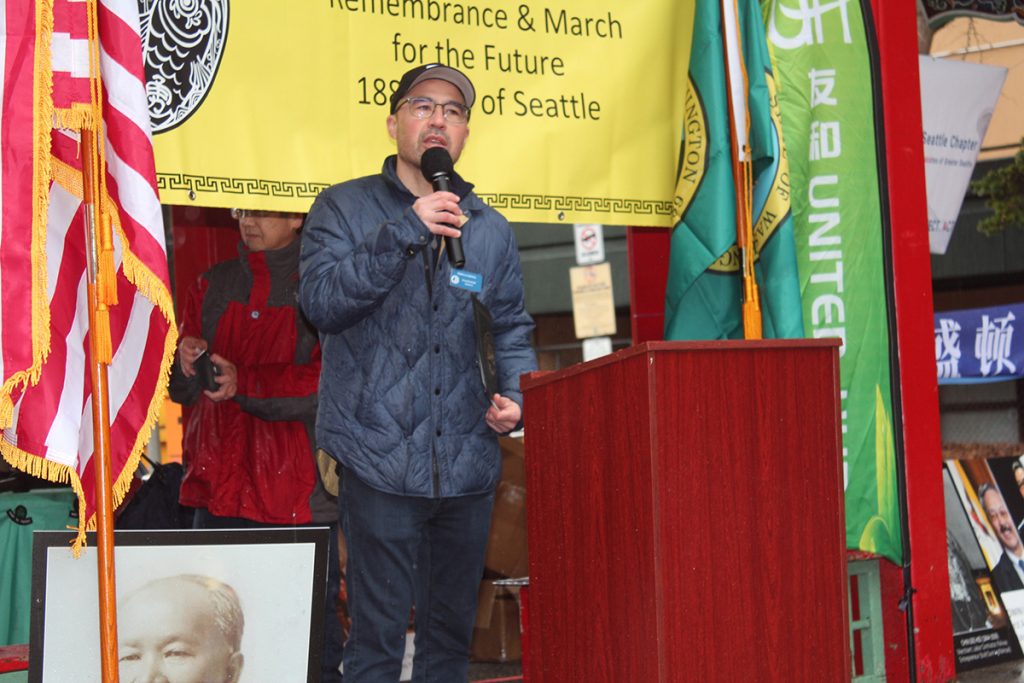
Seattle City Councilmember Eddie Lin speaks at a rally in Hing Hay Park marking the 140th anniversary of the 1886 expulsion of the city’s Chinese residents. (Photo by James Tabafunda)
It featured speeches by Seattle City Councilmember Eddie Lin, who represents District 2, and community leaders who drew direct parallels between the 19th-century mob violence and today’s immigration enforcement operations, before marchers retraced the path of removal from today’s CID to the original waterfront settlement.
“Sound familiar?”
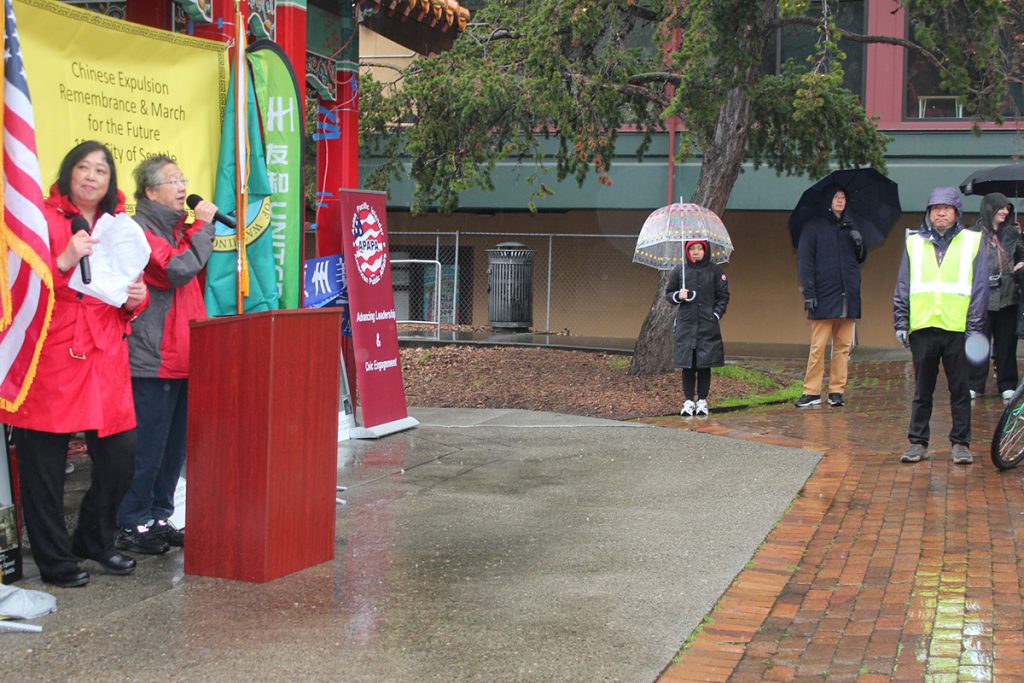
Connie So, teaching professor in the University of Washington’s American Ethnic Studies department and past president of OCA Asian Pacific Advocates of Greater Seattle (Photo by James Tabafunda)
Connie So, a teaching professor in the University of Washington’s American Ethnic Studies department and past president of OCA-Greater Seattle, emceed the rally and struck a tone of urgency, linking the 1886 expulsion to what she called a renewed climate of hostility toward immigrants, refugees, and citizens of color. Alan Lai interpreted the speeches in Cantonese—historically the dominant language of the CID.
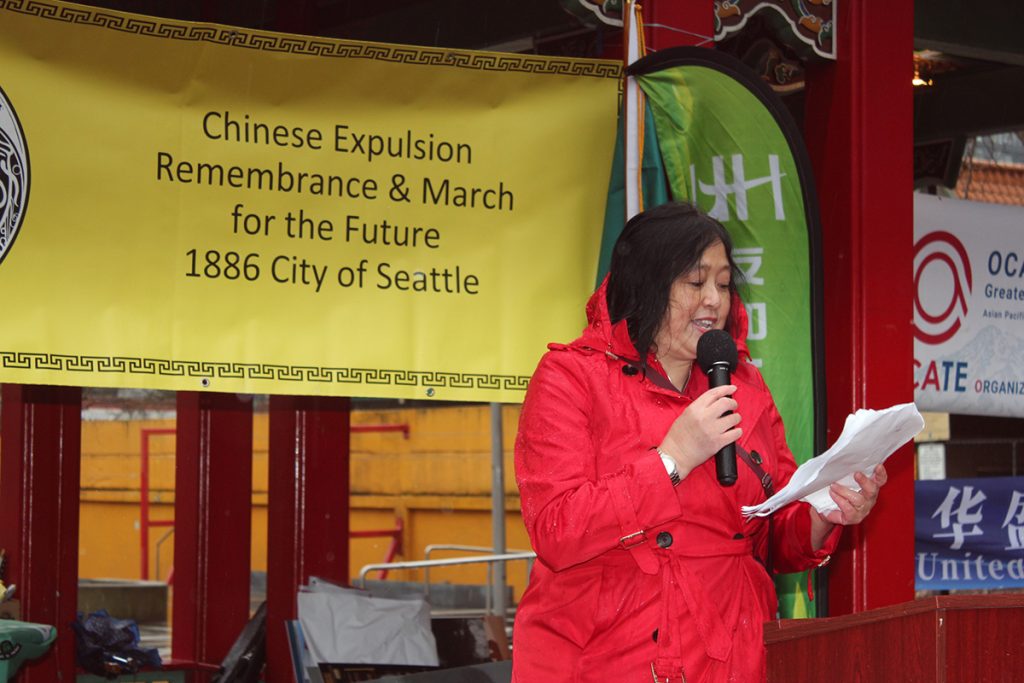
Connie So, teaching professor in the University of Washington’s American Ethnic Studies department and past president of OCA Asian Pacific Advocates of Greater Seattle (Photo by James Tabafunda)
“Many white workers accused Chinese immigrants of taking their jobs,” So said. “Economic recession, scapegoating of immigrants, and most of all, stereotypes—prejudice led to the riots. Sound familiar? Sadly so.”
She traced a through-line from the 1886 expulsion to landmark civil-rights victories won by Chinese Americans, including the 14th Amendment equal-protection case Yick Wo v. Hopkins filed by a Chinese laundry owner, the 1898 Supreme Court ruling in United States v. Wong Kim Ark that affirmed birthright citizenship, and the 1974 Lau v. Nichols decision that mandated bilingual education.
“We’re seeing the return and rise of 19th-century-style anti-immigrant, anti-people-of-color hatred,” So said. “We cannot be passive … I’m more worried about what will happen if we all stay silent.”
Lawmakers sound the alarm
Lin, the son of a Taiwanese immigrant father and a white mother from Massachusetts, spoke about the interconnectedness of civil-rights struggles. He cited Loving v. Virginia, the 1967 Supreme Court decision striking down bans on interracial marriage—a ruling that made his own parents’ union possible—and the 14th Amendment’s roots in the abolition of slavery.
“Yesterday, it was the Chinese who were being excluded,” he said. “Today, we see it is our Somali neighbors. The hatred is towards them. And we must stand together with all of our neighbors.” Lin presented a City of Seattle proclamation recognizing the anniversary.
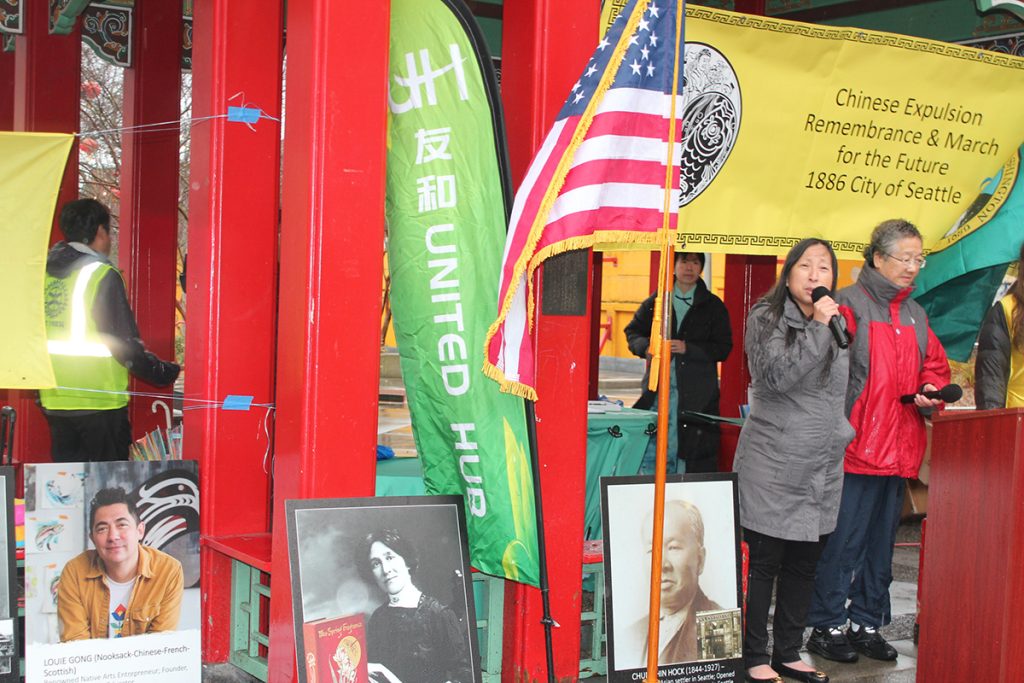
State Rep. Janice Zahn, D-Bellevue, speaks at a rally in Hing Hay Park marking the 140th anniversary of the 1886 expulsion of the city’s Chinese residents. (Photo by James Tabafunda)
State Rep. Janice Zahn said she did not learn about the Chinese Exclusion Act until seven years ago, despite having lived in the United States since emigrating from Hong Kong at age 10. “The Washington State House of Representatives recognizes the importance of reflecting on the history of Chinese American exclusion in Washington state,” she said.
“Yesterday, while I was in Olympia … I saw a video of one of our community members being picked up by ICE and dragged out of his car. Last week, I was in Issaquah, and I heard about 10 people being dragged out of their community. This is not okay,” Zahn said.
“We have our constitutional rights and due process for a reason.”
Her remarks landed a week after Seattle Mayor Katie Wilson issued an executive order barring federal immigration authorities from using any city-owned property for immigration enforcement and directing police to document ICE operations with body-worn cameras and check official identification of federal agents.
A monument takes shape
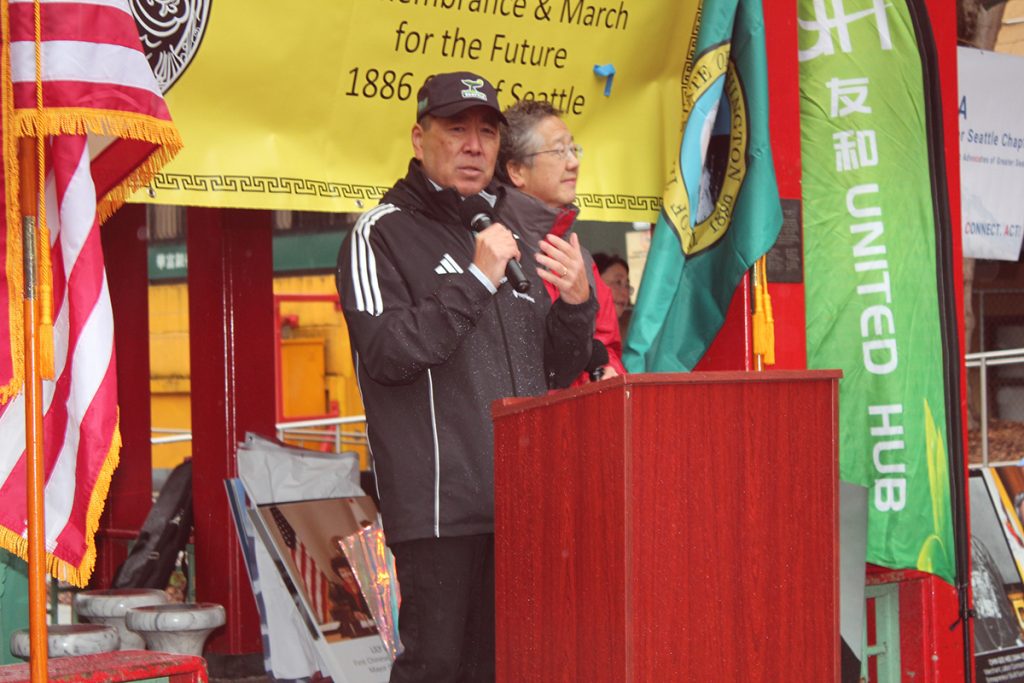
SeattleFWC26 Chief Executive Officer Peter Tomozawa speaks at a rally in Hing Hay Park marking the 140th anniversary of the 1886 expulsion of the city’s Chinese residents. (Photo by James Tabafunda)
SeattleFWC26 Chief Executive Officer Peter Tomozawa said, “I’m very proud to say that we were the final piece of the puzzle to get this Chinese American Legacy Art Project (CALAP) finished.” SeattleFWC26 is the local organizing committee for Seattle’s participation as a host city for the 2026 FIFA World Cup.
The announcement drew applause from the crowd at Hing Hay Park.
The sculpture, titled “Exclusion, Expulsion, Expunge,” stands 14 feet tall and is fabricated from bronze and stainless steel. Created by Seattle artist Stewart Wong, it depicts six life-size figures—three Chinese laborers and three mob members—flanking a towering central X-shaped structure. A tipped scale of justice hangs above, its beam forged from weapon shapes.
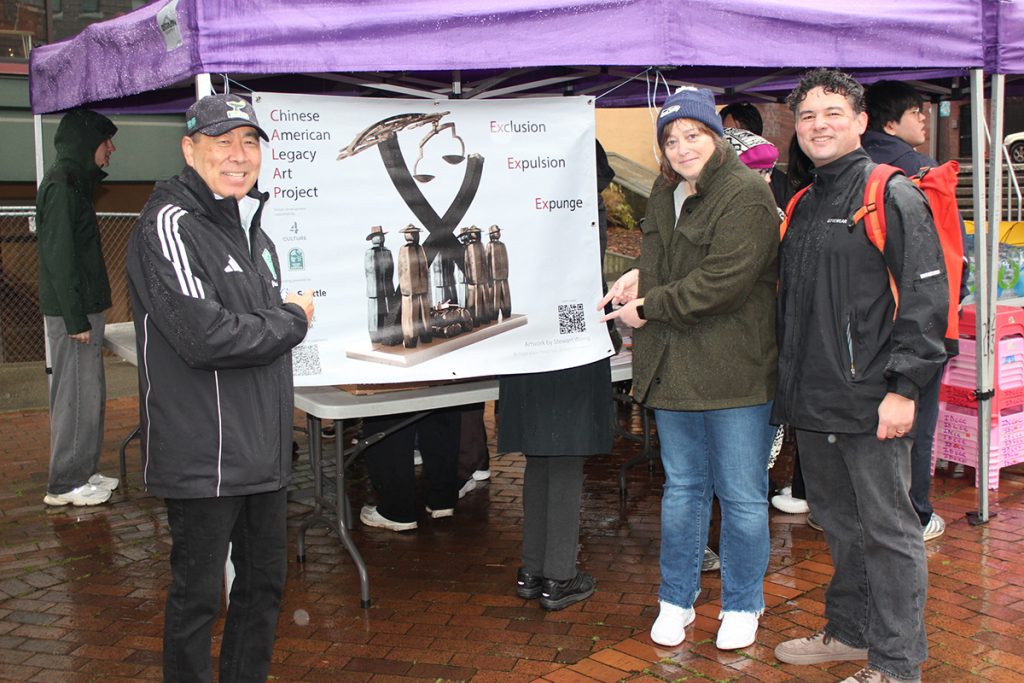
(From left to right): Peter Tomozawa, chief executive officer, SeattleFWC26; April Putney, chief strategy officer, SeattleFWC26; Leo Flor, chief legacy officer, SeattleFWC26 (Photo by James Tabafunda)
Tomozawa said about SeattleFWC26’s $50,000 CALAP donation and public matching challenge, announced last November, “We wanted to fund and be part of a legacy.”
He credited two Seattle-area donors with completing the project’s funding: Li Lu, founder and chairman of Himalaya Capital and a former Tiananmen Square protest leader, and Martin Mao, a technology executive at Palo Alto Networks.
“Working with Wing Luke Museum, we came up with the idea of how we might finish the project. How could we use the World Cup platform to help finish a project that hasn’t been able to be finished in a long time?” Tomozawa said, adding that he hoped the statue would be ready by the 2027 rally.
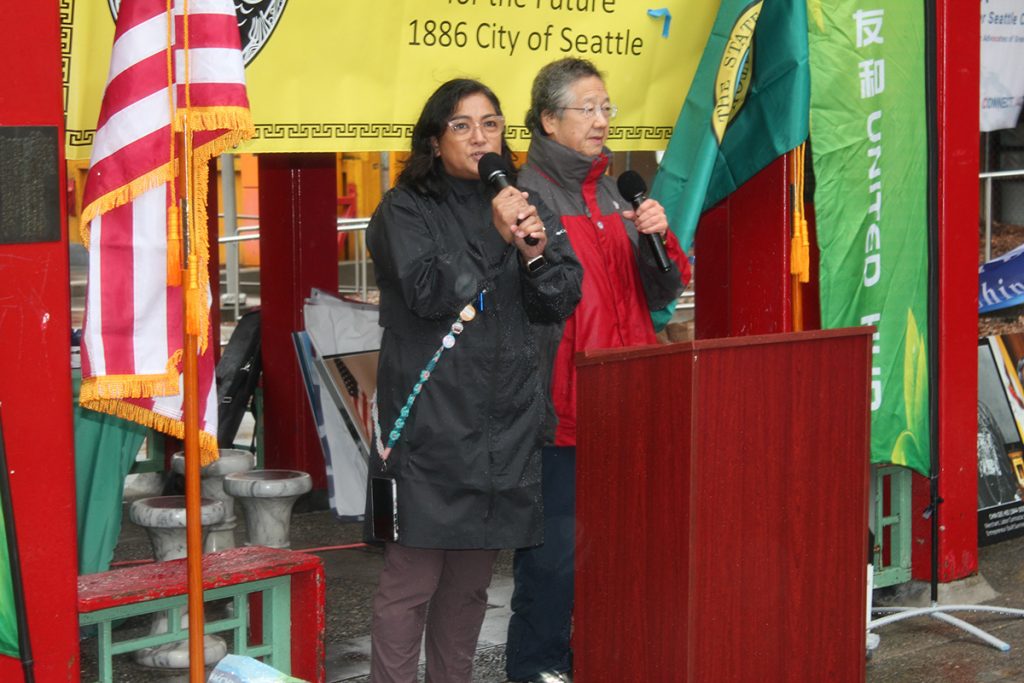
Wren Wheeler, Wing Luke Museum civic engagement specialist, speaks at a rally in Hing Hay Park marking the 140th anniversary of the 1886 expulsion of the city’s Chinese residents. (Photo by James Tabafunda)
Wren Wheeler, the museum’s civic engagement specialist, circulated a petition at the rally urging Seattle to approve the sculpture’s placement in Occidental Park near the city’s waterfront. She said she plans to deliver the signatures to city officials “to make sure that they know that so many people want this sculpture in the city and in the place of our second Chinatown, an important historical location.”
Preserving the neighborhood
State Rep. Sharon Tomiko Santos urged attendees to support House Bill 1408, which would direct 30% of state sales tax revenue collected at major stadiums to fund Community Preservation and Development Authorities (CPDAs) serving the CID and Central District. CPDAs are organizations designed to protect and revitalize neighborhoods in Seattle that have been negatively affected by large public construction projects.
“All of these expulsions, all of these incarcerations took place because government didn’t think we were important enough,” she said. “So we turn our destiny to us. … And power to the people.”
Santos, whose 91-year-old aunt was incarcerated during World War II because of her Japanese ancestry, wore a hand-knitted, red cap bearing the words “Resist. Insist. Persist.”
Community leaders outside Seattle share thoughts
Additional speakers included Renton City Councilmember Kim-Khánh Văn, an immigration lawyer and Vietnamese refugee who fled her homeland at age 6, told the crowd she has carried her passport since 2016 out of fear her citizenship could be questioned. “For us as refugees and immigrants and naturalized citizens, this is our home,” she said, holding up the document.
Văn called for abolishing ICE and holding the federal government accountable. She also paused to honor those who organized against anti-Asian violence during the pandemic, including the late community elder she called “Uncle Frank (Irigon),” his widow “Auntie Felicita,” former Seattle City Councilmember Tanya Woo, and activist Theresa Aragon.
Issaquah City Councilmember Kelly Jiang drew a direct connection between the Seattle expulsion and her own city’s history. In September 1885—five months before the Seattle expulsion—a gang of white and Native American hop pickers attacked sleeping Chinese laborers at a Squak Valley farm, killing three men. Their killers were acquitted.
“Issaquah has its very own sordid anti-Asian history with the Chinese massacre,” she told the crowd. “That’s something that not a lot of people know about.” Jiang, who works in clean energy and was elected to the council in November 2025, said communities across the region must “learn about (history) and remember.”
Threats against immigrant communities persist
So said, “What began as an occasional event for the 100th and 120th anniversaries has become an annual event as people continue targeting immigrants, refugees, citizens, even forgetting and erasing what little has been made available.”
“Our ancestors went ahead and fought through a lot more difficult times and walked in the rain, for all the rights you currently have,” she told the crowd. “Today, on the 140th anniversary of the expulsion, we hope people can reflect and learn from our bitter history, find solace with friends and allies, and help America regain its sanity, humanity, and soul.”
Retracing the path
After the speeches, rain-drenched marchers set out from Hing Hay Park with a Seattle Police Department escort, heading west on South King Street then north on Fifth Avenue South—retracing the less-than-one-mile route of displacement from today’s CID through the site of the city’s second Chinese settlement and toward the waterfront where the original 1800s Chinatown once stood.
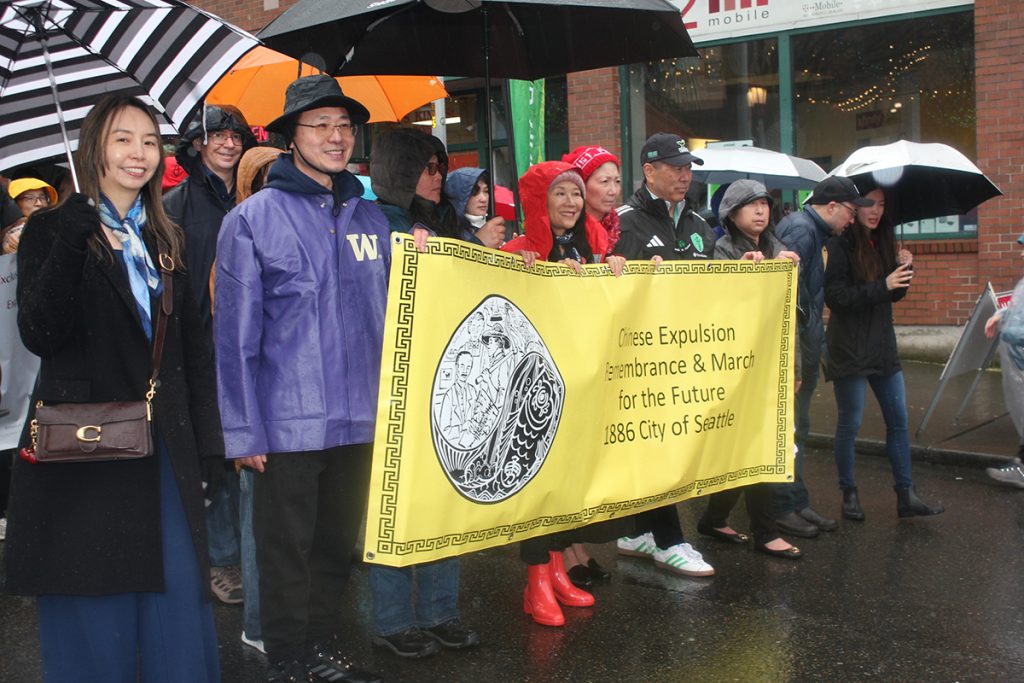
Photo by James Tabafunda
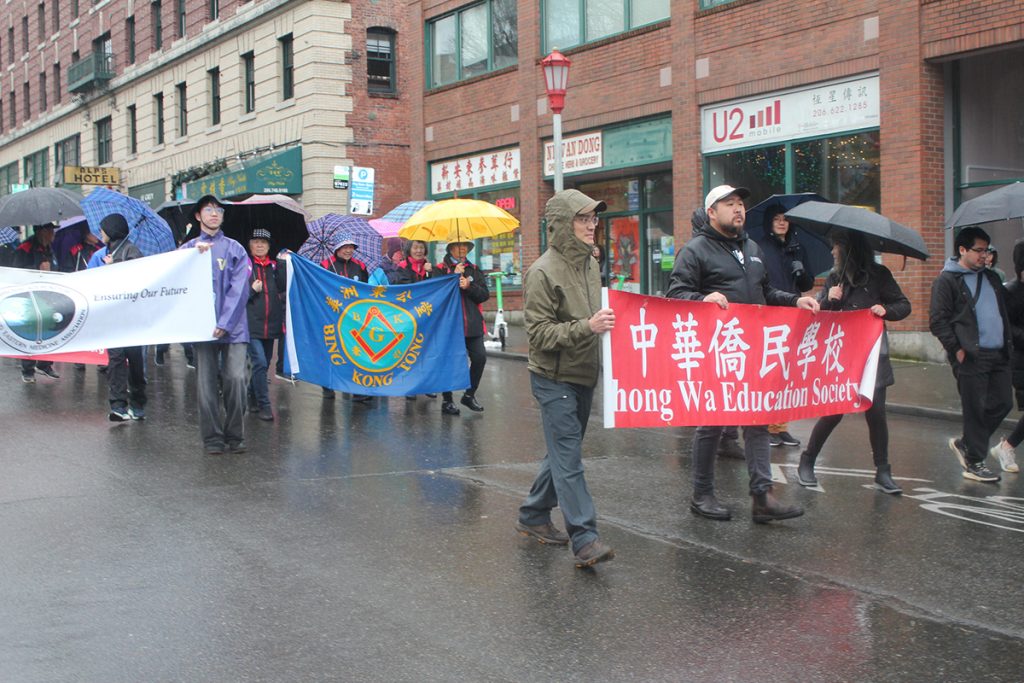
Photo by James Tabafunda