


By Carolyn Bick
NORTHWEST ASIAN WEEKLY
Frank Wu was born in Cleveland, Ohio. But when certain people ask him, “Where are you from?” they’ll follow his answer with, “Where are you really from?”
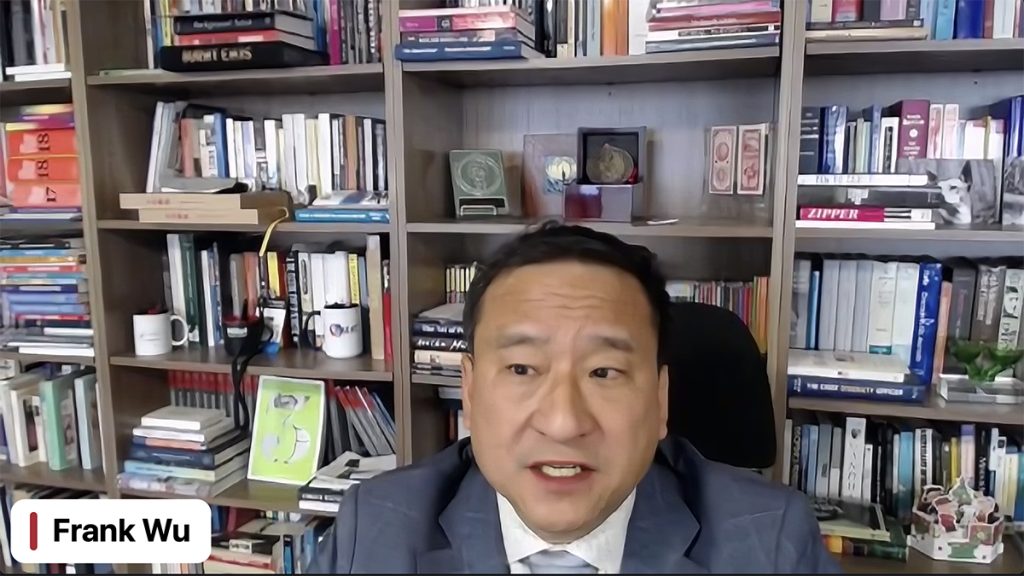
“The addition of that one word speaks volumes, because it says you’re a liar, you’re not who you claim to be. You’re somebody else,” Wu told audience members, in the course of explaining “perpetual foreigner syndrome,” during the Committee of 100’s webinar on Feb. 3.
Wu is the first AANHPI president of Queens College in New York, and a first-generation American born to Taiwanese immigrants. He spoke at length about the history of United States policy towards Asian immigrants, and how that policy has continued to shape the lives and experiences of the AANHPI community today.
Despite the fact that the U.S. has benefitted for centuries from Asian immigrants—Wu discussed Chinese immigrants who built most of the transcontinental railroad in the 1800s—records show that Chinese and other Asian immigrants had already been coming to the U.S. by then, though in smaller numbers. That didn’t stop the country’s politicians from swiftly moving to pass a series of exclusionary laws meant to stop them from staying.
“‘The Chinese must go’ was the rallying cry and politicians of both political parties sought to outdo themselves,” Wu said, explaining the Chinese Exclusion Act of 1882, as well as a series of other anti-Asian laws. “Our ancestors could not naturalize. … Asian immigrants were put into this category as aliens ineligible to citizenship. … It wasn’t until the 1890s that birthright citizenship was established … [but] that was very rare, very rare, because … Asian women weren’t allowed in. And so in San Francisco’s Chinatown, the ratio was 100 to one men to women. Can you imagine that in that hyper-segregated neighborhood?”
This anti-Asian sentiment has expressed itself again and again in different ways, Wu continued. He remembered when two white men murdered Vincent Chin in Detroit in 1982. Wu was about a decade younger than Chin, and Chin’s murder left an impression on him. Though Chin was Chinese, the two men who murdered him used Japanese racial slurs. Fast-forward to contemporary times, and many people once again targeted Asians, this time blaming them for the COVID-19 virus.
The theme running through it all has been this “perpetual foreigner syndrome,” Wu explained.
“During COVID, we saw … people shouting, ‘Go back to where you came from,’ shouting racial slurs. And … it still happens, and it’s all a signal: ‘You’re not one of us. You’re one of them. You made us sick,’” Wu said. “You saw the videos of Asian elders being spit on, shoved to the ground, kicked in the head, shoved down the stairs leading to the subway stab, ultimately in Atlanta, shot. … You never know when you’re walking down the street, and someone starts shouting at you, whether it will escalate or if it’s just someone shouting some slurs.”
Even when people were brought into the hospital for treatment, he continued, they would refuse help from Asian American healthcare staff.
Wu also touched on the China Initiative, a supposed intelligence operation begun under President Donald Trump in his first term. That initiative targeted hundreds of Chinese immigrants, and cost many Chinese researchers and students their careers in the U.S. It was later discovered that the Federal Bureau of Investigation largely faked evidence to push cases forward. At least one professor whom the federal government targeted, Jane Wu, committed suicide.
The only way to combat this kind of racism, Wu said, is through civic engagement, even if it is difficult—“We have to show up for others so that they show up for us.”
But there is a hitch that would-be civic activists within certain circles first must overcome: The generational, ideological, and geographical divides within their own immigrant groups. For instance, Wu said, his 90-something-year-old father is among those elders who mall-walks for health. But he doesn’t walk the mall with just anyone else. Instead, he keeps to one of three groups who walk through the mall together. First, there are the more recent “mainlander” (mainland China) arrivals, who are in the 40s and 50s. Next, there are those who went to Taiwan, and then came to the U.S. several decades ago. Finally, there are those who identify as Taiwanese, and who are supportive of Taiwanese independence.
“To the rest of the people in the mall, the folks around them who are white or black, I’ll bet they look at three groups of older Chinese folks circling the mall, and they can’t tell the difference among these three groups. But they don’t interact,” Wu said. “I understand they might have different views. But here in the United States, we have a common cause. And if we can’t get these groups together, we’re going to have real difficulty getting them to work with … anyone else, because this sort of coalition building doesn’t come easy.”
This is why, Wu said, Asian Americans need some sort of umbrella organization or other unifying factor. This doesn’t mean that every Asian American has to agree with one another.
“We need to be bipartisan. We look at [Washington,] D.C. strategy and beyond D.C.,” he said, referring to the bipartisan nature of the federal government. “The point is, we share a set of goals, I would assert, just by identifying ourselves as Asian American, or Chinese American, and the goal is to belong, to be accepted as equals, while honoring our heritage.”
He warned that if people could not come together, they would ultimately be weaker. Instead of tweeting things out on their own, as individuals, he encouraged attendees and future webinar listeners to join advocacy groups and attend events.
“The perpetual foreigner syndrome … continues to bedevil us today. And I hope I’ve given you a way to think about civic engagement, civil rights activism, standing up and speaking out. It doesn’t mean that all of us have to become full-time activists,” Wu said. “Coalitions are the key in a democracy.”