


By Irfan Shariff
NORTHWEST ASIAN WEEKLY
Six times a day, seven days a week, a coach bus will take you from 6th Avenue South and South Lane Street in the Chinatown-International District to the Snoqualmie Casino 25 miles east. In the past, the $10 it cost to take the bus would pay for itself and more, with gaming credits and food vouchers. It’s often packed with older Asian men and women passing time together.
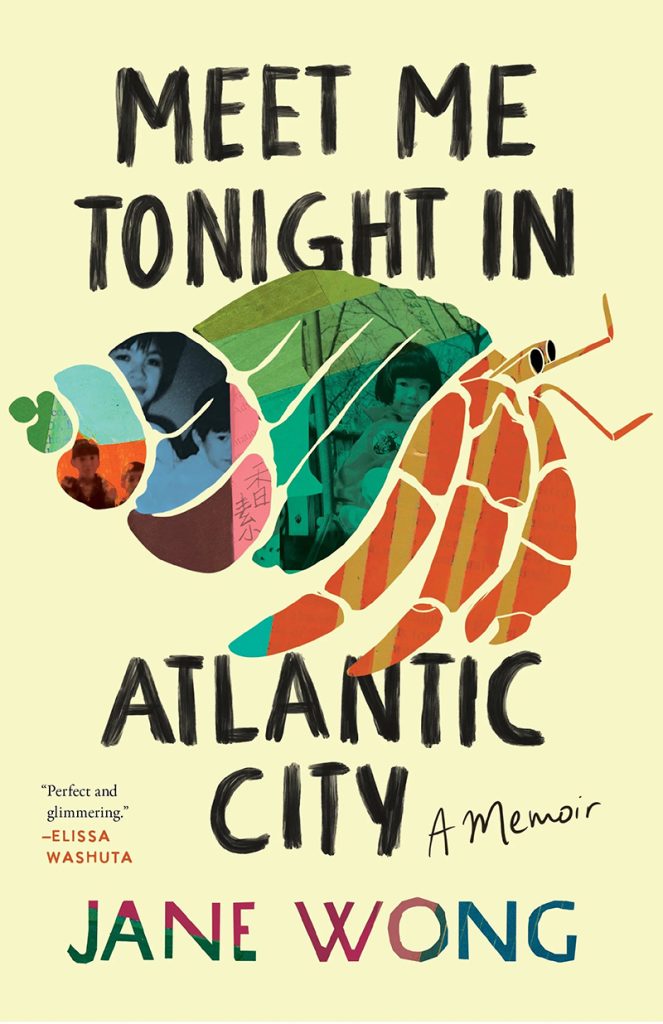
Cover of “Meet Me in Atlantic City” by Jane Wong. Courtesy of Jane Wong.
Seattle-based writer Jane Wong wonders why so many casino buses pick up gamblers in Chinatowns across the U.S.—“It can’t be an accident.”
“So many casinos target Asian American communities,” said Wong, whose 2023 memoir, Meet Me Tonight in Atlantic City, details her experience as the daughter of Chinese immigrants.
Wong’s now-estranged father is also a problem gambler. In writing the book, she received some healing: “I felt a lot of solace. It allowed me to realize this wasn’t a single story and that it was larger than my family.”
It doesn’t come as a surprise that Seattle-area casinos are celebrating Lunar New Year. Festivities run all month long, with drawings, promotions, and entertainment. Tulalip Casino’s ticketed event is sold out.
Las Vegas celebrates on an even larger scale. Every year, the Bellagio Hotel transforms its garden and conservatory into an art installation, and several restaurants offer special menus. Organizations like Chinese New Year in the Desert aim to make Las Vegas the “largest and most dynamic Chinese New Year celebration in the United States.”
“Luck is such a huge part of Chinese culture, especially into the new year,” said Wong. “The red packet and rituals we have around luck get tied to capitalism in complicated ways with casinos.”
At Seattle Center’s Vietnamese new year celebration of Tết, the Asian Counseling and Referral Center (ACRS) has public information booths providing outreach on problem gambling. Aimme Zhang, assistant program supervisor of ACRS’s problem gambling program, noted that in 2025, 16% of her clients were of Vietnamese heritage, 8% were Chinese, 8% were Korean, and 3% were Native Hawaiian. Excluding smaller percentages of Asian American Pacific Islanders (AAPI), at least one-third of her clients last year were AAPI. According to the 2020 Census, AAPIs make up about 18% of Seattle.
Cards and chips for poker on green table.
“Reflecting on my clients, I actually have to say it’s pretty spread out,” she said of age, ethnicity, and gaming types. “A lot of the older clients play slots, younger players do sports betting, the stock market, and card games. Age is spread out around ethnicity.”
Zhang also notes that one-third of her clients were also Caucasian. In addition, one-third each were foreign-born, needed interpretation services, or were over 60. Other research also does not definitively support the AAPI gambler stereotype.
“What really jumps out to me about serving Asian Americans is that Lunar New Year is a time to celebrate and, in Seattle, there is not as much going on compared to the scale in their home countries,” she said.
“At ACRS, we provide outpatient-based services. We offer individual counseling, group counseling, and case management,” Zhang continued. ACRS has one of the few outpatient programs dedicated to problem gambling in Washington state.
Many of her clients struggle financially, and risk eviction and losing their jobs.

Jane Wong. Photo by Gritchelle Fallesgon.
“We provide services reestablishing those areas of life,” she said. “One of the lesser known services we provide is individual counseling to loved ones.”
Wong’s father’s gambling hit its peak when she was 9.
“We never knew when he would come back,” she said. “He wasn’t the only one. My dad’s friends struggled with this. A lot of these families were in this liminal space.”
“On the flipside, one thing I will acknowledge: it is an act of community connections,” Wong continued. “This is what he did with his friends and I have to be mindful of what it was like for him. That didn’t occur to me until I spoke with social workers through a workshop.”
“Historically, gambling has been pretty involved in Chinese culture,” said Zhang, who grew up in China in a household that would play mah-jongg. Gambling has been banned on mainland China since 1949 and people would play mah-jongg without money, she said.
“Gambling ads have really gone up in recent years, especially sports betting,” Zhang said, referring to the scale of digital ads across social media. Older clientele are often hit by mailers for promotions and cultural events, she said, and are more likely to go, if they receive those flyers.
Immigrant and elderly populations are particularly vulnerable. Since their English is limited, “gambling is attractive because you don’t need to speak too much.”
“A lot of them have free time and are on a fixed income, which can be a problem,” said Zhang. “If they run into a problem, it’s hard to resolve the financial issue.”
Mental health is also a big issue, she said. Nearly half of her clients have co-occurring disorders in the form of mental health illness, substance use disorders, or both. Many people who see her come in with suicidal ideation, and gambling has one of the highest rates of suicide among mental illnesses.
Zhang has seen the reality of saving face: “Mental health related services are not very commonly utilized in a lot of Asian cultures. People not understanding behavioral health in general is a barrier.” Many of her AAPI clients do not like group sessions because they don’t want to be seen by others they might know.
“It’s definitely a sign of stigma,” she said. “I think without a cultural understanding, people will not feel comfortable engaging in services.”
“It is something we don’t like to talk about. The stigma is so strong that it doesn’t allow people to see it and see it with care,” said Wong. “One thing I wanted to do while I was writing the book was seeing my father through empathetic eyes, and see him and the systems he was under.”
“Folks who struggle with problem gambling need support, understanding, and care. I know that my father’s problem gambling led to a lot of problems in our family life,” she said. “But I do feel if he had intervention, resources, or talked about his feelings around it, our whole life story could’ve changed.”
For more information on problem gambling, visit the Asian Counseling and Referral Service program page.