


By Carolyn Bick
NORTHWEST ASIAN WEEKLY
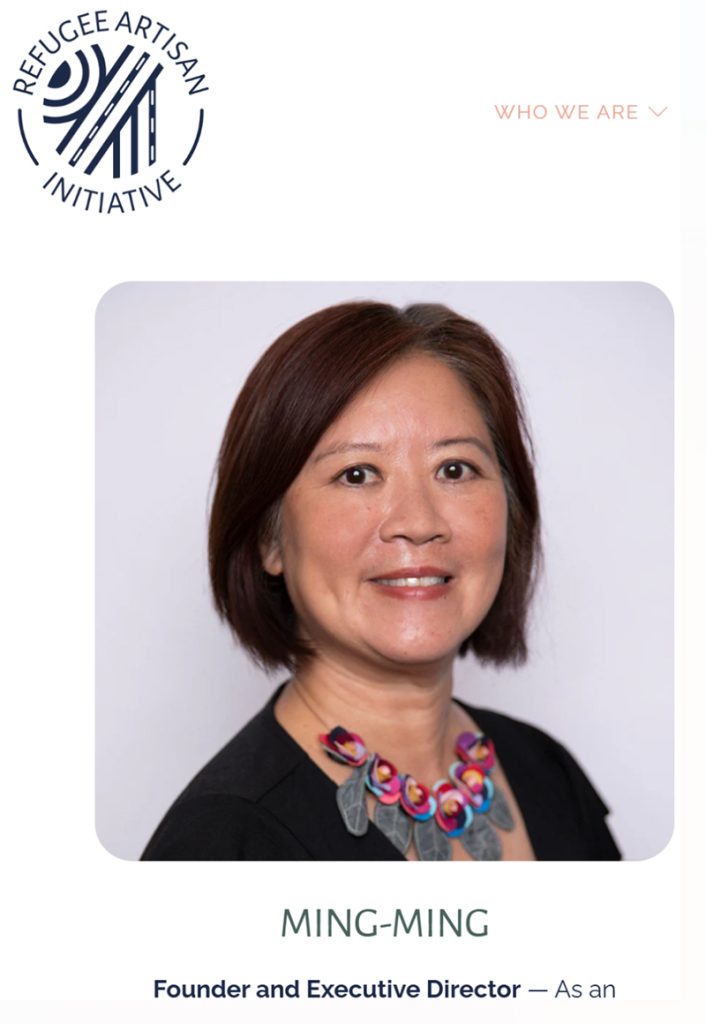
With a determination to reclaim her narrative, Ming-Ming Tung-Edelman unveils the hidden tensions and political maneuvers that led to her unexpected departure from the Refugee Artisans Initiative (RAI).
In her pursuit of corporate sponsorship and growth, she started hiring CEOs from major organizations in 2025. They included people like Kathi Lentzsch, formerly the CEO of Bartell Drugs and Rad Power Bikes, and Beth Halvorsen, a commercial real estate executive.
“I thought it might be good for us to get more corporate sponsorship and accompanying endorsement,” Tung-Edelman said of her decision to bring in women from the corporate world.
But, she said, that didn’t happen.
Instead, in January, RAI’s board fired Tung-Edelman from her post as executive director, basing their decision on the results of an investigation the board had launched into her conduct, following an employee’s complaint against her alleging retaliation and a hostile work environment.
But Tung-Edelman’s January removal was on paper only.
Her real dismissal, she told the Northwest Asian Weekly, began in mid-October 2025, after the board launched the investigation. She said that the board banned her from the building that month, and that she was not allowed to return without the express permission of the CEO.
The following month, on Nov. 10, 2025, the board advanced her internal removal in a private coffee shop meeting—but Tung-Edelman said that investigation “did not confirm either” of the allegations made against her, per a verbal confirmation she received on Dec. 5, 2025.
Because the board still has not sent her the rest of the investigation and fired her anyway, Tung-Edelman believes that the material contained in the rest of the investigation is what the board used as an excuse to fire her. She said that the organization as a whole had been changing since her decision to bring aboard women from the corporate world, and that the complaint and investigation merely provided a convenient excuse to boot her.
And yet, she said, the board asked her to represent the organization as its executive director with full powers, including signing critical financial contracts as late as December 2025.
She shared documents, including text messages with RAI staff, with the Northwest Asian Weekly. These documents appear to prove she had little-to-no control over the executive director post, and that RAI staff wanted her to continue to sign off as executive director.
RAI’s board disputed Tung-Edelman’s characterization of the situation in a letter to the Northwest Asian Weekly. The board sent the letter, after the Northwest Asian Weekly reached out with a series of questions. The letter answered only some of them.
RAI board response
The letter stated that the board had fielded complaints from “multiple staff members” over a period of years, and that these complaints had to do with “concerns related to Ming-Ming’s conduct and behavior towards them.”
“During this time, the board worked extensively to support Ming-Ming as Executive Director while addressing these serious internal concerns,” the letter continued. The board said that following a formal complaint, they hired an independent firm to investigate the matter. “Although the investigation determined that Ming-Ming did not violate federal, state, or local laws, the investigator recommended, based on their findings, that Ming-Ming not be returned to a position where she had supervisory authority over RAI staff.”
The board declined to provide any details of the complaint that launched the investigation, and did not include any further details about the alleged complaints they received over the years. This is a privacy measure and a usual step in RAI’s processes, the board said, but also limits what it can publicly share.
The board also said that they “crafted a new role” for Tung-Edelman “that would allow her to continue her work with RAI, but without an internal supervisory role. This new structure would allow Ming-Ming, as Founder, to continue to excel at community engagement, promotion of RAI, and fundraising.”
Tung-Edelman said in an email that “[t]he formal description of the proposed new role as ‘Executive Director and Founder’ was limited to ‘public facing activities’ with no direct or indirect supervisory authority.”
“I would also not have operational authority as that would be the role of the new Chief Operating Officer position,” she continued. “These were all part of my previous [executive director] role since RAI was founded and would typically be the responsibility of the [executive director] at most nonprofits.”
The board said that Tung-Edelman’s compensation and benefits remained intact in this new role, and that even after she refused in November, she still received her full pay and benefits. They said that Tung-Edelman repeatedly refused to accept a role without supervisory duties, so “the Board concluded that she had voluntarily ended her relationship with RAI. This occurred on January 15, 2026.”
However, the board sidestepped answering the Northwest Asian Weekly’s question about why they had told Tung-Edelman not to tell funders that she was no longer in her old role as executive director, with full executive director powers.
It also did not further address the fact that Tung-Edelman did not sign a contract with RAI accepting the new role the board had structured for her.
Tung-Edelman said in an email that she “cannot speculate on the specific reason” for the board’s desire to keep her on without full executive powers, but said that “they asked me to keep changes confidential and did not disclose these changes after Nov. 10. Public facing materials listed me as Founder and Executive Director and made no mention of a new CEO during the time period that RAI was actively engaged in soliciting donations as part of year-end fundraising efforts and accepting government funding in support of the major renovation of our space in Lake City.”
Three prominent officials also sent a Jan. 9 letter of support for Tung-Edelman, and took issue with the fact that neither Lentzsch, the RAI Board Chair, nor anyone at RAI kept them apprised of the situation. King County and the state of Washington are among RAI’s major backers. The County has invested $4 million in the organization since 2021.
“They [have been] treating me in a very heavy-handed corporate way, lacking dialogue, lacking understanding,” Tung-Edelman said. “I cannot talk to anybody about this. … I just couldn’t hold it anymore, knowing that I’m misrepresenting the organization. I don’t even know why they’re representing me without even my having email access.”
RAI’s board did not answer the Northwest Asian Weekly’s question asking how the organization handled Tung-Edelman’s email account.
Tung-Edelman later told the Northwest Asian Weekly in an email that while there were no threats per se, “Lentzsch and Heather Bridges called me unprofessional (on Dec. 19) for telling the truth to our public funders and politicians (that I was no longer executive director).”
“RAI is a public facing nonprofit that derives the majority of its funding from government sources (ie. taxpayer money),” she continued. “They have the right to know of significant changes.”
RAI’s board listed a litany of allegations against Tung-Edelman in the letter it sent the Northwest Asian Weekly, saying that “the Board experienced a loss of trust … in [Tung-Edelman’s] ability to operate within the governance and accountability structures required of an Executive Director and employee.”
Among the allegations it listed were “Public statements as early as November indicating she had been fired,” “Untrue allegations of racism and claims of a hostile takeover by the Board,” “Contacting staff and artisans with disparaging statements about the Board and suggestions that staff may lose their jobs,” and “Attempting to download all RAI data files, included highly confidential and private information about employees, donors, and vendors.”
The board also alleged that she publicly shared board members’ personal contact information, and contacted donors and gave them “inaccurate information that would impact the donors’ decisions to continue to contribute.” The board further alleged that she contacted legislators and members of the media with similarly inaccurate information.
As of Jan. 19, the RAI website still displayed Tung-Edelman as executive director.
Unheeded warnings
Tung-Edelman shared a letter dated Jan. 9 that King County Councilmember Rod Dembowski, state Sen. Javier Valdez, and state Rep. Darya Farivar co-signed and sent to Lentzsch.
The letter states in no uncertain terms that these officials oppose RAI’s decision to remove Tung-Edelman. It also reveals that RAI did not keep outside funders in the loop about the inner workings of RAI—“We write today to express our grave concerns about developments that we are just coming to learn about at the Refugee Artisan Initiative.”—as well as the fact that King County has invested $4 million in the organization, while the state has invested $778,000. Dembowski was also “personally involved in negotiating the acquisition of the new headquarters for RAI with the building’s former owner.”
“Candidly,” the letter continues, “we are concerned about this apparent attempt to take over RAI by individuals who do not have strong connections to our immigrant and refugee communities and that such a series of actions would be taken with no outreach to key supporters such as us. We believe that your actions could spell the end of RAI. King County is the beneficiary of a deed restriction on the headquarters property and has a direct interest in the future of RAI as we know it and funded it.”
“We request that the Board immediately stop its apparent efforts to remove Ming-Ming from her role as leader of RAI. Such a drastic move would result in our collective loss of confidence in RAI as a well-functioning organization and jeopardize further support from King County and the State of Washington could be in jeopardy,” the letter concludes. “We suggest a time-out and further dialogue with community partners and broader reflection by the Board on its approach to leading RAI through its growth and the natural challenges that come with such growth.”
The letter appears to have gone unheeded.
RAI’s board did not respond, when asked whether there had been any internal action, since receiving the legislators’ letter.
No real power
Tung-Edelman highlighted that the board did not send her the full report from the investigation, and only allegedly told her that the conclusion absolved her of wrongdoing.
“They still have other comments in there. I don’t have the full report. That’s why I think maybe there’s a second part of this,” Tung-Edelman said.
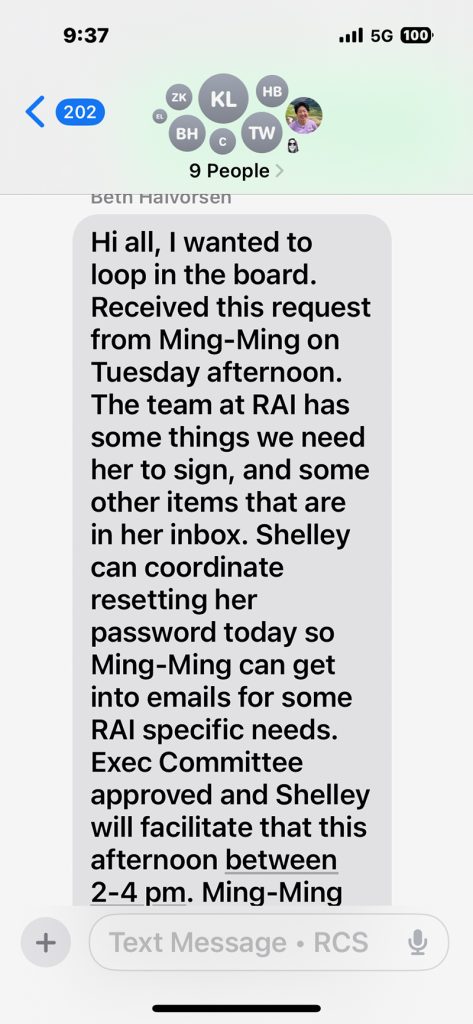
Tung-Edelman shared group text messages from Dec. 4, 2025 that board members sent her. These text messages show that RAI’s interim CEO Beth Halvorsen told Tung-Edelman that the board would grant her two-hour access to sign a crucial funding document as executive director, even though they had removed her from her post. It was a contract concerning a $150,000 grant from the City of Seattle.
“Shelley (Lawson) can coordinate her (Tung-Edelman) resetting her password today so Ming-Ming can get into emails for some RAI specific needs,” a text from Halvorsen reads. “Exec Committee approved and Shelley will facilitate that this afternoon between 2 – 4 p.m.”
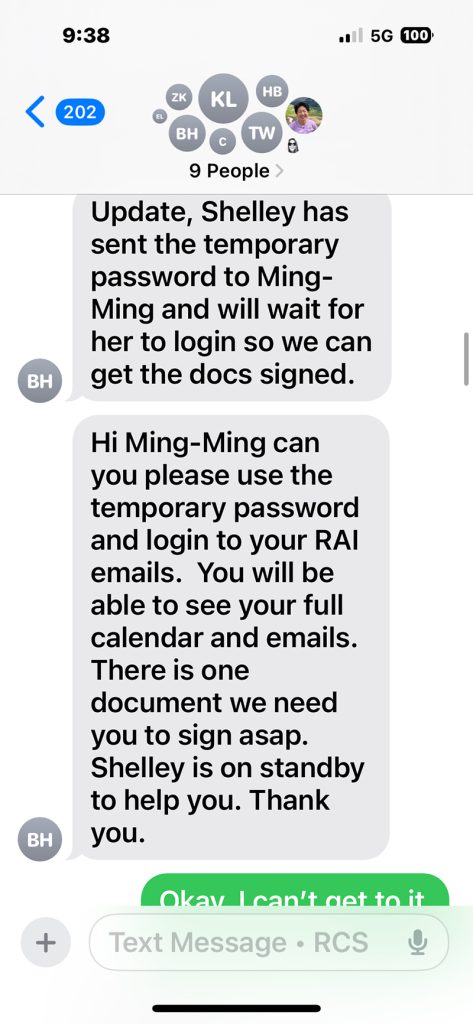
In a later text, Halvorsen asks Tung-Edelman to “please use the temporary password and login to your RAI emails. … There is one document we need you to sign asap.”
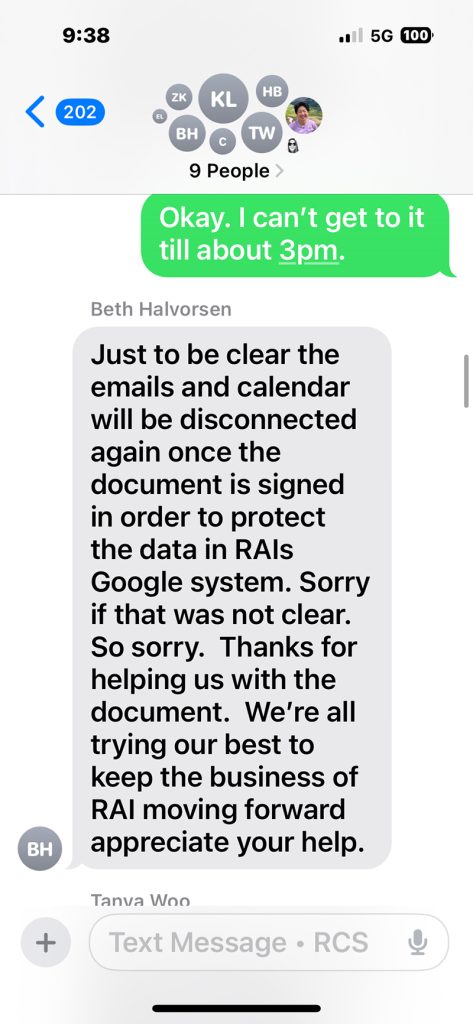
Tung-Edelman said in the group chat that she would not be able to get to it until 3 p.m. that day. Halvorsen replied, “Just to be clear the emails and calendar will be disconnected again once the document is signed in order to protect the data in RAIs Google system.”
Tung-Edelman replied that because the group would be meeting for mediation the following day that they “postpone the meeting at the bank.” She also requested that if the board would be transferring authorization for access to RAI’s funds, that she receive a signed letter from Halvorsen as acting CEO. Finally, she said, “Regarding the contract. If my name is on the contract, I will need the opportunity to review.”
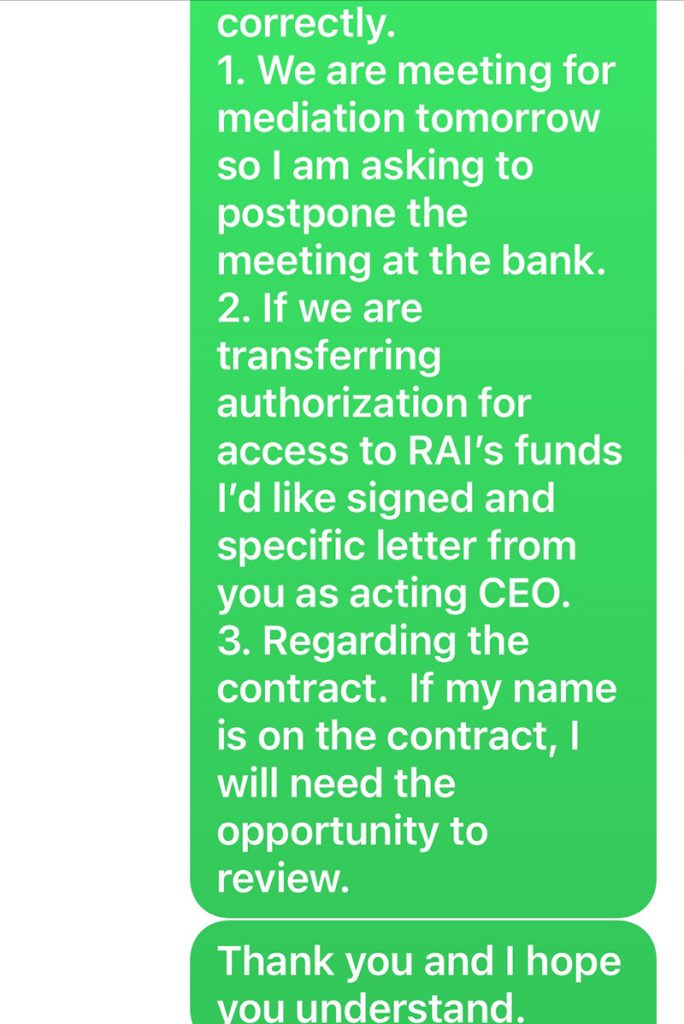
“I let the time to sign … [expire],” Tung-Edelman told the Northwest Asian Weekly. She said that at a facilitation meeting on Dec. 5, 2025, Lentzsch physically gave her the contract to sign. Lentzsch had become RAI’s board chair around August or September 2025.
Tung-Edelman declined to sign the documents.
“[It] didn’t feel right to sign as an ED,” Tung-Edelman said. She said that she later sent a letter declining to sign on Dec. 8, 2025.
It is immediately unclear whether, in the time Tung-Edelman was shut out of her email, someone else was answering emails directed to her.
Tung-Edelman also alleged that, in the interim between her removal and her official firing, Lentzsch told her that her accent and the fact that English was not her first language was “affecting my leadership ability … and that she also had to coach me about leadership.”
“There was coaching here and there,” she continued but “there was no real, defined coaching process.”
“Be the minority face”
Additionally, she said, that the company had taken a markedly different turn since hiring people from the corporate world became even more apparent in November, she said.
On Nov. 10, Halvorsen and Hayden Bixby (now no longer on RAI’s board), met her at a coffee house and told her she was no longer the executive director. The board had met the day prior to discuss the preliminary findings of the investigation, Tung-Edelman said, and had “instituted structural organizational changes” without including her in that discussion.
During this meeting, she said, Halvorsen and Bixby asked her to “[p]lease keep the conversation we had with you confidential in its entirety.”
Tung-Edelman had previously asked to meet with the entire board, following the investigation’s conclusion, but “they never gave me the opportunity.”
“[Halvorsen] told me that she’s the new CEO and she will mentor me, but now I need to obey and she’s the boss—that under her leadership, new leadership, that we can ‘crush it like Russell Wilson and Ciara,’” Tung-Edelman recalled.
She later told the Northwest Asian Weekly in an email that the board changed her role to “Founder,” which bore the duty description of “community facing, fundraising, networking, collaborating with media and civic leaders, attending events as the face of RAI.”
“Later, they offered me the title of ‘Executive Director and Founder’ with no supervisory or operational responsibilities,” she continued. “Hence the concept of executive director in name only which would be obviously misleading to private and public funders. It is insulting and oppressive.”
Additionally, she said, in describing the founder role to her, Halvorsen and Bixby “used the analogy of Russell Wilson and Ciara’s involvement with the ‘Why Not You’ foundation.”
“This is an obvious microaggression,” she explained. “While I have tremendous respect for Russell Wilson and Ciara, and their service to their foundation, the reference is insulting to Wilson, Ciara, and myself. The only real common ground that we share is that we are all minorities.”
“The implications,” she continued, “are that I would remain as the ‘minority face’ of RAI.”
Including the $150,000 City of Seattle contract, Tung-Edelman alleged that the board wanted her to sign other documents as executive director despite no longer having full executive powers or signing a contract to that effect, and sign over RAI’s financial accounts to another employee.
“I signed a request for payment for $50,000 from the City of Seattle neighborhood grant and then realized that I should not be signing such documents that listed me as Executive Director,” she said in an email. “They also told me to sign over access to RAI’s accounts to another employee. They provided no written authorization for this. This contradicts RAI’s bylaws which state: ‘The Executive Director and Board President and Treasurer are the signatories on all of the corporation’s bank accounts.’”
She said she has no idea whether someone else represented themselves as her over email or in some other way.
She also said that Lentzsch was unhappy with her telling public funders that she was no longer the executive director.
“She told me that only … my organization knows, that the outside world doesn’t know, that I need to keep it quiet,” Tung-Edelman said. Even as the false executive director, she said, she was told she “would not have access back to my old emails, and I would still need to obey the new CEO.”
Consulting firm Reverb conducted the investigation, but because that firm was started by former RAI board member Mikaela Kiner, Tung-Edelman feels this could be a conflict of interest.
RAI did not directly answer the Northwest Asian Weekly’s question about why it decided to go with a firm run by a former board member, and whether this was a conflict of interest. Instead, it said that the board “hired an experienced and respected local HR consulting firm to investigate the allegations. The firm assigned an investigator from their team who did not know Ming-Ming, the Board, or any staff members, to conduct the interviews.”
History
Tung-Edelman founded RAI in 2017. She is an immigrant daughter of a refugee, her father having fled China during the Communist Revolution. Tung-Edelman was born in Taiwan and immigrated to the United States in 1985. She said in a written statement that her experience as an immigrant and “first-generation” refugee allowed her to “relate to the challenges, struggles, and the barriers that the refugee immigrant women we serve face,” and that she also recognizes “the resiliency and skills that these women have.”
“My grandmother was a seamstress who raised my mom and her two siblings as a home-based seamstress and single mother in Taiwan,” she said in the statement.
It’s because of this sewing background, she told the Northwest Asian Weekly, that she decided to start RAI—named, in part, because the acronym is “RAI, like a ray of sunshine.”
“It’s an organization that has a mission to partner with refugees and women, and make sure they can be prosperous here in the U.S. through skill training and micro business development,” she said. “[We primarily] focus on the sewing trade. I see sewing as a universal language, where a lot of women come already knowing how to do that—and why not bring work for them, allow them to use that skill to be self-sufficient?”
It also allows excess materials and textiles to be diverted from landfills, thus helping the environment, too, she said.
When she started RAI, Tung-Edelman was a pharmacist, eventually quitting her job in 2022 to run the organization full-time. For nearly nine full years, Tung-Edelman ran RAI, expanding it from a one-woman operation to a thriving organization that has raised more than $4 million in the course of its work to help refugee women, and engages in advocacy and strengthens ties with and within refugee communities.
“From 2019 to 2024, our assets grew from $32,000 to $1,450,000 (45 fold increase),” Tung-Edelman shared. “Revenue grew from $119,000 to $ 1,420,000 (12-fold increase).”
Both Tung-Edelman and RAI have won both local and national awards for their work, and Tung-Edelman was named SeaFair Queen at the celebration’s 75th anniversary in 2024.
Gei Chan, a former fashion designer who worked for famous designer Jessica McClintock in San Francisco and who advised Tung-Edelman for the duration of her tenure at RAI, said in a letter to the RAI board and media that firing Tung-Edelman “is an utter travesty and a definitive slap in the face to all women of color.”
Chan watched Tung-Edelman “grow RAI from a small grassroots project to a million-dollar organization.” Chan praised Tung-Edelman’s tenacity and creative mind, and said that she “has always looked for ways to support her sewers, not just through acquisition of physical upgrades to production equipment (including industrial sewing machines), but also providing safe workshop space in Lake City Way for the growing community of sewers to receive and provide support for one another.”
“I am extremely proud of Ming-Ming, not just for how she has impacted the lives of her individual sewers and their families through the years, but for what she has done to dispel racism and stereotyping of immigrants such as herself by advocating for women of color,” Chan continued. “She is the embodiment of all that hard-working immigrants can accomplish and is a bridge to the wider communities where people of color are not normally welcomed or respected.”
RAI’s future
RAI’s board said in the letter to the Northwest Asian Weekly that, going forward, it’s “focused on how we can support the organization’s mission and is engaged in hiring an Executive Director to lead the team.”
“RAI is writing its next chapter, including the completion of our newly renovated location in Lake City,” the board said. “The RAI MakerSpace will allow us to expand our support of women refugees, divert more materials from landfills, and continue to provide workforce development training for the many artisans whose determination and courage inspire us.”
Tung-Edelman highlighted the significance of this new location in her comments to the Northwest Asian Weekly at the beginning of this story.
“I do not believe that RAI can survive under its current leadership,” Tung-Edelman said.
“The current leadership lacks cultural sensitivity and awareness. It makes no sense to
remove the minority woman founder of an organization created to support minority women.” “I am deeply concerned about the future of relationships with community partnerships, volunteers, grant makers, funders, elected officials, and donors that I have spent the last [nine] years developing.”
She believes that the best path forward for the organization is for her to return as executive director in role, not just in name, and to bring in a new board to continue the organization’s growth.
“Because of my deep connections and widespread relationships throughout Seattle,” she continued, “I have a long list of competent people passionate about the mission of RAI who would be happy to serve as volunteer Board members with my return as executive director to move the organization forward.”