
By Carolyn Bick
NORTHWEST ASIAN WEEKLY
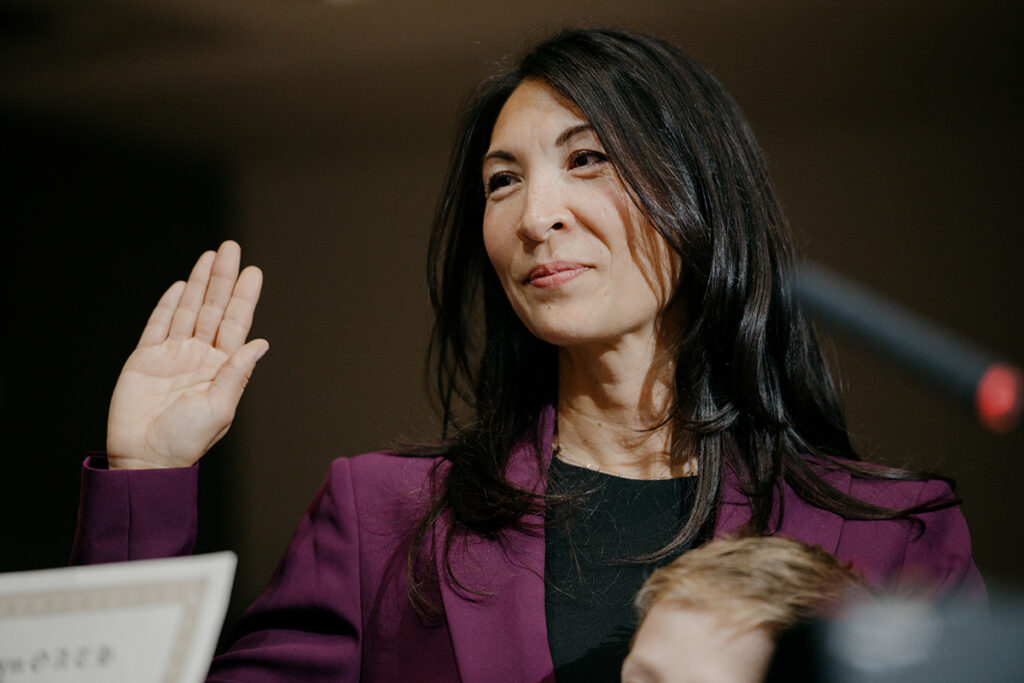
Steffanie Fain
Following her win for the spot of District 5 councilmember, Steffanie Fain became the first Korean American to hold a seat on the King County Council, and the first Asian American in the post for the first time in almost four decades. The Northwest Asian Weekly caught up with Fain in between meetings and new council duties to find out what her days look like, and how she will work to both prioritize South King County and uplift future leaders from the AAPI community.
Northwest Asian Weekly
You are the County’s very first Korean American councilmember and the first Asian American in nearly four decades to serve on the county council. What does that mean to you?
Steffanie Fain
My gosh, it’s an enormous honor…it means that I need to turn and do the same for other people—continue to lift people up into leadership roles and be representative of our community.
District 5, in particular, is one of the most diverse communities in the region. I’m really excited to be a part of a leadership that reflects that diversity.
NWAW
How did you feel when it was clear that you were going to win? Do you remember where you were and what you were doing?
Fain
People told me that they thought it was clear when the results came out, but I’m always very cautious. It was just kind of a slow lead up to it over the next few days.
I really think about that first night of the election. My family was there with me, so it was really fun. My kids were really excited and really proud of me. That’s the highest point—just seeing how excited my kids were, because they know how much time I spent on the street and missing activities. It made all of that worth it.
NWAW
Did they say anything to you in particular? Do they have questions for you?
Fain
They went to quite a few events, and we’ve talked about it over the last year. They’re still 7 and 9. The greatest praise was seeing their faces during my swearing-in ceremony. I almost couldn’t look at them, because they just sat there with so much pride on their faces. It was really, really sweet.
I didn’t know how much they understood or what it really meant, but my parents took them home after that. I saw them for dinner, and my 7-year-old came running up to me, jumped in my arms, gave me the biggest, tightest hug and just said, “I’m so proud of you, Mama.”
It was the greatest feeling.
We still talk about, you know, what we [councilmembers] do. They think I’m this all-powerful person. So I have to tell them I’m one of nine and there’s limited jurisdiction around some things. They’re kids, so it’s—I rule the earth. I’m like, “No, no, it’s not quite like that.”
They do some testing as we’re driving. We pass a building and just talk about it and they’ll want to know what my role would be around that. They already know far more at that age than I did when I was 7 or 9. So, I think it’s exciting.
What’s been fun is a lot of their friends and some of the kids that I’ve coached over the years … they’ve asked their parents about the county and what my role would be. Getting a level of engagement from elementary school kids and middle school kids is really cool to see.
I’m trying to figure out how I can work with the school on a little King County 101 for the elementary school kids, because I think it’s important for everyone to know. And truly some of the kids might learn more than their parents might understand. Explaining what the King County Council does and what the county government does is sometimes something that I’ve had to do on the doorsteps for adults, so it’s been great to be a part of that education.
NWAW
I was curious about how your life has shifted since taking on the duties of councilmember and how your days look different now.
Fain
I’m not doorbelling. All I did was doorbell the last few weeks. It was a lot.
I have that time back and spend time with my kids, trying to do a lot more of that—picking them up from school, taking them to activities—but also a lot of it is the same.
I’ve got a ton of internal and external meetings. I’m trying to listen again and turn what I heard throughout the last year and what I’m hearing now into tangible results for South King County.
The priorities that I heard from constituents throughout the year on affordability and transit and public safety and health service needs, access to essential services like grocery stores and pharmacies and healthcare—all of these things are still top of mind for me.
I met with a lot of city leadership. We’re working through what are the issues that they’re hearing and what can we do with the county to largely increase access, and make sure people are feeling safe and stable. My favorite part of the campaign was actually talking to people, not only in leadership, but folks doing the work or experiencing the hardships, and then matching that up with the services the county provides—and sometimes if the county isn’t able to do that, or if that falls within the city, then working with the city on meeting that need and how can we help the cities do that.
My first full day in office, we spent out in the community. We joined the new King County Executive and his team for a couple of those events for Day of Service. We met with the Des Moines Area Food Bank and did a tour and listened to the needs and barriers and the issues that are coming up to them. I’m going to set up a follow-up meeting with them.
Then, I went down and met with Living Well Kent and got a tour of our distribution facility. It was right before Thanksgiving, so it was watching the endless line of folks coming through, needing food assistance. The amount and the number of volunteers that were out trying to help was incredible.
Then, I went back to Tukwila and met with the executive’s team there, with the Still Waters organization. They provide food within Tukwila Elementary School. It was fun because my father-in-law actually was a longtime principal of Tukwila Elementary School. I can’t recall the year, but he was there for over two decades, I think, or even longer. One of the gentlemen that volunteers there was hired by my father-in-law many, many years ago, and so it was fun to get that kind of full circle, and then take my father-in-law back to tour the school and meet the folks that are still there.
NWAW
You’ll be representing South King County, as you just mentioned, which has a large number of people of color, including many folks who belong to the AAPI community. What does that in particular mean to you? I was also curious whether it informs your priorities at all.
Fain
I talked about this a lot throughout the campaign, about how incredibly diverse our community is and how important it is to have leadership that reflects that. Throughout the campaign, I met with so many amazing AANHPI leaders and leaders of all different communities. I’m trying to figure out a way to build that up.
I’m not sure what that structure looks like, and I try not to create work for other people. I want to take that load on my own. As I meet with, uh, groups throughout this next year, I’ll be working on a way to lift those communities up. Whether we lean into some of the different organizations that are already existing within King County, I don’t know yet, but I absolutely want to make sure that we continue to open the door for more AANHPI leaders and particularly youth that need to see themselves in leadership.
One of the things you and I talked about several months ago was also recognizing that there are lots of incredibly amazing nonprofit groups, but they don’t have the same infrastructure that for-profit groups have. It’s really expensive to have an accountant or someone to help them figure out how to do grants. I still am exploring how we can build that infrastructure and maybe it’s even tied into the work that’s going to be done in the county on the DCHS (Department of Community and Health Services) audit, and the infrastructure needs that are going to be built in there to help nonprofits get grants and make sure they’re complying with all the requirements and all that.
NWAW
Have any of your key focus areas shifted a little bit or maybe become more defined or detailed?
Fain
I will also be on the Sound Transit Board. The reason I wanted to take that role on was reliable, safe transit access in my district is a huge area of need.
Transit is an area that I have flagged throughout the campaign, but I’m really turning to focus on it next year. It’s really exciting work because I will have the ability to be in those meetings and have a voice at the table for South King County.
What I’m finding—and I think this is true of government in general—there’s a lot of siloed work that happens simply because there’s not an extension that naturally occurs over the different regional committees. Now that I will actually be over all three, I think this is a great opportunity to create a more accessible system and increase access for residents who don’t live along the primary North-South transit lines. I’m excited to dive into the transit work and make sure that District 5 is heard there.
NWAW
I was wondering how that might also play into, say, something like transit-oriented development for South King County, and the need for it.
Fain
I don’t have the numbers offhand, but I know that when the light rail stations opened in the North End and the East Side, they had either finished or were well along the way of developing a lot of [transit-oriented development].
We don’t have that as prolifically as they do. There’s a variety of reasons, but a lot of that is work we can do at the county level to ensure that we are making systems work for developers to have the incentives to build. It’s really critical, making sure that we’re not making it too complicated or too many requirements in place that don’t encourage people to come down to the South End and build. And we do need so much housing in South King County.
It is really important that communities of color are not just living and working in their community. It allows them an affordable way to access other services like health care or the many human services and behavioral health supports that are located throughout the county. We don’t have enough in South King County right now. It’s most impactful to communities of color, because it’s really expensive to drive and find parking in other parts of the county.