
By Kai Curry
NORTHWEST ASIAN WEEKLY
A new health center at Beacon Pacific Village is redefining what aging can look like in Seattle. Operated by International Community Health Services (ICHS), the Ron Chew Healthy Aging and Wellness Center (HAWC) offers care for older adults through a Medicare program called PACE (Program of All-Inclusive Care for the Elderly). This senior health space is a “three-way win,” according to ICHS. It keeps seniors in their homes, eases the burden on caregivers, and strengthens the community as a whole.
The center, which is named after ICHS Foundation’s former executive director, is a dream a decade in the making. ICHS ran the PACE program at its Chinatown-International District location, and assisted about 100 patients. The new facility will help up to 400 patients. According to current ICHS CEO, Kelli Nomura, the vision for the center happened when the ICHS board and then-CEO Teresita Batoyola realized that the aging population in our region was going to continue to grow.
“We want to be a valuable resource in the community for our elders,” said Nomura.
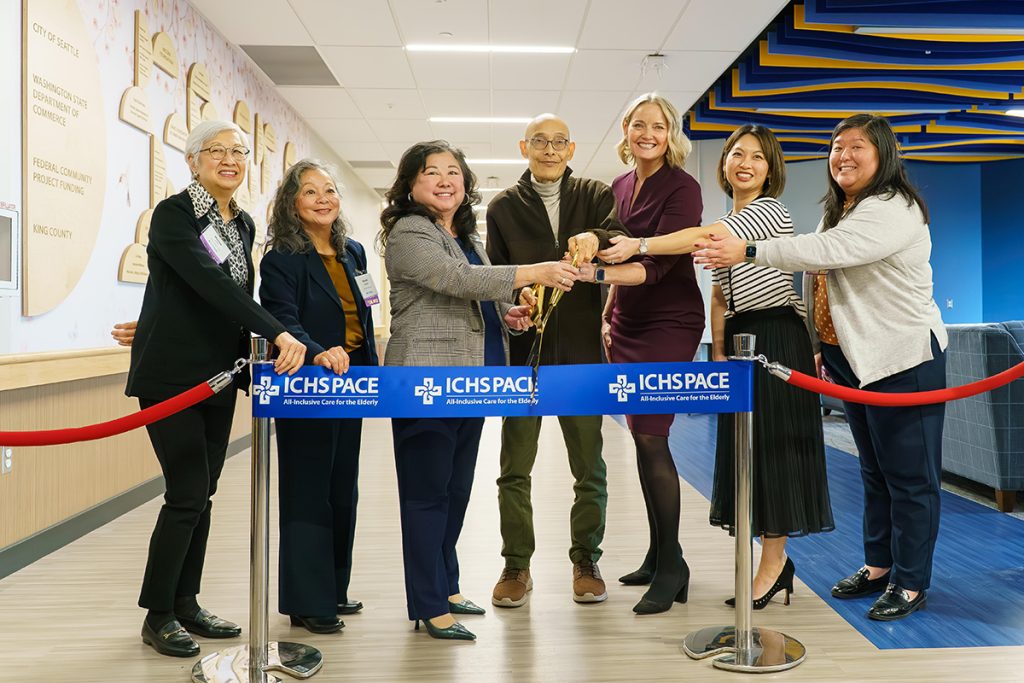
From left to right: Former Seattle City Council Member and Capital Campaign Co-Chair Martha Choe, Retired ICHS CEO Teresita Batayola, ICHS CEO Kelli Nomura, Ron Chew, King County Executive Shannon Braddock, Capital Campaign Co-Chair Leeching Tran, and Seattle Chinatown International District Preservation and Development Authority Co-Executive Director Jamie Lee.
The ribbon cutting for the HAWC took place Nov. 10. However, it has been open for business since August. Participants are able to access care from home, without having to move into assisted living. Once enrolled, the PACE staff will come up with a tailored plan for each person, which may include any of a variety of all-inclusive services. The center also provides transportation which, unlike some of the other PACE programs around the country, is sourced from ICHS instead of an outside vendor—meaning that there will be familiar, neighborly, culturally-sensitive representatives driving the vehicles.
The PACE program is for anyone 55 and older who is using either Medicaid or Medicare or both and who needs a nursing home level of care, Nomura explained, but they are able to stay home. This way, the patient resides in their community and gets all of their needs met. Types of care include primary medical care, pharmacy, behavioral health counseling, physical therapy, occupational therapy, and speech therapy. There is support with daily tasks and personal hygiene, including a facility to take a shower at the center; and nutritional services that include communal culturally appropriate Asian- or Pacific Islander-style meals at the cafeteria. The level of involvement is up to the treatment plan and the patient. They may want to stay all day and socialize, in addition to attending their appointments. They may want to be in and out more quickly. If a treatment is required that is not available at the center, that treatment will also be coordinated as possible under PACE.
The center and PACE give elders the support they need to stay relatively independent and vital. At the same time, the program gives caretakers a respite and the support they need so that they can care for themselves better, too. Caring for elders is ICHS’s “heart and soul,” Nomura told the Northwest Asian Weekly. They are very proud of this new facility, which took years, and a lot of fundraising, to happen. The 25,000-square-foot center is located on the bottom floor of the Beacon Pacific, a low-income housing space. Next to the center is one of ICHS’s partners, El Centro de la Raza. The medical clinic inside the center is named after Batayola. In addition to those services already mentioned, there is also a dental clinic.
“We are really dedicated and committed to building out older adult elder services here at ICHS,” said Nomura.
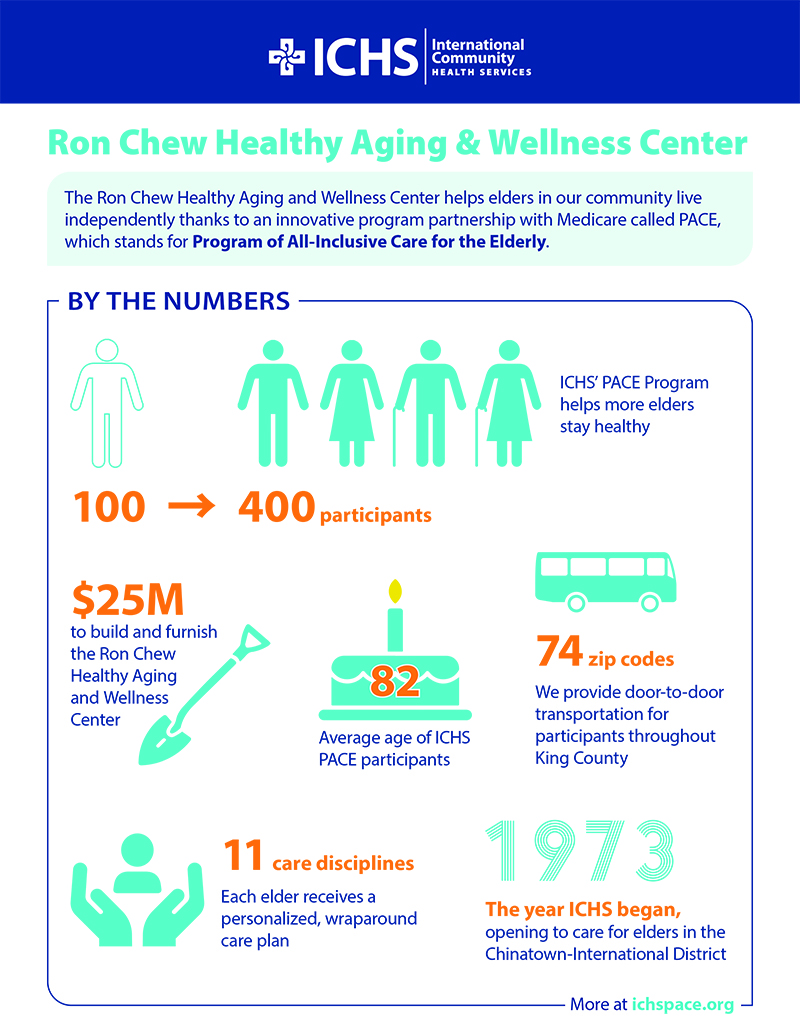 PACE itself is a federal program that started some decades ago. A PACE consultant helped ICHS set up their own branch of the program here in Seattle, and it is largely paid for by the funding provided. It is also indefinite. According to Nomura, many current participants are in their 80s and 90s. Should a patient need more intensive care, the PACE team will assist them and their loved ones in determining the next move. The new center houses only the PACE program. Those who seek care with ICHS, but do not qualify for PACE, will be referred to one of ICHS’s clinics, maybe downtown, or Bellevue, wherever is most convenient.
There are three existing PACE programs being run in the state of Washington. ICHS’s PACE program at the new center is the only one offering tailored care for the Asian and Pacific Islander community, said Nomura. The staff at the center speak at least six or seven Asian languages (at ICHS’s clinic downtown, they speak around 70), primarily Chinese, Korean, and Japanese. In Nomura’s view, the center is a place where patients can feel safe and comfortable, and know that they will receive culturally and linguistically appropriate care.
“It’s a really unique way that we can communicate our support and care.” Along with the above-mentioned possibilities, the center also offers a recreational area, and what they call memory care—which is a secure environment for those who are in a stage of dementia.
So far, PACE is one of the few federal government-funded programs that, in today’s insecure political environment, Nomura feels confident will still stick around. PACE is a proven healthcare model that is seen as valuable for our elders,” she said. ICHS hopes to open PACE in other locations in the future. In particular, they are looking towards South King County, where many of their patients come from. They have already expanded regular (non-PACE) care to Shoreline and Holly Park.
“We wanted to be more accessible to our patients in the community.”
The Ron Chew Healthy Aging and Wellness Center is located at 939 Golf Drive South in Seattle. Information on PACE at ICHS can be found at https://www.ichspace.org.
Kai can be reached at newstips@nwasianweekly.com.