

By Carolyn Bick
NORTHWEST ASIAN WEEKLY
Decades ago, Chinatown-International District (CID) activist and community leader Bob Santos led the fight against bringing a McDonald’s to the CID—what Santos called in a 2005 Seattle Times article “the kind of development that would have destroyed the community.”
Now, community members and activists who have followed in his footsteps find themselves once again having to fight against another attempt to place the fast food behemoth in the CID.
“As a Filipino American,” CID community member Kevin Peralta told the International Special Review District (ISRD) board at its Tuesday night meeting, “I think Uncle Bob would be rolling in his grave, if we were to allow McDonald’s to come back.”
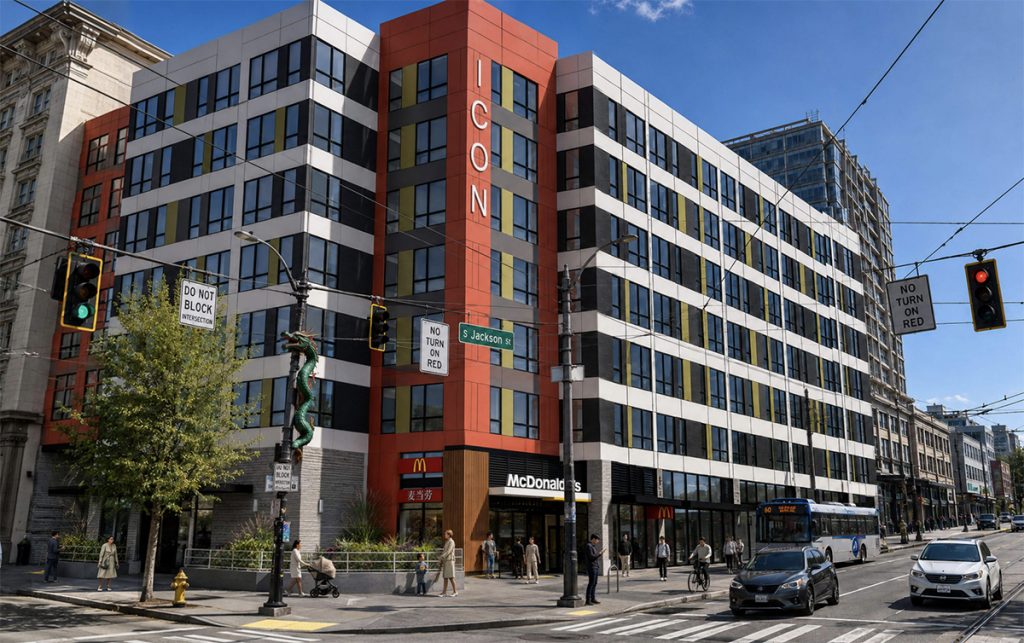
Peralta was just one of a number of people who spoke against bringing McDonald’s to the CID, during the Nov. 10 ISRD board meeting at InterimCDA in the Donnie Chin Community Room. The proposed location is at 400 Jackson St., below ICON apartments in the former Bartell Drugs storefront.
Community members from Historic South Downtown and InterinCDA, as well as individuals, such as small business owners and labor leaders, voiced their dissent. Several community members spoke on behalf of an even larger group of community members who had shown up to the meeting to oppose the proposal. Even Kelabe Tewolde, the newly elected representative for Legislative District 37, showed up to speak against the proposed development.
Community members also circulated an open opposition letter for signatures just prior to the meeting. The letter has so far garnered nearly 150 signatures.
The proposal
Bartell Drugs vacated the space below ICON apartments about four years ago. The space has stood vacant since then. Property manager Niko McHenry told the board that multiple brokers had tried and failed to lease the storefront over those four years.
The McDonald’s would sit at the corner of the empty space, with about 50% of the rest of the area divided up for a different future tenant. Milrose Consultants representatives repeatedly characterized the development as “activating” the corner, and said that the business would bring about 60 new jobs that people who are “probably local” to the CID would fill.
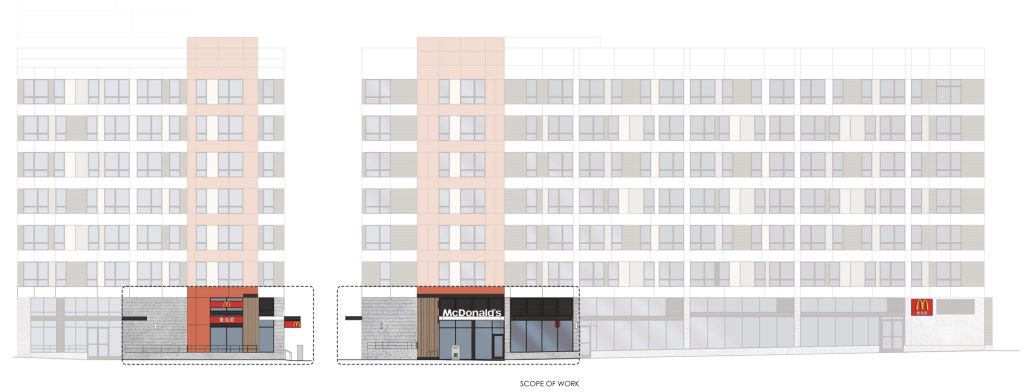
The project proposal packet states that the work will include “selective interior demolition,” and the construction of dining and kitchen areas, as well as installation of new finishes and fixtures, and upgrades to electrical equipment. The space would be a dine-in space only, with no drive-through.
Strong community opposition
Though the meeting regarded process only, and Milrose Consultants on behalf of McDonald’s only presented a concept to the board to get early feedback, the outpouring of community opposition even at such an early stage meant that the board had to shorten the usual two-minute public comment time per commenter to one minute.
The board also received more than 75 comments ahead of the meeting, with 140 more that board members needed to review.
Speaking on behalf of InterimCDA, policy analyst Derek Lum said that the nearly 60-year-old community organization is “appalled by the prospect of a McDonald’s might come to our community.”
He said that the global corporate giant is difficult to engage with on a local level, because they do not have a local identity. Moreover, McDonald’s and other big box businesses have the potential to draw customers away from businesses that are already struggling. Unlike businesses elsewhere in the city, CID businesses are still trying to recover from both the onset of the COVID pandemic and the acute injury of the World Cup games. Many have closed their doors for good.
McDonald’s, he said, could “encourage corporate consolidation in our beloved CID, furthering gentrification of our community and furthering economic and cultural displacement.”
“Our community is a special, beloved community—not just Chinese, not just Asian, but Pan-Asian, of people of many different ethnicities, including people who are not Asian immigrants and not Asian-Americans,” Lum said. “They don’t understand this at all.”
He also said that InterimCDA fears that McDonald’s will worsen the public health and safety issues the neighborhood already faces.
“You can look at the McDonald’s at 3rd and Pike to know that this will be true, because our community has many people in crisis, just like they are in Pike,” he said, referencing the downtown McDonald’s location widely associated with open-air drug use and crime. In 2020, gunmen shot and killed one person and wounded seven others, including a young child.
“This McDonald’s will just further that,” Lum said. “We remind you the ISRD’s mission is to promote, preserve, and perpetuate the cultural, economic, historical, otherwise beneficial qualities of the area, particularly features derived from its Asian heritage. … McDonald’s failed on all of these proposals. It’s not good for our economics, not good for social order, not good for our history, and not good for any other aspect of the community.”
Speaking as part of a larger group of former ISRD board members, former board member Andrew Koh read a statement from fellow former board member Eliza Tan. Tan served on the board from September 2016 until November 2018.
Koh asked the board to reject the proposal. Reading from Tan’s statement, Koh said that the group was concerned that the proposed, required change of use of the space to a “formula fast food restaurant” that would need to accompany a successful siting of a McDonald’s would “make it harder for local business to complete and gradually change the neighborhood’s character.’
“Those concerns remain relevant today. A business entering the International District should consider more than its own brand and business objectives,” Koh read. “It should consider its responsibilities to the community that it’s entering. McDonald’s referenced the neighborhood’s cultural context through Chinese language and branding and then being inspired through design elements. But cultural identity is much deeper than that. It comes from the people, local business, cultural institutions, and relationships built over generations. A vacant storefront is an opportunity.”
Born-and-raised Seattleite Linda Vong said that she and her relatives still live in the CID, and that when they go out to eat, they do so at local restaurants. When they shop, they shop at small, CID-local businesses. She even gets her vision checked at a CID-local eye doctor.
So, she said, “[t]here’s absolutely no benefit to adding this soulless fast food chain to such a vibrant neighborhood and it would only harm the people and communities who live, work, and play there.”
“We must protect the health of our community, that the CID needs affordable and healthy options, not McDonald’s, that we must protect our small businesses,” she continued. “McDonald’s in the CID would set a precedent for big businesses to settle in the neighborhood, pushing out and displacing our communities. … We have no interest in that. We’ve rejected McDonald’s in the CID before and we’ll continue doing so.”
Board skepticism
In addition to the Department of Neighborhood’s approval to change the use of the space to a “formula fast food restaurant” use, siting the mega fast food chain in the CID would require Seattle’s Department of Neighborhoods to issue a certificate of approval. The board needs to review the proposal and feedback, and make its recommendation to the department.
But at least one board member did not appear inclined to take the proposal any further, while others expressed skepticism.
Milrose Consultants representatives said that in addition to removing the Bartell Drugs sign, the only thing McDonald’s would do would be to add “a bamboo brand element on the corner, which is used on our restaurants pretty historically around the United States and the globe.” The representatives also said that they are “open to working with the board and the guidelines to adjust the frontage wherever we can.”
Board member Huy Pham said in no uncertain terms that there was no world in which any further discussion regarding the design—or any other element—could be fruitful. The issues aren’t just aesthetic, he said: siting a McDonald’s in the CID is outright antithetical to the soul of the neighborhood.
“One comment that really struck out was… the Chinese characters for the McDonald’s signage,” he said, referencing Tan’s statement. “We’ve seen that incorporated in [Washington,] D.C.’s Chinatown, which in our community is known as the worst lost Chinatown, because it has allowed for big box businesses to come in with the minimum requirement of putting Chinese characters in it.”
Since then, he said, several major chains, including Taco Bell, Panera, and CVS have all come into D.C.’s Chinatown with nothing different about them save for Chinese characters.
“I think you did your job in presenting and providing the proforma … but there isn’t really anything that you can modify to gain mine or community consensus to approve,” Pham said. “I would suggest saving your time and money on moving with a different project.”
A Milrose Consultants representative replied that they weren’t kicking a tenant or a mom-and-pop store out of the space, and that they were “just proposing to go into this space that is vacant.”
Board member Jade Yan challenged that reasoning: “Your argument or proposal is that the space right now is vacant and potential economic benefit is to activate the corner that has been vacant. But I haven’t really heard from you. Why McDonald’s over literally anything else? I think what I’ve heard from you in your presentation is that it’s just a matter of it’s empty.”
Fellow board member Kyle Jacobson said that the board’s role is centered on self-determination for the community, “after a number of really large projects had huge impacts on the neighborhood over the objection of many community members.”
“As someone who was elected twice to serve in this position, I can’t imagine ignoring such a strong community response. It’s pretty clear that folk don’t want this,” he said.
He also added that “our power here is often pretty blunt,” and that the board can veto projects. However, it has no power to directly change economic conditions or make vacant commercial property more desirable.
“There’s a lot we don’t have control over in the neighborhood, and I think it’s always worth keeping that in mind,” he said. “I think it’s always worth being thoughtful and careful in how we exercise this veto power. However, the addition of formula fast food restaurants in our neighborhood is something very specifically considered by the City Council when they created the ISRD and when they empowered the community. We can point to a very specific authority here, and we can see that community sentiment is in alignment with the very thing that the City Council considered when empowering the ISRD board.”
While he emphasized that the board wasn’t taking a vote that evening, Jacobson said that he didn’t “see how I could do honor to the trust placed in me by the community if I voted to approve what’s been presented so far.”
Speaking earlier during the public comment period, Bush Garden restaurant owner Karen Sakata urged the board to remember this commitment, and the reason they exist at all.
“It’s the board’s responsibility to keep this neighborhood strong and what you’re supposed to protect is being part of the preservation of this neighborhood,” she said. “[McDonald’s] does not belong here in this neighborhood. … We want something that represents and takes care of this neighborhood. And the uniqueness of all the small businesses, not large corporations, is part of what makes this neighborhood special. The different languages, all the variety of foods—we don’t need to homogenize this neighborhood.”
Leave a Reply