

By James Tabafunda
NORTHWEST ASIAN WEEKLY
Mayor Katie Wilson authorized the Seattle Police Department (SPD) to expand its police closed-circuit television (CCTV) network into three more neighborhoods, while promising new safeguards intended to keep the footage away from federal immigration enforcement.

Interim Seattle Police Department Chief Andre Sayles (left) and Seattle Mayor Katie Wilson. (Photo by James Tabafunda)
Wilson said at a City Hall media conference on Nov. 10 that cameras already installed at 21 locations in the Stadium District will be turned on immediately. Cameras near Garfield High School in the Central District and in the Capitol Hill nightlife district will be purchased, installed, and activated in the coming months.
The announcement lifts a pause Wilson imposed last March. It came one day after New York University School of Law’s Policing Project released a 77-page audit titled “Seattle’s Real-Time Crime Center: A Civil Rights, Civil Liberties, and Governance Audit” that found “important gaps” in how the city governs its Real Time Crime Center (RTCC), the police hub that monitors the cameras.
“When I paused the expansion of CCTV, I did so because I believed we needed to ask some hard questions about data security and the protection of civil liberties, especially in the context of a federal administration that is targeting vulnerable communities and violating civil rights,” Wilson said in a statement released after the media conference.
Audit makes recommendations
The Policing Project’s audit made 19 recommendations. They include making the SPD’s practice of deleting raw camera footage after five days a formal policy, publishing a public dashboard on RTCC use, and requiring a judge’s warrant before police use the RTCC to reconstruct a person’s movements after a crime, except in emergencies.
Wilson said her office and the SPD will carry out most of the recommendations over the next four to six months. The department will publish the dashboard, complete an omnibus surveillance technology policy, and strengthen rules on permissible uses, access logs, data retention, and requests from outside agencies, according to the mayor’s office.
Wilson said police currently do not use the RTCC in situations that could require a warrant and are not tracking individuals after the fact.
A new advisory group will help write policies on connecting privately owned cameras to the system, use of the RTCC during protests and other First Amendment activity, and criteria for any future camera locations. The group will include representatives of the Community Police Commission, the Seattle Information Technology Department, City Council Central Staff, SPD, the Community Surveillance Working Group, “and potentially others.”
Pledge to refuse federal requests
“If there is a type of request that we are not legally able to refuse, we will shut down the camera system, I believe, for 60 days,” she said. “So that is what is in our policy.”
The city requires CCTV cameras to be turned off if the federal government is found trying to access their feeds for immigration enforcement or to target people seeking reproductive or gender-related care. Wilson said she was not aware of any such request.
“There’s no such thing as zero risk,” she said. “My assessment based on the audit is that the risk is very low. I think, in general, ICE (Immigration and Customs Enforcement) has its own ways of getting information and does not need our camera footage.”
The audit warned that “once data exists, no city or agency can guarantee it will never be shared.” It found that outside agencies could seek footage through public records requests or court orders, including orders served on Axon, the city’s vendor, which stores some police video on its Evidence.com cloud platform.
Wilson said the city will be working on “not preserving that data indefinitely.”
The Community Not Cameras Coalition said in a Nov. 10 statement released before the media conference, “The audit confirms what we have known all along: once the footage exists, no city policy can prevent the footage from being accessed by the federal government.”
Pledges for immigrants
“I will not allow the data that the city collects to be used to harm immigrants, LGBTQ+ people, or others who may be targeted by federal agencies or other bad actors,” Wilson said.
Interim SPD Chief Andre Sayles spoke directly to residents of immigrant neighborhoods.

Interim Seattle Police Department Chief Andre Sayles (Photo by James Tabafunda)
“To those worried about privacy, about our most vulnerable and immigrant neighborhoods being targeted, or about illegal surveillance, I hear you,” Sayles said. “Like you, I get frustrated when I hear of government agencies misusing camera technology. That is not who we are, and it is not how these cameras will be used. Our commitment is concrete, clear safeguards on how the system is used.”
History of CCTV in the Chinatown-International District (CID)
City crews began installing CCTV cameras in the CID in April 2025. The $1.5 million project also covered Aurora Avenue North and the Third Avenue corridor downtown. It began with cameras at 62 locations in those three areas, according to the city’s Office of Inspector General for Public Safety (OIG).
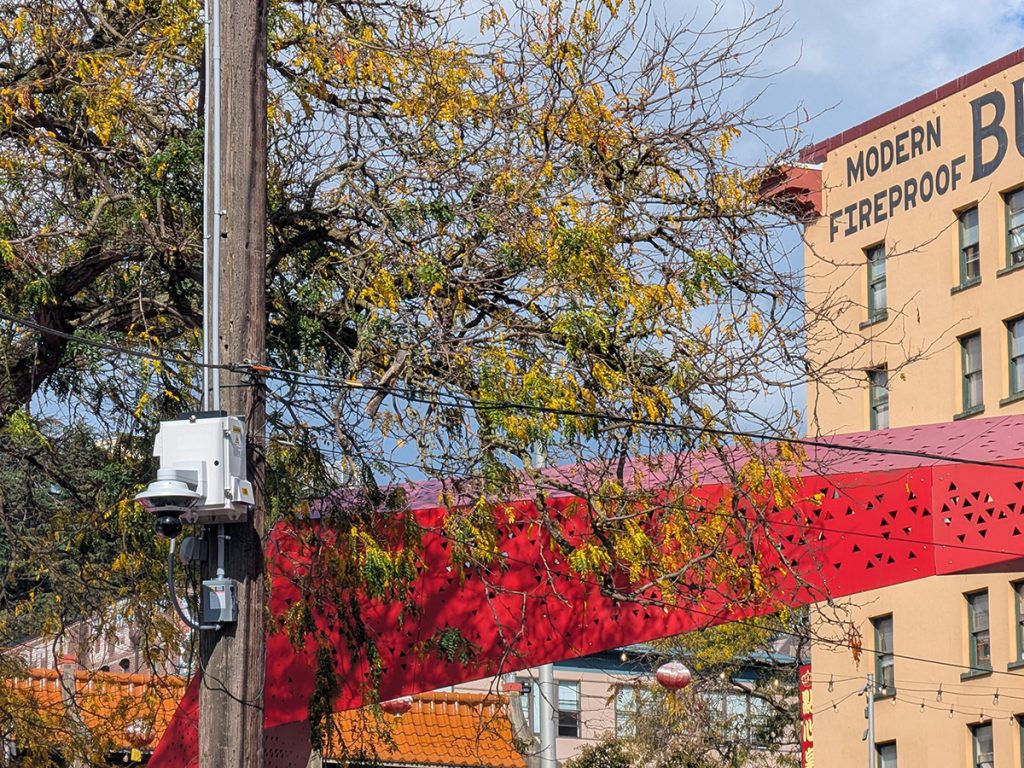
One of the CCTV cameras in Seattle’s Chinatown-International District (Photo by Ruth Bayang)
When Wilson paused the CCTV expansion on Mar. 19, she said the existing cameras would stay on. Five days later, CID seniors and residents delivered a 1,032-signature petition to City Council members urging the city to keep the neighborhood’s cameras on and install more.
Wilson’s decision keeps the CID cameras in operation. It does not add new cameras in the neighborhood.
Analysts, not officers, run cameras
Sayles said civilian analysts operate the CCTV cameras.
“The unique thing we have here at Seattle Police Department is our analysts are the ones that control the cameras,” he said. “Our officers don’t have access to the cameras.”
Nick Zajchowski, the SPD’s director of technology, said the analysts are “full-time, permanent SPD employees.”
He said the SPD’s initial purchase from Axon included 100 devices that can link private business cameras to the RTCC. “We have decided not to give those devices away to the community at this time,” Zajchowski said.
“That collection of evidence is going to be an opportunity for our detectives to push the investigations forward faster and make appropriate arrests when we need to,” Sayles said.
He said he will discuss the changes with the Seattle Police Officers Guild and the Seattle Police Management Association, the unions representing the department’s officers and added that he was not sure whether any of the changes would be subject to negotiation.
Results remain under review
Sayles said the CCTV network helped solve 17 homicides last year. Wilson said the audit found that camera footage was used in those 17 investigations, and she said that did not prove the cases would have gone unsolved without it.
The OIG found in a Sept. 30 review that the SPD largely followed program rules in 2025. It also found that the camera software did not require analysts to enter a case number before viewing live feeds. The SPD is working with Axon to make that a required step.
A separate study of the cameras’ effectiveness by the University of Pennsylvania, overseen by the OIG, is scheduled to be completed next year. Inspector General Lisa Judge said her office plans to add unscheduled spot checks of the RTCC in 2027.
‘Important but very limited’
Wilson said the cameras should be seen as one modest piece of the city’s public safety system.
“I think it’s very important not to oversell cameras,” she said. “I believe that our RTCC and these camera systems are an important but very limited part of our overall public safety system.”
She said research on camera effectiveness is “really murky,” in part because controlled experiments are difficult to conduct. She also cited police staffing shortages.
“I do think that the RTCC can help us be more efficient with our police resources when it comes to investigations and when it comes to effectiveness in responding to real-time incidents,” she said.
“I am dedicated to making Seattle the safest big city in the country, safe from gun violence and serious crime, and safe from authoritarianism from the federal government. That is why I ordered this audit months ago, and why I am taking these steps today toward the safety that everyone in our city deserves,” she said in a statement.
At the media conference, she said, “I believe that a targeted, limited camera system is a good investment.”
To view the media conference, go to www.seattlechannel.org/videos?videoid=x191980.
Leave a Reply