

By Carolyn Bick
NORTHWEST ASIAN WEEKLY

Dr. Christine J. Hong (Photo by Lindsey Lingenfelter)
Dr. Christine J. Hong, a Presbyterian minister and associate professor of Religious and Interreligious Education at Columbia Theological Seminary, has been able to perceive spirits since she was a child. But growing up in a Christian household whose Korean ancestors had converted generations ago from Indigenous Korean belief systems, her experiences were often at odds with the church’s teachings.
Born in Los Angeles in 1980, Hong moved to Bellevue, Washington when she was between 8 and 9 years old. She attended the University of Washington, the Princeton Theological Seminary for her Masters of Divinity, and later the Claremont School of Theology, where she received her Ph.D. in religious education.
But it wasn’t until she had her own children that she started to try to make deeper sense of her ongoing experiences beyond the bounds of her family’s faith.
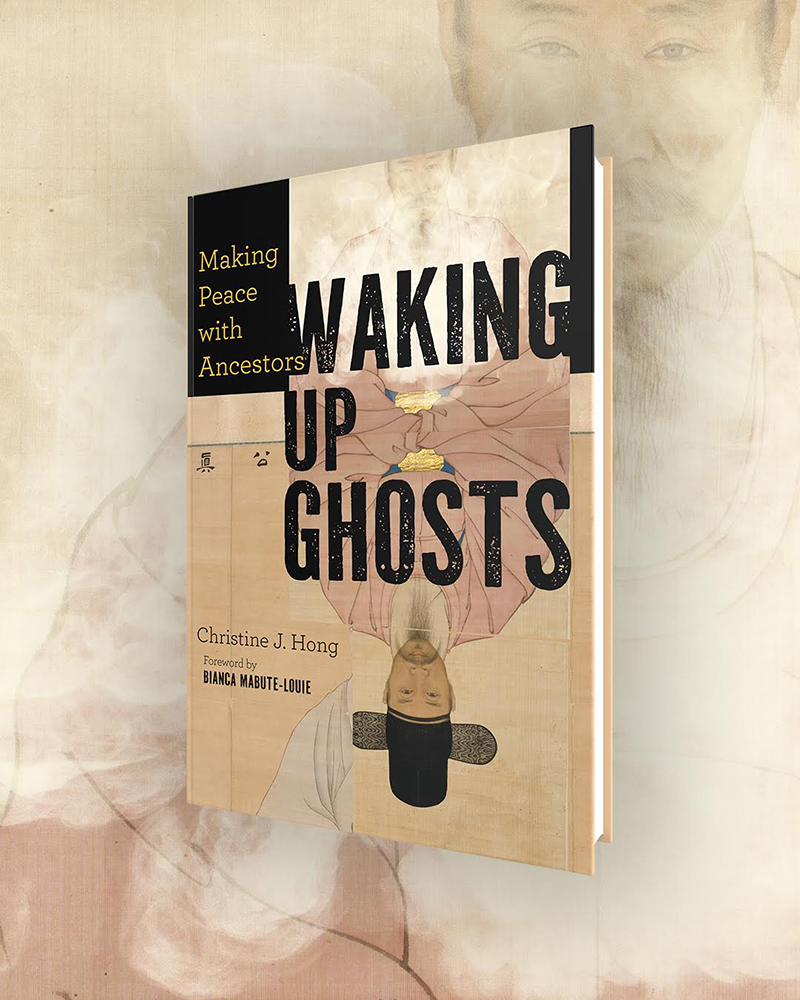
In her upcoming memoir, Waking Up Ghosts: Making Peace with Ancestors, which will be released on Nov. 17 through Broadleaf Books, Hong invites the reader to join her in experiencing both her life and the lives—and deaths—of her ancestors.
The Northwest Asian Weekly recently chatted with Hong about the book and her experience of writing it. She told the Northwest Asian Weekly that she had initially begun the book as a gift to her ancestors, but that it quickly became much more.
This interview has been edited for length and clarity.
Northwest Asian Weekly
I’d love to know more about your background and how that shaped you and your experiences.
Dr. Christine J. Hong
Both sides of my family converted from Korean indigenous shamanism to Christianity before the war, and then after the war, in the process of becoming displaced people, deepened their conversion during the displacement.
…
I think that happens for a lot of people through trauma. They’re looking for something to cling onto. So because of those particular experiences, that was something that they really pressed upon their kids and even their grandkids and that’s how that came into my life.
Faith and Christianity was always bound up [with] the [traumatic] experiences of our family and also the very thing that kind of saved us. So it was always very heavy to carry. It always felt kind of like, you can’t give this up, you can’t abandon it.
…
Growing up, when you have very spiritual, mystical experiences, you either assume everybody’s having them [or] when people tell you that you’re the only one having them, you learn very quickly to keep it to yourself. I learned that very, very early on.
And then I learned that it was only acceptable to talk about it if you couched it within the Christian experience. So I could talk about it, but I could only talk about it through the vehicle of Christian language, the experience with the Christian God, and then tie it back to, ‘This must be part of the larger family experience of Christianity.’
Even to this day, I think talking to my mother about it, she still has a hard time imagining that it’s something else besides that—that it’s outside of those bounds. … My pushback is always, ‘Why does it have to be connected to that?’
It doesn’t have to be. And it doesn’t negate the Christian tradition. It also doesn’t have to be owned by the Christian tradition. Not everything has to fall under that umbrella.
…
When my grandparents passed, I realized even though they died as Christians, I felt a connection to them beyond that Christian connection. There was a deep ancestral connection that was not something that was taught in Sunday school. It was different. It was cultural. And my grandparents hadn’t taught that to me.
NWAW
How do you see the connections between actual ghosts and spirits and being able to work with them and speak alongside them in the book to discuss cultural trauma?
Hong
This is from my research and work with Korean mudangs, too, Korean shamans, because they’re really the ones that do this every day with people and with ancestors and with their own deities.
The way that I understand it and perceive it is, when our ancestors cross over, they cross over as they are. There’s not any perfection that happens when you cross the portal between life and death. You only know when you’re going. You cross over as you are, and you’re separated from your body, and, so, there is opportunity for growth, even on the other side. You can look at it that way, or you can look at it [as] there’s opportunity for healing. We’re unlearning and undoing.
One of the things that I really had to undo in my mind was this Christian theology that when we die, somehow we’re perfected on the other side, and death comes with this liberation—you’re liberated from your suffering, you’re liberated from your sorrow and grief, and whatever harm was done to you.
But in Korean indigenous belief, that’s not true. You are free from your body, and the suffering of your body, but everything else is still there. What is new is that you are free from your body. And then on the other side, you have a whole host of ancestors that are there to help you with that transition.
If you’re a good ancestor, you’re going to be able to use that energy that you’ve harnessed, things you’ve learned, both on life’s side and death’s side, to share and impart that wisdom with the people who are still living that you care about.
That’s what I realized when I started venerating my maternal grandparents. … They were [also] imparting things that they had learned on the other side. And some of these things were [that] there is so much more than we thought while we were alive. There’s so much more expanse of this life in the spiritual realm than we taught you while we were alive.
…
They’re not perfected and they still need healing, but they need us to be able to heal just like we need them to be able to heal.
Part of what my impetus for writing this book was, my grandparents when they were alive—especially my grandmother—they had so many regrets that emerged from the war, including a major one that has to do with her younger brother. It was one she carried to her grave with her. Whenever she talked about it, she would just weep. And she would say things like, ‘One of the things I’m afraid of when I pass, is seeing him, is having to be confronted by him.’ Her other deepest fear was not seeing him.
…
I needed to write this book because part of her healing, part of our family healing and my healing was to get this story out into the world. Part of the reason she couldn’t heal was because it was just a private story. It was just private grief and guilt. And in our tradition, things that are private and secret like that can’t heal, because the community hasn’t heard those stories. … [Healing] is a communal effort.
NWAW
Another thing I love about this book is that you weave it together through important words and rituals rather than breaking it up into chapters. I was curious if you could please explain why you did that and why you went in the order that you did.
Hong
I don’t know why I did the order. The reason why I chose Korean words is because, as a person in the diaspora, the way that we learn about our culture and about our Korean-ness is through just singular words. They carry deeper meaning because we don’t have the full vocabulary.
Not many of us are fully bilingual. I am bilingual, but I think about people like my children or my husband or my brother who aren’t bilingual. They have some words [that are] really, really simple. For native speakers, those words just need the one definition.
For instance, my children know the word gimbap, which is like the Korean rice roll with vegetables inside. My children know the word gimbap. And for a Korean native speaker, gimbap just means gimbap.
But for my kids, that’s like one of maybe 50 words they know in Korean. So that word means lots of different things.
It means both one of their favorite Korean meals that they love, but it also means the thing that their mom makes, that Umma makes for them. It’s associated with me. It’s associated with a favorite lunch they get to bring to school.
It’s associated with particular ingredients they like that their friends don’t eat, like spam. It’s associated with particular moments that they have in diaspora that are not happening within an ethnic Korean community and happening sort of uniquely here in the United States, in Georgia and Atlanta. It’s associated with their grandmother making it for them once in a while, her hands making it, her teaching them how to roll it on their own.
So they have these 50 words, but each word is like a volume, like a chapter of their lives. And I think that’s why I did that. Each of those words for me is like a giant volume of things that I’ve learned about myself as a person in diaspora, about my family, and that I’m still learning.
NWAW
How did writing this book serve as a generational healing ritual for you, and how did your perspectives, thoughts, and feelings change as you wrote it?
Hong
My paternal grandmother died while I was writing about her, which was so interesting. Chapter five is about my relationship with my father, which is low-contact. Growing up with him was really hard. He’s not somebody, when he passes, that I’m going to be venerating. I feel like so much of my life has been about accommodating him and his needs. And my childhood is really violent because of his presence.
…
But in writing that story, I also was able to heal so much of the wounds that I was born from that relationship. When my grandmother passed as I was writing that—his mother—I also began to unpack her story of her own woundings because she also was a vicious woman.
And there’s reasons. She also was a refugee of war, had an abusive husband, was in a situation where she was married to a much older man who had children who were not that much younger than her. And it was so hard. She left her kids in Korea to immigrate on her own, once her husband died. I don’t know mothers that would do that unless it was an incredibly desperate situation.
But that was just how she was. She was a survivor. And my dad learned that from her.
…
And so I understand where that anger, that deep-seated violence comes from in him. It had to go somewhere. It was seeded in him and seated in him from a generation-plus ago. It came down the family line.
…
As I was writing about her life and writing the truths about the things that she had done, the experiences that she had, I was having the worst migraines. I was doing the final drafts—I had to turn them into my editor of that particular chapter—and it was to the point where I couldn’t even see the words I was typing and I had to start to dictate them into my laptop. The more I wrote about her, the worse [the migraines would be]. I would have migraines for days and days at a time.
I talked to one of my friends who was a mudang, and I was like, ‘Is this her? Is this her?’ And she was like, ‘Absolutely, it’s her.’ And I just had this feeling that she did not want me to talk about her. ‘Don’t talk about me. It’s so disrespectful, number one. And also, how dare you? How dare you talk about me in this way or how dare you think about me in this way?’
She had just died, [so she was] still in the transition period. So she was actually very, very close, which is why I really felt her presence. She was not happy that her story was being told in this way. But I didn’t feel like I was telling her story in a way that wasn’t generous.
But I also felt like I had to do it because it felt like an exorcism for me. After she died and I was writing that chapter, I felt so much rage in my body, and I was like, ‘I don’t know where this is coming from.’ Like the more I wrote, the more I was like, ‘I’m so angry and I have nowhere to put this anger.’ It was like I had a fever, but I didn’t. I was crying, I was sweating.
I would just go into parking lots and just cry in my car, just angry crying.
And I was like, ‘Wow, this is what it feels like to have all that violence stuck in your body … decades of it.’ It really felt like a deep haunting.
…
As soon as I hit send [on that chapter], I was fine again.
NWAW
What changed in you when you finished [the book]?
Hong
I started this book as a gift to my ancestors, as a way of helping them release sorrow. And I think when I finished it, I realized, ‘Oh my gosh, there’s such a price to pay for telling the truth.’ So I was a little bit like, ‘What if people can’t hold the truth that I’m telling?’
Namely, I was really worried about what my mother would think. So before I sent the final typeset copy to the publisher, I sent it to her. … I was so afraid that once this book was out there, that my relationships with my family would change. … I fully expected her to call me and say, ‘Pull the book right now.’
But she called me and we had a conversation all night. And she was like, ‘Number one, I’m just glad that you’re still a Christian.’ But she goes, ‘Other than that, I really realized that we had such different experiences of your childhood. I didn’t realize how hard it was for you to grow up with immigrant parents.’
…
What changed in me was not the need to be right. I just don’t want anyone to be hurt by what I wrote. This book was supposed to heal, not wound. So that was my fear, was that I would create more woundings and not more opportunities for healing.
NWAW
Is there anything else that I didn’t ask about that you think is important for me or for readers to know?
Hong
People usually have questions about mediumship and like, ‘How do you see your ancestors?’ or ‘How do you connect with your ancestors?’
I don’t think connecting with your ancestors has anything to do with mediumship. Connecting with your ancestors and venerating them—all it means is remembering them. Remembering their stories and telling them often. And telling the truth about who they are, not with rose-colored glasses, or the fabrication, but their fragility, the mishaps that happened, their regrets, but also their joys and their hopes and their dreams. And then being in constant relationship with their memory. That’s how you keep them alive spiritually.
…
The way I look at the altar is, it’s a portal. And when we put offerings on the portal, on the altar, and we make vows to the altar, there are people on the other side making vows at the same time. … People think like, ‘Oh, are they just sitting and receiving our offerings?’ No, they’re putting offerings on that table, too. And it’s things that we need, like strength, courage, the ability to speak the truth.
It’s liberation. It’s all the things that we need to survive today. These are things that they’ve earned in their lifetime, that they’ve earned through the mistakes that they’ve made, the lessons that they’ve learned, and that they’ve learned on the other side from their ancestors.
And they put that on the altar for us, too, so that we can gain that, that we can learn those things. And we receive those from them. And that’s their veneration to us.
…
I want people to know that there’s nothing magical about venerating your ancestors. It’s a relationship that just doesn’t end. And, especially if it was a loving relationship, it is still a loving relationship, but out of body.
Leave a Reply