


By Kai Curry
NORTHWEST ASIAN WEEKLY
Art lovers are not stopped by rain. A significant crowd showed up on the morning of Oct. 29 for a free tour of public art installed on the grounds of the Seattle Center. The art shown was part of Seattle Center Sculpture Walk, a collaboration between Seattle Center and the Seattle Office of Arts & Culture that commissions artists to create temporary public art around campus. Many of the pieces are set for deinstallation in November, so this was the last chance to see them.
The tour started at the south doors of the Armory, then made its way to the Poetry Garden, around the International Fountain to the Bagley Wright Theater, then past McCaw Hall, and back towards the Museum of Pop Culture (MOPOP). The tour was led by Adetola Abatan, Public Art Project Manager for the Seattle Office of Arts & Culture, and Pete Rush, Arts Program Manager at Seattle Center. Along the route, seven artists who accompanied the group spoke about their art.
No one felt the steps or the rain, which was intermittent. Everyone was transfixed by each spotlighted work of art, starting with three pieces by Megan Prince and culminating with a work by Morgan Madison. Each piece had a fascinating story. Towards the middle of the tour, hung near the Pacific Ballet and the Seattle Opera, in the Founder’s Court, was a work by Teruko Nimura, titled Koi No Taki Nobori, or Carp Climbing a Waterfall.
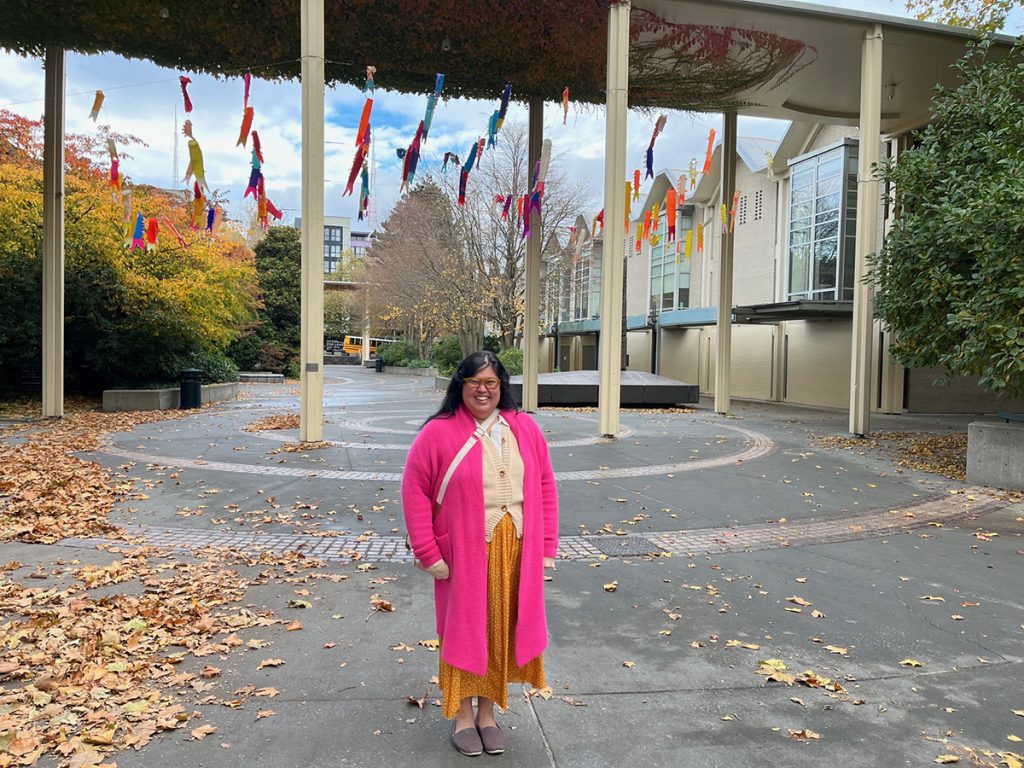
Tacoma artist Teruko Nimura and her installation on the grounds of the Seattle Center, Koi No Taki Nobori, or Carp Climbing a Waterfall. (Photos by Kai Curry)
Nimura’s work was reminiscent of what she installed at the South Sound Sustainability Expo in 2025, a difference being that in this work, Nimura was able to focus entirely on the symbol and story of the carp. The legend of the koi that climbs the waterfall appears in folklore across Asia. In Japan, Japanese Filipina American Nimura said, it comes from a proverb about resilience. “The carp swims so fiercely upstream… it’s a beautiful, fantastical idea of perseverance,” Nimura explained as she stood below the flying fish in a brightly colored outfit that complemented the piece perfectly. Nimura had driven over an hour from Tacoma to be present for the tour.
The carp streamers, or koinobori, are part of Japan’s Children’s Day, which takes place in the spring, and celebrates the health and happiness of children. Aptly, Nimura thanked the students from The Center School, located just nearby on Harrison Street, who had come out to join the tour. Although Nimura’s father—who died early in her life—was Japanese, she did not recall having received a lot of education about Japanese culture from her family. Her work is part of her own effort to understand her culture, or cultures, through getting to know festivals such as Children’s Day or proverbs such as Koi No Taki Nobori. Some of her interest must have come through osmosis, she speculated laughingly, and just got into her DNA from sitting next to a carp streamer hung in the family home on so many occasions (but never talked about).
The most recent piece in the tour was Under the Same Sky by Stevie Shao and Cristina Martinez, in collaboration with students from The Center School. This piece occupied the fence alongside the construction for Seattle Public School’s Memorial Stadium. According to the Seattle Center’s news release about the tour, this piece gives the community a “colorful preview” of the diverse community that the redeveloped stadium will serve. On a black background, Martinez and Shao painted images such as a sketchbook upon which are doodles made by the students. Martinez said that, in making the different parts of the wall, they had sought to depict everything and everyone that “lives on this earth together,” including animals and the environment. The students had been asked as part of the project to workshop “what community looked like or felt like.”
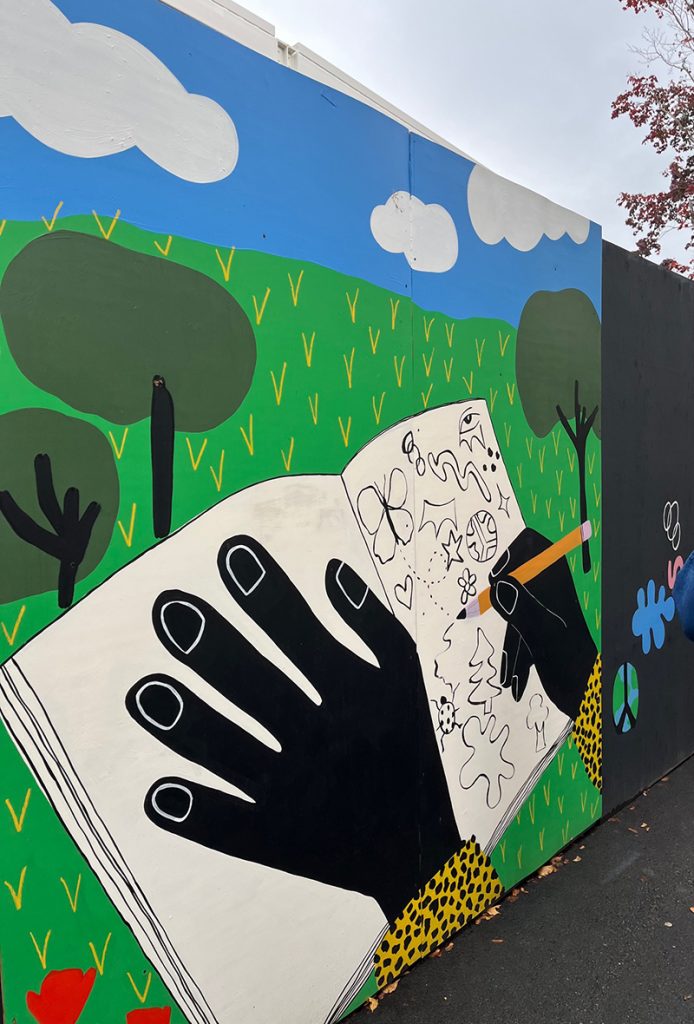
The Center School students’ doodles on part of Under the Same Sky by Stevie Shao and Cristina Martinez, in collaboration with students from The Center School. (Photo by Kai Curry)
Public art is meant to be easily accessed by the public. It is readily available and yet, many people hurry past without noticing or understanding. The works are meant to provide “moments of pause,” according to organizers. The artists understood the assignment. Christy Caravaglio, whose piece, Play of Color, was appropriately placed in the Artists at Play Plaza, wanted to create for people a “moment of surprise and joy in the course of their everyday lives.” She had long ago wondered how to make art that could decorate not a flat wall, but a chain-link fence. Her piece was woven, so to speak, from bright acrylic yarn. Here, a student asked, what do you do with the art when you take it down? Caravaglio admitted she has piles of yarn at her studio.
All of the works on the tour were temporary, and yet their impact is lasting. Each work, in some way, showed the public how to look at life differently. Take Will Jewett’s Find Your Angle: four seemingly benign blue chairs outside the Bagley Wright. Look closer, though, change your perspective, or your viewing spot, and you notice that each chair is angled slightly differently. Prince, whose three works started the tour, demonstrated how to repurpose something old into something new. At the same time, she showed how art incorporates history by using banners once hung on the Seattle Center grounds, given to her to reinterpret and rehang. Morgan Madison also used recycling-related materials for his piece, Cambia. For the blue and brass-colored tree trunk next to MOPOP, Madison had used old building exterior cladding provided by the museum. The trunk, Madison explained, represented Seattle’s logging history, while the branch extending out of the trunk, and the leaves, represented culture, change, and forward motion.
Interaction with the public isn’t always heart-warming, but it is always interesting. Madison’s piece had been vandalized twice. On one occasion, someone had chosen to move the work back a few feet. Given that the tree trunk is very heavy, this action was not only bizarre but difficult, and required Madison to come to the Center, take the work apart, and put it back where he’d originally placed it. Some of the leaves had also been stolen. Public work sometimes evolves or changes in this way. Madison chose to see it as a positive experience, he said.
Nimura, after completing a stint as the artist-in-residence at Tacoma’s Office of Environmental Services, is currently working on a new work, which will be an indoors piece made out of reclaimed material from kimonos and obis. “I have a vision,” she said, although she doesn’t have a place yet. Instead of reacting to wind and weather like the piece from the tour, this new work will be reactive to the people who will walk through it. She plans to release it in 2027.
Kai can be reached at newstips@nwasianweekly.com.
Leave a Reply