



By Kai Curry
NORTHWEST ASIAN WEEKLY
For its fifth anniversary, The Asian American Foundation (TAAF), along with Third State Books, has released the third and final graphic novel in their three-part series: Fighting to Belong!
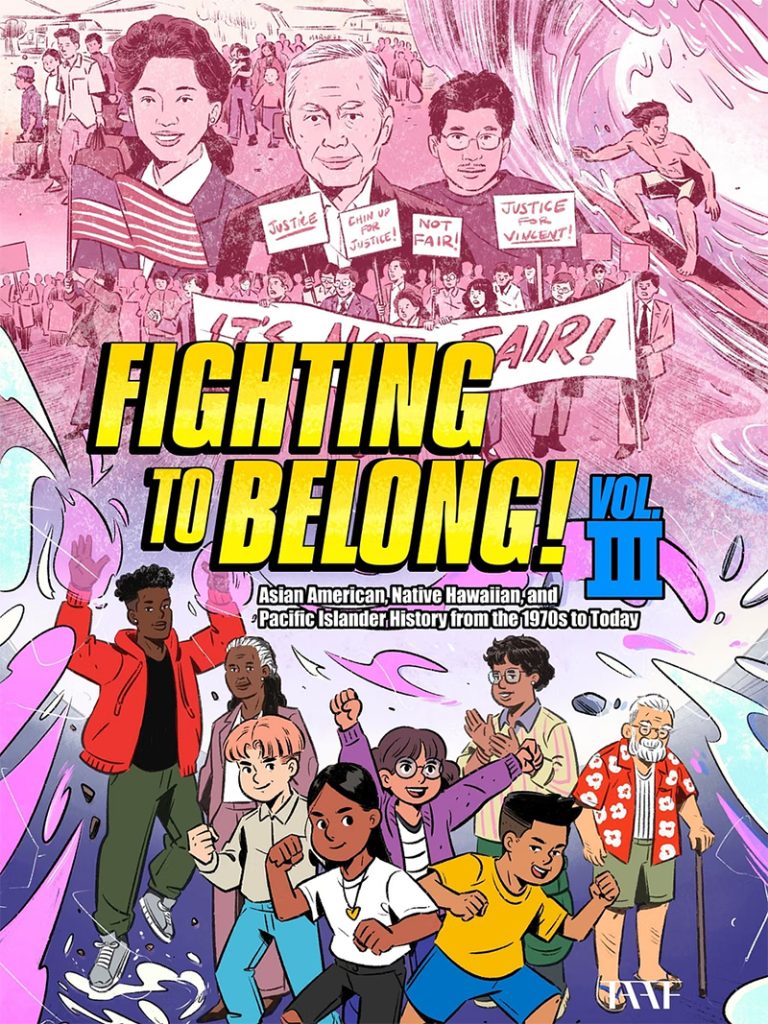
Courtesy of TAAF and Third State Books.
The series follows four middle school students with diverse backgrounds, as they embark upon a project that will teach them the role of Asians Americans and Pacific Islanders (AAPIs) in the history of the United States. It is a role too often left out of history books.
“We know books remain a powerful medium to inform, inspire, and share our community’s stories,” said Norman Chen, TAAF’s chief executive officer. “Fighting to Belong! fills the gap for teachers and parents looking to teach Asian American history.”
Some schools have requirements to fulfill regarding Asian American history, and TAAF is committed to helping with those requirements. For those schools that don’t have such requirements, the series could be a vital addition to the lesson plan. To assist teachers, each book in the series includes a curriculum guide from The Asian American Education Project. TAAF also provides access to more than 400 free, vetted, and classroom-ready resources through their AAPI History Hub.
The three graphic novels are major resources for people of any age who want to learn more about AAPI history. Bestselling comic book writers Amy Chu (Wonder Woman, Deadpool) and Alexander Chang, and illustrator Louie Chin (Bodega Cat) are behind the series. The series is now available in hardcover, softcover, and digital formats through Third State Books and other retailers.
About the first half of Volume III picks up from where Volume II left off. Featuring colorful images and descriptions, the second half is a list of significant AAPIs in many fields, from sports to science.
The series’ timeline starts in the 1700s, when Filipino sailors called “Manilamen” arrived in Louisiana and took up the shrimp fishing trade. Volume II covers significant events related to AAPIs during the 20th century, including WWII, when the U.S. incarcerated Japanese Americans, through to the Civil Rights era.
The third volume, released Oct. 13, begins with post-WWII impact on the Pacific Islands and ends with the COVID-19 pandemic—and a disturbing, racist incident that, while it happens in-book, echoes what has happened, and continues to happen, in real life, too.
-

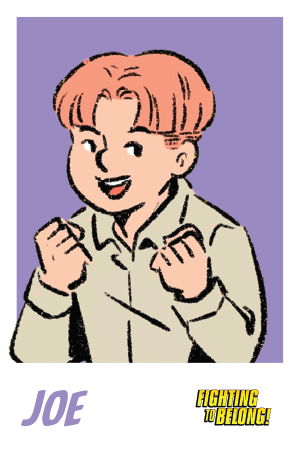
- Joe. Courtesy of TAAF and Third State Books.
-
- Padmini. Courtesy of TAAF and Third State Books.

-
- Maria. Courtesy of TAAF and Third State Books.

-
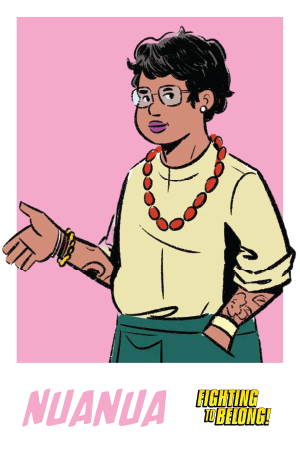
- Nuanua. Courtesy of TAAF and Third State Books.
-
- Ken. Courtesy of TAAF and Third State Books.
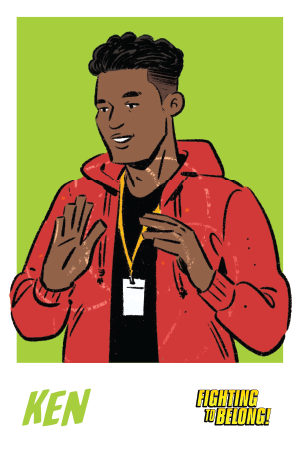
The books follow Sammy, Tiana, Joe, and Padmini, students at Community Middle School. Their neighbor, Kenji, has been teaching them about AAPI history. Kenji is also a budding thaumaturge and gets in a little bit of trouble with his boss at the American History Museum.
The four students come from Filipino, Latine (the gender-neutral term), White, and Indian backgrounds. Nuanua is CHamoru and Samoan, while Kenji is Haitian and Japanese. (Interested readers can learn why “CHamoru” begins with two capital letters here.)
In Volume III, one of Kenji’s colleagues, Nuanua, picks up the lesson where Kenji left off, at the same time as the kids try to convince Kenji’s boss to give their friend his job back. He was, after all, just trying to engage them in the very subject that the museum purports to care about.
At the end of the lesson (and the children’s re-hiring efforts), when Nuanua is teaching the children about anti-Asian hate during the COVID-19 pandemic—including the coining of the phrase, “China Flu”—everyone is called outside the museum. Someone has spraypainted: “GO BACK TO YOUR COUNTRY!”
“The children don’t need to see this,” the museum’s director objects.
“I think they do,” says Nuanua.
Chen pointed out that TAAF’s 2026 STAATUS Index found that the American public struggles to name famous Asian Americans. According to TAAF’s research, 53% of adults in the United States cannot name a single significant moment in Asian American history. Schools simply do not teach Asian American history in the same ways they teach other kinds of history.
“These findings point to a glaring absence of Asian American figures, movements, and events in our nation’s curriculum, something that we all have a responsibility to address,” said Chen.
The third volume also includes an explanation of different terms preferred by different parts of the AAPI community, such as “Pasifika” or “Pasifeka,” which Nuanua explains is a more “global” choice of words for some. It also makes important distinctions amongst the circumstances surrounding immigration. Some Asians and Pacific Islanders had a choice in coming to the United States, and some had no choice at all.
The book also addresses the myth of the Asian monolith.
“Why is everyone lumped together?” Joe asks.
“There can be power in numbers,” Tiana answers.
Other times, each distinct AAPI community would like to claim their own unique heritage.As a second-generation Chinese American, there have been moments in Chen’s life when he has wondered why he didn’t see himself in books or see any characters that looked like him on the screen. “When we first started this project with Third State Books years ago, I kept thinking to myself how I would have loved a book like Fighting to Belong! when I was growing up,” he said.
This lack of representation, in so many areas of our lives in the United States, has direct and even dire consequences. Because so many people do not have any connection to AAPIs nor any information about them, Chen said, they tend to form views that lead to Asian Americans being scapegoated, excluded, and targeted.
“Even though our roots in this nation span centuries,” he said, “you only need to glance at the headlines today to realize we continue to be viewed as perpetual foreigners and painted as potential economic and national security threats.”
Volume III, and every graphic novel in this series, offers a wealth of information about AAPI history in this country and AAPI contributions. There are sad stories and there are happy stories, tragedies and triumphs. But this isn’t antithetical to teaching history, if we are to learn from it. It’s rather the point.
“Understanding our past is fundamental to building a better future,” Chen said.
Kai can be reached at newstips@nwasianweekly.com.
Leave a Reply