



By Becky Chan
NORTHWEST ASIAN WEEKLY
The bus dipped low as though it were a camel kneeling to receive riders. Tap, tap, tap—Yan ( 甄)and her cane boarded the Route 7 bus at Maynard and Jackson, heading towards her destination of the day: the Columbia City Farmers Market.
Yan sat in the front, in an area reserved for seniors and people with disabilities, next to another elderly woman with a walker. A second woman with a walker also boarded at the same stop. Maybe it’s not quite the “everybody knows your name” type of place, but a gentle wave or a nod of acknowledgement went around.
Yan befriended this writer, a fellow passenger who was along for the ride, reporting for the Northwest Asian Weekly about the fuss with Route 7 and the farmers market.
In heavily accented Toisanese Cantonese, Yan said that she was going to buy some vegetables at Columbia City. But why there?
“Oh, the vegetables are so fresh, so green!” Yan answered, pulling down her mask.
The bus ambled along south on Rainier Avenue, past the medical plaza with Nguyen’s pharmacy, the Cheryl Chow Park, and the Safeway and QFC where Yan shops.
Yan lives with her children. I asked why she didn’t wait to go shopping with her kids, so they could drive in a car.
“They work,” she said.
The bus passed the fenced-in lot that once housed Jumbo Seafood Restaurant. It passed the Neck & Back Pain Relief clinic. It passed the Lighthouse for the Blind.
As the bus crept along Rainier Avenue, Yan said she likes bus Route 7 because of the familiarity. She wouldn’t know where to get off on another bus. Yan doesn’t speak English.
She pointed out Lowe’s where she buys soil for her garden. How can she carry those big bags?
“I buy small bags and use my small cart,” she pointed to her folded shopping cart—the ubiquitous carts that all the seniors in the Chinatown-International District (CID) seem to be pulling behind them, as if they were pulling a grandkid.
The bus passed by Ross, a discount clothing store. Yan said they had nice clothes, and she shops or browses there sometimes.
At the Alaska street stop, Yan reminded me that the next stop was where she would get off to go to the farmers market.
At Edmunds, all the cart-toting seniors got off. I fell in with the masses, all the way to the market.
For these CID seniors, the draw to the farmers market was not only the fresh vegetables, but also other benefits.
Finch Brown of the Neighborhood Farmers Market Alliance said the Columbia City Farmers Market is in a pilot program offering a fresh produce award up to $50 per month, when a Supplemental Nutrition Assistance Program (SNAP)-EBT card is used. The same amount of money is put back into the SNAP-EBT card.
That explains the line of hat-wearing, masked elderly Asians snaking through the market at vendor OJ’s Produce, a half-hour before the market opened at 3 p.m.
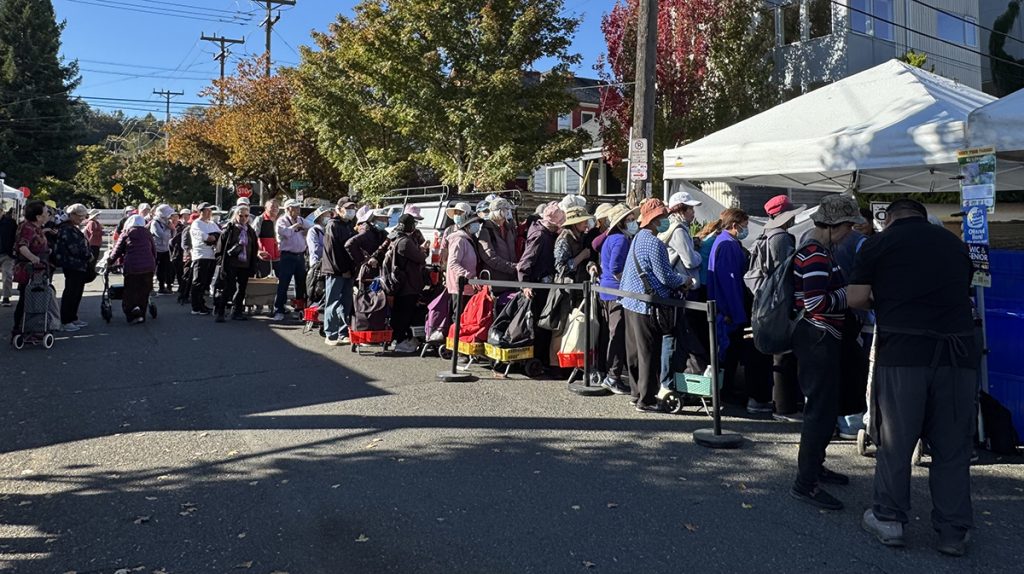
The long line at OJ’s Produce. Photo by Becky Chan.
“Yeah, they started lining up at 1 o’clock! They got here before me,” OJ’s owner, Cania Lee, chuckled.
Lee is a second-generation Hmong vegetable farmer based in Ethel, Washington. His family have been farming for 30 years. They started in Snohomish County, but moved further south to Lewis County for better access to water and to avoid flood risks. Their farm specializes in Asian greens, such as bok choi, gailan, and gai choi.
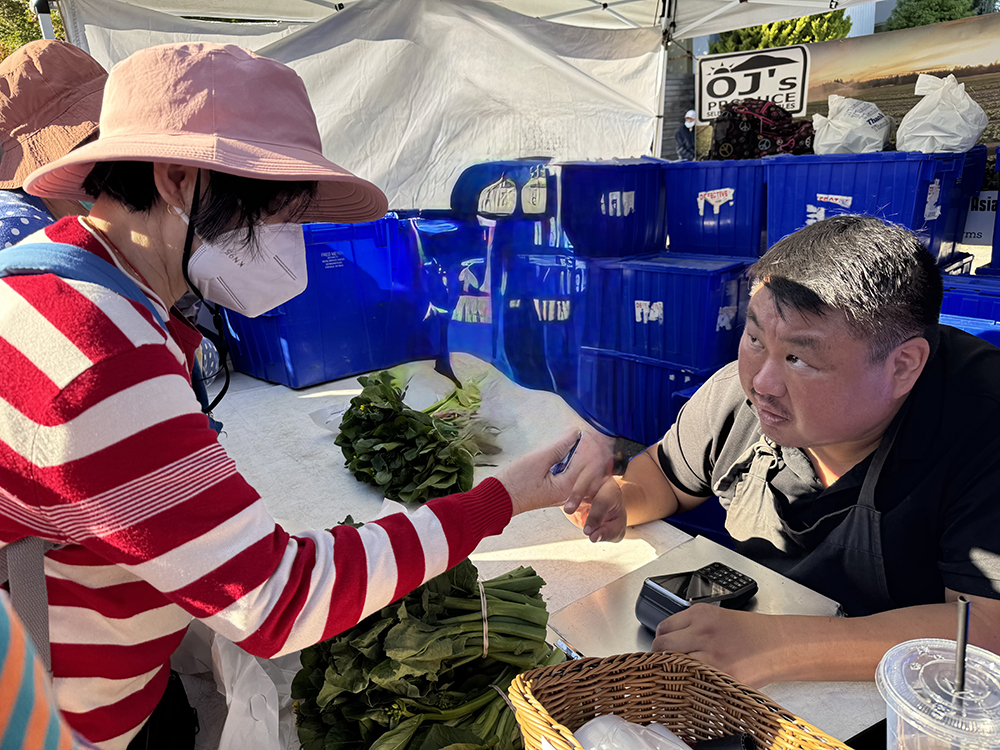
Cania Lee, right, owner of OJ’s Produce, speaks to a customer. Photo by Becky Chan.
When the Columbia City Farmers Market closes on Oct. 28 for the season, Lee said he will move to sell at the West Seattle Farmers Market, which runs year-round. He is trying to let his non-English speaking fans know where to find their favorite vegetable vendor. In front of him were printed flyers in Chinese about the change. He said the bus routes will be added to the flyers. That means learning a new route for the seniors.
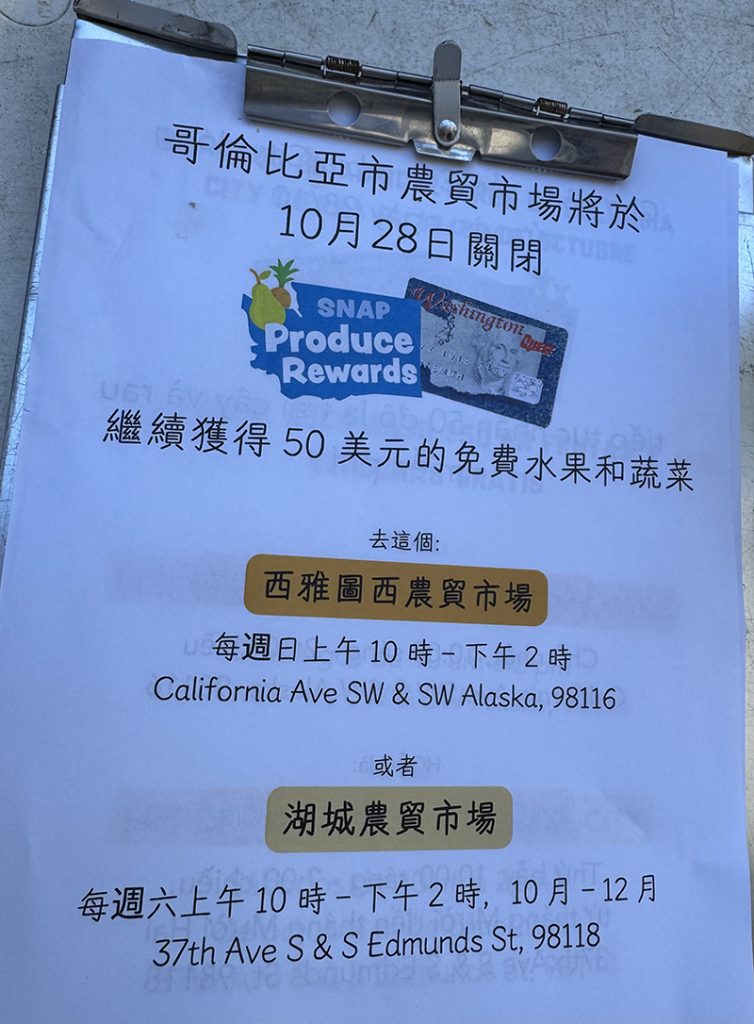
Chinese flyer notifying that SNAP rewards are available at West Seattle and Lake City Farmers Markets, after the Columbia City market closes for the year. Photo by Becky Chan.
Even if they don’t decide to try to get to the West Seattle market, these seniors may eventually need to learn a new route, anyway.
Despite having the second highest ridership in the metro system with between 11,000 and 12,000 weekday riders, Route 7 may be doomed. King County plans to launch the RapidRide R line in 2032 to, its website says, “upgrade Metro’s Route 7, with faster, more reliable buses and a new connection to the Rainier Beach Station.” The site states that the project has been underway since 2015, and that King County Executive Girmay Zahilay has prioritized it.
Some community groups are not happy about the change and are initiating some pushback.
“What’s being done to preserve bus access to those places non-English speaking seniors need for their health, daily lives, and general wellbeing?” asked Betty Lau, co-founder of the grassroots, CID-based organization Transit Equity for All.
Lau said that seniors—many of whom have both limited mobility and limited English proficiency—use buses from the CID to shop along Rainier Avenue. About 50-60 seniors travel by bus Route 7 to the Columbia City Farmers Market on Wednesdays from May through October.
The Nondrivers Alliance, an organizing group that advocates for car-less transportation solutions, is also circulating a petition to save Route 7.
Tim Lee is the vice president of Seniors in Action, an advocacy group for seniors by seniors. He said that the RapidRide R line serves a different group of riders. Lee believes Route 7 needs to operate between 9 a.m. and 5 p.m. for the seniors for them to remain independent.
Independence for seniors like Yan makes living in Seattle easier. She moved here from San Francisco because of her children and is adjusting to the Pacific Northwest. Yan takes Route 7 by herself, walking to the bus stop on Maynard from her apartment in the CID, where about 1,400 seniors live in low-income housing.
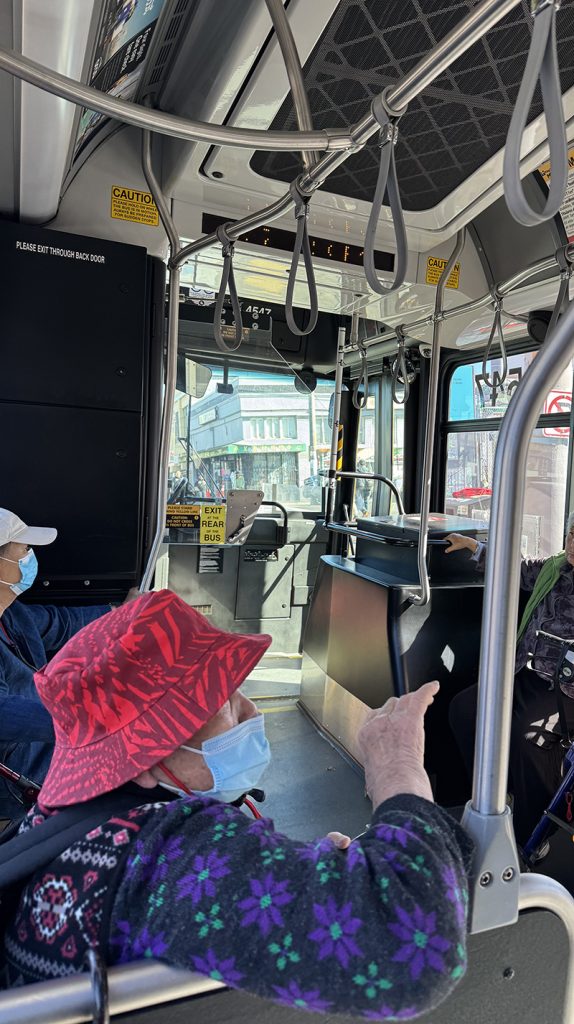
Yan rides the Route 7 bus. Photo by Becky Chan.
Transit-wise, Seattle may not compare to Yan’s former home in San Francisco, but Rainier Avenue seems to have everything she needs. With a smile, she shared with me that she still has $30 left on her EBT card and motioned for me to join her under the sun, in line for some of the freshest Asian greens at OJ’s Produce.
Becky can be reached at newstips@nwasianweekly.com.
Leave a Reply